
What is a broker-dealer? A private-market investor's guide
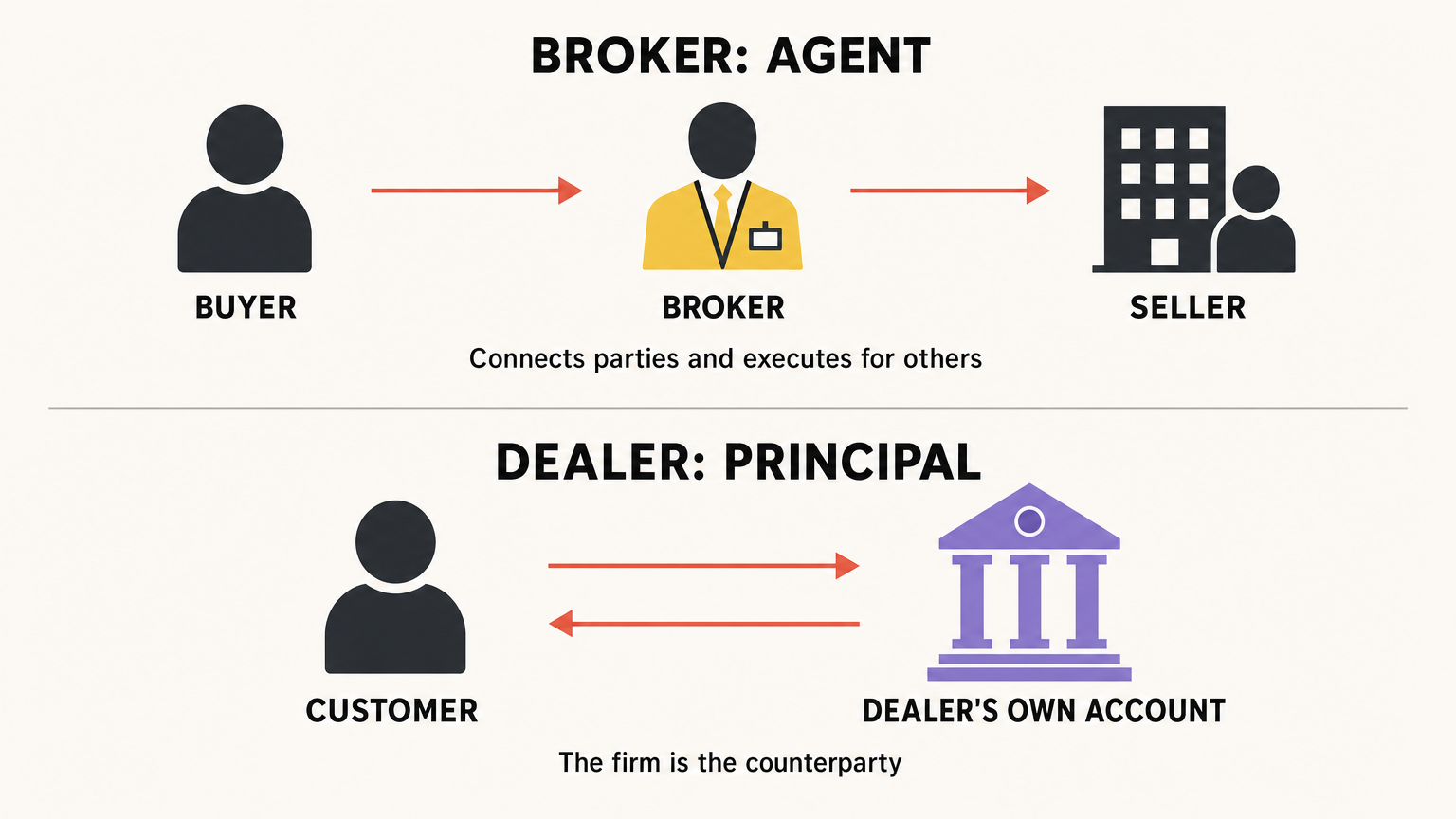
A broker-dealer is a person or firm in the business of buying and selling securities. The broker side handles transactions for other people. The dealer side buys or sells securities for the firm's own account.
That distinction sounds technical until you meet an intermediary in a startup round, pre-IPO fund, or private-share sale. Then it tells you what role the firm is playing, how it may get paid, which rules apply, and where to check its record.
Broker and dealer are two different jobs
When a firm acts as a broker, it is an agent. Imagine that you want to buy shares from an employee of a private company. A broker may help bring the parties together, route the order, coordinate documents, or execute the transaction. The firm may earn a commission or another transaction fee.
When a firm acts as a dealer, it is a principal. The firm buys or sells for its own account as part of its business. Instead of finding you another seller, for example, it may sell you securities it already owns and earn a markup or spread.
The same registered firm can act as a broker in one transaction and a dealer in another. Do not infer its role from the logo at the top of an email. Ask which capacity applies to your transaction. A customer confirmation generally must identify whether the broker-dealer acted as agent or principal and disclose certain compensation under the SEC's confirmation rules.
Where broker-dealers show up in private markets
Private markets include direct startup financings, special purpose vehicles (SPVs), private funds, and sales of existing private-company shares. A broker-dealer can appear in several parts of that landscape.
Primary private placements
A startup, fund, or other issuer may hire a broker-dealer as a placement or selling agent. Depending on the engagement, the firm might identify prospective investors, distribute offering material, discuss the opportunity, help with subscription documents, or facilitate the sale.
The firm usually works for the issuer or sponsor in that arrangement, even though its representatives communicate with investors. That is why you should ask who the client is and who pays the fee.
Broker-dealers do not appear in every private financing. A 2025 FINRA white paper analyzed 279,985 new Regulation D offerings filed from 2013 through 2022. Under the paper's classifications, around 8% identified broker-dealer participation and less than 1% identified finder participation. Many startup rounds still happen directly between the issuer and investors.
Secondary private-share sales
In a secondary transaction, an existing shareholder sells to another investor. A broker-dealer may locate interest, relay bids and asks, help process an order, or coordinate steps around closing.
Finding a willing buyer does not make private shares freely tradeable. The seller still needs a valid resale path under federal and state law. Company documents may impose a right of first refusal, board approval, or other transfer limits. The SEC's secondary-market guide also notes that restricted securities can remain subject to holding periods, sale conditions, and purchaser requirements.
Alternative trading systems
Some private-market platforms include an alternative trading system (ATS), a system that brings together orders from multiple buyers and sellers. An ATS relying on Regulation ATS must register as a broker-dealer and file Form ATS with the SEC.
That filing is not an SEC approval of the venue or anything traded there. The SEC's ATS overview says Form ATS is a notice filing, not an application the Commission approves before the system begins operating.
What registration changes, and what it does not
Broker-dealer registration brings a firm into a regulatory system. A firm that cannot rely on an exemption generally files Form BD with the SEC, becomes a member of a self-regulatory organization such as the Financial Industry Regulatory Authority (FINRA), satisfies applicable state requirements, and registers or qualifies the people performing regulated work. Most registered broker-dealers must also belong to the Securities Investor Protection Corporation (SIPC), subject to limited exceptions.
That framework can include supervision, books and records, financial-responsibility rules, customer confirmations, communications standards, examinations, and disciplinary enforcement. For private placements, FINRA rules may also require member firms to file offering documents or retail communications, subject to exemptions.
Registration is valuable information. It is not a quality seal for the investment.
A registered broker-dealer does not mean:
- the SEC or FINRA approved the offering;
- the private company is likely to succeed;
- the price is fair;
- the shares are authentic, transferable, or liquid;
- a recommendation fits your portfolio; or
- your principal is protected from investment loss.
SIPC is often misunderstood here. It may help restore missing customer cash or securities if a SIPC-member brokerage fails. It does not cover a drop in value, bad advice, or an unsuitable recommendation, according to SIPC's investor guide.
Private placements also carry fewer disclosure protections than registered public offerings. Offering documents typically are not reviewed by a regulator and may not present the risks in a balanced way. The SEC's private-placement bulletin tells investors to be prepared for limited information, restricted resale, illiquidity, and a possible total loss.
Broker-dealer vs. investment adviser vs. finder
These labels can describe very different relationships. One company may even have separate affiliates, or the same professional may hold more than one registration. Ask which legal entity and which capacity apply right now.
Broker-dealer
A broker-dealer's core job is effecting securities transactions or dealing in securities. When a broker-dealer recommends a securities transaction or investment strategy to a retail customer, Regulation Best Interest (Reg BI) requires it to act in that customer's best interest at the time of the recommendation and not put its interests first.
Reg BI has disclosure, care, conflict-of-interest, and compliance components. It does not automatically govern every communication or self-directed trade; whether the firm made a recommendation depends on the facts. An accredited investor who is a natural person is not excluded merely for being accredited, as the SEC's Reg BI FAQs make clear.
If you are still working out whether you meet the current criteria, use our accredited-investor guide as a starting point, then confirm your situation against current SEC rules and the offering documents.
Investment adviser
An investment adviser is generally in the business of providing securities advice for compensation. The adviser relationship is often broader and ongoing, with a fiduciary duty covering the relationship's agreed scope.
A dual registrant can provide both brokerage and advisory services. That does not mean the standards blend into one. Its relationship summary, known as Form CRS, should explain services, fees, conflicts, and standards. Ask, “Are you acting as my broker or my adviser in this conversation?”
Finder
“Finder” describes what someone claims to do. It is not a universal exemption from broker-dealer registration.
The legal analysis depends on the facts. The SEC registration guide flags activities such as soliciting investors, participating in negotiation or execution, handling other people's funds or securities, and receiving compensation tied to a deal's outcome or size. It specifically includes finding investors for venture or angel financings among the activities that may require registration.
An introduction with no further involvement can look very different from repeatedly pitching investments for a success fee. If the line is unclear, pause and ask qualified securities counsel. The word “finder” on an invoice does not settle it.
Follow the money before you follow the recommendation
Broker-dealers can earn money through commissions, issuer-paid selling compensation, markups or markdowns on principal trades, third-party payments, platform charges, and administrative fees. Different arrangements create different incentives.
Our managing partner, Shiyan Koh, puts the principle plainly: “Show me the incentives, and I'll show you the outcome.” A fee does not make a recommendation bad. A disclosed conflict does not disappear, either.
Ask four questions before you act:
- Who pays the firm and the individual? Is it you, the issuer, the seller, a fund sponsor, or an affiliate?
- What changes the payment? Does the person get paid only if you invest, or get more for one offering than another?
- Is the firm agent or principal? If it owns the security, ask how the price and markup were determined.
- What is the all-in cost? Include entry, platform, administration, custody, transfer, and exit charges, not just the headline commission.
Compare the answers with Form CRS, offering documents, the fee schedule, and the final confirmation. Unexplained differences deserve a pause.
How to vet a broker-dealer before a private-market deal
Use this checklist for both the firm and the person contacting you.
- Get exact identifiers. Ask for the firm's legal name and Central Registration Depository (CRD) number, plus the representative's full legal name and CRD number. Marketing names can differ from registered entities.
- Search both records. FINRA BrokerCheck shows registration status, employment, qualifications, firm operations, and disclosures such as customer disputes or disciplinary events. A disclosure can be an allegation or pending matter, so read the details rather than treating every item as a proven finding.
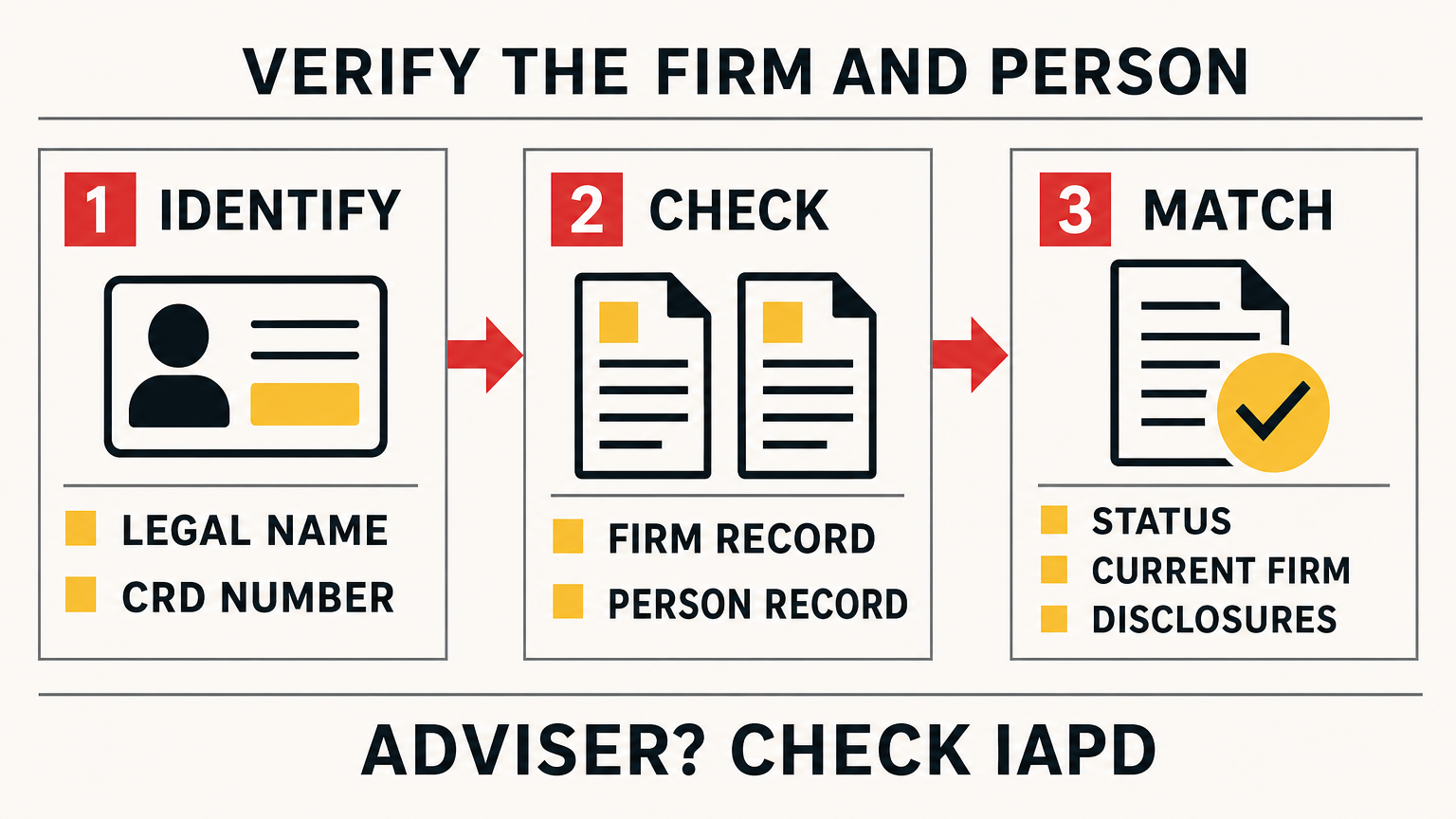
- Match the registration to the job. Confirm that the firm reports the kind of business being proposed, such as private placements or operating an ATS. Check whether the person is currently registered through that firm in the relevant jurisdictions.
- Read Form CRS when it applies. Compare the stated services, fees, conflicts, and disciplinary history with the pitch you received. If a firm is also an investment adviser, review both its brokerage and advisory records.
- Identify capacity and compensation. Ask who hired the intermediary, who pays it, whether it or an affiliate owns the securities, and whether the communication is a recommendation.
- Ask what the firm verified. For a recommended private placement, FINRA says a reasonable investigation should address the issuer and management, business prospects, assets, claims, and intended use of proceeds. Ask which work the firm performed, what it outsourced, and which questions remain open.
- Trace the closing. Match the entity names across the email domain, offering memorandum, subscription agreement, escrow or custody instructions, wire destination, transfer approval, and confirmation. Do not send money to a personal or unexplained account.
FINRA's 2026 oversight report makes steps 5-7 concrete. FINRA said it had observed potentially fraudulent pre-IPO fund sales involving misstatements or omissions about sales compensation. It also found firms that failed to confirm whether a fund had possession of or access to the pre-IPO shares it claimed to hold.
Your intermediary check and your company check are separate workstreams. Use a startup due diligence checklist to investigate the team, market, traction, financials, cap table, legal documents, and terms even when the broker-dealer's record is clean.
Elizabeth Yin, our co-founder and general partner, has said, “At the end of the day, money is a commodity.” Registration is the baseline. An intermediary earns trust by being clear about its role, resolving discrepancies, and making the process easier to inspect.
If you want practice separating transaction mechanics from the investment thesis, Angel Squad, our angel-investing community, gives aspiring and active angels education, real deal-by-deal context, and peers to compare questions with. You still decide whether each investment fits your own thesis and risk tolerance.
Red flags that deserve a pause
Slow down when:
- you cannot match the firm or person in BrokerCheck;
- the entity on the email, agreement, wire instructions, and regulatory record keeps changing;
- a “finder” solicits, negotiates, or takes a success fee but dismisses registration questions;
- the firm will not say whether it is an agent, principal, adviser, or placement agent;
- compensation or affiliation is vague;
- someone guarantees allocation, liquidity, valuation, an exit, or a return;
- you are pressured to wire before you receive documents or resolve discrepancies;
- the seller or intermediary refuses to explain what was verified and what was not; or
- sales material celebrates upside while brushing past resale limits and total-loss risk.
One red flag is not always proof of misconduct. It is a reason to stop, verify independently, and get legal advice before money moves.
The bottom line
A broker-dealer can connect parties, execute a trade, sell an offering, operate a trading venue, or act as the principal on the other side. The useful question is not simply, “Are you registered?” Ask which legal entity and person are involved, which capacity applies, how they get paid, and what they verified.
Then do the deal diligence yourself. A clean BrokerCheck record cannot make an illiquid security liquid or turn a weak company into a strong investment.
Want to build that judgment with other operators and investors? Apply to Angel Squad to learn the mechanics, examine real opportunities, and make your own deal-by-deal decisions.
This guide is general education, not legal, tax, or investment advice. Broker-dealer status and exemptions depend on the facts and applicable law. Have qualified securities counsel review any unclear intermediary arrangement before you invest or pay a transaction-based fee.















.png)