
Robotics market map: 4 layers angel investors should know
Brian Nichols is the co-founder of Angel Squad, an angel investing community where aspiring and active angels learn from Hustle Fund’s approach, review curated deal flow, and connect with peers.
Robotics demos can make startups look similar even when they sell different assets, software, and outcomes. Those differences shape the buyer, capital needs, sales cycle, and evidence an investor should request.
The International Federation of Robotics reported 5 million industrial robots operating globally in 2025.
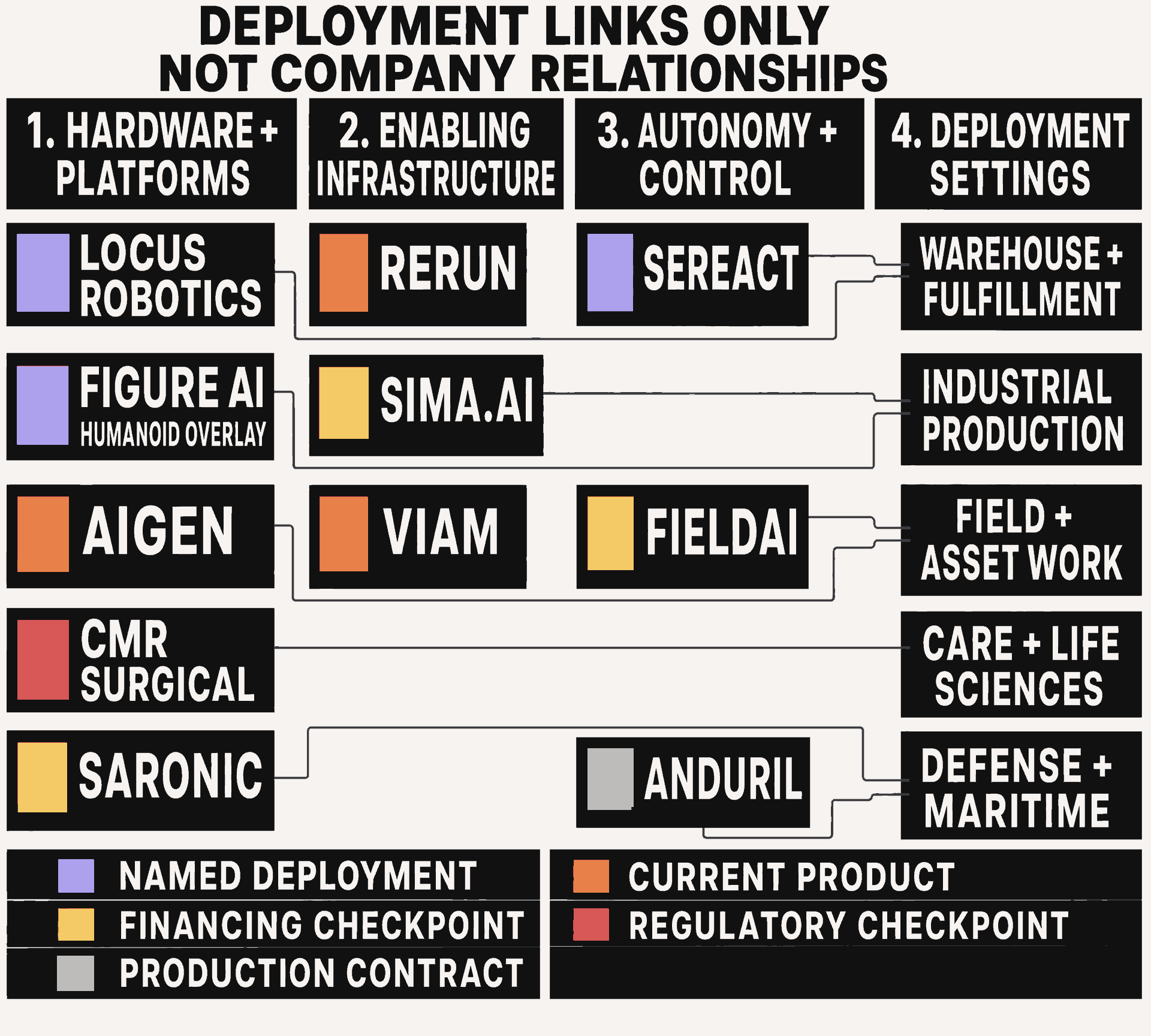
This 2026 map compares 11 representative robotics companies across four layers and five deployment settings. Several are recent private-company candidates whose placement relies on dated financing or operating checkpoints, not proof of current ownership or listing status. It is a dated, non-exhaustive view, not a ranking or recommendation.
How to read the four-layer robotics market map
The first three layers describe a company’s primary technical role. The fourth describes where a system has to produce economic value. A company appears once, then a connector shows a relevant deployment setting. The layers are analytical lenses, not a required sequence, maturity ladder, value ranking, or claim of exclusivity.
Humanoid and mobile-manipulation systems sit as an overlay on hardware. A body shape does not create a separate end market. The buyer still cares about the task, productive hours, safety, service load, and cost.
Four terms will help you read the map:
- Autonomy is a system’s ability to perceive, plan, and act in a physical environment with limited human input.
- Teleoperation means a person remotely guides or intervenes in a robot’s work.
- End effector is the tool at the end of a robot arm, such as a gripper or surgical instrument.
- Robotics as a Service (RaaS) is a recurring contract in which the vendor provides robots and often maintenance, software, and support.
The evidence colors show the strongest public checkpoint used for each tile: a named deployment, current product, recent financing, regulatory event, or production contract. A checkpoint establishes a fact at a point in time. It does not establish current ownership or listing status, recurring revenue, margins, retention, safety, or scale. Several placements rely on dated financing or operating evidence and require current-status confirmation before any investment decision.
Affiliation disclosure: The Angel Squad investments directory lists Anduril and Saronic in its Pre-IPO group. That public listing shows an investment-access affiliation. It does not establish direct Hustle Fund or community ownership, position size, timing, or terms. The same page attributes a member-voice card to Barron Ernst, head of growth at Figure. That is a community or testimonial connection, not evidence of an investment, sponsorship, partnership, or paid editorial relationship. The same neutral selection standard applies to all 11 companies.
The map draws a tighter boundary than our broader guide to investing in AI and robotics. Generic AI software sits outside this map unless it controls or supports a physical system.
Layer 1: hardware and platforms
Hardware and platform companies deliver the physical robotic system. Their economics depend on manufacturing yield, component supply, installation, field service, warranties, and the time between a signed order and accepted production use.
- Figure AI is the map’s humanoid overlay. Figure reports industrial work at BMW and announced more than $1 billion in Series C commitments in 2025. That announcement is a dated commitments checkpoint, not proof of current private status or completed cash financing. The cited BMW and Series C releases did not report customer fleet counts, pricing, retention, uptime, or productive-hour economics. The community connection disclosed above is testimonial only.
- Locus Robotics supplies autonomous mobile robots and warehouse orchestration, including a RaaS option. Its named HelloFresh deployment shows current warehouse use. Investors still need utilization, renewal, service-cost, hardware-financing, and customer-concentration data.
- Aigen builds solar-powered mechanical-weeding fleets for growers and states that its offering gives growers a predictable per-acre cost. Its robot count and autonomous field hours are company-reported. Seasonal support, crop and weed variation, solar uptime, and planned 2027 delivery remain execution questions.
- CMR Surgical sells the Versius surgical platform to hospitals and ambulatory surgery centers. Its U.S. clearance covers adult cholecystectomy. Clearance does not establish reimbursement, broad clinical utility, utilization, or hospital payback.
- Saronic builds autonomous surface vessels and maritime systems. The U.S. Navy named Saronic among seven companies selected for the MUSV Marketplace’s at-sea testing phase. That selection is a procurement and testing checkpoint. The selection itself does not establish a production contract or recognized revenue. The directory listing disclosed above shows access affiliation, not direct ownership or terms.
The core hardware question is whether deployment work becomes repeatable. A robot with attractive unit-level gross margin can still consume cash if every site requires custom engineering, extended acceptance testing, or a large field-service team.
Layer 2: enabling infrastructure
Infrastructure companies sell tools used across robot types. Their economic user is usually a robotics engineer, machine-learning team, fleet operator, or original equipment manufacturer. Recurring software revenue can coexist with substantial cloud, storage, integration, and support costs.
- Rerun provides open-source logging and visualization plus commercial data infrastructure for robot-learning workflows. Current product work and design partners show use, while paid adoption, security requirements, storage economics, and open-source conversion still need proof.
- Viam provides a development, runtime, data, and fleet platform. Its breadth can help teams move from one machine to a fleet. Diligence should separate recurring software from implementation and support, then test retention within each customer vertical.
- SiMa.ai sells edge-compute chips and software, which run machine-learning workloads close to the robot. SiMa.ai says its Modalix product is shipping, but the cited release does not establish production volume. Average selling price, qualified yield, margin, software attachment, and supply partners all matter.
Infrastructure can look capital-light beside a robot manufacturer. That label deserves scrutiny. Data storage, customer-specific integration, technical support, and component inventory can change the actual margin profile.
Layer 3: autonomy and control
Autonomy and control companies provide perception, planning, manipulation, or mission software that enables a physical system to act. They may depend on another company’s robot body, sensors, integration channel, or customer relationship.
- FieldAI develops an embodiment-agnostic control stack for industrial robots in dynamic settings. Its Boston Dynamics construction partnership is a route to deployment. A partnership does not prove scaled paid use, so investors should test safety performance, edge cases, integration margin, and customer concentration.
- Sereact develops manipulation intelligence for warehouse picking and related tasks across multiple robot forms. It offers subscription and RaaS positioning and reports live systems in production. Those scale and pick metrics are company-reported. Intervention rates, exception handling, hardware dependence, data rights, and fully loaded RaaS economics remain central.
- Anduril combines mission autonomy with autonomous defense systems. Anduril says the U.S. Air Force selected it for the Collaborative Combat Aircraft production phase. The cited announcement is issuer reporting; the government material reviewed for this map did not independently name Anduril as the production-award recipient. A production-phase award still does not equal recognized revenue or production margin. Procurement milestones, security, export controls, supply chain, and manufacturing capacity can govern the outcome. The directory listing disclosed above shows access affiliation, not direct ownership or terms.
Embodied autonomy has a different proof burden from generic software agents. Our AI agents market map covers software-agent infrastructure. Here, the useful test is performance in a real physical environment, including failures and human intervention.
Layer 4: end-market deployment
Deployment settings reveal who controls the budget and which operating constraint can stop adoption. The map uses five settings without duplicating company tiles.
- Warehouse and fulfillment: Operations leaders buy throughput, service levels, and labor capacity. Ask for accepted production use, pick exceptions, seasonal utilization, renewal, and cost per order after service, financing, and human intervention. Locus Robotics and Sereact illustrate different hardware-plus-fleet and manipulation-intelligence routes.
- Industrial production: Plant and automation leaders care about cycle time, uptime, scrap, safety, and line integration. A useful economic unit is contribution per productive hour after installation, repair, training, and downtime. Figure AI and SiMa.ai show how physical systems and edge compute enter the same setting through different layers.
- Field and asset work: Growers, contractors, and asset owners operate across weather, terrain, seasons, and weak connectivity. Evidence should cover the actual environment distribution, transport, operator logistics, repair time, and cost per acre, site, or completed task. Aigen and FieldAI represent the physical-fleet and autonomy routes.
- Care delivery and life sciences: Hospitals, ambulatory surgery centers, clinicians, and labs face regulation, capital approval, training, sterile workflow, and reimbursement. Measure utilization and cost per procedure or workflow after instruments, service, training, and validation. CMR Surgical is the mapped clinical-system example.
- Defense and maritime: Program offices and procurement teams buy mission capability, availability, security, and sustainment. Distinguish an MOU, marketplace selection, task order, contract, production award, and recognized revenue. Saronic and Anduril occupy different technical layers within this setting.
Rerun and Viam remain cross-market tooling in the infrastructure layer. The map does not force an end-market connector or imply a customer relationship that the public evidence does not establish.
Nine diligence questions for a robotics startup
Our co-founder Elizabeth Yin writes, “The more disciplined you are in your thought process/rubric, the more you can improve over time.” For robotics, a repeatable rubric helps you look past the polished demo and ask for production evidence.
- What exactly happens in production? Request attempts, autonomous completions, assisted completions, failures, downtime, and the distribution of operating conditions.
- How much human intervention remains? Measure teleoperation minutes per productive hour and remote operators per active robot or fleet.
- What are uptime and repair economics? Ask for mean time between failures, mean time to repair, spare-parts needs, warranty cost, and field-service staffing.
- How long does deployment take? Separate repeatable installation from site preparation, integration, validation, training, and customer change management.
- Who owns safety and liability? Review the exact environment, hazard analysis, incident process, insurance, applicable standards, and contractual responsibility.
- Who controls the data? Examine collection rights, training rights, privacy, retention, customer security, offline operation, and software rollback.
- What has to be manufactured and financed? Review the bill of materials, component concentration, yield, test time, rework, inventory, depreciation, and working capital.
- Where is concentration hiding? Look across customers, integrators, manufacturing partners, channels, suppliers, and government programs.
- What is the fully loaded economic unit? Use cost and contribution per productive hour, order, acre, procedure, site, or mission after labor, teleoperation, service, cloud, financing, and downtime.
Category-specific questions should then tighten the screen. Humanoids need productive-hour, fall-and-recovery, safe speed and payload, and fleet-support evidence. Healthcare needs the exact cleared indication, procedure volume, training, reimbursement, and clinical claims. Field systems need seasonal and terrain distributions. Defense and maritime need funded scope, acceptance milestones, security, export classification, options, and mission availability.
Use these sector questions inside a full five-step diligence process. The map can also help you write an investment thesis that names the buyer, workflow, layer, and evidence you require before taking a meeting.
What can move a company on or off the map
This snapshot uses public sources available through September 27, 2026. A company qualified through a 2025 or 2026 operating or product signal, a dated financing or private-status checkpoint, a clear primary robotics role, and evidence such as a named deployment, partner, regulator, shipping product, or contract. Several entries remain recent private-company candidates because a financing round or active product release does not prove current ownership or listing status.
The screen was designed to exclude companies affirmatively identified as public incumbents, acquired companies, or pending public-transition companies, along with research-only demos, consumer gadgets, autonomous passenger vehicles, and analytics-only products. Company status can change quickly, and a financing announcement only establishes the dated financing event described by its source.
Maps should change when the evidence changes. Elizabeth Yin’s reminder fits here: “Going back to first principles is super important since the market always changes and evolves.” A status change, acquisition, regulatory event, accepted production deployment, or failed commercialization checkpoint can change a company’s placement or remove it entirely.
Build your robotics diligence muscle
Reading a map is easier than judging a live startup with incomplete evidence. If you want to review curated deals with other operators and learn how Hustle Fund approaches early-stage questions, apply to Angel Squad.
This material is for educational and research purposes only and is not investment advice or an investment recommendation. The map is representative, non-exhaustive, and based on public information available through September 27, 2026. Inclusion or exclusion does not imply endorsement. Early-stage investments are speculative, illiquid, long-term, and may result in total loss. Conduct independent diligence and seek advice from qualified financial, legal, tax, and other professional advisers for your circumstances.












.png)