
Vertical AI market map: 8 industries for investors
Brian Nichols is the co-founder of Angel Squad, an angel investing community where aspiring and active angels learn from Hustle Fund’s approach, review curated deal flow, and connect with peers.
AI startups can use the same model and still sell radically different products. A clinical documentation platform, legal research system, and construction takeoff tool face different buyers, data, integrations, and failure costs.
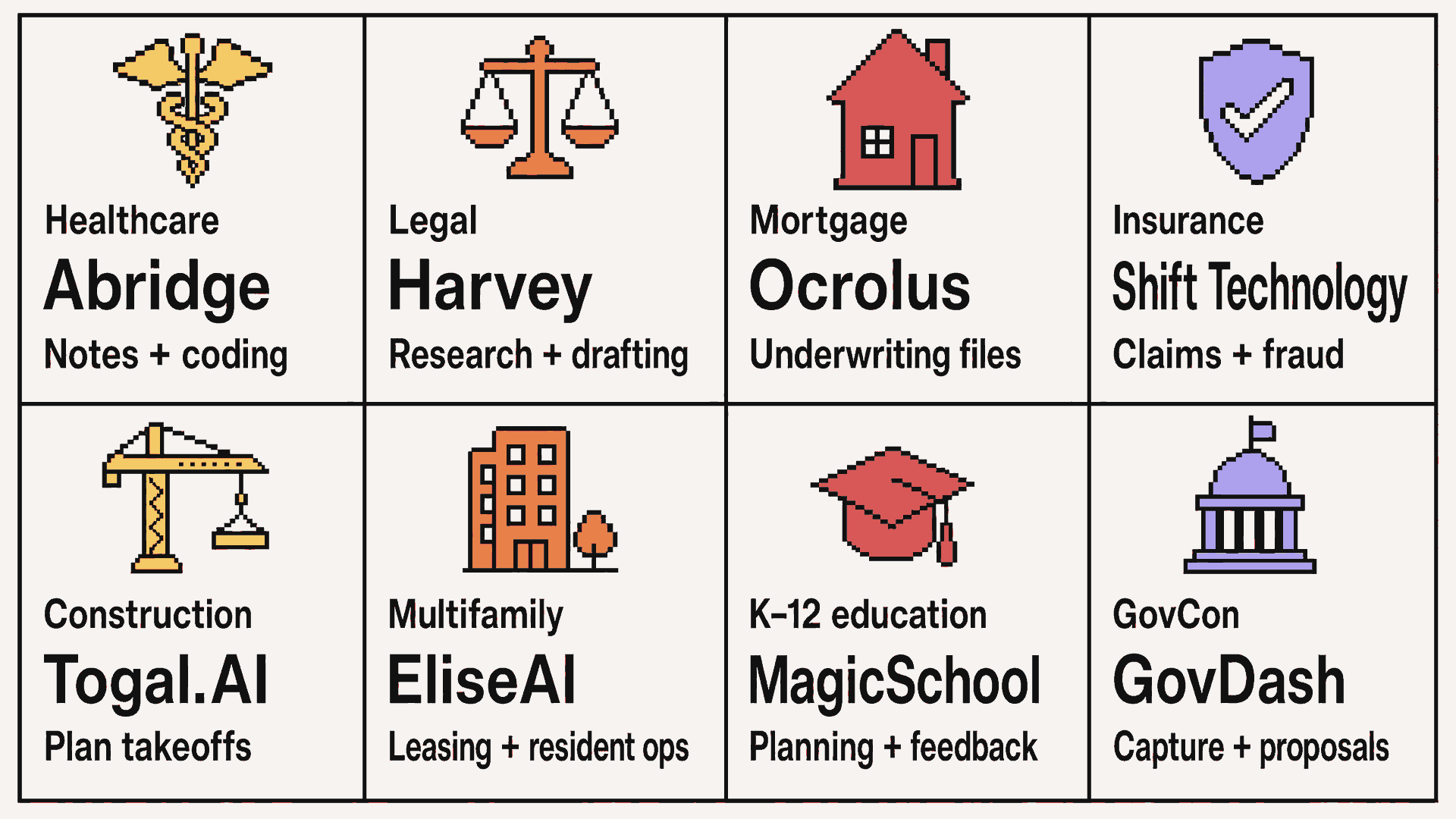
Our vertical AI market map groups representative private companies by end market and first workflow wedge as of October 1, 2026. It also gives investors a way to inspect buyer economics, defensibility, and risk without mistaking a category placement for investment quality.
What counts as vertical AI?
Vertical AI is software whose core product uses artificial intelligence to complete or materially assist a recurring, industry-specific workflow. The workflow usually depends on domain data, domain rules, specialist review, or an integration with an industry system of record.
That definition creates four useful boundaries:
- Vertical AI versus horizontal AI. A general coding assistant or customer-support agent can serve many industries. A mortgage document system has to understand borrower files, income calculations, underwriting exceptions, and lender systems. Our broader AI startup stack covers models, infrastructure, controls, and cross-industry applications.
- Vertical AI versus vertical software as a service. Vertical software stores records and manages an industry process. It becomes vertical AI when AI is central to the work product, such as drafting a clinical note or interpreting a construction plan. A minor AI feature inside an established suite does not qualify here.
- Vertical AI versus an AI agent. An agent chooses steps and takes actions with some independence. A vertical product may instead classify a document, recommend a decision, or draft an output for human review. Our AI agents market map covers the agent-specific stack and autonomy questions.
- Vertical AI versus voice AI. Voice is an interface or delivery method. The vertical is the buyer and job, such as scheduling a patient or servicing a loan. The voice AI market map goes deeper on speech models, telephony, latency, and call operations.
Earlier machine-learning products belong in the category when AI is essential to the workflow. Generative AI is one technical approach inside a wider vertical AI market.
How to read this vertical AI market map
We selected companies with an active product page, a documented industry buyer, and a core AI workflow. We then placed each company once, at its first clear wedge. Several now sell into adjacent workflows or markets.
The map is representative, non-exhaustive, and non-ranked. Inclusion is not an endorsement, partnership, investment recommendation, or claim about revenue, market share, model quality, or availability to investors. Public product material supports each placement, while vendor-reported performance remains unverified unless stated otherwise.
We excluded model providers, infrastructure vendors, generic functional copilots, public incumbents with an incidental AI feature, acquired products, and companies whose industry fit could not be established from current first-party material.
The October 2026 vertical AI market map
The useful unit is the buyer’s recurring job. Each company below appears beside a workflow, the likely economic unit, and the evidence an investor should request.
Provider healthcare: clinical notes and coding
Abridge turns clinical conversations and patient context into draft documentation and other outputs inside electronic health record workflows. Clinicians remain reviewers, and health-system clinical or revenue leaders are the buyers.
- Economic unit: Per clinician, encounter, or enterprise deployment.
- Value evidence: Accepted note rate, review time, coding accuracy, clinician usage, and correction severity.
- Hard question: Does expansion from notes into coding or revenue-cycle work use the same trusted data and integration, or require a separate implementation and budget?
Healthcare investors also need a precise product boundary. Documentation, clinical decision support, and a regulated medical device can carry different evidence and oversight requirements.
Legal services: research, drafting, and matter workflows
Harvey provides legal research, document analysis, drafting, knowledge, and multi-step workflows for law firms and corporate legal teams. Lawyers still own professional judgment and the final work.
- Economic unit: Seat, matter, document set, or completed workflow.
- Value evidence: Active usage, matter turnaround, review time, source accuracy, and correction burden.
- Hard question: Which firm knowledge, integrations, and repeatable workflows stay valuable when general models improve?
Legal AI can show high usage while shifting work rather than reducing it. Customer references should explain which steps disappeared, which new review steps appeared, and whether clients accept the resulting work and billing model.
Mortgage lending: borrower-file underwriting
Ocrolus indexes borrower documents, extracts financial data, calculates income, and flags inconsistencies for lenders and underwriters. The completed job is a cleaner, decision-ready loan file.
- Economic unit: File or loan application.
- Value evidence: Clean-file throughput, exception rate, manual touches, decision time, and downstream fraud or credit outcomes.
- Hard question: Does the product improve the lender’s full decision process, or move errors and review work to another team?
Mortgage is one AI workflow inside a much larger fintech sector landscape. A company still depends on lending cycles, credit policy, loan-system integrations, and the economics of its financial-institution customers.
Property and casualty insurance: claims fraud
Shift Technology applies predictive, generative, and agentic methods to claims-fraud detection and investigation. It is a useful reminder that vertical AI includes long-running machine-learning vendors as well as newer generative AI companies.
- Economic unit: Claim, policy, or carrier contract.
- Value evidence: Incremental recoveries, investigator yield, false-positive cost, resolution time, and performance by claim cohort.
- Hard question: Can the vendor prove added value against existing fraud rules and carrier data, with a clean holdout rather than a before-and-after sales story?
A high fraud score creates work. The economic outcome arrives only when the carrier investigates the right cases, treats policyholders fairly, and recovers more value than the system and extra review cost.
Construction: plan takeoffs and revisions
Togal.AI detects and measures elements in construction drawings, supports quantity takeoffs, and compares drawing sets. Estimators and contractors use the output to prepare bids and assess changes.
- Economic unit: Estimator, project, plan set, or takeoff.
- Value evidence: Bid throughput, estimator review time, missed quantities, revision errors, and rework tied to takeoff quality.
- Hard question: Does the product perform across trades, plan quality, and project types without a growing layer of manual cleanup?
Vendor accuracy and speed claims need buyer-side testing on a representative plan sample. One polished floor plan says little about messy revisions, symbols, and specialty trades.
Multifamily housing: leasing and resident operations
EliseAI handles prospect questions and tour scheduling, then extends into maintenance, payments, renewals, and resident follow-up for multifamily operators. Its initial communications wedge reaches deeper into property operations.
- Economic unit: Property, housing unit, conversation, or portfolio contract.
- Value evidence: Lead-to-lease conversion, response coverage, staff minutes, resident escalation, renewal outcomes, and usage by property cohort.
- Hard question: Does broader workflow coverage increase value per property without increasing implementation and support labor at the same pace?
Voice is one channel inside this business. The deeper position comes from owning the handoff from conversation to a correct action in the property-management system.
K–12 education: planning and feedback
MagicSchool offers district, educator, and student tools for lesson planning, materials, feedback, and governed school deployment. The buyer may be a teacher, school, or district, and those paths have different budgets and oversight.
- Economic unit: Educator, student, school, or district license.
- Value evidence: Sustained teacher use, time moved to instruction, output quality, administrator controls, and privacy incidents.
- Hard question: Does the product improve a defined educational workflow and outcome, or mainly generate more classroom material?
Time saved is useful. Claims about learning gains require evidence that separates the product from curriculum, teacher practice, student mix, and other changes.
Government contracting: capture and proposals
GovDash supports opportunity discovery, capture, pricing, proposal work, and contract management for companies that sell to the U.S. government. Its buyer is a government contractor, not a government agency.
- Economic unit: Business-development team, contract opportunity, proposal, or subscription.
- Value evidence: Qualified bids, proposal cycle time, compliance errors, team usage, and win rate adjusted for opportunity mix.
- Hard question: Does the company own a durable government-contracting workflow and data layer, or a drafting interface that another proposal tool can copy?
The distinction affects market sizing, sales motion, data access, and procurement risk. Government-contractor software is part of the public-sector procurement ecosystem, while agency case processing is a separate lane.
Buyer economics start with the completed work unit
Seat count can be a convenient price. It rarely captures the whole value story. Investors should trace one work unit from trigger to accepted output, including human review and exceptions.
Four common pricing models create different incentives:
- Seat or site subscription. This fits a copilot with recurring human users. Usage penetration and renewal matter more than licenses purchased during a pilot.
- Volume pricing. Encounters, claims, files, properties, or documents can match the customer’s activity. Gross margin can still suffer if complex cases require more inference, support, or expert review.
- Outcome pricing. A fee tied to recoveries, completed tasks, or another audited result can align value. The contract must define attribution, errors, reversals, and tail liability.
- AI-delivered service. The buyer purchases finished work. This can reach an existing outsourced-services budget, while expert labor, quality assurance, and customer-specific operations remain in the cost base.
Our general partner Shiyan Koh puts the incentive test plainly: “Show me the incentives, and I'll show you the outcome.” Pricing should reward a correct completed task. A per-document fee can reward volume even when it creates more exceptions. Outcome pricing can encourage automation while leaving the vendor responsible for mistakes.
Build buyer return on investment from the workflow. Start with the relevant work volume and the value of time, revenue, loss avoidance, or service quality. Then subtract software fees, implementation, integrations, inference, specialist review, change management, and the cost of errors. A faster draft has little value if a professional spends the saved time correcting it.
A 2026 Thomson Reuters survey found organizational generative AI use among its professional-services respondents at 40%, while only 18% said their organizations tracked return on investment. That measurement gap is a diligence signal. Ask for the customer’s baseline and measurement method before accepting a payback claim.
Defensibility grows around the workflow
Model access is available to many teams. A vertical AI company can still build a durable position through assets that compound with real use:
- Permissioned domain data and feedback. The useful question is whether the company has rights to retain and learn from corrections, plus labels tied to accepted outcomes.
- System-of-record integration. Reading data is easier than writing a correct, auditable action back into an electronic health record, loan system, claims platform, or property-management system.
- Task-specific evaluation. Aggregate model benchmarks miss the errors that matter in a specialty. A company needs evaluations by customer cohort, geography, document type, and edge case.
- Trust and deployment knowledge. Security review, data governance, professional oversight, and implementation playbooks can reduce time to production. They also create cost, so inspect repeatability.
- Distribution inside the industry. Partnerships, referrals, practitioner credibility, and access to a concentrated buyer channel can lower customer acquisition cost. Concentration in one channel can also create dependency.
- A credible next workflow. The first wedge should produce context, trust, or integration that helps with an adjacent job. A roadmap alone is not evidence. Look for production use, a distinct buyer budget, and cohort expansion.
The strongest evidence is behavior: customers send more work through the product, require less vendor labor over time, and renew after the pilot team’s enthusiasm fades.
Risks that can break the vertical AI case
Vertical focus removes some uncertainty and adds new failure modes. Investors should put these risks in the memo before discussing upside.
- Accuracy and safety: Ask for ground truth, denominator, abstention rate, error severity, reviewer corrections, and performance drift. NIST’s GenAI risk profile provides a useful vocabulary for testing and monitoring without validating any specific vendor.
- Professional accountability: A lawyer, clinician, underwriter, or teacher may remain responsible for the final output. Legal teams should assess confidentiality, competence, supervision, and billing duties described in ABA Formal Opinion 512. Healthcare teams should determine whether relevant FDA digital-health guidance applies to the product’s claims and function.
- Data rights and privacy: Inspect rights to ingest, retain, train on, and export customer, patient, student, or client data. Confirm lineage, residency, breach duties, deletion, and the terms of any third-party model provider.
- Incumbent response: Industry systems already control customer records and distribution. A startup needs a reason buyers will keep a separate vendor when the incumbent bundles a similar feature.
- Services drag: Custom integrations and specialist review can win early customers while hiding a labor-heavy business. Request gross margin by customer cohort after implementation, inference, expert quality assurance, and support.
- Procurement and concentration: Regulated and institutional buyers can run long pilots and security reviews. A handful of enterprise contracts can create renewal and bargaining risk.
- Supplier dependence: Foundation-model pricing, availability, terms, or performance can change. Test whether the product can switch models and whether its own evaluations guide that choice.
An investor diligence checklist for vertical AI
Our co-founder and general partner Elizabeth Yin writes in Democratizing Knowledge, “The more disciplined you are in your thought process/rubric, the more you can improve over time.” Use the same questions across companies so a fluent demo does not reset your standard.
- Name the buyer and budget. Who signs, who uses the product, who reviews its output, and which current expense can fund it?
- Map the work before and after. What triggers the task, which steps disappear, which steps remain, and where do exceptions go?
- Inspect production evidence. How many eligible work units enter the product, reach an accepted output, get corrected, abstain, or escalate?
- Rebuild buyer economics. What is the baseline cost or loss, and what remains after software, setup, integration, review, errors, and change management?
- Test implementation repeatability. How long does launch take, how many vendor hours are required, and how much customer-specific code survives into the next deployment?
- Trace data rights. Which data can the company use, for what purpose, for how long, and with which revocation and export rights?
- Compare the real alternatives. Include manual work, outsourced services, an incumbent module, a general model, and the customer building internally.
- Challenge the moat. What remains if the underlying model becomes cheaper and better next quarter?
- Check cohort quality. Do usage, gross margin, and expansion improve for newer cohorts, or does every account require the founding team?
- Define the expansion proof. Which adjacent workflow is live, who buys it, and does it improve retention or economics rather than add roadmap surface area?
What this map cannot tell you
A market map shows where companies work. It cannot establish adoption, retention, revenue quality, technical performance, defensibility, valuation, governance, regulatory readiness, or investment fit.
The thin lanes in this snapshot, including agriculture, hospitality, industrial maintenance, and government-agency case processing, are research gaps rather than proof of open opportunity. A crowded lane can hold several large businesses, while an empty lane may lack an urgent buyer or workable economics.
Early-stage investments are speculative, illiquid, and long term. Many startups fail, and you can lose the full investment. Thoughtful investors can inspect the same company and reach different conclusions.
Turn category curiosity into a repeatable diligence habit
If you want to practice applying a consistent framework to early-stage companies and compare your reasoning with other operators, apply to Angel Squad.
This material is for educational purposes only. It is not investment, legal, tax, or technical advice. Seek qualified independent advisers for decisions that require those forms of review.














.png)