
Voice AI market map: 51 companies across six layers
Brian Nichols is the co-founder of Angel Squad, a community where you’ll learn how to angel invest and get a chance to invest as little as $1k into Hustle Fund’s top performing early-stage startups.
This market map is general research. It is not an investment recommendation or legal advice. Startup investing is speculative, illiquid, long-term, and can result in total loss. Review each opportunity, its governing documents, and compliance questions with qualified independent advisers.
Voice AI demos now take minutes to build. Production systems still have to hear a noisy caller, reason, take an action, obey policy, and recover when something breaks. That gap is where startup value is moving. Our September 2026 map organizes 51 companies by the layer they primarily own, then gives angels a diligence framework for separating a nice voice from a durable business.
How to read the voice AI market map
Voice AI is software that receives or produces speech with artificial intelligence. A voice agent goes one step further: it interprets what someone wants, decides what to do, takes an action in another system, and continues the conversation.
The map includes active companies that supply a core building block for real-time voice agents or sell a voice-first agent or workflow. We prioritized private startups, while including a few large platform companies that anchor the stack. Placement reflects each company’s main wedge. It is not a ranking, no company paid to appear, and many companies span two or more layers.
That distinction matters in a market that changes this quickly. As Hustle Fund co-founder and general partner Elizabeth Yin puts it, “Going back to first principles is super important since the market always changes and evolves.”
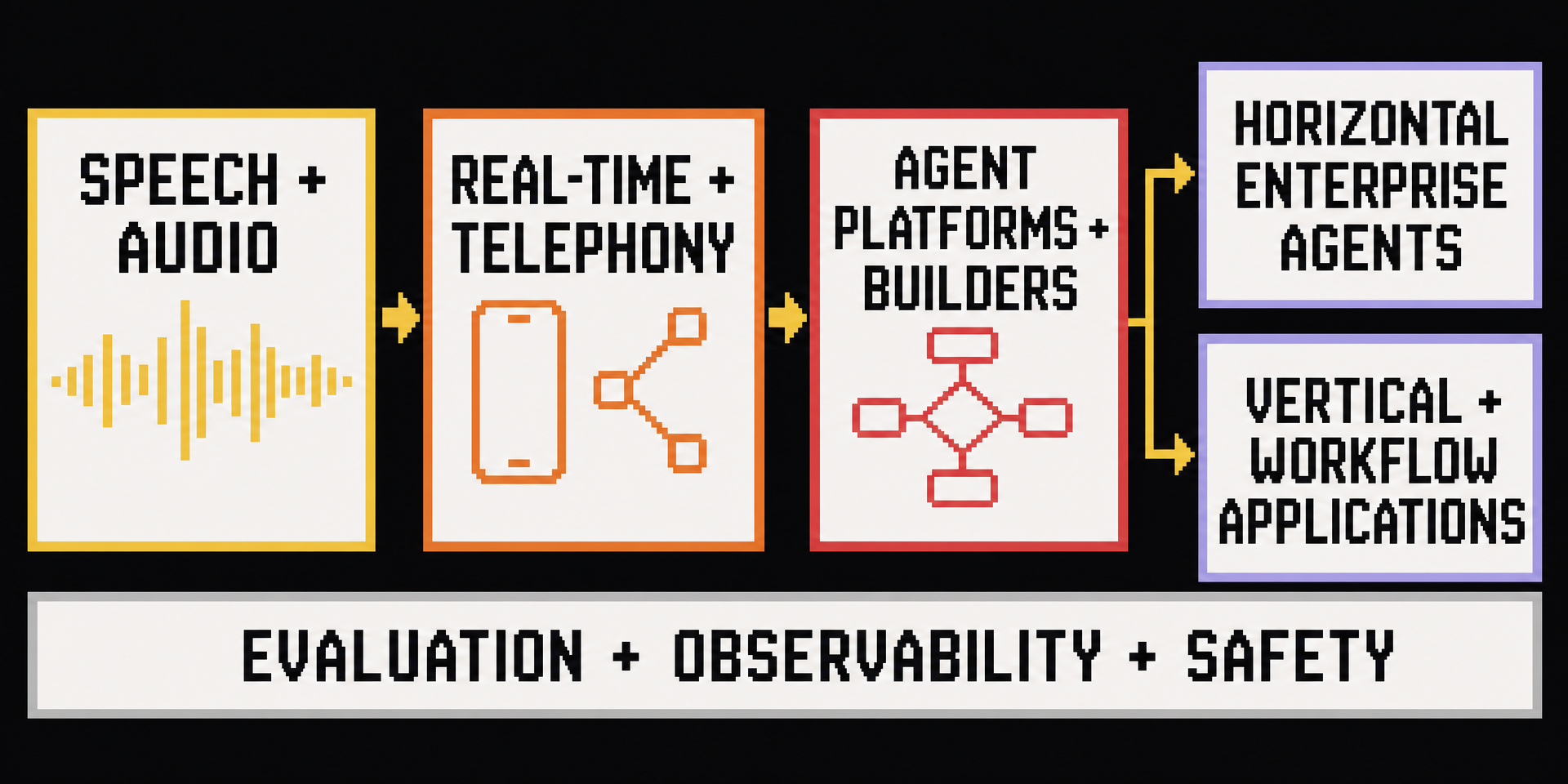
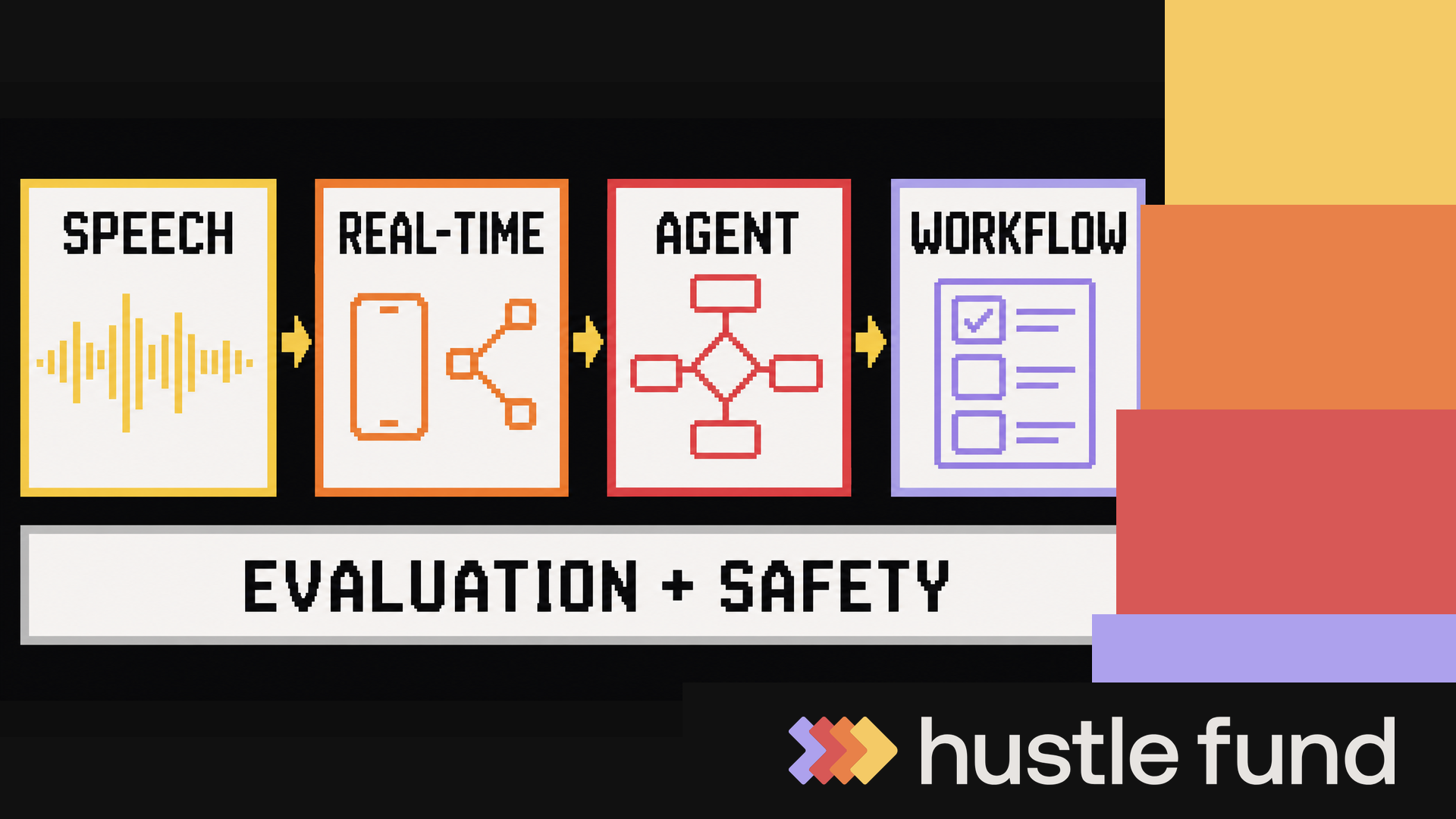
A production call usually crosses four connected layers:
- Speech and audio models hear the caller or generate the agent’s voice.
- Real-time infrastructure carries audio over a browser, app, or phone network.
- Agent platforms manage prompts, tools, memory, call flows, and model routing.
- Applications complete a customer or employee workflow.
Evaluation, observability, security, and identity sit across the whole path. A failure at any point can ruin the call.
There are two common technical paths. A cascaded system converts speech to text, sends the text to a language model, then converts the response back to speech. A speech-to-speech system processes audio directly. Neither architecture wins by default. Investors should care about task success, reliability, cost, and user experience in the intended environment.
Humans often leave gaps of roughly 200 milliseconds between conversational turns, according to turn-taking research. A voice product has little room for serial model calls, network delays, and slow tools. “Low latency” also means little if the agent responds quickly with the wrong answer.
The September 2026 voice AI market map
The 51 companies fall into six layers:
- Speech and audio models: 9
- Real-time media and telephony: 6
- Agent platforms and builders: 6
- Evaluation, observability, and safety: 8
- Horizontal enterprise agents: 8
- Vertical and workflow applications: 14
1. Speech and audio models
This layer supplies automatic speech recognition (ASR), text-to-speech (TTS), voice cloning, audio understanding, or speech-to-speech models. Some vendors stay focused on one primitive. Others are expanding toward the complete agent stack.
- Speech recognition and understanding: AssemblyAI, Gladia, and Speechmatics.
- Generative speech and speech-to-speech: Cartesia, ElevenLabs, Hume AI, and Smallest.ai.
- Broader voice stacks: Deepgram and Resemble AI.
The investment question is whether a model company owns a lasting performance advantage, a distribution channel, or proprietary data rights. A benchmark lead can vanish after the next model release. Enterprise controls, deployment options, developer adoption, and the right to train on customer audio may last longer.
2. Real-time media and telephony
This layer connects a model or agent to users. It handles streaming audio, WebRTC, phone numbers, call routing, session state, concurrency, and the public switched telephone network.
The six reference companies are Agora, Daily (with its open-source Pipecat framework), LiveKit, SignalWire, Telnyx, and Twilio.
Infrastructure founders can win through network quality, developer experience, routing, and scale. The risk is margin compression when buyers treat minutes and transport as interchangeable. Ask what the company controls below its API, how it performs across regions and carriers, and whether customers can switch without rewriting their application.
3. Agent platforms and builders
These products let developers or operations teams assemble a voice agent without owning every model and telecom integration. They provide orchestration, call flows, tool calling, knowledge retrieval, model selection, testing, and deployment.
The six companies are Bland AI, Goodcall, Retell AI, Synthflow AI, Vapi, and Voiceflow.
This is a crowded layer because underlying models and telephony services are accessible. A durable platform needs more than a clean builder. Look for deeply embedded workflows, reusable integrations, production data, a developer ecosystem, or operational tooling that makes moving away painful.
4. Evaluation, observability, and safety
Voice agents create failure modes that text-agent tests miss: overlapping speech, long silences, accents, background noise, packet loss, emotional cues, mispronunciations, and dropped calls. This layer simulates calls, scores behavior, monitors production, catches regressions, and checks voice identity.
- Testing and observability: Braintrust, Cekura, Coval, Hamming AI, Roark AI, and Tuner.
- Identity and deepfake defense: Pindrop and Reality Defender.
The 2024 VoiceBench research tested speaker traits, echo, far-field audio, packet loss, noise, grammar errors, mispronunciations, and disfluencies. That is much closer to a real deployment than a founder speaking into a studio microphone.
This layer deserves more investor attention. As voice agents move into healthcare, finance, recruiting, and customer service, continuous evaluation becomes part of the product’s control system. Strong tooling can turn every production failure into a regression test while keeping sensitive audio protected.
5. Horizontal enterprise agents
These companies sell complete customer-service or contact-center agents across industries. Voice may be one channel alongside chat, email, and messaging.
The eight companies are Cresta, Decagon, Kore.ai, Parloa, PolyAI, Regal, Replicant, and Sierra.
Horizontal reach creates a large market and lets a company spread product development across customers. It also creates competition with contact-center incumbents, internal enterprise teams, and the builder platforms below. Diligence should focus on deployment time, repeatability, customer concentration, human escalation, and expansion across channels or workflows.
6. Vertical and workflow applications
Vertical companies package voice around the vocabulary, systems, policies, and outcomes of one industry. Their pitch is the completed job: book the appointment, verify the benefit, service the loan, schedule the repair, or fill the table.
- Healthcare access and operations: Hippocratic AI, Hyro, and Infinitus.
- Insurance, banking, and lending: Liberate, Posh, and Salient.
- Logistics operations: HappyRobot.
- Home services and automotive: Avoca, Sameday AI, and Toma.
- Restaurants: ConverseNow and Slang AI.
- Recruiting: ConverzAI.
- Property operations: EliseAI.
This layer can own a deep workflow moat because the agent must integrate with systems of record and handle industry-specific exceptions. The tradeoff is a heavier implementation burden, tighter regulation, and a smaller initial market. Strong vertical founders know the workflow as deeply as the voice stack.
Where value is moving in voice AI
The stack is filling in fast. We see five shifts that matter more than the length of any company list.
From a good demo to a completed job
A realistic voice can open the door. It does not create a business by itself. Value accrues when the agent can retrieve the right record, apply policy, update a system, take payment, and hand off cleanly when it reaches a boundary.
Ask founders to show the ugly calls. A startup that can explain failure classes and recovery paths is usually further along than one with a flawless scripted demo.
From average latency to the full quality distribution
An average hides the calls that drive complaints. Investors should request median and tail latency, task-completion rate, caller interruption rate, repeat-question rate, transfer success, and hang-ups by cause. Break those metrics out by language, accent, device, carrier, and noise level.
A 2020 study of five commercial systems found an average word error rate of 35% for Black speakers and 19% for white speakers. The products have changed, but the speech-recognition disparity is a durable warning against testing only on a founder’s voice.
From one channel to workflow ownership
Calls are rarely the whole process. Customers send documents, confirm by text, receive an email, or finish in an app. A voice startup that follows the work across channels can own more of the outcome and reduce handoff failure.
From model access to evidence that compounds
Model access is widely available. A stronger moat may come from an approved integration, a labeled failure library, a repeatable deployment playbook, or distribution inside a specific industry. Audio volume alone is not a moat if the company lacks consent, usable labels, or the right to train on it.
From pilot revenue to repeatable expansion
Enterprises run many AI pilots. Evidence of a business appears when customers move from one workflow or location to many, call volume expands, and support effort per deployment falls. Separate contracted value from live usage. Separate a paid experiment from a production budget.
Seven questions for diligencing a voice AI startup
Hustle Fund co-founder and general partner Elizabeth Yin offers a useful reminder: “Decisions are never in isolation - they are a comparison game.” Use the same questions across companies so a smooth demo does not reset your standards.
- Which job does the customer buy? Name the buyer, current process, call volume, cost of failure, and measurable outcome. “Better conversations” is too vague. Booked appointments, resolved claims, collected payments, or reduced hold time can be measured.
- What happens on real calls? Request production task completion, escalation, hang-up, repeat, latency, and error data. Ask for performance across accents, languages, noise, poor connections, interruptions, and adversarial callers. Listen to randomly selected failures as well as curated wins.
- How does the agent fail safely? Map every external tool, permission, confirmation step, retry, and human handoff. Check whether one slow model or broken integration stalls the whole call. Our technical due diligence guide explains how operator expertise can expose architecture risks that a pitch deck will not.
- Do unit economics improve with scale? Rebuild gross margin after model inference, speech generation, telecom, recording, storage, third-party software, implementation, and support. Then stress it with longer calls, peak concurrency, retries, and a customer that negotiates lower prices.
- What compounds as models improve? Look for proprietary distribution, exclusive or hard-won integrations, customer-specific workflow knowledge, a growing evaluation set, and lower deployment effort. Then ask how quickly a customer could reproduce the product with a builder platform.
- Is trust designed into the product? Ask who may call, record, store, clone, and analyze a voice, and how consent, disclosure, deletion, security, and model training are handled. The FCC confirmed that AI-generated voices fall within the Telephone Consumer Protection Act’s restrictions on artificial or prerecorded voice. The FTC describes prevention, authentication, real-time detection, and post-use evaluation as complementary approaches to voice-cloning harm. State, sector, and international rules add more layers.
- Does adoption repeat? Compare cohorts by deployment time, live call volume, renewal, expansion, support load, and workflow count. Talk to customers who expanded, stayed flat, and left. In a crowded startup market, retention and distribution say more than a long feature list.
Inside Angel Squad, members can compare diligence notes with operators who understand AI, infrastructure, and regulated workflows, then apply those lenses to curated startup opportunities.
Apply the map to a hypothetical startup
Consider a simplified, hypothetical company selling a voice agent that books dental appointments.
The startup buys speech models from layer one, telephony from layer two, and perhaps orchestration from layer three. Its real claim sits in layer six: it knows dental scheduling, insurance questions, emergency routing, and practice-management integrations.
An investor should resist spending the whole meeting debating which TTS provider it uses. Better questions are:
- What percentage of eligible calls end in a correctly booked appointment?
- How often does the agent misunderstand names, dates, insurance terms, or urgent symptoms?
- Can a caller reach a person without repeating the conversation?
- How long does a new practice take to launch, and who does the setup work?
- Does call volume expand after 90 days?
- What is gross margin after telecom, models, support, and implementation?
- Which integration, data, or distribution advantage survives a better foundation model?
The map tells you where dependencies sit. The diligence tells you where the company creates value.
Voice AI market map FAQs
What is the difference between voice AI and a voice agent?
Voice AI can transcribe, analyze, or generate speech. A voice agent also reasons and acts during a conversation, such as checking inventory, changing a booking, or updating a customer record.
How big is the voice AI market?
There is no single useful figure because reports mix speech software, assistants, contact centers, devices, and agent applications. For startup diligence, build a bottom-up view from the target workflow: addressable accounts, relevant calls, current labor or lost revenue, attainable adoption, and realistic pricing. Our market analysis framework shows how to connect a top-down category view with bottom-up economics.
Are the 51 companies ranked?
No. They are representative companies grouped by their main product wedge. Inclusion is not an endorsement, and the map is not exhaustive. Company boundaries will keep moving as model vendors add agent tooling and application companies expand across channels.
If you want to turn sector knowledge into sharper startup decisions, apply to Angel Squad and practice alongside investors and operators who do the work.












.png)