
Best Venture Capital Tools for Angel Investors
Brian Nichols is the co-founder of Angel Squad, a community where you’ll learn how to angel invest and get a chance to invest as little as $1k into Hustle Fund’s top performing early-stage startups.
This is general education, not investment, legal, accounting, or tax advice. Private investments and governing documents are fact-specific. Seek independent review from qualified investment, legal, accounting, and tax professionals.
Choosing venture capital tools can produce a clean decision record or an expensive pile of unused subscriptions. Your right stack depends on your investing model, portfolio, and team. The goal is to solve the operating problems you have today without creating a second job maintaining software.
Choose the right venture capital tool stack
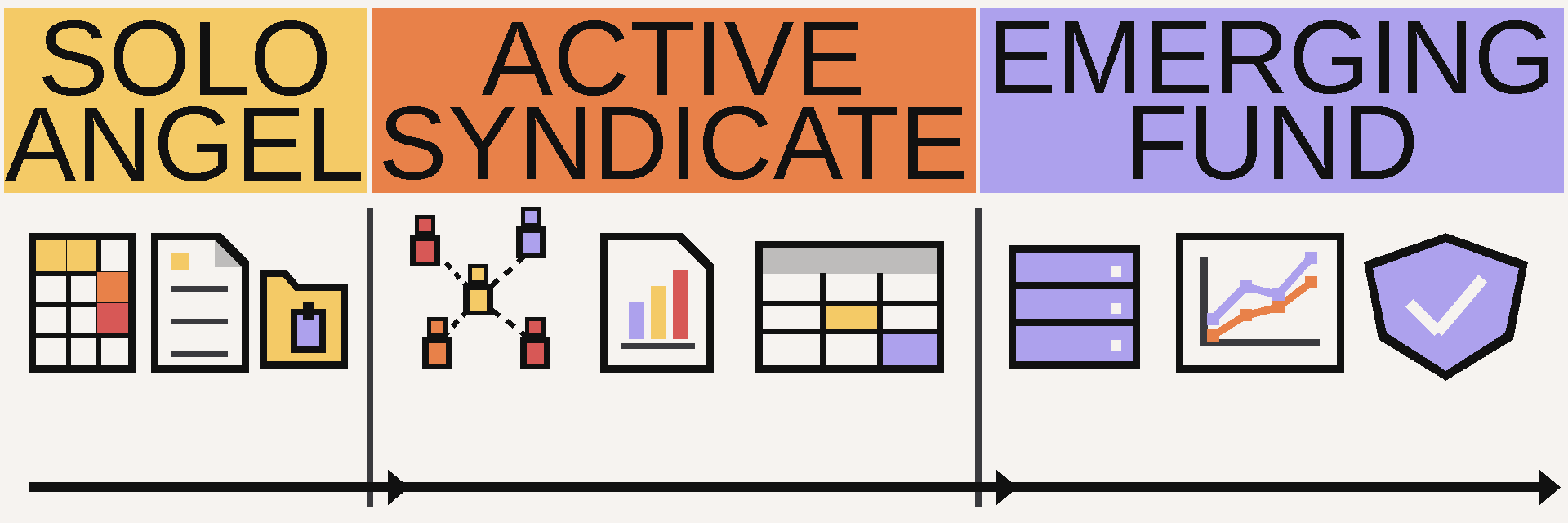
A tool belongs in your stack only when it owns a clear job. Use these starting points for three common operating models:
- Solo angel: Start with Airtable for deal flow, Google Workspace or Microsoft 365 for diligence files and memos, and one portfolio register that links to signed documents and each company's cap table. Add Crunchbase only if market mapping is a recurring part of your strategy. Skip a dedicated CRM, portfolio reporting platform, and fund administrator while you invest directly and manage the process yourself.
- Active syndicate: Use Attio for founder and investor relationships, Google Workspace or Microsoft 365 as a controlled document home, and the founder's cap-table portal or dated export for ownership records. Use an administrator such as AngelList when you pool checks through a special purpose vehicle (SPV). Add Visible when portfolio data requests and investor reporting become a recurring workflow. Choose Affinity instead of Attio when several investing partners rely on shared relationship history and warm paths every week.
- Emerging fund: Use Affinity for relationship-driven deal flow, Google Workspace or Microsoft 365 for source documents and memos, Visible for a lean reporting workflow, and a fund administrator such as AngelList for the books, capital activity, tax work, and limited partner (LP) portal. Choose Standard Metrics instead of Visible when a finance or operations team needs deeper valuation and audit workflows. Add Harmonic or PitchBook only when proactive research is part of the investment thesis, and add Carta Fund Forecasting when reserves and pacing require portfolio-wide scenarios.
Those recommendations keep different records in different places. A private-company database tells you what its sources say about the market. A customer relationship management (CRM) system records your firm's relationships, actions, and decisions.
A founder-side cap-table product maintains the company's ownership record. An investor system tracks your position and portfolio.
A document room controls files. It does not conduct diligence.
Portfolio reporting collects and analyzes company data. Fund administration maintains the vehicle's operational and accounting records.
Start with the smallest stack that preserves good decisions
A venture capital tool should remove a recurring operating problem. It might capture a founder introduction, keep diligence evidence together, reconcile portfolio records, or produce an investor report. Buying a platform because other funds use it is how tooling debt begins.
Our co-founder and general partner Elizabeth Yin puts it plainly: “The more disciplined you are in your thought process / rubric, the more you can improve over time.” The software matters only if it preserves that rubric and the reasoning behind each decision.
A solo angel usually needs five things:
- One deal tracker: a spreadsheet or Airtable base with company, source, stage, owner, next action, memo, and decision.
- One document home: an access-controlled folder for executed documents, founder materials, notes, and company updates.
- One diligence template: the same claims, questions, sources, and pass reasons for every deal.
- One portfolio register: instrument, investment date, amount, holding entity, document links, material rights, company status, and next action.
- A calendar: follow-ups, decision deadlines, reporting dates, and expected tax documents.
If your constraint is access or learning, software is the wrong purchase. Angel Squad adds curated deal flow, live pitches, investing education, and peers who can challenge your analysis. That human layer lets you keep the software layer lean while you build judgment.
An emerging manager adds tools when other people, LPs, or multiple entities enter the workflow. That usually means a relationship-aware CRM, a portfolio reporting platform, and a fund administrator. A private-company database and fund forecasting tool earn their place only when proactive sourcing or scenario planning is part of the strategy.
How to compare venture capital software
Product demos make every interface look tidy. Compare the work underneath it.
- Workflow fit: Does the tool solve sourcing, evaluation, ownership tracking, portfolio monitoring, or fund operations? Similar-looking products often own different records.
- Data burden: Identify what is captured automatically, what founders must submit, and what your team must maintain.
- Source authority: A CRM note, cap table, signed security, bank record, and administrator statement carry different weight. The platform should preserve the source and its date.
- Portability: Favor clean CSV exports, document downloads, and an application programming interface (API) when integrations matter. Your decision history should survive a vendor change.
- Permissions: Require multifactor authentication, role-based access, sensible retention controls, and a clear path to revoke former team members.
- Full cost: Include setup, schema design, data cleanup, integrations, staff time, and migration. The subscription is only one line.
Deal-flow and relationship management: Airtable, Attio, and Affinity
Your deal-flow system should answer what the company is, who introduced it, where it sits, what happens next, and why you invested or passed. We compare more dedicated options in our deal-flow software guide. These three cover the usual progression from a personal tracker to a relationship-aware fund CRM.
The public US prices below were listed on September 9, 2026. They exclude taxes, add-ons, usage charges, implementation, and negotiated terms.
Airtable
Best suited to: Solo angels and two-person teams that want a flexible deal tracker.
Airtable combines a spreadsheet-like interface with linked records, forms, views, interfaces, and automations. Its Free plan is designed for individuals and very small teams. The Team plan is $20 per user per month when billed annually, Business is $45 per user per month when billed annually, and Enterprise Scale uses custom pricing.
Its flexibility is both the appeal and the tax. You must design the schema, prevent duplicate companies, and maintain the automations. Choose Airtable when one person owns the process and manual context is still manageable.
Attio
Best suited to: Small investing teams that source through a broad operator network.
Attio syncs email and calendar activity, enriches records, and lets a team model founders, referrers, companies, and deals around a custom process. The Free plan supports up to three seats. Plus is $35 per user per month with annual billing or $44 with monthly billing. Pro is $79 per user per month with annual billing or $99 with monthly billing, and Enterprise pricing is custom.
Attio reduces contact upkeep. It still needs an investor-specific data model for evaluation scores, investment committee decisions, terms, and pass reasons.
Affinity
Best suited to: Active funds with several partners contributing relationship data.
Affinity is built for private-capital teams. Its plans capture email and calendar activity, score relationships, show warm paths, preserve firm-wide interaction history, and connect that context to a deal pipeline. Essential is $2,000 per user per year, Scale is $2,300, Advanced is $2,700, and Enterprise uses custom pricing.
Those annual per-seat prices make Affinity hard to justify for an occasional angel. It earns its place when missed relationship context costs the firm deals or time every week.
Private-company data: Crunchbase, Harmonic, and PitchBook
These products are research databases. They can feed a sourcing list or enrich a company record. Your CRM still has to preserve the team's relationship history, actions, and decisions.
Crunchbase
Best suited to: Solo angels and lean funds building quick market maps.
Crunchbase Pro supports company discovery, funding and investor research, leadership signals, change alerts, notes, tags, and exports. It fits an angel or small fund building market maps and doing a quick first pass on a company or investor.
Harmonic
Best suited to: Thesis-driven pre-seed teams that source founders proactively.
Harmonic maps companies, people, investors, and network connections, with console, API, bulk-data, export, and CRM-sync options. It fits investors looking for startups and team signals before a financing announcement creates an obvious record.
As of September 9, 2026, Harmonic pricing is not publicly listed. Its pricing page directs buyers to request pricing, so budget comparisons require a vendor quote rather than an online estimate.
PitchBook
Best suited to: Funds that conduct frequent transaction, valuation, investor, and fund research.
PitchBook data combines private-company profiles with financing, valuation, investor, fund, and exit data. Its comparable-transaction and fund research fit teams conducting frequent market and transaction analysis. As of September 9, 2026, pricing is not publicly listed on its pricing page.
No private-company database is a source of truth. A benchmark of eight VC databases compared 108 startups and 339 financing rounds and found meaningful differences in coverage, quality, and sampling bias. Larger financing rounds were more likely to appear. The study dates to 2020, so it supports the durable caution, not a current vendor ranking.
Use a small evaluation set drawn from companies you already know across your stage, sector, and geography. Score each database on company presence, founder accuracy, latest financing, round date, investor coverage, useful filters, export limits, and update speed. A giant headline company count is weak evidence if your niche is thin.
Diligence tools: documents, AI, and primary sources
Early-stage diligence is a process, not a software category. A secure workspace, a structured source log, and real conversations do more work than a branded diligence portal.
Google Workspace or Microsoft 365
Best suited to: Solo angels and small teams that need one controlled diligence record.
Use a restricted shared folder, a question log, and a standard memo template. Google Drive permissions support view, comment, and edit access plus expiration controls on eligible plans. Microsoft 365 provides the same basic pattern through SharePoint and OneDrive. Store links to the founder's data room, source documents, customer calls, references, open questions, and the final decision.
An investor seldom needs to buy virtual data-room software. The company usually owns the room. Your job is to preserve the evidence and conclusions you are allowed to retain. Access controls organize documents; they do not validate revenue, customer claims, intellectual property, or the founding team.
Claude or ChatGPT
Best suited to: Investors with an approved business workspace and a source-linked review process.
An approved business workspace can extract claims from a deck, compare document versions, turn notes into an issue list, and draft a memo outline. Keep every material conclusion tied to its original source. Models can miss qualifications and invent plausible details.
Use a plan with contractual data controls, appropriate retention, and central administration. OpenAI states that business data is not used to train its models by default. Claude Team and Enterprise include organization controls, and Enterprise adds features such as custom data retention. Those protections differ from a personal consumer account and still require correct workspace settings and access rules. The NIST generative AI profile identifies confabulation, data privacy, Human-AI Configuration, and information security as distinct risk categories, and recommends human oversight as a control.
Free primary-source tools
Best suited to: Any investor answering a narrow factual question about an entity, filing, patent, or public codebase.
SEC EDGAR can surface public Form D notices and other filings. State corporate registries can identify an entity and its status. USPTO and Google Patents cover published patent records. GitHub can show public code activity. None gives a complete picture, and a record's absence does not prove a founder's claim is false. Save the source, query, date, and limitation in the memo.
Software still cannot conduct a candid founder reference call. Our co-founder and general partner Eric Bahn says, “We've never done a deal without doing 10 back references on founders.” Our due diligence checklist covers the questions and documents those tools should support.
Cap tables and waterfalls: Carta, Pulley, and fund forecasting
A cap table records securities and ownership. A company exit waterfall applies each security's rights to a specific liquidity outcome. A fund distribution waterfall allocates fund proceeds between LPs and the general partner under the governing fund documents. Those are three different jobs.
Carta and Pulley
Best suited to: Direct investors and funds whose portfolio companies already maintain records on one of these platforms.
Carta cap-table management gives companies a system of record, stakeholder access, equity administration, and company-level modeling. Pulley combines cap-table administration with fundraising and dilution modeling. Pulley's public plans make the buyer clear: as of September 9, 2026, Startup costs $1,200 per year for a company with up to 25 included stakeholders and Growth costs $3,500 per year with up to 40, with both limits based on Pulley's stakeholder-counting rules; Enterprise is quote-only.
Those are founder-side company plans. They are not the price of an investor portfolio system. An angel typically receives stakeholder access or a dated export and records the investment in an internal portfolio register. The portfolio company typically chooses and pays for its cap-table platform.
Carta Fund Forecasting, formerly Tactyc, serves another need. It models fund construction, pacing, reserves, follow-ons, and portfolio scenarios. This is an emerging-manager tool. It does not replace a company's legal stock ledger or the fund administrator's books. As of September 9, 2026, pricing is not publicly listed.
For a direct investment with preferred stock, a Simple Agreement for Future Equity (SAFE), a note, or securities from several financing rounds, our exit waterfall guide explains how signed terms affect payouts. Simplified spreadsheet scenarios are useful for sensitivity analysis. The executed documents control the real outcome.
Portfolio reporting and fund administration: Visible, Standard Metrics, and AngelList
Portfolio reporting and fund administration are separate jobs. Portfolio software collects company metrics, investment records, valuation inputs, and updates. Fund administration maintains entity books, LP records, capital calls, distributions, tax work, banking workflows, and financial reporting. One portal can expose both, but a dashboard does not assume an administrator's responsibilities.
Visible
Best suited to: Lean funds whose quarterly reporting process has outgrown email and spreadsheets.
Visible's investor product supports recurring company requests, dashboards, investment tracking, portfolio and fund reports, LP updates, permissions, and audit features. It fits an emerging manager who wants a structured reporting workflow without jumping straight to a finance-heavy system.
Visible separates founder and investor pricing. Its founder plans publish self-serve prices for fundraising updates and investor communications. Those numbers do not price the portfolio-monitoring product. As of September 9, 2026, Visible lists Essential, Premium, and Enterprise investor plans as contact-for-pricing.
The founder experience still matters. Request only metrics that inform a decision or an LP obligation, and define each metric consistently. A prettier dashboard cannot rescue inconsistent inputs.
Standard Metrics
Best suited to: Funds with finance or operations staff and recurring valuation, audit, or LP reporting work.
Standard Metrics centralizes portfolio and investment data, automates collection, and supports analysis, valuations, reports, permissions, and audit trails. It fits firms with a larger portfolio or recurring valuation and audit work. As of September 9, 2026, pricing is not publicly listed.
Its value comes from consistent processes across the firm. A solo angel with irregular company updates will get little benefit from an institutional workflow.
AngelList
Best suited to: Emerging managers launching or operating venture funds and SPVs.
AngelList Venture Funds combines software and services for investor onboarding, fund accounting, tax documents, banking and wiring, capital activity, valuations, audit support, reporting, and an LP portal.
Its current Venture Funds pricing is quote-only. As of September 9, 2026, AngelList lists Base and Institutional plans with 10-year contracts and asks prospective managers to get a quote. It does not publish a standard annual fee or percentage-of-committed-capital formula for those plans, so we have not substituted a third-party estimate.
This is infrastructure for an actual fund or pooled vehicle. It is excessive for tracking direct personal investments. Choose an administrator before the first close and capital activity, with counsel and accounting advisers aligned on entity structure, controls, reporting, and responsibilities.
Our angel portfolio management guide shows the records every setup needs, including positions, transactions, documents, rights, marks, follow-ons, and next actions.
Buy the next layer only when the trigger is real
Use recurring failure as the upgrade signal:
- Spreadsheet to CRM: duplicate companies, missed follow-ups, private inbox context, or several reviewers now create rework.
- General CRM to Affinity: warm introductions and shared relationship history materially drive sourcing across a team.
- Free research to a paid database: proactive market mapping is part of the investment strategy, and public search leaves repeated gaps.
- Portfolio register to Visible or Standard Metrics: quarterly collection, normalization, valuation support, or LP reporting consumes material staff time.
- Spreadsheet scenarios to fund forecasting: reserves, pacing, ownership, and follow-on decisions require repeatable portfolio-wide analysis.
- Personal tracking to fund administration: outside LP capital, pooled vehicles, capital calls, distributions, tax reporting, or formal controls enter the picture.
Before signing, name the system of record for companies, contacts, deals, documents, ownership, cash, and portfolio metrics. Assign one owner for data quality. Set a quarterly export and access review. If two tools own the same field, one of them will quietly become wrong.
The best venture capital stack leaves more time for founder conversations and sharper decisions. If you want the investing education, peer feedback, and curated deal exposure that software cannot supply, apply to Angel Squad. You can join without accredited-investor status; investing in relevant offerings requires it, and participation never guarantees an allocation or return.






.png)







.png)