
Venture Capital Method: Valuing a Startup From Exit Back to Entry
Brian Nichols is the co-founder of Angel Squad, an angel investing community where aspiring and active angels learn from Hustle Fund’s approach, review curated deal flow, and connect with peers.
An early-stage startup may have little revenue, no profit, and a price that still has to be negotiated. The venture capital method gives investors a disciplined way to reason about that price. It starts with a possible exit, works backward to the ownership needed today, and exposes the assumptions that can break the answer.
What the venture capital method estimates
The venture capital method estimates an acceptable entry price for an investor under a stated exit scenario and return target. It does not produce an objective intrinsic value. The output answers a conditional question: if the company reaches a given exit value and the investor needs a given return, what entry valuation could make the math work?
That distinction matters because a venture-scale outcome and a good business are different tests. In Democratizing Knowledge (2021), p. 125, our co-founder and general partner Elizabeth Yin wrote, “Investors are looking for THE VERY HIGHEST ROI opp. NOT great businesses.” A high return hurdle reflects a fund’s constraints and portfolio math. It is not a verdict on the founder, product, or company quality.
Our broader startup valuation guide also explains that our fund model does not require a target ownership percentage. The ownership calculation below is a general convention of the venture capital method, not a statement of our underwriting policy.
The venture capital method formula
Use one consistent chain from exit proceeds to entry price. Each link needs its own assumption.
- Required exit proceeds = investment × target gross multiple. A gross multiple is the cash and remaining value attributed to the investment before fees, carry, and taxes, divided by invested capital.
- Required exit ownership = required exit proceeds ÷ exit equity value. This is the percentage of equity value the investor must receive at exit under a simple pro-rata payout.
- Required entry ownership = required exit ownership ÷ ownership retention rate. Retention is one minus expected cumulative dilution. If ownership is expected to dilute by 25%, retention is 75%.
- Implied post-money valuation = investment ÷ required entry ownership. Post-money means the company’s negotiated equity value after the new primary investment.
- Implied pre-money valuation = post-money valuation − new primary investment. This assumes the full check is new money going into the company.
A target annual return can replace the target multiple:
Target gross multiple = (1 + annual return)^years
For one investment followed by one exit payment and no other cash flows, that annualized return is the internal rate of return (IRR). Multiple on invested capital (MOIC) measures how many dollars of value came back per dollar invested. MOIC ignores time, while IRR depends on it.
The method runs from a possible exit value back to the negotiated entry price. Dilution sits between exit ownership and entry ownership, so skipping it makes the entry price look too high.
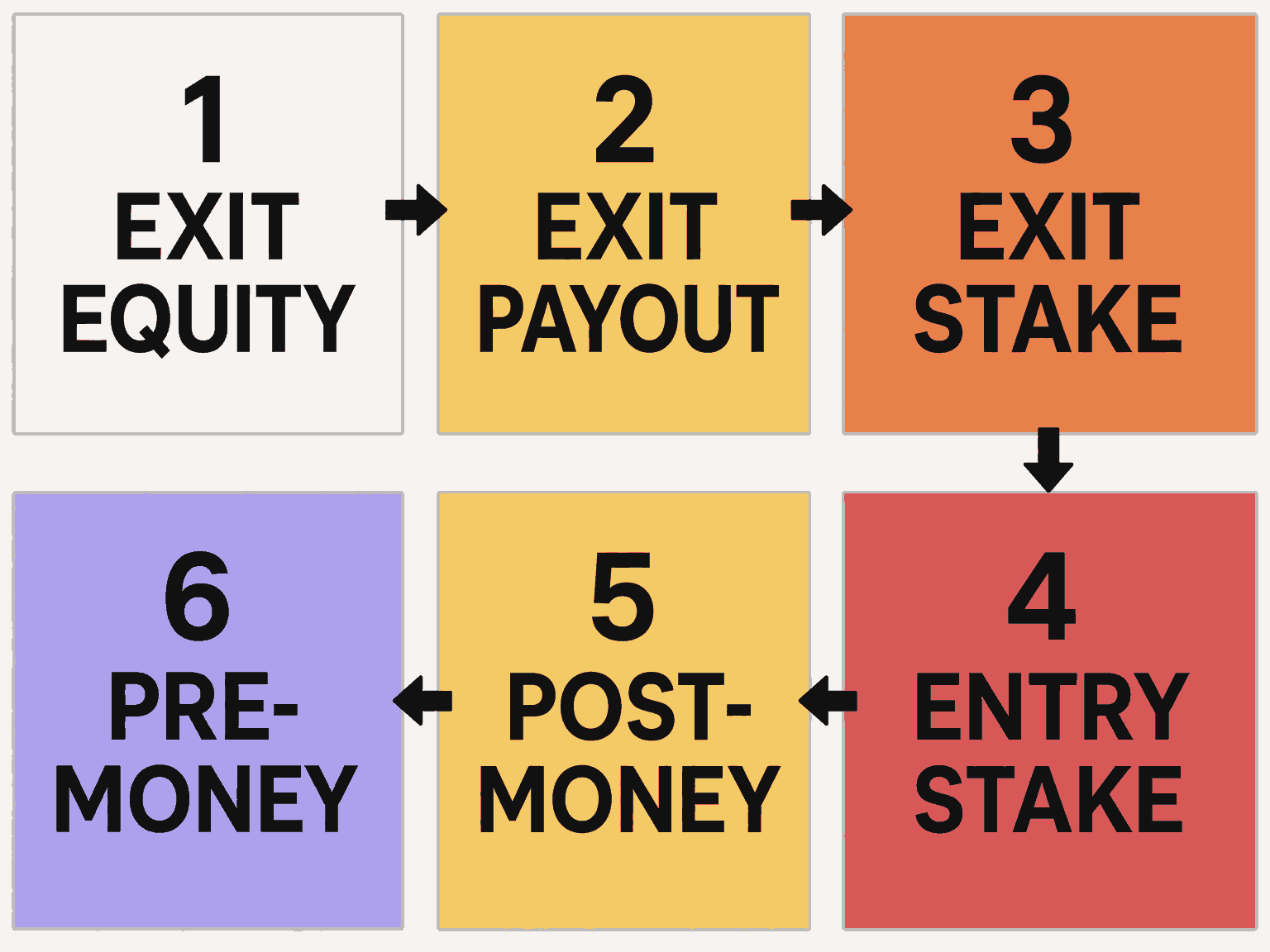
Build the calculation step by step
1. Choose the exit year and operating metric
Pick the year when a sale or public listing could plausibly occur. Then forecast a metric that fits the business at that point, such as revenue or earnings before interest, taxes, depreciation, and amortization (EBITDA). The forecast should connect to an operating plan rather than a growth percentage chosen to reach a desired valuation.
2. Apply an exit multiple
Match the metric to the multiple. Revenue pairs with enterprise value (EV) divided by revenue. Net income pairs with an equity-value multiple such as price to earnings. A 2026 CFA Institute practitioner analysis recommends checking exit multiples against long-run growth, returns on capital, interest rates, public comparables, and transaction evidence. A current median is not automatically a sensible multiple several years from now.
3. Bridge enterprise value to equity value
Enterprise value represents the operating business independent of how it is financed. Equity value is what remains for shareholders after the relevant debt and cash adjustments.
Exit equity value = exit enterprise value − debt + cash
Other non-operating assets, liabilities, transaction costs, or deal adjustments may also belong in the bridge. This step cannot be skipped when a revenue or EBITDA multiple produces EV. Aswath Damodaran’s critique of the method flags this exact mismatch: an EV/revenue output is the value of the business, while the investor’s target return applies to equity proceeds.
4. Set the return target and dilution case
State whether the target is a gross MOIC or an annualized return, and state the time horizon. Then estimate how much ownership the investor may retain after later rounds, employee option-pool increases, Simple Agreements for Future Equity (SAFEs), convertible notes, warrants, or other issuances.
Dilution occurs when new shares leave an existing holder with a smaller percentage. It can be estimated as a single cumulative factor for a first pass, but a dated, pro forma capitalization table is better for a real deal. Our co-founder and general partner Eric Bahn warns, “It is really easy to mess up these calculations.”
A worked venture capital method example
Example status and scope: Hypothetical and simplified as of October 1, 2026. This is one private-company deal on a gross basis, starting as a fully unrealized position. It assumes no interim distributions, no follow-on investment by this investor, no fees, no carry, and no taxes. The modeled 25% dilution comes from later company equity issuances to other investors. It is an illustration, not a projection, benchmark, promise, or our policy.
The example assumes identical economic rights across holders; no debt or excess cash at exit; no option-pool change, SAFE, note, warrant, or other convertible instrument; no liquidation preference, participation right, dividend, anti-dilution adjustment, or senior claim; and no difference between signing, closing, or payment dates. Real cap tables, governing documents, valuation policies, and transaction timing can change the result.
Step 1: Estimate exit enterprise value
Assume forecast revenue of $20,000,000 in year five and a hypothetical 5.0× EV/revenue multiple.
$20,000,000 × 5.0 = $100,000,000 exit enterprise value
The example assumes no net debt solely to keep the bridge visible. Exit equity value is therefore also $100,000,000.
Step 2: Calculate required exit proceeds
Assume a $1,000,000 new primary investment and an illustrative target of 10.0× gross MOIC.
$1,000,000 × 10.0 = $10,000,000 required exit proceeds
Step 3: Calculate required exit ownership
$10,000,000 ÷ $100,000,000 = 10.0% required exit ownership
Under the example’s equal-rights assumption, 10.0% of exit equity value produces 10.0% of the shareholder proceeds.
Step 4: Adjust for dilution
Assume 25% cumulative ownership dilution before exit, which means the investor retains 75% of the entry stake.
10.0% ÷ 75% = 13⅓% required entry ownership, or about 13.33%
Step 5: Solve post-money and pre-money valuation
$1,000,000 ÷ 13⅓% = $7,500,000 implied post-money valuation
This calculation uses the exact fractional value, 2⁄15, rather than the rounded 13.33% display.
$7,500,000 − $1,000,000 = $6,500,000 implied pre-money valuation
The SEC’s capital-raising glossary makes the ownership distinction concrete: a new investment can be quoted against either pre-money or post-money value, and the choice changes the ownership percentage. Keep the convention explicit in every model and term-sheet discussion.
Step 6: Check the answer forward
The exact 13⅓% entry ownership multiplied by 75% retention becomes 10.0% at exit. That stake multiplied by $100,000,000 of exit equity value produces $10,000,000. The $1,000,000 investment therefore returns 10.0× gross MOIC under the stated assumptions.
Over five years, a 10.0× outcome is about 58.5% annualized before fees, carry, taxes, and timing differences:
10.0^(1 ÷ 5) − 1 = 58.5%
If your forward check does not reproduce the stated exit proceeds and return, the model has mixed conventions or dropped an assumption.
Sensitivity analysis shows the real answer is a range
Sensitivity analysis changes one input and measures the effect on the output. CFA Institute’s 2026 valuation curriculum calls for sensitivity analysis, clearly identified assumptions, and internally consistent forecasts.
Each scenario below is hypothetical and simplified as of October 1, 2026. It inherits the base example’s one-deal, gross, fully unrealized basis and its assumption of no follow-on investment by this investor. Each scenario changes only the named input.
- Exit equity value: Holding the $1,000,000 check, 10.0× target, and 25% dilution constant, a $50,000,000 exit implies a $3,750,000 post-money and $2,750,000 pre-money valuation. A $150,000,000 exit implies $11,250,000 post-money and $10,250,000 pre-money.
- Timing: Holding 10.0× constant, the entry valuation stays at $6,500,000 pre-money, but the annualized return is 77.8% over four years, 58.5% over five, and 38.9% over seven. If 58.5% is the fixed annual target instead, the required multiple becomes about 6.31× at four years and 25.12× at seven years. The corresponding pre-money valuations are about $10,890,000 and $1,990,000.
- Dilution: With 10% cumulative dilution, required entry ownership is 11⅑%, or about 11.11%, which implies $9,000,000 post-money and $8,000,000 pre-money. At 40% dilution, required entry ownership is 16⅔%, or about 16.67%, which implies $6,000,000 post-money and $5,000,000 pre-money. Both valuation calculations use the unrounded ownership values.
- Target multiple: At a 5.0× target, the implied pre-money valuation is $14,000,000. At a 15.0× target, it is $4,000,000. A target multiple is an investment-policy input, not a market fact.
- Security rights: A liquidation preference may pay preferred holders before common holders, while participation, conversion, seniority, dividends, and caps can change the split again. The SEC notes that preference terms vary by stock class and round. A simple ownership percentage is incomplete when rights differ, so use an exit waterfall.
The lesson is blunt: the venture capital method gives you a range driven by assumptions. A single output with two decimal places is decoration.
Where the method is most fragile
The method is useful because it forces return math into the open. It is fragile because almost every important number sits in the future.
- The forecast can be reverse-engineered. Exit revenue can become the number needed to justify the desired price. Tie it to customers, pricing, retention, margins, hiring, and capital needs.
- The exit multiple hides another forecast. Growth, margins, capital intensity, rates, and market conditions at exit determine what buyers may pay. Today’s multiple can be a poor terminal assumption.
- Risk can be counted twice. A target return may already reflect failure risk. Applying a separate survival haircut without explaining the interaction can punish the same risk twice.
- Future capital is easy to understate. More rounds can mean more dilution, different preferences, and follow-on decisions. A single retention percentage is a shortcut.
- Ownership may not equal proceeds. Preferred rights, debt, costs, escrows, earnouts, and fees can separate headline exit value from investor cash.
- Valuation serves a purpose. A financing price, an investor’s return screen, a financial-reporting mark, and a tax valuation answer different questions. IVSC’s valuation guidance treats uncertainty and a range of credible outcomes as normal.
Use the method as one lens. Compare the result with recent financings and transactions, then test the business using other early-stage methods. A discounted cash flow model can force operating cash flows and reinvestment into view when the company has enough evidence to support them. Scenario analysis can show how failure, a modest outcome, and a large outcome affect the weighted result.
An investor checklist before relying on the output
- Date every forecast, comparable set, cap table, and document.
- Match the operating metric to the exit multiple.
- Bridge enterprise value to equity value.
- State whether the return target is MOIC or IRR, gross or net, and over how many years.
- Model dilution from the actual cap table and planned financing path.
- Apply the security’s contractual rights through an exit waterfall.
- Change one assumption at a time and record the valuation range.
- Check the math forward from entry ownership to exit proceeds.
Practice the judgment behind the math
The formulas fit on a page. Choosing defensible inputs takes repetition and feedback. If you want to review real startup opportunities with experienced investors and peers, apply to Angel Squad.
Disclaimer: This material is for general education only and is not investment, legal, tax, accounting, or valuation advice. Early-stage private investments are speculative, illiquid, and long-term, and you can lose your entire investment. Hypothetical examples are simplified and do not predict results. Past results and current marks do not guarantee future results. Actual outcomes depend on governing documents, security rights, fees, carried interest, taxes, cap-table changes, valuation policies, follow-on capital, transaction terms, and timing. Review the controlling documents and consult qualified independent investment, legal, tax, accounting, and valuation professionals for your circumstances.















.png)