
How to Read an S-1 Filing as an Investor
Brian Nichols is the co-founder of Angel Squad, an angel investing community where aspiring and active angels learn from Hustle Fund’s approach, review curated deal flow, and connect with peers.
A public S-1 may be the first time a private-company investor can see audited financials, ownership, risks, and offering terms in one place. It is also long, repetitive, and easy to misread. A practical review starts with the transaction, follows the business evidence, and ends with questions about your own shares. The filing supplies evidence. It does not make the investment decision for you.
What an S-1 filing is
Form S-1 is a registration statement filed with the U.S. Securities and Exchange Commission (SEC) to register securities for sale. Companies often use it for an initial public offering (IPO), though the form can support other offerings and resale registrations too.
A registration statement has two parts. Part I is the prospectus, the investor-facing offering document. Part II contains additional filed information and exhibits. The SEC's registration-statement guide explains this structure, while the official Form S-1 instructions map the required disclosure.
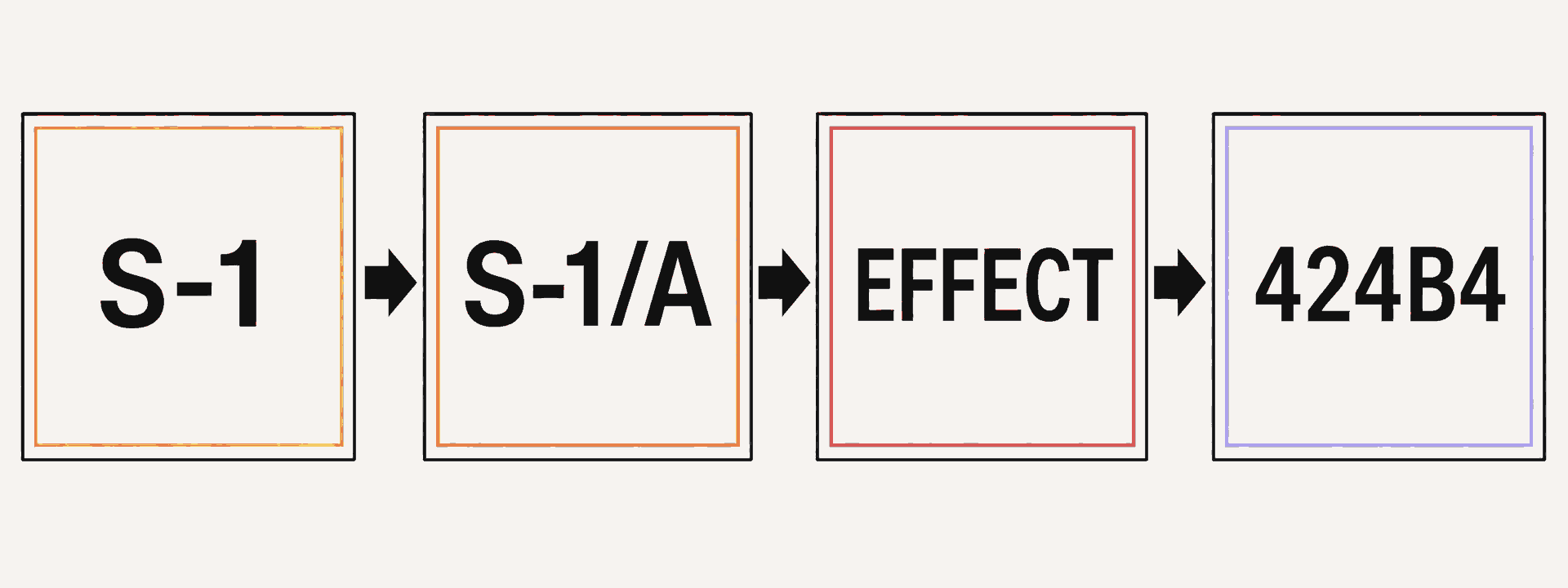
Five labels prevent most document mix-ups:
- S-1: A public registration statement on Form S-1. In an IPO filing trail, it is often the first publicly filed version. The form is also used for other registered offerings.
- S-1/A: An amended S-1. Each amendment replaces or updates parts of the earlier filing. Later versions may add financial periods, pricing, share counts, risks, exhibits, or underwriter details.
- EFFECT: The SEC notice that the registration statement became effective. Effectiveness allows the registered sale to proceed. It is not an endorsement, accuracy certificate, or judgment about investment quality.
- Preliminary prospectus: The evolving Part I used before final pricing. You may hear it called a red herring.
- Final prospectus: The priced offering document filed under Rule 424, often as 424B4 for an IPO and sometimes under another 424B form. It usually supplies the final price and share count.
The SEC's IPO investor bulletin describes this progression. Read it as a filing trail rather than one permanent document.
How to find the right S-1 on EDGAR
The Electronic Data Gathering, Analysis, and Retrieval system (EDGAR) is the SEC's public filing database. Use the SEC's own company filing search, especially when summaries or news reports disagree.
- Search the legal company name. A ticker may not exist yet. A Central Index Key, the SEC's unique company identifier, is even safer when you have it.
- Filter for Form S-1. Open the filing detail page and confirm the issuer, filing date, securities, and file number. A similarly named company or separate resale registration can lead you to the wrong transaction.
- Open the initial S-1 and every S-1/A. The latest amendment is the best current view, while the earlier versions show what changed.
- Look for an EFFECT notice. Its presence tells you the registration statement became effective. It says nothing about whether the security fits your portfolio.
- Find the final 424B prospectus. For a priced IPO, use it for the offer price, base share count, underwriting terms, and estimated net company proceeds. Check later filings for any underwriters’ option exercise or updated actual proceeds.
Some issuers submit draft registration statements for nonpublic SEC review before a public filing. You cannot read a draft while it remains nonpublic. A visible S-1 also does not guarantee the company will finish the offering or begin trading.
A separate issue is a redacted public exhibit. SEC rules permit companies to omit certain immaterial contract terms that they customarily and actually treat as private or confidential, as the SEC's confidential-treatment guidance explains. The company must mark the omissions. A marked redaction does not make the entire S-1 confidential, and the missing terms should not be guessed.
Read the S-1 in this order
The table of contents is your map, and browser search is faster than scrolling. Search for the section names below, then trace claims across sections. Exact names and order can vary, and eligible issuers may use scaled disclosure.
1. Confirm the offering on the cover
Start with the security being sold, proposed exchange and ticker, price or range, share classes, underwriters, and the split between new and existing shares. Record which fields are still blank.
The key distinction is primary versus secondary shares:
- Primary shares are newly issued by the company. Their sale brings gross proceeds to the company and increases the share count. The company receives net proceeds after underwriting discounts and offering expenses.
- Secondary shares are existing shares sold by current holders. The selling holder receives the proceeds. The company commonly states that it receives none of that money.
An offering can contain both. Read the cover, Selling Stockholders, Use of Proceeds, and Underwriting sections together. Also check whether the underwriters' option covers new company shares, selling-holder shares, or a mix.
- Ask as a private shareholder: Is the company raising operating capital, giving existing holders liquidity, or doing both? Does new issuance reduce my ownership percentage? Am I named as a selling holder, and are my shares subject to separate restrictions?
2. Translate the business story into operating facts
The Prospectus Summary and Business sections explain the product, customer, revenue model, market, growth strategy, competition, and dependencies. Summarize the business in three sentences without using the issuer's slogans. Then locate the evidence for each claim.
Our co-founder and general partner Elizabeth Yin writes, “Charismatic people can really fool you. Having charisma is a great trait, just in general. But, it can mask actual execution.” Apply that lens to the prospectus narrative. Compare market claims with customer growth, retention, acquisition spending, gross margin, and concentration.
- Ask as a private shareholder: Does the public story match the company you backed? Which growth claims have operating proof? Has the business model, customer mix, or competitive set changed since your investment?
3. Connect risk factors to evidence
Risk Factors can run for dozens of pages. Mark the risks that name a specific customer, supplier, platform, law, lawsuit, debt term, security incident, accounting judgment, or founder-control provision. Then connect each risk to Business, Management's Discussion and Analysis (MD&A), financial notes, and legal proceedings.
Repeated legal language still matters, though it should not receive the same weight as a quantified dependency. Watch for a risk written as hypothetical when another section indicates that the event has already occurred.
- Ask as a private shareholder: Which risks could change revenue, cash needs, ownership, voting control, or the timing of liquidity? What evidence would show that each risk is getting better or worse?
4. Follow every dollar in Use of Proceeds
Use of Proceeds explains how the issuer plans to use its net cash. Possible uses include working capital, product development, acquisitions, debt repayment, or general corporate purposes.
Do not multiply every offered share by the price and call the result company financing. Calculate gross proceeds from the company's primary shares, then subtract underwriting discounts and issuer expenses to reach net proceeds. Debt repayment can also consume much of the cash that reaches the company.
- Ask as a private shareholder: How much new cash reaches the balance sheet? How much pays debt or transaction costs? Are the stated uses specific enough to compare with the company's existing plan?
5. Rebuild the financial story from statements and notes
MD&A is management's explanation of changes in results, liquidity, and known trends. The audited financial statements and notes contain the accounting detail. Read them together.
Focus on a short set of relationships:
Revenue and gross margin: Is growth accelerating or slowing? Is the cost to deliver the product moving in the same direction?
Operating expenses and stock-based compensation: Which spending categories drive losses or operating efficiency? How much compensation is paid in equity?
Cash flow and liquidity: Does the business produce cash, or does it depend on new financing? Which working-capital changes explain the gap between net income and cash flow?
Debt and obligations: What must be repaid, when, and at what cost? Does the offering trigger repayment, conversion, or settlement?
Concentration and accounting policies: Do a few customers or suppliers matter? How does the company recognize revenue? What estimates could materially change results?
Auditor's report and controls: Is there a going-concern paragraph, material weakness, or other limitation that deserves follow-up?
Ask as a private shareholder: Which metrics improved because of durable operations? Which changed because of accounting, one-time items, or capital structure? How do the public numbers reconcile with the updates you previously received?
6. Separate three kinds of dilution
The word dilution can describe different effects. Keep them separate.
- Ownership dilution happens when new shares increase the share count and reduce an existing holder's percentage, assuming that holder does not buy enough to maintain it. Options, restricted stock units (RSUs), warrants, and convertible securities can add more potential shares.
- Accounting dilution in the S-1 commonly compares the public offering price with pro forma as-adjusted net tangible book value per share. It measures the gap between what a new buyer pays and a balance-sheet amount after the offering.
- Market-price loss happens if a security later trades below someone's purchase price or cost basis. Market supply, demand, results, and expectations drive that outcome. The S-1 accounting dilution figure does not forecast it.
Read Capitalization, Dilution, Description of Capital Stock, Principal Stockholders, and the equity-compensation notes as one package. Build both a basic share count and a fully diluted view that includes potential shares.
- Ask as a private shareholder: What will I own after the offering? Which awards or conversions expand the share base? How do my economic rights and voting rights change when preferred shares convert or multiple common-stock classes remain?
7. Inspect control, incentives, and related parties
Principal Stockholders shows major beneficial owners before and after the offering. Description of Capital Stock explains voting, conversion, dividend, and other rights. Executive Compensation and Related-Party Transactions show how insiders are paid and where the company has arrangements with founders, executives, directors, or major holders.
Check who controls board votes, who can sell, who receives offering-related payments, and how conflicts are governed. Multi-class stock can give a founder voting control well above their economic ownership.
- Ask as a private shareholder: Who controls the company after the IPO? Do your class rights convert, expire, or remain? Does any insider receive a benefit that public investors or smaller holders do not?
8. Finish with underwriting, lockups, future sales, and exhibits
Underwriting or Plan of Distribution explains commissions, the underwriters' commitments, allocation mechanics, stabilization activity, and potential conflicts. Shares Eligible for Future Sale and lockup disclosure help you understand when more shares may become tradable.
A lockup is a contractual restriction on selling for a period after an offering. It is separate from securities-law restrictions and your own investment documents. Our IPO liquidity guide explains why filing, pricing, listing, lockup expiry, and cash in an investor's account are different events. The Rule 144 guide covers one federal resale path for restricted securities.
Part II's exhibit index can contain credit agreements, charter documents, material contracts, legal opinions, and other source documents behind the summary. Read the underlying exhibit when one term could change your rights or the issuer's cash.
- Ask as a private shareholder: Which restriction applies to my exact shares? When could supply increase? Which agreement, side letter, or plan document governs my rights if the prospectus summary is incomplete?
Historical walkthrough: Figma's completed 2025 IPO
Figma's 2025 filing trail is a historical navigation example. The offering is complete. The figures below describe those filings and do not express a current view on Figma or its securities.
The document changed before pricing
Figma filed its initial S-1 on July 1, 2025, followed by a July 21 amendment and a July 28 amendment. The second amendment used an assumed $31 midpoint for certain calculations.
The registration statement became effective on July 30, as shown by the EFFECT notice. The final 424B4 prospectus, filed July 31, set the IPO price at $33. The progression shows why an initial S-1, the latest amendment, effectiveness, and final pricing are separate facts.
Most offered shares did not fund the company
The final prospectus cover listed 12,472,657 new shares sold by Figma and 24,464,423 shares sold by existing holders. It also gave underwriters an option to buy up to 5,540,561 additional shares from existing holders. Figma stated that it would receive no proceeds from selling-stockholder shares.
The prospectus estimated $383.4 million in net proceeds to Figma after discounts and estimated issuer expenses. Figma planned to use $330.5 million to repay borrowings under its revolving credit facility, with the remainder for general corporate purposes. Total shares sold multiplied by $33 would badly overstate the cash that financed the company.
Check operating results against MD&A
Figma reported $737.8 million in net income for 2023 and a $732.1 million net loss for 2024 in its final prospectus. MD&A explains that 2023 included a $1.0 billion fee from the terminated Adobe merger, while 2024 included $889.3 million in stock-based compensation expense, net of capitalized amounts, tied to the May 2024 restricted stock unit release and stock-option grants. Those events change the year-to-year comparison. Check the cash-flow statement and notes before treating either bottom-line figure as recurring operating performance.
The dilution figure was an accounting comparison
Figma's final Dilution section showed a $33 offering price, $2.47 in pro forma as-adjusted net tangible book value per share, and $30.53 in dilution to a new investor. That $30.53 was the prospectus's accounting comparison. It did not predict that the stock would lose $30.53 in the market.
The share count also required more work than reading the cover. The prospectus identified equity awards and other potential shares outside the headline offering count. An existing holder needed the capitalization, equity-plan notes, and future-sale disclosure to understand the broader share base.
Economic ownership and voting control diverged
Figma's Class A shares carried one vote per share, while Class B carried 15. The final prospectus estimated that co-founder and CEO Dylan Field would hold or be able to control about 73.6% of voting power after the offering, including 25.0% through an irrevocable proxy. That is why a post-offering ownership percentage alone cannot tell you who controls the company.
The Underwriters section disclosed that affiliates of six underwriters were lenders under Figma's revolving credit facility. Some or all of those affiliates would receive 5% or more of the offering's net proceeds through repayment, a FINRA Rule 5121 conflict of interest identified in the prospectus. This is a prompt to inspect incentives and terms, not proof of wrongdoing.
Turn the filing into an investor memo
An S-1 is disclosure, not investment approval. Filing means the document was submitted. Effectiveness means the registered sale can proceed. A final prospectus records priced terms. None of those events says the offering is attractive, suitable, or likely to perform well.
Our co-founder and general partner Elizabeth Yin has written, “The more disciplined you are in your thought process/rubric, the more you can improve over time.” Use the same memo structure for every filing so you can compare your reasoning with later evidence.
Write a one-page memo after your review:
- Transaction: Security, price or range, primary and secondary shares, expected company proceeds, and key dates.
- Business evidence: Revenue model, customer proof, margins, cash use, debt, and the two or three metrics that drive the thesis.
- Ownership and control: Basic and fully diluted shares, class rights, major holders, voting power, and related-party arrangements.
- Risks and open questions: The company-specific issues that could change your view, with links to the filing sections.
- Your position: Your security, cost basis, governing documents, restrictions, tax questions, and what still requires independent professional review.
The memo forces you to separate filing facts from assumptions. If you're evaluating a Regulation Crowdfunding offering instead, our Form C investor guide covers that distinct disclosure path.
Practice the process with other angels
Reading one filing teaches vocabulary. Repeating the process across real opportunities improves judgment. If you want to review curated deal flow, compare diligence questions with peers, and learn from Hustle Fund's approach, apply to Angel Squad.
Important disclosure
This material is for general educational and informational purposes only. It is not personalized investment, legal, tax, accounting, or valuation advice; an offer or solicitation; or a recommendation to buy, sell, or hold Figma or any other security. The Figma walkthrough is historical and limited to the cited 2025 filings. Filing data, offering terms, company circumstances, and market conditions can change.
Private and public-company investments involve substantial risk, including illiquidity, long holding periods, volatility, dilution, and loss of all invested capital. Many startup investments fail. Past results, historical prices, and current valuations do not guarantee future results. Actual rights, restrictions, proceeds, fees, carry, taxes, ownership, and outcomes depend on the applicable security, cap table, governing documents, transaction documents, valuation policy, and timing. Review the latest SEC filings and your own governing documents, and seek independent advice from qualified legal, tax, accounting, valuation, and investment professionals for your circumstances.















.png)