
Startup company database for investors: 7 options compared
Brian Nichols is the co-founder of Angel Squad, an angel investing community where aspiring and active angels learn from Hustle Fund’s approach, review curated deal flow, and connect with peers.
A database that finds financed comparables may miss the startup formed last month. A discovery product that finds a new team may have little dependable information about financing terms or valuation. Choosing well starts with the investing job, then a sample from the exact market you care about.
Match the database to the investing job
Startup-company data supports four different jobs. Discovery finds companies and founders early. Market mapping defines a sector or geography. Financing research reconstructs rounds, investors, and valuations. Desktop diligence gathers enough context for a team to decide where primary-source work should begin.
We would start with four demos, each matched to one job:
- PitchBook for financing and transaction diligence. It fits an institutional venture capital or private equity team preparing comparable transactions, capital-structure work, or an investment committee memo.
- Dealroom for ecosystem and market mapping. It fits investors mapping sectors and geographies, especially in Europe, and teams that need shareable landscapes.
- Harmonic for very-early-stage discovery. It fits pre-seed investors searching for newly formed companies, founders, team changes, and network signals.
- Crunchbase Pro for a self-serve baseline. It fits solo angels and small teams that want a low-friction way to explore companies before paying for an institutional data product.
Tracxn, CB Insights, and Beauhurst belong on the list when their particular mandates match yours. They are conditional choices rather than lower-ranked products.
An angel searching for unfunded climate founders should care about young-company recall and founder accuracy. A fund validating a Series A comparable should care more about deal terms, the source behind each round, and whether a valuation was reported or modeled. One headline company count cannot answer both questions.
What to check in a startup-company database
Company databases use different inclusion rules and sources. A count that mixes public companies, local businesses, and startups tells you very little about coverage in your niche. Use this rubric instead:
- Target-company recall and entity matching: Does the database find the companies you already know, then match each brand to the correct legal entity, website, founders, and status?
- A dated event trail: Inspect the latest verified financing, filing, founder change, acquisition, shutdown, or other event. “Updated daily” describes a pipeline. It does not prove one profile is current.
- Source provenance: Can you see whether a fact came from a filing, company announcement, founder submission, news report, partner feed, or model?
- Filters that express your thesis: Test stage, sector, business model, geography, founder, launch year, funding, and team signals using a real investment thesis.
- Funding and valuation labels: A startup funding database should separate confirmed round data from estimates. A modeled valuation is an input for investigation, never a confirmed deal price.
- Usable data rights: Check on-screen result limits, comma-separated values (CSV) exports, monthly credits, application programming interface (API) access, bulk delivery, sharing rights, and what happens when you cancel.
- Full team cost: Compare seats, data modules, markets, integration fees, export packs, implementation, renewal terms, and staff time on the same basis.
In Democratizing Knowledge (Hustle Fund, 2021), p. 43, Elizabeth Yin writes, “Investors use their life perspective to assess. For this reason, we need more funders with more varied life perspectives.” A database organizes evidence. The investor brings the interpretation.
Four starting points for investor demos
The right first demo depends on which missing information creates repeated work.
PitchBook: financing and valuation diligence
Best suited to: Venture and private equity teams that regularly prepare comparable transactions, investment committee materials, or capital-structure analysis.
PitchBook connects companies to financing events, investors, funds, exits, deal terms, cap tables, and pre- and post-money valuations. Its venture-capital database documents transaction details such as voting rights, liquidation preferences, shares, and deal-time financials. Those fields make it the strongest starting demo here for institutional financing research.
Price and access require care. PitchBook uses quote-based pricing, and its API requires a separate agreement. Excel downloads also count against account limits. Ask for the allowed seats, markets, fields, downloads, API or data-feed rights, external sharing rules, and renewal terms in writing.
The main coverage test is younger companies. Include newly formed, unfunded, and quiet startups in the sample instead of testing only well-known funded businesses.
Ask on the demo: Which fields are observed transaction data, which are estimates, and how does the license handle your exact investment-committee workflow?
Dealroom: ecosystem and sector mapping
Best suited to: Investors, corporate venture teams, and ecosystem researchers mapping a sector or region, especially across Europe.
Dealroom combines filings and trade registers, ecosystem partners, manually checked user submissions, public sources, and predictive models. Its data FAQ says funding rounds, team changes, and new-company detections enter continuously, while disclosed and modeled valuations receive separate labels. Its market-map workflow supports a research job that starts with a landscape rather than one transaction.
Dealroom also publishes a list price. On October 1, 2026, its Premium plan listed €12,600 per year, starting at three seats, with 10,000 export credits per user. API and larger-data access used custom terms. That is a team subscription with credits, so a direct price comparison with a one-person monthly plan would mislead.
Test the map against local companies you know and examine the source behind each funding or valuation field. Ecosystem breadth still needs primary documents before it becomes investment-committee evidence.
Ask on the demo: Can your team reproduce, export, and share its full target-market cohort under the quoted license, with reported and modeled values clearly separated?
Harmonic: founder and very-early-stage discovery
Best suited to: Pre-seed investors and thesis-driven scouts who want newly formed companies, people data, team changes, and network context.
Harmonic’s product emphasizes companies, people, investors, network mapping, and discovery signals. Its integration options include a web console, REST and GraphQL APIs, and bulk warehouse delivery through Snowflake, BigQuery, or S3. Console searches and lists also support CSV export. That range matters when a sourcing team wants new profiles to flow into an existing process.
The buying boundary deserves attention. Harmonic lists financing and investor data as an add-on for API and bulk access. Its current pricing documents establish funding-history features, yet they do not establish systematic valuation coverage across the company universe. Get the financing fields, refresh terms, export rights, and valuation availability into the written quote.
Its own pricing page also presents conflicting headline coverage counts in different sections. Skip the count contest and test your early-stage sample.
Ask on the demo: How many of your known unfunded companies appear with the correct founders, formation timing, and team signals, and which financing fields cost extra?
Crunchbase Pro: the self-serve control group
Best suited to: Solo angels and small teams that need exploratory research, saved searches, alerts, and moderate exports without a long procurement process.
Crunchbase Pro covers company profiles, funding history, investors, leadership signals, lists, notes, alerts, and CSV export. On October 1, 2026, Pro listed at $99 billed monthly. The plan comparison capped Pro at 1,000 displayed search results and 2,000 exported rows per month. Those limits are workable for focused research and restrictive for an exhaustive market map.
Valuation fields also need precise labels. Pre-money data is absent for some rounds. Confirmed and model-estimated post-money values are available through a separately sold Fundamental Data API package, rather than a standard Pro field.
Use Crunchbase Pro as the budget-comparable control in a trial. If a higher-cost tool cannot improve your target-company recall, event sourcing, financing depth, or usable cohort export, it has not earned the difference.
Ask on the demo: Can the plan display and export the complete cohort your thesis produces, and which desired fields move you into Business or an API package?
Three specialists when your mandate calls for them
These products deserve a demo when their narrower jobs match your mandate:
- Tracxn for taxonomy-heavy global screening. Tracxn documents more than 100 company filters across geography, stage, funding, sector, business model, founders, financials, and company signals. Its Lite tier and exports use strict personal-use and credit limits. Premium and API or data-dump access have separate commercial terms. It fits sector specialists who need a granular longlist and are willing to test depth and total credit cost in their target markets.
- CB Insights for corporate strategy and technology-market work. Its data catalogue joins company and market profiles with funding, reported or estimated valuations, research, market maps, customer material, and proprietary scores. Strategy Terminal uses quote-based terms, while APIs and data feeds are separately provisioned. It fits corporate venture and strategy teams that will use the research layer. A sourcing-only angel may be buying far more product than the job needs.
- Beauhurst for UK, German, and Irish private-company detail. Beauhurst’s regional datasets cover private companies in those three countries and add filings, ownership, financial statements, fundraisings, and some unannounced rounds. Its pricing and API access require a quote, while CSV downloads consume monthly export credits. Its geographic boundary is the point: choose it as a regional supplement, not a global replacement.
The inclusion boundary matters. Grata is oriented toward founder-owned and lower-middle-market merger and acquisition or private equity origination. OpenVC and NFX Signal mainly help founders find investors. They answer different questions from a database of startup companies for investment research.
Can a free startup database do the job?
A free startup database can build a targeted starting list. It seldom gives you comprehensive, exportable, cross-market intelligence.
The YC Startup Directory is useful when the cohort itself is the filter. Its boundary is Y Combinator companies. Tracxn Lite lets an individual explore its database under strict personal-use limits. Crunchbase Free supports quick company lookups, while full search results are heavily limited and data export sits in paid plans.
Free access works for a narrow question such as “Which YC climate companies launched in recent batches?” It struggles with “Give our three-person team a reusable global cohort with event history, sources, valuations, and licensed monthly exports.” Paid intelligence buys broader workflows, filters, event data, and usage rights. It still does not buy guaranteed accuracy.
Test before you buy or trust the list
Run the same blind sample through every serious candidate. We suggest 48 companies because four groups of 12 are large enough to expose patterns and small enough to check by hand. This is a proposed test, not a benchmark we performed.
- Build the reference set. Include 12 recent unfunded or quiet companies, 12 seed or Series A companies, 12 growth-stage companies, and 12 known exits, shutdowns, or pivots. Spread them across three sectors and three geographies that match your mandate.
- Hide the answers. Give the tester company names and websites without your known founders, legal entities, events, round data, and status. This reduces the urge to excuse misses after seeing the expected result.
- Run identical searches. Use the same stage, sector, geography, founder, and funding filters. Record whether each company appears and whether it matches the correct entity.
- Inspect the evidence. Capture the most recent verified event, its date, and its underlying source. Check founders, round amount, investor names, status, and ownership fields against primary evidence you already hold.
- Separate facts from models. Record reported valuations and model-derived values in different columns. Count a labeled estimate as available modeled data, never as a confirmed term.
- Attempt the real cohort export. Recreate the list your team would use, then export it with the fields and row count you need. Confirm CSV, API, bulk, internal sharing, external sharing, and cancellation rights under the proposed license.
- Review misses with the vendor. Ask why a company was missing or stale and whether the fix reflects a repeatable source improvement or a one-off profile correction. Save the scorecard and rerun it in six months.
Keep recall, entity accuracy, event recency, source quality, valuation labeling, and export success as separate measures. A single blended score can hide the failure that matters most to your process.
Turn a profile into a decision, not a longer list
Discovery should feed a four-stage workflow. Each stage owns a different record and a different standard of evidence.
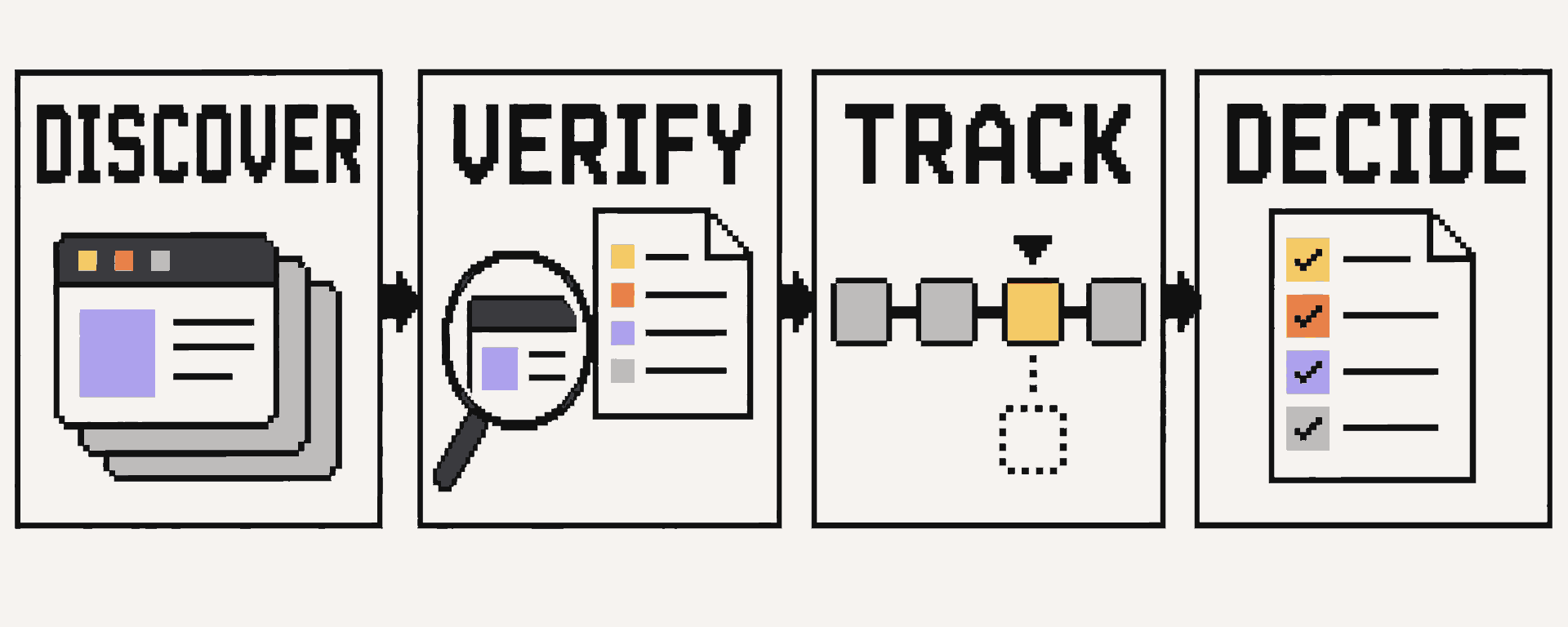
- Discover against the thesis. Search for the stage, sector, geography, founder profile, and signals your strategy calls for.
- Verify the company and claims. Match the legal entity and founders, then confirm material facts through the company, founder, filings, customers, references, and other primary evidence. Our due-diligence checklist can structure that work.
- Track the relationship and next step. Move a qualified lead into deal-flow management software with its source, owner, notes, open questions, and decision history. A research database is not your relationship record.
- Make an independent decision. Apply an evaluation lens such as Sandy Naidu’s five-part framework, review the actual offering and governing documents, and confirm whether an investment is available. Finding a company does not create access or allocation.
The human review belongs inside this process. In Democratizing Knowledge (Hustle Fund, 2021), p. 131, Yin advises, “Try to find other people who have been angel investing or even funds to at least look at companies with.” Other investors can challenge your reading of the evidence. They cannot remove the risk or make the decision for you.
The startup-company database is one layer in a broader venture-capital tool stack. Assign research, verification, relationship tracking, and decisions to the right system.
Frequently asked questions
Which database is best for startup funding and valuations?
PitchBook is the strongest starting demo here for teams that need financing terms, comparable transactions, cap tables, and pre- and post-money valuations. Dealroom is useful for market maps with disclosed and modeled values labeled separately. Crunchbase has funding history in Pro, while some confirmed and estimated post-money valuation data sits in a separate API package. No product has a reliable valuation for every private company.
Can a database find stealth or very new startups?
Sometimes. People and team signals can surface a company before a financing announcement, which makes Harmonic a relevant first demo. Coverage varies by market and source. Put known quiet or newly formed companies into the blind sample and measure recall rather than accepting a universal freshness claim.
How is a startup database different from a deal-flow CRM?
A startup database helps you find and research companies across a market. A customer relationship management system records your team’s introductions, messages, notes, next steps, memos, and decisions. Some products offer parts of both, but your team should still name one system of record for each job.
A researched list gives you possible companies. If you want to build judgment with frameworks, peers, and Hustle Fund-sourced curated opportunities, apply to Angel Squad. You choose whether to invest in any opportunity.
This material is for general education only and is not investment, legal, accounting, or tax advice. Startup investments are speculative, illiquid, long-term, and can result in total loss. Database records and modeled valuations can be incomplete or wrong. Review primary evidence and consult qualified independent legal and tax professionals before investing.















.png)