
K-1 Tax Form: What Private-Market and SPV Investors Need to Know
If you invest through a special purpose vehicle (SPV) or venture fund that is taxed as a partnership, the vehicle generally reports your share of its tax results on Schedule K-1 (Form 1065). That allocation can include income, gains, losses, deductions, and credits, and it may not match the cash you received.
This guide provides general information about U.S. federal taxes. It is not legal or tax advice, and neither Hustle Fund nor Angel Squad provides legal or tax review. Your entity, residence, investment terms, full K-1 package, and other circumstances can change the result. Ask qualified, independent tax and legal professionals to review the parts that depend on your situation.
Schedule K-1 in 60 seconds
Partnerships generally use Form 1065 to report federal tax information. Schedule K summarizes the partnership's totals. A separate Schedule K-1 shows each partner's share, goes to the IRS with the partnership return, and is furnished to that partner.
The practical points are:
- It is an allocation statement, not a payment receipt. The IRS partner instructions say a partner may owe tax on allocated partnership income whether or not the partnership distributed cash.
- The entity's federal tax classification controls. The words SPV, fund, or LLC do not guarantee a Form 1065 K-1.
- The face of the K-1 is not always the complete package. Codes, continuation statements, state schedules, and Schedule K-3 information can matter.
- A reported loss is not automatically a current deduction. Basis, at-risk, passive-activity, excess-business-loss, and other limits may apply.
- This guide focuses on Schedule K-1 (Form 1065). S corporations use Schedule K-1 (Form 1120-S), while trusts and estates use Schedule K-1 (Form 1041).
Use the 2025 partner instructions for a 2025 K-1. For another tax year, open that year's instructions; codes and rules can change.
Why SPV and fund investors receive a K-1
An SPV can turn what feels like a direct startup investment into a partnership interest for tax reporting.
You invest in the SPV or fund. The vehicle buys the startup's stock, Simple Agreement for Future Equity (SAFE), note, or other security. If the vehicle is taxed as a partnership, it generally files Form 1065 and reports each partner's allocated tax items on a K-1.
The underlying startup may still be a C corporation. The key is that you own an interest in the vehicle, while the vehicle owns the startup security.
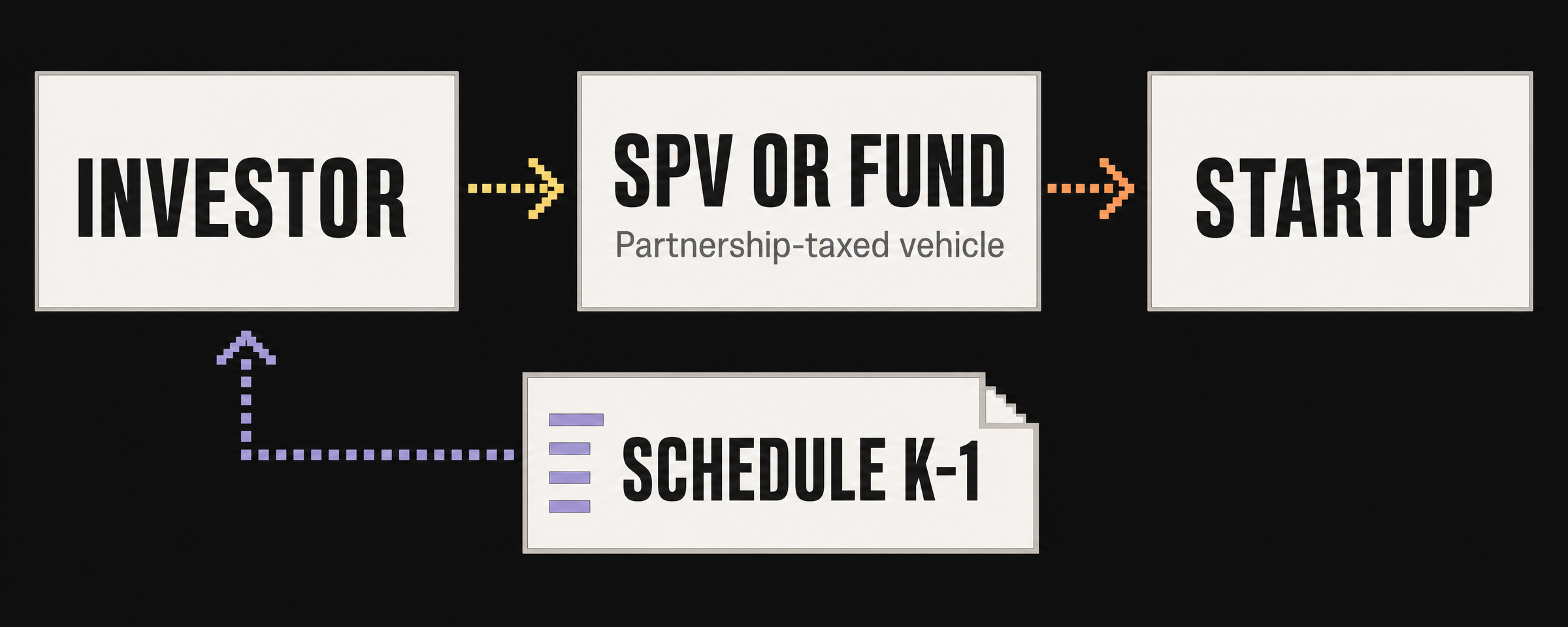
This distinction also explains why the startup may not be the name sending your tax package. The issuer on the K-1 is usually the partnership whose interest you own.
If the structure is new to you, our guide to investing through an SPV walks through the ownership and administration process. In our Angel Squad angel-investing community, eligible members can opt into startup investments deal by deal through AngelList-administered SPVs. Understanding the vehicle is part of understanding the investment.
Tax reporting is one output of the vehicle's economics. Our general partner Shiyan Koh uses a simple rule:
"Show me the incentives, and I'll show you the outcome."
Before you invest, understand the manager, fees, carry, decision rights, reporting duties, and distribution mechanics. Your K-1 arrives downstream of those choices.
Will every private investment generate a K-1?
No. Private status alone does not trigger a partnership K-1.
Here are the common patterns:
- Direct C-corporation stock: Usually not a Form 1065 K-1 relationship. Dividends or a broker-reported sale may produce a Form 1099 instead.
- A SAFE or note held directly: The instrument's terms and tax events matter, but holding it directly does not by itself make you a partner in a Form 1065 partnership.
- An interest in a partnership-taxed SPV or fund: This is the common private-market K-1 case. The vehicle reports your allocated share.
- An interest in an S corporation: That entity uses a different K-1, Schedule K-1 (Form 1120-S).
- A trust or estate interest: The beneficiary version is Schedule K-1 (Form 1041).
Even the LLC label is not decisive. The IRS classification guidance explains that a domestic LLC with at least two members generally defaults to partnership classification unless it elects corporate treatment. A single-member LLC is generally disregarded unless it elects corporate treatment. Confirm the legal investing entity and its tax classification instead of assuming from the product name.
K-1 versus 1099: different reporting jobs
A Form 1099 usually tells you what a payer or broker reported for a particular payment or transaction. A partnership K-1 tells you which slices of the partnership's tax results belong to you as an owner.
That difference shows up in three ways:
- Scope: A K-1 can report several kinds of income, gains, losses, deductions, credits, distributions, and supplemental information. Each 1099 type has a narrower reporting job, such as interest, dividends, or broker transactions.
- Cash: K-1 allocations can exist without a matching cash distribution. Do not define a 1099 as "cash only," either; reinvested or noncash reportable items can exist.
- Ownership: A K-1 can allocate partnership losses and credits, subject to partner-level limits. A 1099 does not allocate a partnership's operating results to an owner.
The same investment chain can involve both. An SPV might receive a 1099 from a bank, broker, or corporation, or receive another K-1 from a lower-tier partnership. It then incorporates the relevant tax items into the K-1 it issues to its own partners.
How a K-1 can affect your tax return
A K-1 keeps income, gains, losses, deductions, and credits separate because those items can follow different rules. The package may affect taxable income, outside basis, suspended losses, credits, and state or international reporting.
Cash and taxable income can diverge. In a simplified example, an SPV could allocate $2,000 of income to an investor and distribute only $500. The allocation may still affect the investor's taxable income; the distribution is a separate item and does not cap the allocation. A tax professional should apply the item's character and any partner-level limits.
What to read in the K-1 packet
Do not hunt for one number called "the K-1 total." The form preserves different tax categories because they can receive different treatment.
Parts I and II: who filed and who received it
Part I identifies the partnership, including its name and employer identification number (EIN).
Part II identifies the partner and the capacity in which the interest is held. It also includes ownership percentages, shares of liabilities, and a capital-account analysis.
Check the partnership name and EIN, your name and the identifying-number digits shown, your investing entity, the tax year, and whether the "Final K-1" or "Amended K-1" box is checked. The recipient copy may show only the last four digits of your identifying number. Also note any draft or preliminary label elsewhere in the package.
Part III: what the partnership allocated
For a typical private-market investor, Part III can be read in groups:
- Boxes 1-3: Ordinary business and rental income or loss.
- Box 4: Guaranteed payments for services or capital.
- Boxes 5-11: Interest, dividends, royalties, capital gains and losses, section 1231 items, and coded other income or loss.
- Boxes 12-15: Section 179, other deductions, self-employment information, and credits.
- Boxes 16-20: The Schedule K-3 indicator, alternative minimum tax items, tax-exempt income and nondeductible expenses, distributions, and other coded information.
- Box 21: Foreign taxes paid or accrued, reported solely for basis purposes. Schedules K-2 and K-3 provide the information needed to claim a foreign tax credit.
- Boxes 22-23: Flags showing that activity-level statements are attached for at-risk or passive-activity analysis.
Codes, asterisks, and "STMT" references point to attachments. If Box 16 is checked, Schedule K-3 is attached. If it is not checked, review any separate notice explaining whether or how to request K-3. State K-1s and withholding or credit statements may arrive in the same package.
Capital account is not outside basis
Item L shows a capital-account rollforward based on the partnership's records. The IRS explicitly says it cannot be used by itself to calculate your adjusted basis in the partnership interest, often called outside basis.
Outside basis can change with contributions, allocated income, liabilities, distributions, losses, and other items. The partner is responsible for tracking it.
This is also why a negative amount on a K-1 is not automatically deductible. The IRS partner instructions describe the main loss limits in this order: basis, at-risk, passive activity, and excess business loss. Specific item limits can apply too.
Ask a qualified tax professional to review a large loss, distribution, liability change, sale, or incomplete prior-year record.
When K-1s arrive and why they can be late
March 15 is common, but it is not a universal K-1 date.
The 2025 Form 1065 instructions say a domestic partnership generally files by the 15th day of the third month after its tax year ends. A calendar-year partnership is therefore generally due March 15, subject to weekends, holidays, and disaster relief. For tax year 2025, March 15, 2026 fell on a Sunday, so the calendar-year due date was March 16, 2026.
For a calendar-year 2025 partnership, a timely Form 7004 generally moved the Form 1065 filing deadline, and the deadline for furnishing K-1s, to September 15, 2026.
Fiscal-year partnerships follow their own year-end. If you use a calendar tax year, the IRS generally tells you to report a fiscal-year K-1 on the return for the calendar year in which the partnership year ends.
Private-market packages may take longer when the vehicle is waiting for a lower-tier partnership K-1, has multistate or international activity, or needs to resolve a transaction. That explains the delay; it does not change your own filing and payment obligations.
The partnership's Form 7004 does not extend your Form 1040 deadline. Individuals generally request a separate filing extension on Form 4868, but Form 4868 does not postpone payment of tax due.
What to do if a K-1 is late, missing, or wrong
Do not quietly guess or edit the form yourself.
- Confirm the partnership tax year. A fiscal-year K-1 can look late when it is not yet due.
- Ask whether the partnership extended. Contact the manager or administrator for the expected final date and any preliminary tax information.
- Raise your own deadline early. Ask an independent qualified tax professional about the applicable filing-extension and payment process before your deadline. An extension to file does not extend time to pay.
- Label estimates as estimates. Preliminary information can change and is not a final K-1.
- Request a correction when something is wrong. The IRS partner instructions say to notify the partnership, ask for a corrected K-1, avoid changing the copy yourself, and make sure the partnership sends the correction to the IRS.
If a K-1 remains missing at your filing deadline, or you believe your return must treat an item differently from the partnership, Form 8082 may be required. A partnership subject to the centralized partnership audit regime generally corrects partnership-related items through an administrative adjustment request rather than an amended Form 1065 or amended K-1. Ask a qualified tax professional how any resulting adjustment applies to you.
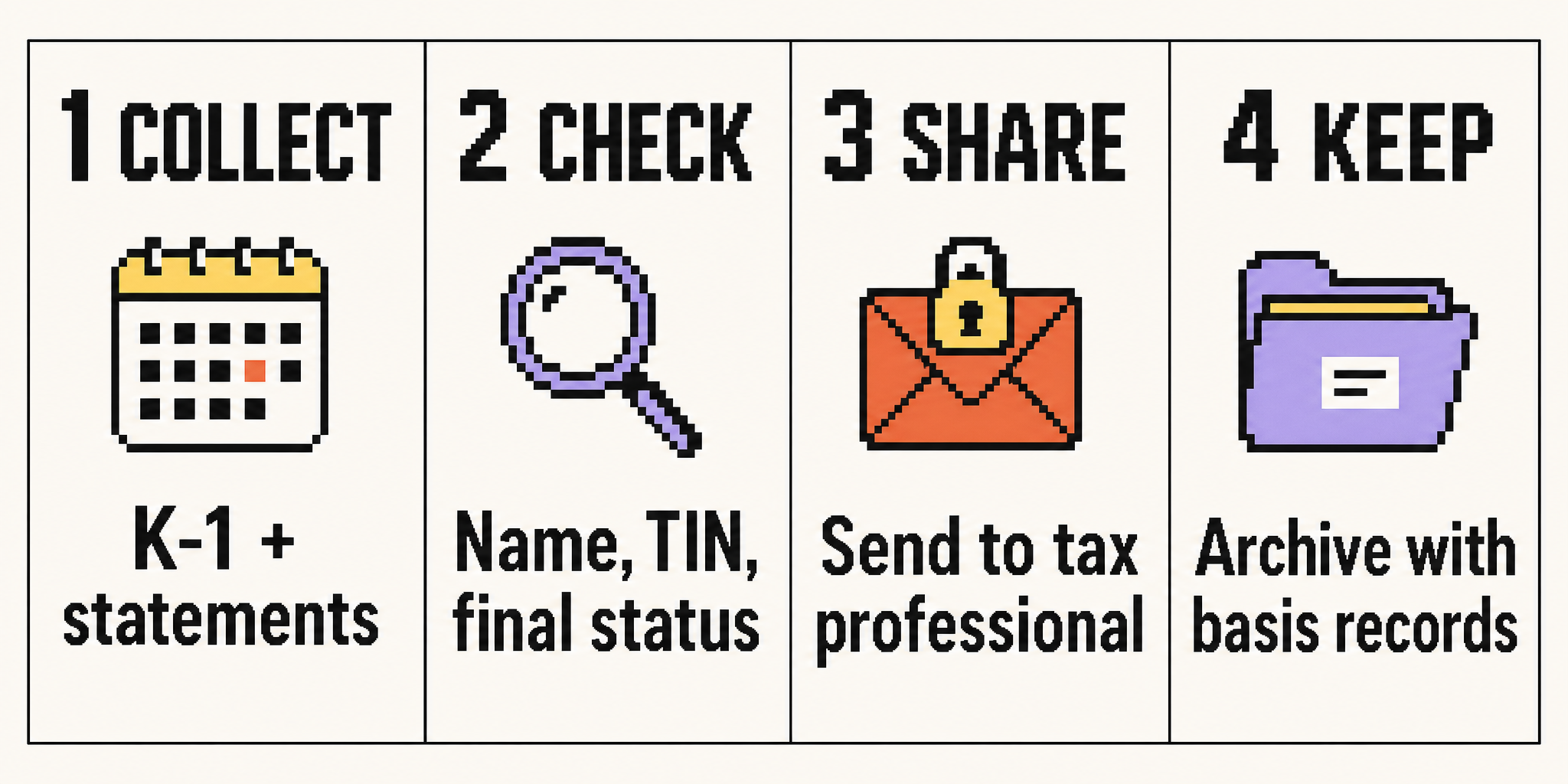
Use a collect, check, share, keep workflow
The easiest way to make K-1 season harder is to treat each PDF as an isolated annual event. Build a record by investing entity and vehicle instead.
1. Collect the full package
Download the K-1, every continuation statement, any state schedules, the K-3 or related notice, and any withholding, estimated-payment, composite-return, or pass-through entity tax credit statements.
Also retain subscription documents, capital call notices, contribution confirmations, distribution notices, and exit documents.
2. Check identity and status
Repeat the identity, tax-year, and final-or-amended checks above. Then review the ownership information against your records.
Reconcile contributions and distributions with your records, but do not force them to equal taxable income. They measure different things.
3. Share the whole packet
Send the complete package and prior-year basis or suspended-loss records to an independent qualified tax professional who understands partnership and private-fund reporting. A K-1 without its statements can omit the detail needed to interpret coded items.
4. Keep the history
Archive the final and corrected packages with your outside-basis workpapers, suspended-loss schedules, contributions, distributions, liabilities, and sale or liquidation records. A later exit can depend on years of history.
In our Angel Squad community, members learn private-market mechanics and review opportunities with peers. That context can help you ask better questions about a vehicle, but it does not replace independent tax or legal advice.
Our co-founder Elizabeth Yin puts the portfolio-selection discipline this way:
"Every company looks great in isolation, but if you have 100 companies, who are the 5-10 you're going to pick?"
That is an investment-selection question, not a K-1 question. Complete tax records help you manage positions you already own; they do not make the next illiquid private investment suitable.
When the packet needs specialized review
Bring in specialized independent guidance when the package includes any of the following:
- Multiple states: State-source income, nonresident withholding or estimates, composite or group returns, pass-through entity tax credits, and local taxes vary by jurisdiction. A federal K-1 does not resolve them.
- Schedule K-3 or international statements: Foreign-source income, foreign taxes, controlled foreign corporation or passive foreign investment company data, and foreign-partner rules can trigger additional analysis.
- A retirement or other tax-exempt account: Box 20 can include information relevant to unrelated business taxable income. Do not assume the account can ignore the K-1.
- Losses or basis questions: Large losses, liability changes, distributions, missing history, or prior suspended amounts can affect what is usable and when.
- A sale, liquidation, or corrected package: Cumulative basis, prior losses, ordinary-income recharacterization, and partnership-audit rules may matter.
A K-1 is one input to your return. You still need the attached statements, your basis history, and the rules that apply to your circumstances.
Tax paperwork is part of the investment, not the thesis
The annual K-1 records part of the structure you bought into. It does not tell you whether the underlying deal was a good investment. Revisit your investment risk tolerance before adding another vehicle and another annual tax package.
If you want to learn the full private-market process with peers and evaluate optional deal-by-deal opportunities from Hustle Fund, apply to Angel Squad. Bring an independent qualified tax professional into the parts of that process that depend on your personal tax facts.














.png)