
Rule 144: A Startup Investor’s Guide to Restricted Shares
An early startup check can become public-company stock. That does not mean you can sell it on the day a ticker appears.
Rule 144 sits between private issuance and public resale. To understand whether it applies, you need to classify the security, the seller, the issuer, and the transaction. The hard part is knowing which conditions attach to your specific shares and which separate restrictions can still stop a sale.
This is general educational information, not legal, tax, or investment advice. Engage independent securities counsel and qualified tax professionals to review your shares, documents, proposed sale, and tax consequences.
What Rule 144 actually does
The Securities Act generally requires a public securities sale to be registered unless an exemption applies. Section 4(a)(1) exempts transactions by a person other than an issuer, underwriter, or dealer. That raises an awkward question for someone who received stock in a private transaction: could the seller be treated as an underwriter participating in a distribution?
Rule 144 supplies an objective safe harbor. A seller who meets its applicable conditions is deemed not to be engaged in a distribution and therefore not to be an underwriter for that transaction. The sale can then rely on Section 4(a)(1).
That legal structure matters. Rule 144 does not register the shares, guarantee a buyer, set a fair price, or override a contract. It is also nonexclusive, so counsel may analyze another exemption when the safe harbor is unavailable. The current federal rule contains the controlling conditions.
Rule 144 deals with two categories:
- Restricted securities generally come from the issuer or an affiliate in an unregistered transaction. A seed investor who buys preferred stock in a private placement will usually receive restricted securities. So can an investor who buys shares from a founder or other affiliate.
- Control securities are securities held by an affiliate of the issuer. They may have been acquired in the public market and may never have carried a restrictive legend. Their status follows the seller’s control relationship.
One lot can be both restricted and a control security. That is why starting with “How long have I held this?” can produce the wrong answer.
“Going back to first principles is super important since the market always changes and evolves.”
Elizabeth Yin, Democratizing Knowledge (Hustle Fund, 2021)
Answer three questions before counting months
The common five-condition summary is useful only after you know which branch of Rule 144 you are on.
1. Are the securities restricted?
Stock bought directly from a startup in a private round usually is. So are many securities issued under Regulation D, issued as compensation, or purchased from an affiliate.
Your record should identify the legal issuer, security, acquisition transaction, payment date, conversion history, transfers, and current registered holder. If you invested through a special purpose vehicle, you probably own an interest in the vehicle while the vehicle owns the startup security. Do not apply the portfolio company’s Rule 144 clock directly to your SPV interest.
2. Are you an affiliate now, or were you one during the prior three months?
An affiliate directly or indirectly controls, is controlled by, or is under common control with the issuer. Directors, executive officers, founders, and controlling shareholders are common examples.
There is no universal ownership percentage that automatically answers the Rule 144 affiliate question. A 10% threshold appears in other securities-law contexts and on Form 144 examples, but Rule 144 uses a facts-and-circumstances control test. Board rights, voting arrangements, contracts, ownership concentration, and actual influence can all matter.
For the nonaffiliate path, the seller must be unaffiliated at the sale and must not have been an affiliate during the preceding three months.
3. Has the issuer been an Exchange Act reporting company for at least 90 days?
The shorter holding period applies only when the issuer is, and has been for at least 90 days before the sale, subject to the reporting requirements of Section 13 or 15(d) of the Securities Exchange Act.
“Reporting company” and “company with a familiar name” are not synonyms. A private company can have reporting obligations, and a newly public company does not satisfy Rule 144’s 90-day reporting-history test on its first trading day.
Choose one seller branch in the map. Conditions apply only when Rule 144 makes them relevant to that security and sale.
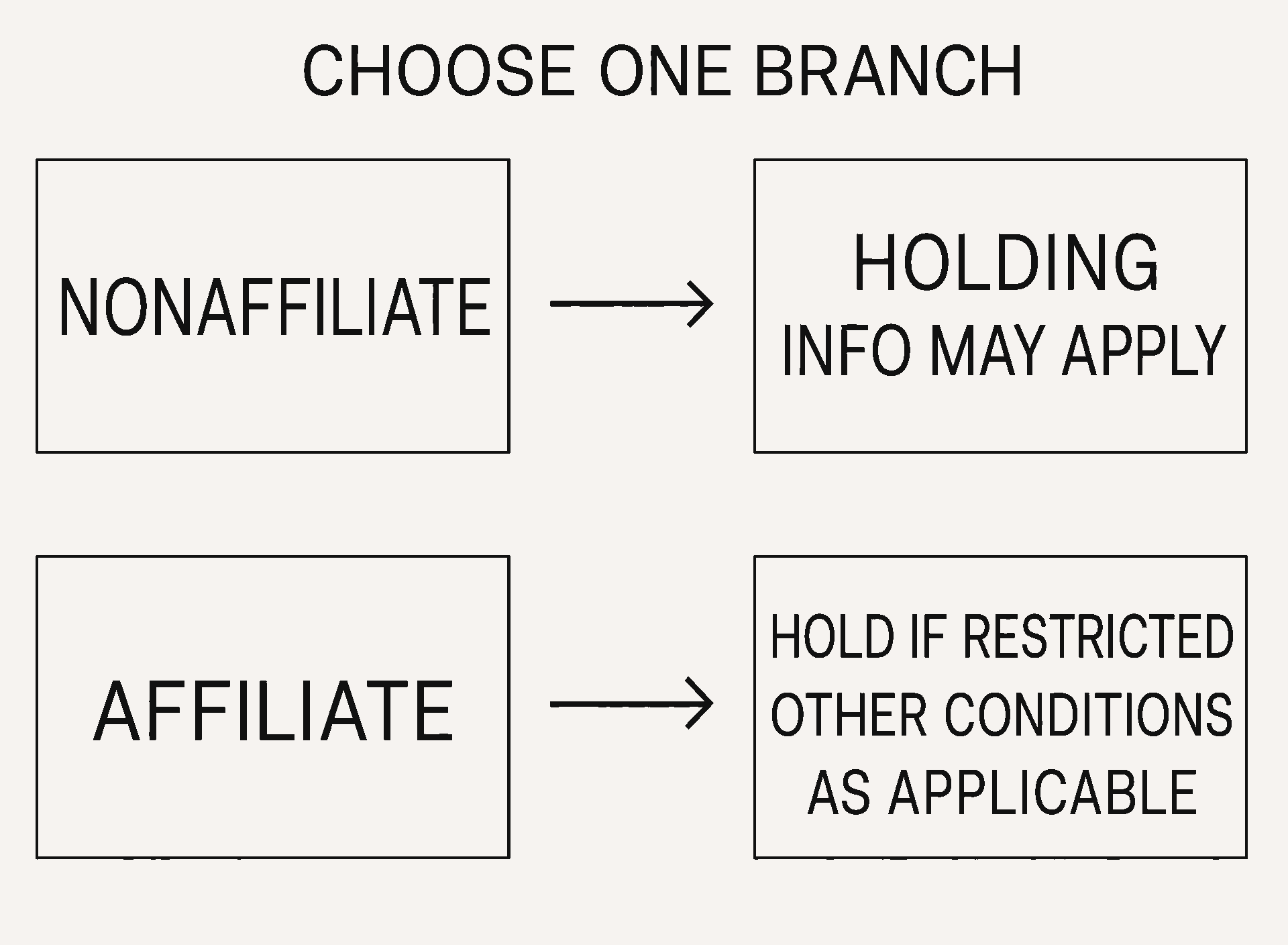
Which Rule 144 requirements apply to you?
The answer changes with seller status, security status, and issuer reporting status.
Nonaffiliate selling restricted securities of a reporting issuer
- Before six months: The Rule 144 safe harbor is unavailable.
- From six months until one year has elapsed: The holding-period and current-public-information conditions apply.
- Once one year has elapsed: A seller who is not an affiliate and has not been one during the prior three months can sell under Rule 144 without its other conditions.
The issuer must have been subject to Exchange Act reporting for at least 90 days before the sale to use this reporting-issuer path.
Nonaffiliate selling restricted securities of a nonreporting issuer
The minimum holding period is one year. Once that period has elapsed, a qualifying nonaffiliate can use the safe harbor without Rule 144’s current-information, volume, manner-of-sale, or notice conditions.
That does not create a market for private shares. Company consent rights, a right of first refusal, transfer restrictions, buyer eligibility, and the mechanics of the chosen resale exemption can still determine whether a private-company transaction closes.
Affiliate selling restricted or control securities
An affiliate must satisfy all applicable Rule 144 conditions:
- the holding period, if the securities are restricted;
- adequate current public information;
- the volume limit;
- the manner-of-sale rules for equity securities; and
- Form 144 when the notice threshold is exceeded.
An affiliate who bought ordinary shares in the public market has no Rule 144 holding period for that lot because it is not restricted. The other affiliate conditions still apply when the shares are sold as control securities.
Rule 144 also has a separate limitation for shell companies and former shell companies. Treat any shell-company history as a mandatory counsel issue rather than applying the ordinary timeline above.
How the five Rule 144 conditions work
1. Holding period
Restricted securities generally require:
- six months for an issuer that has met the 90-day Exchange Act reporting test; or
- one year for a nonreporting issuer.
The clock starts when the securities were acquired from the issuer or an affiliate and fully paid for. The “fully paid” point can complicate purchases involving promissory notes or installments.
Some transactions let a later holder add, or “tack,” an earlier holding period. The details are exacting:
- Shares received solely in exchange for another security of the same issuer may carry over the earlier acquisition date.
- A cashless exercise of an investment warrant may permit tacking in circumstances described by the rule.
- An employee option generally starts its holding period when exercised, since an unexercised compensatory option usually creates no investment risk for the employee.
- A gift from an affiliate generally carries the donor’s acquisition date, with separate aggregation rules for sales.
- A purchase from an affiliate generally starts a new period when the buyer acquires and pays for the shares.
This is where Simple Agreements for Future Equity (SAFEs), convertible notes, warrants, reorganizations, gifts, and secondary transfers deserve lot-by-lot legal analysis. “I invested two years ago” is not enough. The instrument, conversion terms, issuer identity, additional consideration, and chain of ownership determine the date.
2. Current public information
For a reporting issuer, adequate current information generally requires at least 90 days of reporting status, all required Exchange Act reports during the prior 12 months or shorter reporting period, and required interactive data submissions. Form 8-K is excluded from the specific all-reports test in Rule 144(c)(1), though other legal and market issues can still arise from a missing filing.
For a nonreporting issuer, the rule points to a defined set of publicly available business, management, financial, and ownership information. Affiliates need this condition. A qualifying nonaffiliate who has completed the one-year period does not.
3. Volume limit
For an affiliate selling equity, the amount sold during any three-month period generally cannot exceed the greatest applicable measure under the rule. For a typical exchange-traded stock, the practical comparison is:
- 1% of the outstanding shares of the class; or
- average weekly reported trading volume during the preceding four calendar weeks.
Suppose the company has 20 million common shares outstanding and average weekly reported volume of 350,000 shares. One percent is 200,000 shares, so the trading-volume measure would set a 350,000-share ceiling for the three-month period, before considering aggregation and the other conditions.
The three months roll. It is not a calendar-quarter reset. Sales by certain related people, entities, donees, trusts, pledgees, or people acting together may need to be combined.
4. Manner of sale
An affiliate’s equity sale generally must use a permitted broker’s transaction, a transaction directly with a market maker, or a qualifying riskless principal transaction. The seller cannot solicit buy orders in connection with the sale or pay anyone other than the executing broker or dealer. The broker also has commission, solicitation, and reasonable-inquiry duties.
This condition does not apply to debt securities. It also does not apply to the nonaffiliate paths described above.
5. Form 144
An affiliate must file Form 144 when the amount proposed to be sold under Rule 144 during any three-month period exceeds 5,000 shares or other units, or has an aggregate sale price above $50,000.
For a reporting issuer, the filing is electronic through EDGAR. For a nonreporting issuer, the current rule retains paper filing. The notice is transmitted concurrently with placing the order with a broker or executing the sale directly with a market maker. Filing is notice to the Securities and Exchange Commission (SEC), not SEC approval of the sale.
The current Form 144 asks for the seller’s relationship to the issuer, the proposed sale, acquisition and payment history, and sales during the preceding three months. It also asks for the adoption or instruction date when a seller relies on Rule 10b5-1.
A practical Rule 144 workflow for startup shares
Consider an investor who signed a SAFE, received preferred stock when it converted, later received common stock in an IPO conversion, and now wants to sell.
The elapsed time since the SAFE wire tells only part of the story. A defensible workflow is:
- Map the chain of ownership. Identify who owns the sale security today, including any SPV, trust, transfer, gift, or distribution.
- Build a lot history. Record every acquisition, payment, conversion, exchange, split, and transfer with the supporting agreements and cap-table statements.
- Resolve affiliate status. Have securities counsel analyze present and recent control relationships. Do not substitute a percentage shortcut.
- Classify the issuer. Establish whether the issuer meets the 90-day reporting test and whether it has current public information.
- Calculate the holding period. Counsel should apply the payment and tacking rules to each lot. A SAFE or note conversion may qualify for tacking when the new security was received solely in exchange for a security of the same issuer, but the documents control.
- Layer in separate restrictions. Review the IPO lockup, right of first refusal, company transfer policy, investor-rights agreement, blackout policy, and any contractual consent requirement. Rule 144 does not cancel them.
- Plan the sale. If the seller is an affiliate, calculate aggregated three-month volume, use a permitted sale method, and prepare Form 144 when required.
- Clear the operational restriction. The issuer, its counsel, the transfer agent, and the broker coordinate the legal opinion, restricted-position release, and trade. The SEC’s legend guidance explains why satisfying Rule 144 does not automatically remove a restrictive legend.
Material nonpublic information, insider-trading rules, Section 16 obligations, taxes, and company trading windows sit outside Rule 144. They can still affect whether, when, and how an investor sells.
Members of Angel Squad, our angel-investing community, learn to separate these legal mechanics from the investment decision and compare notes with other investors before bringing transaction-specific questions to their own advisers.
Rule 144 eligibility is not a sell recommendation
A sale can fit Rule 144 and still be a poor portfolio decision. A compliant path does not tell you whether the available price reflects an illiquidity discount, whether the company’s outlook has changed, how the sale affects concentration, or what taxes it may trigger.
“Decisions are never in isolation - they are a comparison game.”
Elizabeth Yin, Democratizing Knowledge (Hustle Fund, 2021)
Compare the proposed sale with the choices actually available. That may include holding through a lockup, selling part of a position, accepting a private secondary bid, or doing nothing. Our guide to why startups stay private longer explains why a paper valuation and an executable exit can remain far apart.
Rule 144 FAQ
What is the difference between Rule 144 and Rule 144A?
Rule 144 is a safe harbor used by holders reselling restricted or control securities into the public market. Rule 144A is a different safe harbor for certain resales to qualified institutional buyers. The shared number causes confusion, but the eligible buyers, transaction structure, information requirements, and market are different.
How often can an affiliate sell under Rule 144?
Rule 144 does not impose a fixed number of sales. The affiliate must keep all covered sales within the applicable rolling three-month volume limit, aggregate the sales the rule requires, comply with the sale-method rules, and file Form 144 when the threshold is exceeded. Several trades do not create several fresh limits.
Does Rule 144 make private-company shares liquid?
No. Rule 144 can supply a federal resale safe harbor, but it does not produce a willing buyer, a trading venue, company consent, or an acceptable price. Private-company transfers can also face contractual restrictions and operational requirements. Many startup investors receive their first practical public liquidity only after an IPO, the end of a contractual lockup, legal clearance, and a transfer-agent process.
Treat Rule 144 as a process, not a date
The safest mental model is a sequence: classify the security, determine affiliate status, classify the issuer, calculate the lot-level holding period, apply the remaining conditions, clear separate restrictions, and coordinate the sale.
If you want to build that kind of disciplined investing process alongside experienced operators and investors, apply to Angel Squad.















.png)