
AI Market Map 2026: Startup Stack for Investors
Brian Nichols is the co-founder of Angel Squad, an angel investing community where aspiring and active angels learn from Hustle Fund’s approach, review curated deal flow, and connect with peers.
AI startups can look similar from a pitch deck while occupying very different parts of the commercial stack. One may sell model access. Another may package the same model inside a regulated workflow, with different buyers, costs, risks, and defenses.
This AI market map shows that stack as of September 27, 2026. It is representative and non-exhaustive. Placement is not a ranking, endorsement, partnership, or investment recommendation.
How to read this AI market map
This page is the broad-stack hub for model access, infrastructure, controls, software, and physical systems. The map covers independent commercial companies and the AI-native products or infrastructure they sell to external customers.
AI must be central to the paid product, and public product material must support the placement. Research labs, internal corporate teams, open-source projects without a commercial company, acquired products, and public-incumbent suites sit outside the boundary.
We give each featured company one primary placement based on the main paid role of its commercial product. Many companies and products span several layers. A model provider may also sell agents, for example, but belongs in the model layer when model access remains its main commercial role.
Our eight categories are an editorial taxonomy, built to inspect dependencies and economics. No industry standard cleanly captures the commercial stack.
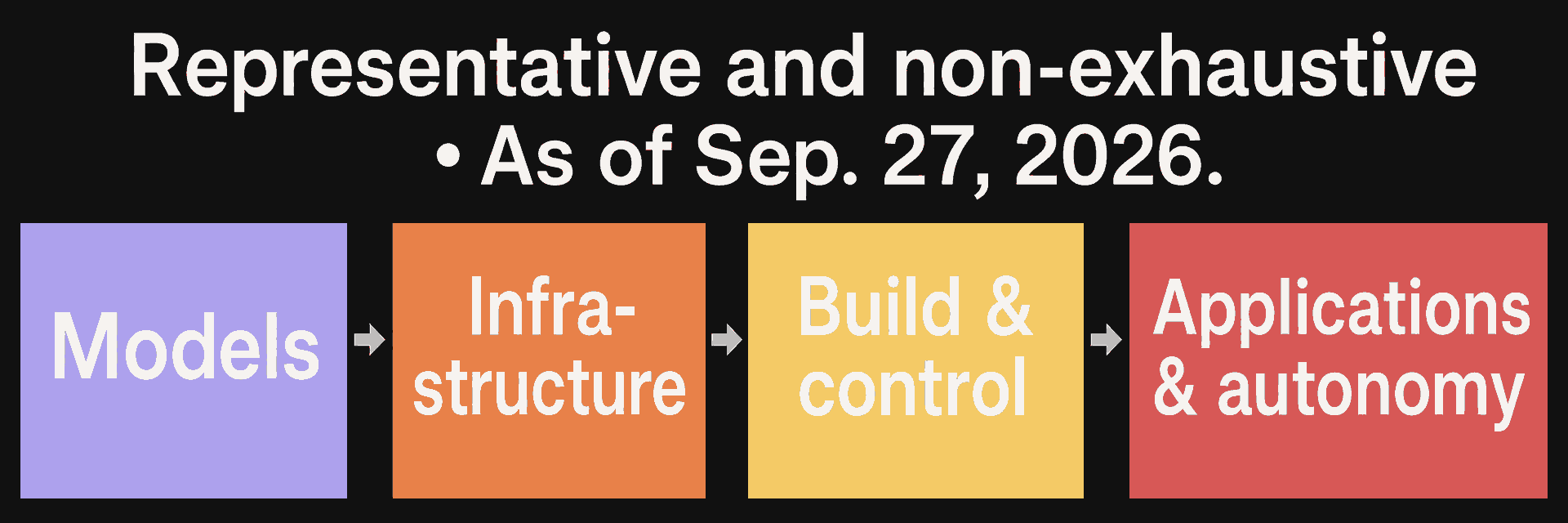
The broad AI startup ecosystem moves through four commercial stages: Models → Infrastructure → Build & control → Applications & autonomy. The stages depend on one another, and one vendor can sell across several of them. The arrows are a teaching sequence. They do not claim that every company operates in each stage or that value and revenue flow through the stack in a straight line.
The eight layers of the AI startup stack
1. Foundation-model access
These companies sell general-purpose model capabilities through application programming interfaces (APIs), enterprise contracts, or deployable model families. Product and engineering teams buy the ability to generate, reason, code, search, or work across several data types.
Anthropic belongs here because Claude model access is central to its offer. The investor question is whether model quality, reliability, distribution, or deployment choice can support durable pricing as buyers gain more substitutes.
2. Compute, training, and inference
This layer supplies or improves the capacity required to train, tune, route, deploy, and run models. Inference means running a trained model to produce an output. Buyers care about latency, throughput, uptime, and cost per useful result.
Together AI sells inference, fine-tuning, and graphics processing unit (GPU) capacity. Baseten focuses on production model deployment and runtime performance. Their economics can depend on hardware supply, cloud commitments, utilization, and continued price-performance gains.
3. Data, retrieval, and knowledge preparation
Models need relevant, permitted, and well-prepared context. This layer helps companies transform documents, retrieve the right information, and connect customer data to AI systems.
Pinecone sells vector search infrastructure for retrieval and agent applications. Unstructured turns documents into data that retrieval systems can use. A useful diligence question is whether the product becomes part of a customer’s durable data foundation or remains a replaceable preparation step.
4. Agent development, evaluation, and operations
Developers use this layer to build, trace, test, evaluate, and monitor AI applications. The customer buys tools to create and operate a system, not a finished business workflow.
LangChain’s LangGraph provides a framework for stateful agent applications. Arize sells tracing, evaluation, and observability for AI systems. Our focused AI agents market map goes deeper into orchestration, tools, memory, and agent-specific control layers.
5. AI security and controls
AI systems create attack surfaces that traditional software controls may miss, including poisoned data, prompt injection, excessive tool permissions, and sensitive-output leakage. The NIST attack taxonomy from the National Institute of Standards and Technology describes these adversarial machine learning classes without claiming how often each occurs.
HiddenLayer sells protection and threat detection for AI models. The primary buyer is usually a security, risk, or governance team. Investors should separate AI-specific protection from features that an existing cloud, security, or model platform could bundle.
6. Enterprise knowledge and horizontal workflow agents
These applications work across industries. Some find and synthesize internal knowledge. Others execute customer support, sales, coding, research, or operations tasks across several systems.
Glean spans enterprise search, knowledge, and agents. Decagon builds conversational agents for customer experience. The commercial test is completed work: how often the product resolves the task, when a human steps in, and what the full workflow costs after exceptions and integration.
The voice AI stack deserves separate treatment because real-time audio, telephony, latency, and conversation quality create another set of technical and operating constraints.
7. Regulated and domain-specific AI
Vertical products are built around a field’s data, rules, vocabulary, and established workflow. Domain depth can create an advantage, while privacy requirements, long sales cycles, human review, and implementation work can raise the cost to serve.
Abridge applies AI to clinical documentation and related healthcare workflows. Harvey builds legal work products around professional knowledge and documents. These companies face different evidence, permission, integration, and liability demands even when they use similar underlying models.
8. Physical AI and autonomy
Physical AI connects models and software to machines operating in the real world. The investment case reaches beyond software performance into safety, hardware, manufacturing, field service, insurance, and customer payback.
Waabi develops autonomous trucking technology. A strong simulation or demo result is only one input. Investors also need evidence of repeatable field performance, long-tail reliability, human oversight, and deployment economics.
Where value can accrue, and where it can leak away
AI startups capture value through several recurring business models. The headline pricing unit rarely tells you enough about the underlying economics.
- Model and API consumption. Customers pay for tokens, requests, or committed capacity. Gross margin depends on inference cost, support, discounts, and the company’s ability to keep customers as model options multiply.
- Managed infrastructure. Customers pay for GPU time, throughput, deployment, or reserved capacity. Utilization matters because unused capacity and supplier commitments can turn rapid growth into expensive growth.
- Data and developer platforms. Pricing may combine seats, queries, storage, traces, or evaluations. The product needs to become operationally important before a cloud, model provider, or application suite includes a similar feature.
- Workflow software. Customers may pay per seat, task, workflow, or outcome. Measure the complete result after model calls, human review, failed attempts, support, and implementation.
- Vertical and physical systems. Software revenue can arrive beside integration, services, hardware, maintenance, or financing. Those elements may strengthen customer relationships while lowering margin and slowing deployment.
The OECD’s analysis of AI markets identifies data, compute, and skills as bottlenecks and flags vertical integration, lock-in, and partnership concentration as market-structure risks. Supplier dependence and bundling belong in the business model.
Our co-founder and general partner Elizabeth Yin wrote in Democratizing Knowledge (Hustle Fund, 2021, p. 288), “Going back to first principles is super important since the market always changes and evolves.” In this market, first principles means tracing who pays, what result they buy, every direct cost required to deliver it, and what keeps the customer from switching.
An investor diligence framework for AI startups
Market maps help you form questions. They cannot answer them. As Elizabeth wrote in Democratizing Knowledge (Hustle Fund, 2021, p. 131), “The more disciplined you are in your thought process…”
Use the same core questions across layers, then add technical and domain checks for the company in front of you. Our AI-assisted investment review can help organize evidence, while people remain responsible for the investment judgment.
- Customer and workflow: Who owns the budget? What job does the product complete from start to finish, and what does the customer use today?
- Evidence of value: What baseline and realized result show time saved, cost reduced, revenue gained, quality improved, or risk lowered? Ask what happens on representative work, including exceptions.
- Model and compute dependence: Which models, clouds, and chips matter? What happens if a supplier changes price, access, policy, quality, or distribution?
- Data rights: Who owns the training, retrieval, and evaluation data? What permissions, deletion rights, licenses, and customer restrictions apply?
- Evaluation and reliability: Which task-specific test set, failure categories, monitoring, and rollback process does the team use? Can results survive new customer data and model changes?
- Security and privacy: How does the system handle identity, tool permissions, tenant separation, retention, prompt injection, logs, and incidents? The NIST AI framework offers a neutral structure for discussing risk management.
- Unit economics: What revenue remains after model calls, compute, data licenses, human review, support, services, and hardware? Which usage pattern produces a profitable customer?
- Distribution and integration: Which system of record, channel, or hardware partner controls the workflow? How much implementation and customer change management does each deployment require?
- Competition and bundling: What does a customer lose by choosing an incumbent suite or a cheaper model-plus-services approach? Name the defensible asset: product, data, distribution, clearance, workflow ownership, or cost advantage.
- Regulatory and physical exposure: Which sector rules, contracts, intellectual-property rights, cross-border data rules, safety cases, certifications, or procurement steps apply? The European Union (EU), for example, uses a risk-based AI framework. Physical systems also need evidence on uptime, manufacturing, field service, and safe operation.
Elizabeth’s pitch questions add useful prompts on competitors, partners, customer conversations, and founder motivation.
What this map cannot tell you
A category placement proves only that a company has a public product fitting our rule. It does not prove adoption, retention, revenue quality, technical performance, defensibility, regulatory readiness, or investment fit.
Early-stage investments are speculative, illiquid, and long term. Many startups fail, and an investor can lose the full investment. Thoughtful investors can inspect the same evidence and reach different conclusions, especially while AI capabilities, prices, and distribution keep changing.
Turn a market map into better investing reps
If you want to apply this framework to early-stage companies and compare your reasoning with other investors, apply to Angel Squad.
This material is for educational purposes only. It is not investment, legal, tax, or technical advice. Seek qualified independent advisers for decisions that require those forms of review.













.png)