
New QSBS Rules: What Startup Investors Need to Know
A startup exit can produce a great headline and a complicated tax bill. Qualified small business stock, or QSBS, may let an eligible investor exclude federal gain from a qualifying stock sale. A July 2025 law expanded that benefit for newer shares.
The challenge is matching each stock lot to the right rules and proving the company, shares, and shareholder qualify.
This is general education, not legal or tax advice. Engage qualified legal and tax professionals for independent advice on an investment, sale, rollover, or tax return.
New QSBS rules at a glance
The One Big Beautiful Bill Act became law on July 4, 2025. Section 70431 amended Internal Revenue Code Section 1202 in three main ways:
- Holding-period tiers use the acquisition date. Stock acquired after July 4, 2025 can receive a 50% exclusion at three years, 75% at four years, and 100% at five years. Stock acquired after September 27, 2010 and on or before July 4, 2025 still requires more than five years for a 100% exclusion.
- The per-issuer dollar limit uses the acquisition date. Post-cutoff stock uses a $15 million limit, while stock acquired on or before the cutoff uses $10 million. Each is an alternative to the 10-times-basis limit.
- The company asset test uses the issuance date. Stock issued after July 4, 2025 uses a $75 million aggregate-gross-assets ceiling. Stock issued on or before that date uses $50 million.
- The changes are not retroactive. Selling an older lot after July 4, 2025 does not give it the new three-year or four-year tiers, the $15 million limit, or the $75 million issuance test. Carryover holding-period rules also prevent certain exchanges and transfers from relabeling older stock as post-cutoff stock.
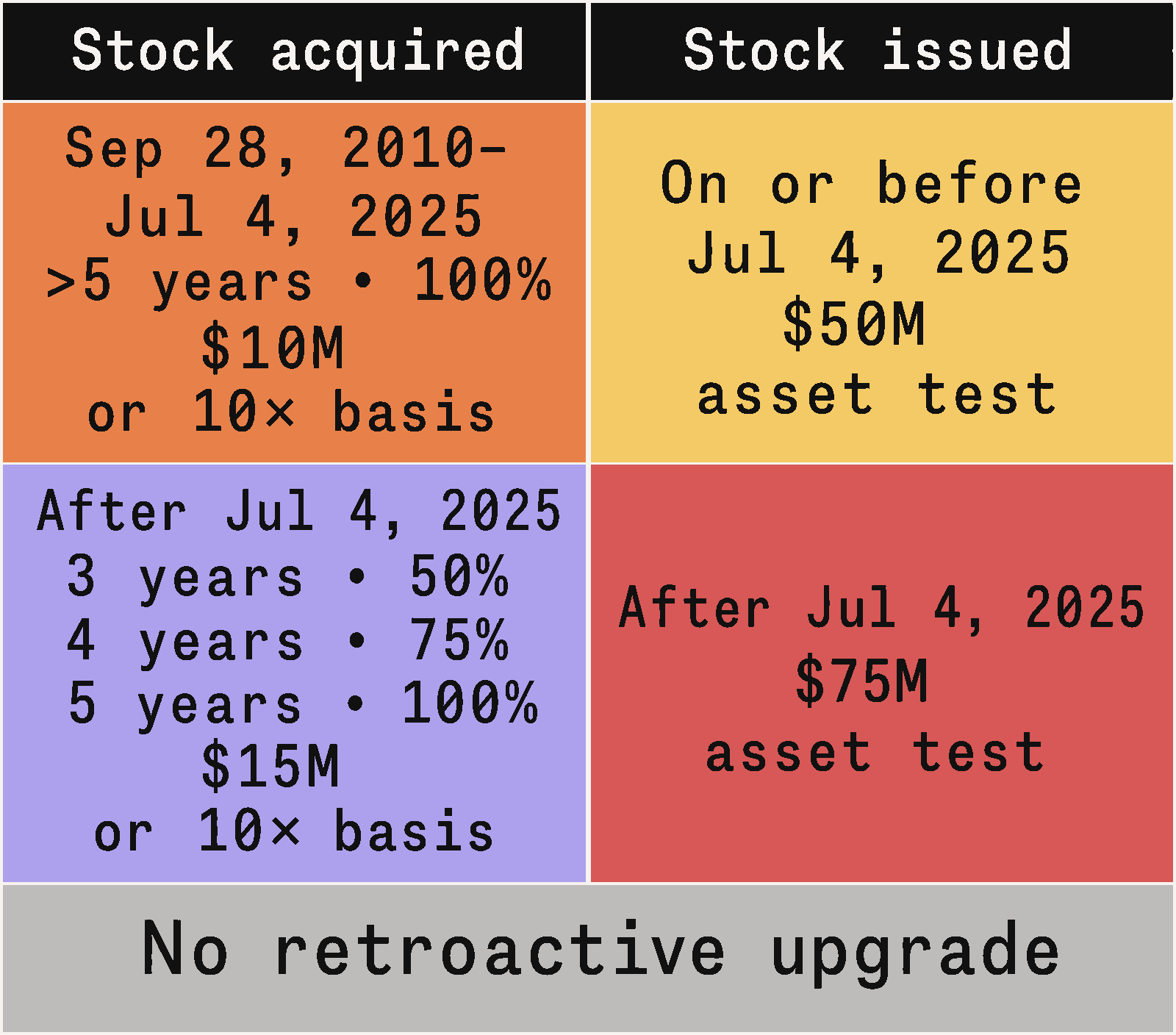
The distinction between acquired and issued matters. In a direct primary investment, both events usually happen together. Gifts, reorganizations, Simple Agreements for Future Equity (SAFEs), and pass-through vehicles can produce different dates. The 2025 statutory text sets out the amendments and effective dates.
The new holding-period tiers
New QSBS uses a graduated schedule:
- At least three years and under four years: 50% of eligible gain can be excluded.
- At least four years and under five years: 75% can be excluded.
- At least five years: 100% can be excluded.
For gain within Section 1202's per-issuer limit, the unexcluded portion at years three and four falls in the federal 28% rate category. Gain above the per-issuer limit is a separate calculation. The 3.8% net investment income tax may also apply, depending on the taxpayer. The current tax code defines the percentage-limited Section 1202 portion as 28% rate gain.
Consider an investor who acquires qualifying stock for $100,000 on July 10, 2025 and later realizes a $4 million gain. If the sale occurs after four years and every other requirement is met, 75%, or $3 million, can be excluded for federal purposes. The remaining $1 million is taxable. After five years, the full $4 million could fall within the 100% exclusion.
The 2025 law preserved the existing AMT treatment
Post-September 27, 2010 excluded QSBS gain was already outside the alternative minimum tax (AMT) preference. The 2025 law did not create that treatment. It preserved it for the new 50%, 75%, and 100% tiers.
The amended Section 57(a)(7) now applies the 7% AMT preference only to excluded gain from stock acquired on or before September 27, 2010. The amendment's effective-date note treats that change as if it had been included in the 2010 law.
Section 1202 governs federal income tax. States may follow different conformity rules, so a 100% federal exclusion does not promise zero state tax. The structure of the exit can also change the result.
How the $15 million per-issuer limit works
Section 1202(b) first limits the eligible gain taken into account from one issuer, then applies the relevant 50%, 75%, or 100% exclusion percentage.
For post-cutoff stock, the dollar arm for a sale year begins with $15 million, adjusted for inflation for tax years beginning after 2026. It is then reduced by both:
- Cumulative eligible gain from all prior taxable years for the same issuer that the taxpayer took into account under Section 1202, across stock acquired before, on, or after the cutoff.
- Current-year eligible gain from pre-cutoff stock of that issuer that the taxpayer takes into account under Section 1202.
The reduction uses eligible gain, which may be larger than the amount actually excluded under a 50% or 75% tier. A married person filing separately uses half the applicable dollar amount.
A separate rule can eliminate the dollar arm for later years. If eligible gain from post-cutoff stock exceeds that year's applicable dollar limit, the applicable dollar limit is zero for every subsequent taxable year. Later inflation adjustments do not restore it. The rule can take effect even when the 10-times-basis arm allows more gain to qualify in the year that triggers it.
The other arm remains 10 times the aggregate adjusted bases of that issuer's QSBS disposed of by the taxpayer during that tax year. It is tied to basis sold in the year, not a lifetime basis pool. Basis additions after the original issuance are disregarded for this calculation.
Assume an investor sells post-cutoff stock after five years in a tax year beginning after 2026. Call the applicable inflation-adjusted dollar limit for that sale year, after the required reductions, L. If the investor disposes of QSBS with $2 million of aggregate adjusted basis, the 10-times-basis arm is $20 million. The eligible gain taken into account is capped by the greater of L or $20 million, and covered gain falls in the 100% exclusion tier.
Now assume the investor has $18 million of eligible post-cutoff gain, L is less than $18 million, and the $20 million basis arm covers the full gain. The investor may still exclude the full $18 million that year if every other requirement is met. Because the post-cutoff eligible gain exceeded L, however, the dollar arm is zero for every later taxable year. A later sale from the same issuer can rely only on the 10-times-basis arm calculated from stock disposed of in that later year.
Investors with pre-cutoff and post-cutoff lots from the same company need lot-level records. Cumulative eligible gain from all earlier years reduces the dollar arm, and a current-year sale of older stock reduces the new stock's dollar arm too. The 10-times-basis arm looks only at the basis of stock disposed of in the year of the sale.
The $75 million company asset test
For stock issued after July 4, 2025, the issuer's aggregate gross assets must not exceed $75 million at any time during the statutory lookback period beginning August 10, 1993 and ending immediately before the issuance. They also must not exceed $75 million immediately after the issuance. The financing proceeds count in the post-issuance measurement. The same lookback and immediate-post-issuance test apply to the $50 million threshold for stock issued on or before the cutoff.
Aggregate gross assets are not the company's fundraising valuation. Section 1202 generally measures cash plus the adjusted tax basis of other property. Property contributed to the corporation is measured at fair market value when contributed.
A startup with a $100 million post-money valuation could still sit below the $75 million ceiling. A company with a lower valuation and more than $75 million of measured assets could fail it.
Controlled companies are aggregated
Section 1202(d)(3) treats every corporation in the same parent-subsidiary controlled group as one corporation for the asset test. For this rule, the usual Section 1563 parent-subsidiary definition is modified by substituting “more than 50%” ownership for “at least 80%.” An investor cannot assess the issuer's balance sheet in isolation when a qualifying parent or subsidiary sits in the group.
The intended inflation adjustment has a drafting problem
The 2025 law clearly replaced $50 million with $75 million in Section 1202(d)(1), effective for stock issued after July 4, 2025. It also appears intended to adjust that $75 million amount for inflation for tax years beginning after 2026.
The inflation language was directed to be added at the end of Section 1202(b), although the asset test sits in Section 1202(d). The current Section 1202 text therefore shows two paragraphs numbered (b)(4), and the House code notes the duplicate numbering. That mismatch creates uncertainty about how the intended post-2026 asset-threshold adjustment operates until a technical correction or authoritative guidance resolves it. The enacted $75 million figure is the operative starting point for post-cutoff issuances.
Crossing the applicable threshold after a qualifying issuance does not by itself strip QSBS treatment from shares already issued. It can stop later shares from qualifying. The active-business rules still apply during substantially all of the shareholder's holding period.
What the 2025 law did not change
The law changed holding periods, one dollar limit, and the company asset ceiling. The remaining QSBS requirements still control.
- The ultimate taxpayer claiming the exclusion must be other than a corporation. Partnerships and S corporations can hold QSBS and pass qualifying gain through under Section 1202(g). The underlying taxpayer claiming the exclusion must still satisfy the noncorporate rule and the pass-through holding requirements. A C corporation cannot claim it.
- The issuer must be a domestic C corporation. A limited liability company taxed as a partnership and an S corporation cannot issue QSBS. If an LLC converts to a C corporation, the earlier LLC holding period does not automatically become a QSBS holding period.
- The investor generally must acquire stock at original issuance. Stock issued directly for money, eligible property, or services may qualify. A routine purchase from another shareholder on a secondary market does not.
- The company must pass the applicable gross-assets test. The issuer, predecessors, and controlled-group members can all affect the measurement.
- The company must satisfy the active-business test. During substantially all of the holding period, at least 80% of its assets by value must be used in one or more qualified trades or businesses.
- Certain redemptions can taint the stock. Company repurchases around the issuance date can disqualify shares, subject to detailed exceptions and thresholds.
The excluded-business categories come from Section 1202(e)(3). They cover service businesses in health, law, engineering, architecture, accounting, actuarial science, performing arts, consulting, athletics, financial services, and brokerage services; businesses whose principal asset is the reputation or skill of one or more employees; banking, insurance, financing, leasing, investing, and similar businesses; farming, including raising or harvesting trees; production or extraction businesses involving products eligible for deductions under Sections 613 or 613A; and hotels, motels, restaurants, and similar businesses.
QSBS is a chain of evidence. A company letter stating that shares “should qualify” can support the file, but it does not bind the Internal Revenue Service.
“The more disciplined you are in your thought process/rubric, the more you can improve over time.”
Elizabeth Yin, our co-founder and general partner, in Democratizing Knowledge (Hustle Fund, 2021)
That discipline belongs in tax diligence too. Our startup due diligence checklist helps investors keep legal structure, business quality, and deal economics in separate lanes.
SAFEs and pass-through vehicles need extra attention
A SAFE date is not automatically the QSBS start date
A SAFE is a contract that may convert into stock later. Its federal tax classification is fact-specific. Some current SAFE forms state that the parties intend equity treatment for Section 1202, but their wording does not bind the IRS.
If a SAFE is treated as stock for tax purposes, its issuance date may start the QSBS holding period and conversion may preserve it. If it is treated as a prepaid forward contract, the holding period generally starts when stock is issued on conversion. Conventional convertible debt starts from an even weaker position because the instrument is labeled and treated as debt. A detailed SAFE tax analysis explains why the instrument terms and consistent tax treatment matter.
When QSBS timing is material, qualified tax counsel should determine the instrument's treatment. A conservative exit model starts the clock when actual stock is issued unless the facts and professional analysis support an earlier date.
A pass-through vehicle can preserve the benefit
A special purpose vehicle (SPV) taxed as a partnership can pass Section 1202 gain through to eligible partners. An S corporation can also hold QSBS and pass qualifying gain through to eligible shareholders. The ultimate claimant must be a noncorporate taxpayer.
For a partnership or S corporation, the taxpayer generally must hold the pass-through interest when the entity acquires the QSBS and continuously until the entity sells it. The benefit is limited by the ownership interest held when the entity acquired the stock.
Joining a vehicle after it bought the shares does not recreate original issuance for a new member. Neither does an SPV turn secondary shares into QSBS. Our plain-English guide to investing through an SPV explains the ownership layer and why the vehicle appears on the startup's capitalization table.
Build the evidence file before an exit
At exit, the people who knew the company's early tax basis and redemption history may be gone. Reconstructing years of records under deal pressure is a bad plan.
For a direct stock investment, retain:
- The stock purchase agreement, board approval, wire record, certificate or electronic ledger entry, and capitalization table
- The exact issuance and acquisition dates for each lot
- Company support for the aggregate-gross-assets calculation immediately before and after issuance, including controlled-group information
- Descriptions of the business and evidence relevant to the active-business test
- Records of company redemptions near the issuance
- SAFE or note documents, conversion documents, and the tax treatment used by both parties
- Any company QSBS analysis, representation, or questionnaire
- Exit statements, Forms 1099, Schedule K-1s, and prior Section 1202 claims involving the same issuer
For an SPV, add the subscription agreement, partnership tax returns, Schedule K-1s, acquisition records, and ownership schedule from the date the SPV bought the stock.
Our Angel Squad angel-investing community combines investor education, peer learning, and curated deal flow. That environment gives aspiring and active angels a place to build a repeatable, structure-first diligence habit before a tax question becomes an exit problem.
Selling before the exclusion period
New QSBS sold before three years receives no Section 1202 exclusion. Section 1045 may still postpone eligible gain, but its rollover test is separate from the new three-year, four-year, and five-year tiers.
Section 1045 rollover mechanics
A noncorporate taxpayer must have held the sold QSBS for more than six months. That more-than-six-month test stands on its own. The taxpayer must then purchase replacement QSBS during the 60-day period beginning on the sale date and elect Section 1045 treatment.
Gain is recognized to the extent the amount realized on the sale exceeds the qualifying cost of replacement QSBS. Any postponed gain reduces the basis of replacement stock, in acquisition order. The Section 1223 holding-period rule generally tacks the sold stock's holding period onto the replacement stock for the Section 1202 exclusion, subject to specific statutory exceptions. The carryover acquisition-date rule also prevents a rollover from turning pre-cutoff stock into stock eligible for the post-cutoff tiers.
The Section 1045 statute governs the nonrecognition, basis, and separate holding-period rules. A SAFE may fail to count as replacement stock if it is not treated as stock for tax purposes.
How the exclusion and rollover are reported
Under the current federal filing route, a direct Section 1202 stock sale is reported on Form 8949, generally in Part II, with code Q in column (f) and the excluded gain entered as a negative adjustment in column (g). The totals flow to Schedule D. A partial 50% or 75% exclusion can also feed the Schedule D 28% Rate Gain Worksheet.
A Section 1045 election is reported on Form 8949 in Part I or Part II based on the holding period, with code R in column (f) and postponed gain entered as a negative adjustment in column (g). The election is due by the tax-return due date, including extensions, for the sale year. If the original return was timely filed, automatic amended-return relief may be available within six months after the original due date, excluding extensions, under the procedure described in the current Schedule D instructions. The forms and instructions for the actual sale year control the filing details.
A rollover is a planned tax transaction, not an automatic reset button. Its 60-day purchase window, election deadline, basis reduction, and entity rules deserve professional review before the sale closes.
QSBS should improve a good investment, never justify a weak one
A tax exclusion changes the upside of a successful exit. It does nothing to improve product demand, founder execution, valuation, liquidation preferences, dilution, or the chance of getting liquidity at all.
“Don't try to pick a co. Select a portfolio.”
Elizabeth Yin, our co-founder and general partner, in Democratizing Knowledge (Hustle Fund, 2021)
We treat QSBS as one after-tax scenario in an investment memo. The core decision still rests on the company, terms, risks, and fit within a diversified startup portfolio. If the deal only works because you assume a perfect QSBS outcome years from now, the underwriting is doing too much wishful thinking.
The new rules give eligible startup investors more flexibility at years three and four, a larger dollar limit, and a higher asset ceiling for stock issued by qualifying companies. Capturing those benefits still requires the right stock, the right company, patient ownership, and a clean evidence trail.
If you want to build those investing reps with experienced peers and real startup opportunities, apply to Angel Squad. You do not need accredited-investor status to join, although investing in relevant private offerings requires it.















.png)