
Tear Sheet Example: A One-Page Template for Startup Investors
A promising startup deal can be hard to reconstruct six months later. The deck changed, a metric lost its date, and the reason you invested now lives across email and memory. A tear sheet gives those details a permanent home. The right format helps you review an opportunity today and judge your original thinking as the company changes.
What is an investment tear sheet?
An investment tear sheet is a one-page, dated summary of a company or fund. It puts the details a reader needs for a quick decision in one place.
The format works because of its constraint. One company. One page. One clear purpose.
Several documents get called a tear sheet, so start by naming the audience:
- A founder's tear sheet gives prospective investors a compressed pitch.
- A fund tear sheet gives limited partners a snapshot of fund strategy and performance.
- An investor's company tear sheet records one investor's thesis, terms, evidence, risks, and next action for a specific startup.
That third version is the useful one for an angel investor. Before you invest, it is a screening and decision record. After you invest, it becomes a living portfolio snapshot.
This is different from a pitch deck, which presents the founder's case, and an investment memo, which contains deeper analysis. A portfolio dashboard rolls up numbers across companies. The tear sheet sits between them: short enough to scan, specific enough to preserve what you believed.
Inside Angel Squad, our angel-investing community, we share deal memos from Hustle Fund, our early-stage venture firm. Distill the thesis, terms, risks, and unresolved questions into your own dated record. That prevents a persuasive narrative from becoming an unexamined conclusion.
One sheet should do two jobs
Most tear sheet templates are built either for fundraising or limited partner reporting. An individual angel needs a slightly different design.
First, the sheet should capture the decision case. What has to be true for this company to become much more valuable? Which facts support that view? Which risks could break it? What would make you pass?
Second, it should preserve a baseline for portfolio monitoring. You should be able to return after a founder update and compare actual progress with the milestones you wrote down before investing.
Keep the original thesis intact. Add a dated current view instead of rewriting history. That is how a one-page summary becomes a feedback loop rather than a prettier set of notes.
The workflow is simple: decide with dated evidence, monitor against the original case, and act when facts change.

“The more disciplined you are in your thought process/rubric, the more you can improve over time.”
Our co-founder and general partner Elizabeth Yin, Democratizing Knowledge, p. 131
What to include in a startup investment tear sheet
Use seven blocks. If the result runs past one page, move supporting analysis to the memo and link it.
1. Snapshot
Orient the reader in seconds:
- Company name, website, sector, stage, and headquarters
- One-sentence description of the customer, problem, and product
- Review status: screening, diligence, invested, passed, monitoring, or exited
- Owner, creation date, and last-updated date
Write the description yourself. A copied tagline often tells you little about who pays and why.
2. Investment thesis
State the case in two or three sentences. A useful thesis contains:
- Why this problem matters now
- Why this team may have an edge
- What must become true for the outcome to justify the risk
Avoid adjectives that cannot be checked. “Huge market” is weak. “The company can reach 500 clinics through two channel partners without adding a large sales team” is a testable claim.
3. Round terms and ownership
Record the security and economics from the actual financing documents:
- Instrument, such as a Simple Agreement for Future Equity (SAFE), convertible note, or preferred stock
- Round size and amount committed or invested
- Valuation cap, discount, pre-money or post-money valuation, as applicable
- Interest rate and maturity date for a convertible note
- Ownership estimate and the assumptions behind it
- Pro rata, information, side-letter, or special purpose vehicle (SPV) terms that apply to you
Link the latest capitalization table and signed instrument. Do not treat the slide deck as the source of legal terms.
For example, an unmodified U.S. YC post-money SAFE with a valuation cap and no discount measures cap-based ownership after all SAFE money is accounted for and before the new money in the priced round that converts it. Purchase amount divided by the post-money cap is a useful reference when the cap-based Safe Price applies. It is not final ownership. New money in the priced round and any new or increased option pool adopted as part of that round dilute the SAFE holder.
The same standard form gives the investor the share count produced by the Safe Price or the priced round's financing price, whichever produces more shares. If the financing price is lower, the cap-based percentage understates the conversion shares. The cap table supplies inputs for this calculation and can reveal other SAFEs, notes, warrants, options, promised options, or commitments. The cap table does not cause dilution. The securities and later issuances do.
This material is educational and does not constitute investment, legal, or tax advice. Startup investments are speculative, illiquid, and can result in the total loss of your investment. Have qualified legal and tax professionals independently review the financing documents and your circumstances.
4. Traction and financial position
Choose the three to five measures that test this company's thesis. Give every figure a period and an as-of date.
For a software company, that may include monthly recurring revenue, customer retention, growth, gross margin, burn, and runway. For a pre-revenue biotech company, it may be study progress, regulatory milestones, intellectual property status, and cash required to reach the next value-inflection point.
Name the metric precisely. Gross merchandise value measures transaction volume. Revenue can be gross or net depending on whether the company controls the promised good or service as principal or arranges for it as agent. Under FASB's principal-versus-agent guidance, a principal generally recognizes gross consideration, while an agent recognizes its fee or commission. Reconcile transaction volume to recognized revenue for that business model.
Annualized recurring revenue is a run-rate calculation, not recognized annual revenue. “Growth of 20%” means little until you state the starting value, ending value, and time window.
5. Team and execution evidence
Capture the evidence that matters for this specific company:
- Relevant founder experience or firsthand customer insight
- Speed of learning and examples of changed behavior
- Key role gaps, founder concentration, or hiring dependencies
- Reference calls completed and unresolved concerns
A biography describes a person. Execution evidence shows how the team works.
6. Risks, milestones, and disconfirming evidence
List the three risks most likely to break your thesis. Pair each one with a milestone or question that could reduce uncertainty.
Examples include customer concentration, unclear retention, regulatory dependency, a long sales cycle, a crowded market, reliance on one founder, or a financing need that arrives before the product proves demand.
Make room for evidence against the deal. A tear sheet that contains only upside is marketing collateral.
7. Next action and source log
End with one explicit action and a date. Examples: pass, invest, request two customer calls, ask for the latest cap table, review with counsel, reserve for a follow-on round, or wait for a milestone.
Then list the source and date behind each important fact. Use three simple tags throughout the page:
- [F] Fact: directly supported by a named, dated source
- [C] Calculation: your formula using stated inputs
- [J] Judgment: your interpretation, thesis, or risk assessment
These tags expose weak spots fast. If a vital claim has no source, it is still a diligence question.
Completed tear sheet example for a fictional startup
OrbitCare is fictional. The figures below illustrate the format and are not investment results or projections.
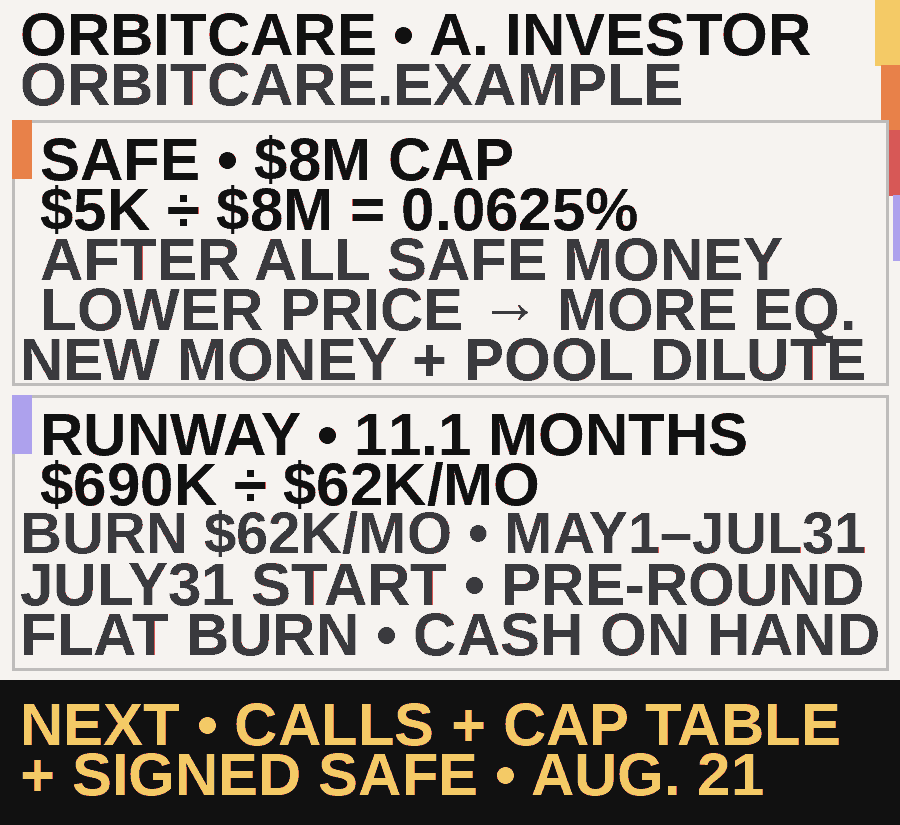
Open the detailed one-page example PDF for the complete tear sheet.
OrbitCare investor tear sheet
Snapshot
- Company: OrbitCare, Inc. | B2B software | Pre-seed | Chicago, Illinois
- Owner: A. Investor | Website: orbitcare.example
- What it does: Scheduling and patient follow-up software for independent outpatient clinics
- Status: Diligence
- Created: August 7, 2026 | Last updated: August 14, 2026
Investment thesis [J]
Independent clinics lose staff time to manual scheduling and fragmented patient communication. OrbitCare may earn durable recurring revenue if its integrations make the product hard to replace and channel partners can lower customer acquisition cost. The case depends on retention remaining strong as the customer base grows beyond the founders' direct relationships.
Round and ownership
- [F] Proposed instrument: Assumed unmodified U.S. YC post-money SAFE, Valuation Cap, No Discount, with an $8 million Post-Money Valuation Cap
- [F] Round target: $750,000
- [F] Proposed check: $5,000
- [C] Cap-based ownership reference: $5,000 ÷ $8 million = 0.0625%. Under the assumed standard form, this is measured after all SAFE money and before new money in the converting priced round
- [C] Conversion and later dilution: At conversion, the investor receives the greater share count produced by the cap-based Safe Price or the priced round's financing price. The priced round's new money and any new or increased option pool adopted as part of that round dilute the SAFE holder
- [F] Rights: No separate pro rata or information-rights side letter provided
- [F] Cap table status: The July 28, 2026 cap table was requested but not received. It supplies Company Capitalization inputs and may reveal other securities or commitments. It does not itself cause dilution
Traction and financial position
- [F] Monthly recurring revenue: $18,700 for July 2026, up from $12,900 for April 2026
- [C] Three-month growth: ($18,700 − $12,900) ÷ $12,900 = 45%
- [C] Annualized recurring revenue: $18,700 × 12 = $224,400. This is a run-rate, not recognized annual revenue
- [F] Customers: 17 paying clinics as of July 31, 2026
- [F] Concentration: Largest clinic group represents 31% of monthly recurring revenue
- [F] Cash: $690,000 as of July 31, 2026
- [F] Average net burn: $62,000 per month, averaged over May 1 through July 31, 2026
- [C] Simple runway from July 31, 2026: $690,000 ÷ $62,000 per month = 11.1 months before new financing, assuming the cash is available, monthly burn stays flat, and no material working-capital changes or one-time outflows occur
Team and execution evidence
- [F] CEO: Seven years operating outpatient clinics, including three years as a regional operations lead
- [F] CTO: Previously led integrations for a healthcare scheduling product
- [J] Evidence of learning: Team cut onboarding from six weeks to 18 days after the first five customers stalled in implementation
- [J] Gap: No full-time sales leader; current pipeline depends on the CEO
Top risks and milestones
- Customer concentration: Reduce the largest group below 20% of monthly recurring revenue by December 31, 2026.
- Retention evidence: Produce six-month gross retention for the first 10 clinics by October 31, 2026.
- Integration dependency: Complete the second practice-management integration without adding more than two weeks to onboarding by November 30, 2026.
Next action
- Request two customer calls, the July 28 cap table, and the signed SAFE form.
- Decide by August 21, 2026.
- Pass if customer references reveal unreliable integrations or if the records reveal material securities or commitments omitted from the ownership assumptions.
Source log
- Founder update dated July 31, 2026
- July profit-and-loss statement and cash report
- Customer and revenue export dated August 2, 2026
- Product demo and founder meeting notes dated August 6, 2026
- Draft SAFE dated August 7, 2026
- Cap table dated July 28, 2026, requested but not yet received
The missing cap table is visible instead of quietly assumed. It does not create dilution. It provides calculation inputs and may reveal securities the initial assumptions missed. The ownership number is labeled as a conditional reference, and the decision has a deadline. That is more useful than a polished page filled with unsupported certainty.
Copy this one-page investor tear sheet template
Download the blank template as an editable Word document or a print-ready one-page PDF. Both versions use the same fixed headings so you can compare opportunities and portfolio updates without relearning the layout.
You can also duplicate the plain-text version below.
COMPANY: [Name] | [Sector] | [Stage] | [Location]
STATUS: [Screening / Diligence / Invested / Passed / Monitoring / Exited]
OWNER: [Name] | CREATED: [Date] | LAST UPDATED: [Date]
SNAPSHOT [F]
[Customer] uses [product] to solve [problem].
Website:
INVESTMENT THESIS [J]
Why now:
Why this team:
What must become true:
ROUND AND OWNERSHIP [F/C]
Instrument and form/version:
Round size:
Check size:
Cap or valuation:
Discount, if applicable:
Convertible-note interest rate, if applicable:
Convertible-note maturity date, if applicable:
Estimated ownership and formula:
Conversion and dilution assumptions:
Pro rata / information / SPV terms:
Cap table date and missing inputs:
TRACTION AND FINANCIAL POSITION [F/C]
Metric 1, value, period, source:
Metric 2, value, period, source:
Metric 3, value, period, source:
Cash balance as of [date]:
Average monthly net burn ($ per month) over [start date–end date]:
Runway from [date], formula, and assumptions:
Dated current view: as of [date], [metric] moved from [prior value/date] to [current value/date]. Response:
TEAM AND EXECUTION [F/J]
Relevant evidence:
Learning speed:
Key gaps:
References completed:
TOP RISKS AND DISCONFIRMING EVIDENCE [J]
1.
2.
3.
MILESTONES
Milestone, owner, and target date:
Milestone, owner, and target date:
QUESTIONS / OPEN QUESTIONS
Question, owner, and due date:
Question, owner, and due date:
ACTION / NEXT ACTION
[Action] by [date]. [Invest / Pass / Wait / Follow on / Other].
Pass or revisit if [condition].
SOURCE LOG
[Document or conversation] | [Date] | [Link]
[Document or conversation] | [Date] | [Link]
Source the facts before you compress them
A one-page limit forces selection. It does not lower the standard of evidence.
Use the signed financing instrument for legal terms, the latest cap table for ownership inputs, company financial records for revenue and cash, product or customer data for operating metrics, and dated founder updates for narrative context. Mark founder-supplied figures as founder-supplied when you have not seen the underlying record.
For a Regulation Crowdfunding deal, the issuer's Form C is a useful starting point. Current 17 CFR 227.201 requires disclosures that include the business, use of proceeds, offering amount and deadline, security price or method, related-party transactions, financial condition, and financial statements. A filing gives you formal disclosures. It does not answer whether the investment is attractive.
Inside our Angel Squad community, comparing questions with other operators and investors can reveal what your first pass missed. Keep your own sheet, though. Your thesis and portfolio constraints may differ from everyone else's.
How to keep the tear sheet useful after you invest
Do not overwrite the pre-investment case. Freeze it, then add a small “current view” block with the new date, the changed facts, and your response.
Update the sheet when new information could change your view:
- A financing closes or terms change
- A core metric moves materially
- Runway crosses a threshold you set
- A founder or senior leader leaves
- A regulatory, product, or customer milestone lands or slips
- The company asks for follow-on capital
- The company is acquired, shuts down, or distributes proceeds
Preserve the prior value beside the new one. “Revenue is $40,000” lacks context. “Monthly recurring revenue rose from $18,700 in July to $40,000 in December” shows direction and time.
Record missing information too. “No update received since March 31” is a fact. A stale financing valuation is not a current market value. A higher-priced primary round by itself does not give existing holders liquidity, though the financing may include a secondary component that buys shares from participating holders.
Detailed tracking can break down even among groups. In a preliminary, self-reported 2025 ACA snapshot, 16 of the first 17 responding angel groups said they tracked aggregate portfolio performance, yet only a minority reported collecting enough detail to draw useful investing lessons. Treat that small early sample as a sign of the operational gap, not a settled benchmark. Your one-page record is small, but the consistency compounds across a portfolio.
“When it comes to markets, you always need to factor in: is something that is true today going to be true tomorrow?”
Our co-founder and general partner Eric Bahn
That question belongs beside every fast-growing metric and market claim. Date the fact. Then write the milestone that would strengthen or weaken it.
Common tear sheet mistakes
- Copying the founder's one-pager. Their document explains why the company deserves attention. Yours records why the deal fits your thesis and what could go wrong.
- Leaving out dates. A metric without a period cannot be compared later.
- Mixing facts and opinions. Source tags keep a founder claim, your calculation, and your judgment from blurring together.
- Tracking too many metrics. Choose the few measures that test the thesis. Put the rest in linked supporting material.
- Using false precision. Ownership, runway, and valuation estimates depend on assumptions. Show the formula and name what is missing.
- Hiding unanswered questions. An empty field creates pressure to invent certainty. Write “unknown,” assign an owner, and set a deadline.
- Treating the sheet as diligence. It summarizes your work. It does not replace customer calls, document review, reference checks, product work, legal review, or tax review.
A tear sheet earns its place when it changes how you decide and learn. Use the template on your next opportunity, then revisit it when the facts change. If you want structured practice evaluating real startup deals alongside experienced operators and investors, join us in Angel Squad.















.png)