
Startup Advisor: How to Be Useful Without Taking Over
Brian Nichols is the co-founder of Angel Squad, an angel investing community where aspiring and active angels learn from Hustle Fund’s approach, review curated deal flow, and connect with peers.
A founder asks for your help. You know the industry, you've solved similar problems, and you're interested in getting closer to startups. Then the request becomes an advisory role, with equity and an open-ended calendar attached. A useful relationship starts with clear expectations about the help you'll provide, the time you'll spend, and the decisions that remain the founder's.
What does a startup advisor do?
A startup advisor provides recurring guidance, specialist knowledge, and useful connections to a founder or leadership team. The relationship can be paid in cash, equity, both, or be unpaid. The work usually focuses on a gap the company needs help closing, such as hiring its first sales leader, understanding hospital purchasing, or improving customer retention.
An advisor helps the founder make decisions and follows through on agreed support. The founder still owns the decision and execution. A startup advisory board is a group of advisors; the word “board” doesn't turn it into the company's governing board of directors.
Several nearby roles have different expectations:
- Mentor: Offers guidance, often informally or through a program, without an ongoing commercial engagement.
- Consultant: Owns defined work, such as producing a pricing analysis or implementing a sales process.
- Fractional executive: Runs a function part-time, with ongoing operating responsibility.
- Director: Holds a formal governance role with legal duties. An advisory title alone doesn't create that position.
- Angel investor: Commits personal capital to a startup. An investor may also advise, but investing and advising are separate commitments.
If you're managing staff, shipping the product, or running weekly sales meetings, agree on an operating engagement that reflects that responsibility. A small advisory grant shouldn't become an undefined part-time job.
Turn your operating experience into a specific contribution
You don't need a famous exit to be useful. You need experience that fits the company's current problem and the ability to explain it within the founder's constraints.
Our co-founder and general partner Elizabeth Yin wrote in Democratizing Knowledge, “Investors use their life perspective to assess.” Operating experience gives you a lens on customers, buying decisions, and execution. Advising lets you apply that lens while learning where your own assumptions stop holding up.
Choose a narrow contribution you can describe in one sentence. For example:
- Sales: “I help founders decide when they're ready for a first sales hire and define what that person will own.”
- Product: “I help teams understand why new users abandon onboarding and choose which problem to address first.”
- Industry knowledge: “I explain how industrial buyers approve purchases, including the people and timelines a new supplier will encounter.”
A large-company playbook needs adjustment for a team of five. Before recommending a new process, understand the company's resources, existing evidence, and immediate priority. A founder with limited cash and one engineer may need a rough customer interview guide more than a new analytics stack.
Good advice includes the assumptions behind it. Explain which parts come from direct experience, which are judgment calls, and what evidence would change your view. Stay within your competence, especially on legal, tax, medical, or regulatory questions.
For operators exploring angel investing, our Angel Squad community's curated deal reviews and peer discussions offer other perspectives on startup decisions. You can compare your operating lens with how investors reason through a deal.
How to find startup advisor opportunities
Make it easy for someone to introduce you around a concrete need. “I advise startups” gives them little to work with. “I help business-software founders move from founder-led sales to their first sales hire” describes a useful match.
Start with people who have seen your work, then spend time in settings where founders discuss problems:
- Reconnect with former colleagues and founders. Describe the company stage, problem, and time commitment you're available for. Ask for introductions to founders facing that problem.
- Offer focused office hours. Accelerator, university, and industry-community sessions let you help several founders without promising an ongoing role to everyone.
- Share a useful operating example. Explain how you made a hiring, distribution, or product decision, including its limitations. Use only information you have permission to share.
- Reach out with a bounded offer. Refer to a specific business problem and offer a short conversation or focused review. Avoid sending a diagnosis based on a homepage alone.
An outreach message might read: “I led the move from founder-led selling to a small sales team at a business-software company. You mentioned hiring your first salesperson. I'd be happy to spend 30 minutes talking through the role and where handoffs tend to break.”
Follow through on that offer before seeking a title. A founder who finds the help useful has a reason to continue the conversation. An introduction or office-hours session creates no obligation to award equity or offer an investment opportunity.
Start with a bounded working period
We recommend a short working period before a long advisory commitment. Agree on the scope and any payment upfront, and resolve confidentiality and employer permissions before sharing sensitive material. Nobody should discover afterward that “getting acquainted” meant weeks of free consulting.
For example, spend 30 days on one question: whether a founder is ready to hire a sales leader. Hold two conversations, review the proposed role, and give a written recommendation with its assumptions. The founder owns the hiring decision.
Both sides get evidence about how the relationship works. Does the founder provide enough context? Do you prepare and follow through? Can you disagree without either person turning the conversation into a contest?
If it fits, write a scope for the next 90 days. Include:
- The problem: One current constraint, such as deciding which customer segment to prioritize.
- Your contribution: Specific support, such as reviewing interview notes and helping compare options.
- The founder's contribution: An agenda, relevant information, and someone responsible for execution.
- The boundaries: Work you won't own, including managing employees or guaranteeing introductions.
- The cadence: Meeting frequency, preparation, response times, and a total monthly time budget.
- The review date: A point to renew, change scope, or end the engagement.
Define success around a useful decision or deliverable you can influence. You can commit to reviewing a sales role. You can't guarantee a hire, a customer contract, or a financing round.
Budget the whole commitment
Calls, preparation, document reviews, introductions, and messages all use time. A “monthly meeting” can become several hours of work even when the call lasts 45 minutes.
Here is a sample four-hour monthly budget, not an industry standard:
- Founder conversation: 45 minutes.
- Preparation: 45 minutes.
- One document review: 60 minutes.
- Introductions and follow-up: 45 minutes.
- Asynchronous questions: 45 minutes.
Specify the communication channel and a response window you can maintain. Two business days for routine questions is one possible arrangement. It doesn't imply evening availability, emergency support, or unlimited messaging.
When requests exceed the budget, choose what to defer, expand the compensated scope, or establish a separate consulting project. If the company needs an operator embedded in the business, an advisory arrangement may no longer fit.
Agree on compensation and understand the equity
Choose compensation that fits the work and your finances. A cash retainer pays for recurring availability; a project fee pays for defined work. Equity gives you a speculative ownership interest or a right to acquire one. An unpaid role can make sense when its purpose and limits are explicit.
If you need dependable income, prioritize cash-paid work. Startup equity can remain illiquid for years and ultimately be worth nothing. It shouldn't carry your household budget.
Equity benchmarks are context for negotiation
Grant size depends on the company's stage, the scope, and the contribution. Carta's advisor compensation data for the first half of 2024 reported median advisor grants of 0.21% at pre-seed, 0.12% at seed, and 0.05% at Series A, measured as a percentage of fully diluted shares. These are historical observations from Carta's dataset, not a universal rate card.
“Fully diluted” generally counts outstanding shares plus shares represented by options and other potential equity, with the exact calculation depending on the capitalization and documents. A percentage needs a defined denominator. The number of shares or options matters too.
Founder Institute's FAST agreement, short for Founder / Advisor Standard Template, provides a framework for documenting equity-based advisory work. Its suggested grants are template recommendations, rather than evidence of what advisors receive across the market. Its expert-advisor example uses two-year vesting; the FAST agreement includes a three-month cliff. Vesting means earning the grant over time; a cliff means no portion vests before the stated threshold.
The percentage is only part of the offer
The grant documents should establish:
- What you're receiving: Shares or options. An option is a right to buy shares at a specified exercise price, rather than shares you already own.
- How much: The share or option count, any percentage representation, and the capitalization basis and date behind that percentage.
- How you earn it: The vesting start, schedule, cliff, and any conditions.
- What happens when work ends: Treatment of vested and unvested equity, termination terms, and any option exercise deadline.
- What it costs: Purchase or exercise costs, taxes, and any time-sensitive filings.
- How it is authorized: The company's required approvals and the actual grant documentation. A promise in an email is different from an approved award.
New financing can dilute your ownership percentage. Common shares can also have different economic rights from investors' preferred shares. Our advisory shares guide explains those mechanics in more detail.
Have qualified independent legal and tax professionals review the arrangement before signing or exercising options. The advisory agreement, equity plan, and grant documents need to work together; a generic template doesn't resolve your employment, jurisdiction, or tax circumstances.
Set boundaries around conflicts and your reputation
For an employed operator, permissions and confidentiality deserve attention before the first substantive conversation. Outside-work policies, invention assignments, and obligations to customers or employers can overlap with the startup's work.
Describe relevant relationships to the founder, obtain required employer approvals, and agree on areas you can't discuss. Use your own time and equipment. Keep employer code, customer lists, internal metrics, and confidential plans out of the engagement.
Other boundaries belong in writing:
- Competing companies: Disclose other advisory roles and investments. Decline or narrow work when confidentiality and competing interests can't be separated.
- Introductions: Obtain permission from both sides and agree on what information may be shared. A contact list is no substitute for a willing introduction.
- Public affiliation: Approve how your name, title, employer, or likeness appears in decks and on the website. Make clear that your employer isn't endorsing the startup.
- Work product: Clarify ownership of materials you create and distinguish them from pre-existing tools or intellectual property.
- Later investment discussions: Disclose your advisory stake and separate your compensation from any decision to invest or recommend the company.
Fundraising creates a separate legal risk. In the U.S., compensation tied to the amount raised or a financing's success can raise broker-dealer registration issues. The Securities and Exchange Commission considers activities as well as compensation, so a fixed fee doesn't automatically resolve the issue. Obtain securities counsel's guidance before taking on compensated investor solicitation or fundraising introductions.
Decide whether the relationship is worth continuing
Before accepting, decide whether the work is worth your time even if the equity never pays out. At the agreed review date, assess the relationship against its scope. Revenue growth alone is a poor measure of your contribution. The founder, team, customers, and market all affect the outcome.
Use four questions:
- Did your help change a decision, clarify a tradeoff, or produce something the team used?
- Did both sides provide the context, preparation, and follow-through they promised?
- Does the company still need your specific expertise?
- Do the time, compensation, conflicts, and reputational exposure still fit your life?
A founder can reasonably reject your recommendation. You can still add value by making the choices clearer. Persistent requests beyond scope, pressure to imply endorsements, or demands to share confidential information are reasons to change or end the engagement.
Ending can be straightforward: document the end date, complete the agreed handoff, and handle access, confidential materials, public affiliation, and equity according to the documents. Successful advisory work may end because the company hired someone with the expertise it needed.
Use advising to build investor judgment
Advising gives you repeated exposure to how founders make decisions with incomplete information. You can observe whether customer feedback changes priorities, how a team allocates limited cash, and what happens after a confident plan meets real constraints. That can build founder empathy and sharpen questions you'd later ask as an angel.
Keep a private decision log within your confidentiality obligations. Record the problem, available evidence, your recommendation, the founder's decision, and what happened next. Revisit the assumptions instead of rewriting your memory around the outcome.
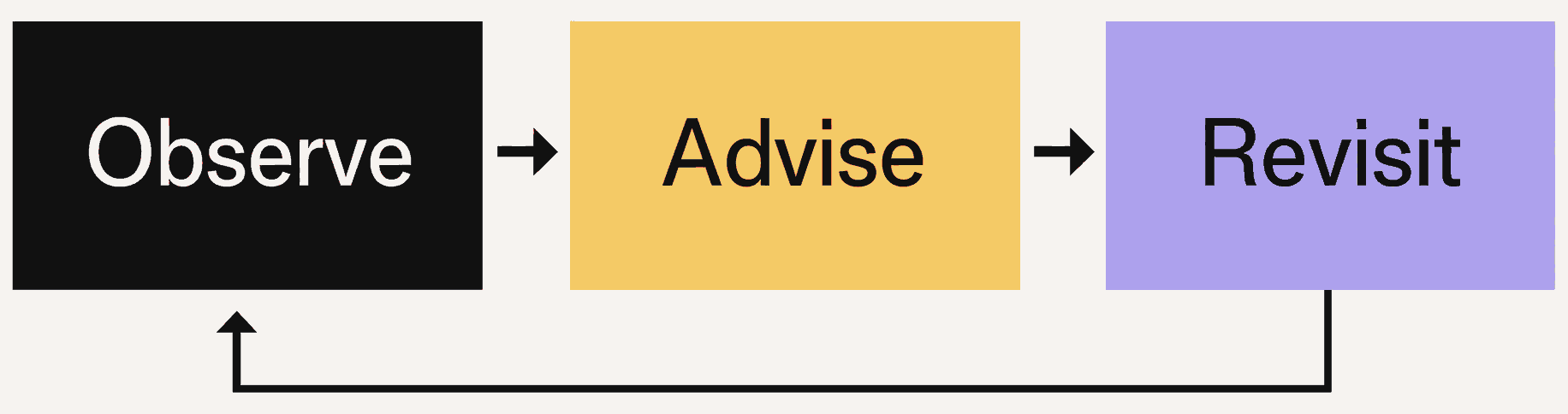
Elizabeth Yin wrote in Democratizing Knowledge, “The more disciplined you are in your thought process/rubric, the more you can improve over time.” A written record makes that discipline practical. It also helps you notice when a familiar pattern from your career doesn't fit a new company.
Advising has limits as investing preparation. Your involvement can make you attached to the team, and a handful of companies is a small, selective sample. Assessing an investment still requires separate diligence on the business, terms, valuation, and your portfolio. Startup investing is risky; many investments may fail, and even a surviving company may never provide liquidity.
Advising doesn't guarantee an allocation, investment readiness, or a financial outcome, and it isn't a prerequisite for learning to invest.
If you want to bring your operating experience into those conversations, apply to Angel Squad.
This material is for education and does not constitute legal, tax, or individualized investment advice. Seek independent review from qualified legal and tax professionals for your circumstances. Startup equity and investments are speculative, illiquid, long-term, and may result in total loss.














.png)