
Berkus Method: Valuing Pre-Revenue Startups With Evidence
Brian Nichols is the co-founder of Angel Squad, an angel investing community where aspiring and active angels learn from Hustle Fund’s approach, review curated deal flow, and connect with peers.
A founder has a working product, interested customers, and no revenue. Before writing a check, you need a view on the price. The Berkus Method organizes that judgment around evidence, dollar limits, and the financing terms that turn a valuation into an investment decision.
What is the Berkus Method?
The Berkus Method estimates an early-stage startup’s value by assigning dollar amounts to progress across five factors: the idea, prototype, management team, strategic relationships, and product rollout or sales. Add those amounts to reach an indicative pre-money valuation, the value before new investment enters the company.
Angel investor Dave Berkus developed the framework in the mid-1990s. Its starting point is evidence that the company has reduced a risk, rather than a detailed revenue forecast. Berkus restated that emphasis in his June 2026 explanation.
We find that distinction useful for an investor facing a polished pitch deck. A five-year forecast describes the founder’s ambition; a working prototype demonstrates something the team has accomplished. Neither establishes the price on its own.
The method gives you a structured valuation hypothesis. The final financing price still depends on negotiation, competing investors, capital needs, and the rights attached to the investment.
The five Berkus Method factors
Berkus’s 2012 explanation assigns up to $500,000 to each factor. Those amounts are ceilings, so a company can receive partial credit or zero. The evidence examples here show how an angel can apply the categories.
1. Sound idea
This is the basic value of a credible business concept. Look for a specific customer problem, a plausible solution, and a reason customers would change their behavior.
An interview in which a customer explains an expensive workaround deserves more weight than a slide claiming a huge market. Enthusiasm without evidence of pain leaves much of the business risk unresolved.
2. Prototype
A prototype reduces technology risk by showing that the core solution can work. Credit depends on what it proves.
A clickable mockup can demonstrate a proposed workflow. It says little about whether the underlying technology works. For a software startup, a functioning integration using customer data may support more credit, while security, reliability, and scale remain open questions.
3. Quality management team
This factor addresses execution risk. Assess relevant customer knowledge, complementary skills, working relationships, and evidence that the founders can learn and deliver.
A recognizable former employer gives you background to explore. It doesn’t establish that the team can sell this product or build this company. A founder who has lived the customer’s problem may have insight that a more conventional résumé misses.
4. Strategic relationships
Relationships can reduce market and competitive risk when they provide meaningful access to customers, distribution, suppliers, or another resource the business needs.
Distinguish a committed partner from an introduction. A signed agreement with a defined scope and an accountable buyer supports a different assessment from an advisor’s promise to make introductions someday.
5. Product rollout or sales
This factor recognizes progress toward delivering the product and generating business. Berkus associates it with reduced financial or production risk.
A shipped product with repeat usage provides more evidence than a launch announcement. Once sales exist, the quality and repeatability of those sales matter. One custom project may leave the planned business model largely unproven.
Our guide to evaluating early-stage traction develops the distinction between activity and evidence of customer demand.
How to calibrate the valuation caps
The familiar $500,000 figures are historical reference points. Berkus’s November 2016 update explicitly allows users to change both the dollar ceilings and the risk categories for their industry and market.
Keep two separate judgments visible: the maximum you’d assign to a factor, and the credit this company has earned within that maximum. Changing the ceiling changes your pricing assumptions. Changing the credit changes your assessment of the evidence.
Keep the original limits in context
Berkus’s 2012 version distinguishes a maximum of $2,000,000 pre-revenue from $2,500,000 after product rollout. The fifth factor explains the difference. Presenting $2,500,000 as an automatic value for any pre-revenue company obscures that distinction.
He also used the potential to reach $20,000,000 in revenue within five years as an opportunity screen. That was his investment hurdle, not an output of the formula or a promised outcome.
Use comparable financing terms
Build your starting range from recent financings of companies with similar development, business models, capital needs, and access to investors. A seed-stage label alone tells you little: one seed company has recurring revenue, while another has a prototype.
Keep pre-money valuations separate from post-money valuations and Simple Agreements for Future Equity (SAFEs), contracts that provide rights to future equity under specified terms. A SAFE valuation cap governs conversion pricing. It isn’t interchangeable with a priced-round valuation.
Record the financing date, instrument, development stage, and the reason each comparable belongs. A broad market median can provide context, but it doesn’t establish what this particular company is worth.
Set limits before assessing the pitch
Choose a defensible maximum for a strongly developed company in your comparison set. Allocate it across the risks that matter. Equal caps are convenient; different caps need an explicit reason.
For a medical-device company, regulatory progress may need its own category. Replace a less relevant category or reallocate the existing budget rather than adding an extra allowance without explanation. Keep a clearly labeled distinction between the classic framework and your adaptation.
Inflation alone doesn’t determine startup financing prices. Neither does the amount a founder hopes to raise. If market evidence is thin, carry that uncertainty into a wider range.
In Angel Squad, our deal discussions and investing education give you opportunities to hear how other investors assess a company and explain your own reasoning. The framework organizes the work; practice develops the judgment.
A step-by-step Berkus Method valuation example
Consider a hypothetical, simplified deal-level example: a pre-revenue software startup automating purchase approvals for small manufacturers. It has two full-time founders, a working prototype, and two unpaid pilot partners. It hasn’t launched commercially.
For illustration, use the historical $500,000 ceiling for each category. These figures demonstrate the method, not a current market benchmark or a projection.
Step 1: Write the evidence beside each amount
- Sound idea: $400,000. Interviews identify a recurring approval problem, and the founders have mapped the current purchasing workflow. Willingness to pay remains uncertain.
- Prototype: $350,000. The core workflow works with pilot data. Deployment across different customers and production reliability remain unproven.
- Team: $450,000. One founder has manufacturing purchasing experience; the other has built enterprise software. They’ve delivered together, but repeatable sales are still a gap.
- Strategic relationships: $200,000. Two manufacturers have committed staff time and data to pilots. Neither has committed to a paid deployment or broader distribution.
- Product rollout or sales: $0. There is no commercial rollout or sales evidence yet. The unpaid pilots receive credit for the specific technical and customer-access risks they reduce.
The amounts add to $1,400,000 pre-money:
$400,000 + $350,000 + $450,000 + $200,000 + $0 = $1,400,000.
A pilot can support more than one category when it proves separate things. Working with real data can support prototype credit, while a committed customer contact can support relationship credit. Awarding full credit in several categories because “we have pilots” would count the same vague claim repeatedly.
Step 2: Turn disagreement into a range
Keep the idea and team amounts fixed at a combined $850,000. Suppose you assess prototype credit at $250,000 to $400,000 and relationship credit at $100,000 to $250,000.
The same hypothetical, simplified example now produces a pre-money range of $1,200,000 to $1,500,000:
- Lower assessment: $850,000 + $250,000 + $100,000 = $1,200,000.
- Upper assessment: $850,000 + $400,000 + $250,000 = $1,500,000.
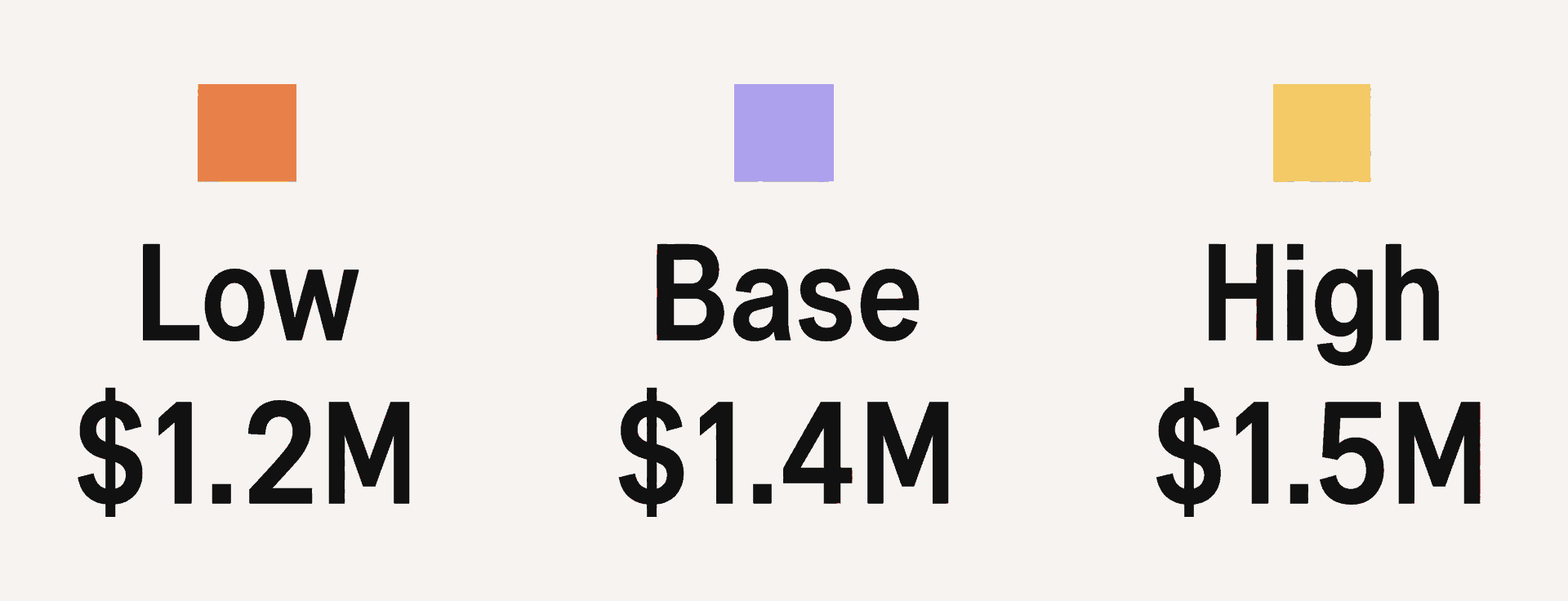
This is a judgment range, not a statistical confidence interval. Its purpose is to show which assumptions move the price. Here, deployment evidence and customer commitment deserve more attention than another discussion about the size of the manufacturing market.
Step 3: Relate the result to the financing
Continue the hypothetical, simplified example with a $350,000 priced equity round at $1,400,000 pre-money. Assume each check is invested in full, with no fees deducted, no existing convertible securities, no option-pool increase, and no other capitalization adjustments.
- Post-money valuation: $1,400,000 + $350,000 = $1,750,000.
- New investors’ combined ownership: $350,000 ÷ $1,750,000 = 20%.
- A $17,500 check’s ownership: $17,500 ÷ $1,750,000 = 1% immediately after the round.
Those are ownership calculations, not return estimates. Future financing can dilute the percentages, and investment rights can change who receives proceeds and how much.
If the company is raising on a SAFE, the priced-round arithmetic doesn’t transfer directly. Y Combinator’s post-money SAFE guide distinguishes ownership before the new priced-round money from ownership afterward. Conversion terms, other securities, and option-pool changes matter.
Where the Berkus Method helps, and where it fails
The method helps when a company has little financial history and you need to make your reasoning explicit. It also helps investors pinpoint disagreements: one person believes the prototype works in real deployments; another sees an unproven demo.
Our co-founder and general partner Elizabeth Yin writes in Democratizing Knowledge (2021, p. 43), “Investors use their life perspective to assess.” A manufacturing operator and a software engineer may notice different weaknesses in this example. Comparing their evidence is more useful than averaging their totals without discussion.
Three limitations deserve particular attention:
- The sum can conceal a fatal dependency. A strong team and prototype won’t solve a missing legal right to use essential data. Separate issues that make the business uninvestable from risks that justify less valuation credit.
- Dollar amounts remain subjective. The framework doesn’t prove that two pilot customers are worth $200,000. It makes that assumption visible so you can challenge it.
- It can underweight future capital needs. A company may have cleared early milestones and still need substantial financing before it can operate sustainably. That affects funding risk and potential dilution.
Berkus says the method ceases to apply once a company is in revenue. In practice, meaningful revenue gives you additional evidence to assess, including retention, margins, and sales efficiency. The qualitative risks still matter, but the five-factor sum becomes a weaker basis for pricing.
The calculation also doesn’t establish a formal tax, accounting, or fair-value appraisal. Its role here is an investor’s early-stage negotiation framework.
Berkus Method vs. other startup valuation methods
Other methods answer different questions. The Scorecard Method starts with comparable financings, Risk Factor Summation expands the risk assessment, and the Venture Capital Method works backward from a possible exit. Discounted cash flow estimates today’s value from future cash flows.
- Berkus Method: Assign dollar credit to demonstrated progress. Useful for an angel assessing a prototype-stage company whose forecasts carry little weight.
- Scorecard Method: Adjust a comparable-company valuation using weighted assessments of the startup’s relative strengths and weaknesses. Bill Payne’s original Scorecard explanation also addresses pre-revenue companies. Revenue isn’t a prerequisite; a relevant comparison set is.
- Risk Factor Summation: Adjust a regional starting valuation upward or downward across a broader set of risks. Payne’s risk-factor explanation includes financing, manufacturing, litigation, and other risks that five Berkus categories can miss.
- Venture Capital Method: Work backward from a hypothetical exit value and target return, allowing for future dilution. It helps examine whether the entry price could fit an investor’s objectives, but exit and timing assumptions can dominate the answer. Our venture capital valuation guide explains the mechanics.
- Discounted cash flow: Discount projected future cash flows to present value. It becomes more useful when operating history supports those forecasts; for a pre-revenue startup, small assumption changes can overwhelm the apparent precision.
Use a second method to challenge the first. If the results differ sharply, examine the comparison set, capital requirements, risk credits, and financing terms. Averaging two poorly supported numbers gives you another poorly supported number.
Keep a record you can learn from
Save a short investment memo containing your valuation range, category caps, evidence behind each credit, unresolved dependencies, and financing terms. Include what would change your assessment, such as a successful production deployment or a paid renewal.
Our general partner Elizabeth Yin puts the habit plainly in Democratizing Knowledge (2021, p. 131): “The more disciplined you are in your thought process/rubric, the more you can improve over time.” Revisit the assumptions as the company develops. You can learn whether your technical or customer judgment was sound long before an exit.
If you want to build that judgment alongside other aspiring and active angels, apply to Angel Squad.
This is educational information, not investment, valuation, accounting, legal, or tax advice. Examples are hypothetical and simplified. Startup investments are speculative, illiquid, and long-term; most bets may fail, and you can lose your entire investment.
Past results and current valuation marks do not guarantee future results. Outcomes depend on governing documents, the capitalization table, investment rights, valuation policies, fees, carried interest where applicable, taxes, and the timing of financing and liquidity. Obtain independent review of the governing documents and your circumstances from qualified investment, valuation, accounting, legal, and tax advisers.














.png)