Preferred stock vs common stock for startup investors
Brian Nichols is the co-founder of Angel Squad, an angel investing community where aspiring and active angels learn from Hustle Fund’s approach, review curated deal flow, and connect with peers.
Two investors can own the same percentage of a startup and receive different payouts when it sells. The share class and financing terms help explain why. Understanding preferred stock vs common stock means separating ownership, control, and exit proceeds before you decide what a deal is worth to you.
What preferred and common stock mean in a startup
Common stock is an ownership interest that generally receives whatever remains after creditors and preferred equity claims are satisfied. Founders usually hold common stock. Employee options generally give employees the right to buy common stock.
Preferred stock is an ownership interest with specified preferences over common stock, often including priority in certain exit distributions. Investors in priced startup rounds commonly buy convertible preferred stock, which can become common stock under the terms of the company's charter.
Both are equity. Neither guarantees repayment, income, or an exit. Their rights depend on the governing documents and applicable law. The SEC’s startup securities overview distinguishes these share classes from options and instruments that can become equity. The examples here use a simplified U.S. venture-backed corporation.
Public-market preferred shares are often discussed as dividend-paying investments with limited voting rights. Venture preferred stock can carry substantial voting rights, conversion rights, and exposure to the company's upside. Applying a public-market comparison to a startup deal can lead you to the wrong assumptions.
We evaluate the price and the rights together. A preferred share with a large preference stack ahead of it can still receive nothing. A common share bought at an appropriate price can still be a reasonable investment.
Seven differences that affect your investment
1. Voting rights and control
Common stock often carries one vote per share, but a company can have multiple common classes with different voting power. Owning common stock doesn't automatically give you control.
Venture preferred investors often vote alongside common holders on an as-converted basis, meaning the votes reflect the common shares their preferred shares could become. They may also have separate class or series approval rights over specified actions, such as issuing senior securities or changing the charter.
Those protective provisions are different from a board seat. Board representation may be negotiated through the charter and voting agreement. A small angel check doesn't automatically get the lead investor's board seat or an individual veto. The approval threshold may let a majority of a series decide for everyone in that series.
The National Venture Capital Association’s model financing documents separate the certificate of incorporation, voting agreement, and investors' rights agreement. Your rights package may span all three. The models offer alternative starting terms, not universal rights or the agreement for your investment.
2. Dividends
A dividend is a distribution to shareholders. Common holders may receive dividends when properly declared, subject to legal limits and any preferred rights. Early-stage startup investors generally look to a future liquidity event rather than regular dividend income.
Preferred dividend language varies. A non-cumulative dividend doesn't keep accruing merely because it wasn't declared. A cumulative dividend can accrue under the stated formula and may increase the amount payable in specified circumstances, including an exit if the documents provide for it.
A stated dividend rate doesn't establish that cash will arrive each year. The declaration requirements, accrual language, payment conditions, and interaction with the liquidation preference determine the economics.
3. Conversion
Convertible preferred stock lets its holder exchange preferred shares for common shares at a defined ratio. One-for-one may be the starting ratio, but stock splits and negotiated adjustments can change it.
Voluntary conversion can let an investor take the common-stock payout when that amount exceeds the preference. Converting also gives up the preference attached to those shares.
Mandatory conversion can occur after a qualifying initial public offering (IPO) or the specified investor approval. The thresholds matter because another group of holders may be able to trigger conversion of your shares. Common stock usually has no corresponding right to become preferred stock.
4. Liquidation preference
A liquidation preference gives preferred holders a claim ahead of junior equity when a defined liquidation event occurs. Startup charters often include certain acquisitions or mergers as “deemed liquidation events.”
A 1x preference commonly starts with one times the original issue price. It is a priority claim on available proceeds, with no guarantee that enough money will exist to satisfy it. Creditors and other company obligations can consume the money before any equity receives a distribution.
The participation terms determine what comes next:
- Non-participating preferred: The holder generally receives the better of its preference or its as-converted common payout, under the applicable election or greater-of mechanics.
- Participating preferred: The holder receives its preference and then shares in the remaining proceeds as specified. A cap may limit participation, while conversion may preserve a larger common-stock outcome.
- Common stock: The holder receives its share of the residual pool after claims ahead of common are satisfied.
Preferred series can rank equally, called pari passu, or one can rank ahead of another. Our liquidation preference guide explains the payout order and participation mechanics in more depth.
5. Dilution and follow-on rights
Both common and preferred holders can be diluted when the company issues more shares. Their share counts may stay the same while their percentage ownership falls.
Preferred stock may include price-based anti-dilution protection. In a qualifying financing at a lower price, an adjustment can increase the common shares received on conversion. A weighted-average formula accounts for the size and price of the issuance; a full-ratchet formula can reset the conversion price to the lower price regardless of issuance size. Exceptions and waivers matter.
That protection doesn't freeze your ownership percentage. It also differs from pro rata rights, which give eligible investors an opportunity to put in more money to help maintain ownership in future issuances. Those rights require additional capital and depend on the agreement's eligibility, exclusions, and deadlines.
An employee option-pool increase, converting securities, and a new senior preferred series can all change the outcome for an existing investor. Our cap table guide explains how to follow those ownership changes.
6. Information rights
Owning preferred stock doesn't automatically entitle every investor to the same financial reports. Contractual information rights may include annual financial statements, quarterly reporting, budgets, and inspection rights, subject to conditions.
The model investors' rights agreement uses a defined “Major Investor” category for specified rights. A minimum-holding threshold can mean a lead investor gets reporting rights that a smaller preferred holder doesn't. Side letters, separately negotiated agreements, can also change an individual investor's rights.
Common holders may have statutory inspection rights under applicable law, subject to its requirements. Delaware’s stockholder inspection statute is one example. Those rights are different from a contractual promise to send regular updates.
If you invest through a special purpose vehicle (SPV), an entity that pools investors into a deal, the vehicle may hold the startup's preferred shares. Your own asset is an interest in the vehicle. The manager's reporting, voting authority, fees, and distribution terms determine what reaches you.
7. Exit outcomes and liquidity
An acquisition can trigger the negotiated preference waterfall, the order in which proceeds are distributed. The headline sale price may differ from the amount available to shareholders after debt, expenses, and other obligations. Escrow (money held back), earnouts (payments conditional on future results), and non-cash consideration can also affect payment timing and value.
An IPO often triggers preferred-to-common conversion under the charter rather than a cash preference payout. Conversion itself doesn't put money in your account. Lockups, securities laws, and other restrictions may limit when shares can be sold. The SEC’s exit and liquidity guidance distinguishes a possible exit route from cash an investor can access.
A secondary sale, where an existing holder sells shares, can involve transfer restrictions, company approval, and rights of first refusal that give the company or other holders an opportunity to buy first. A preferred class name doesn't establish that you can sell freely or receive the latest financing price.
A hypothetical exit example with the terms spelled out
This simplified, hypothetical deal-level illustration is dated October 30, 2026. It compares alternative fully realized cash exits, with no unrealized holdings or marks. It is a mechanics example, not a projection.
Assume one investor puts in $1,000,000 and owns the only preferred series, representing 20% of the company on an as-converted basis. Everyone else holds the remaining 80% as common stock. The preferred shares have a 1x non-participating preference, one-for-one conversion, no accrued or declared dividends, and the right to take the greater of the preference or as-converted proceeds.
For the common-stock comparison, change only that investor's security to common, keeping the same investment and 20% ownership. Assume no other preferred series, options, convertible securities, dilution, follow-ons, or other capital contributions. Each exit amount is cash available to equity after company debt, taxes, and transaction costs. Investor payouts are gross and pre-tax, before any vehicle fees, carried interest (a manager’s share of investment profits), or personal taxes, and paid immediately.
At $500,000 available to equity
The preferred investor receives the entire $500,000. The preference claim was $1,000,000, but only half that amount exists. Common holders receive nothing. The preferred investor loses $500,000 of the original investment.
In the all-common alternative, the same investor receives 20% of $500,000, or $100,000. The other common holders receive $400,000.
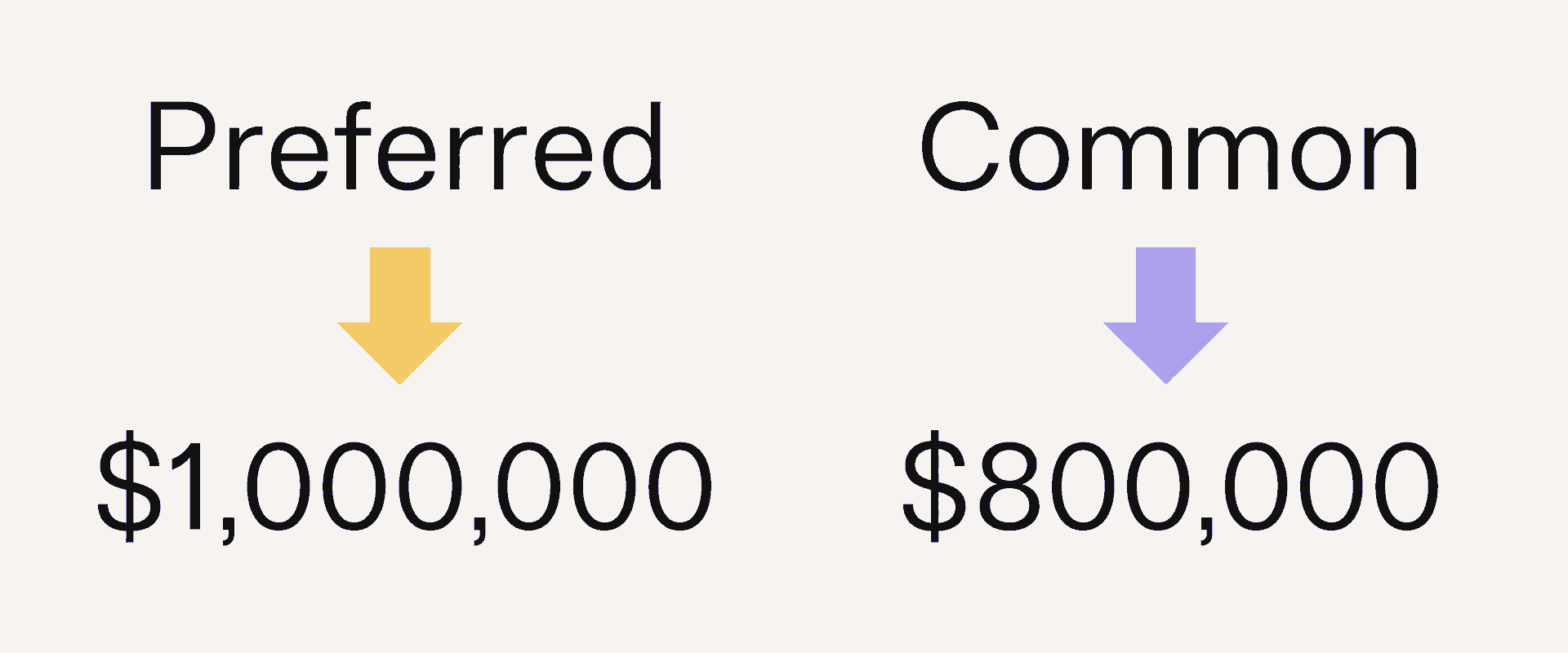
At $4,000,000 available to equity
The preferred investor receives $1,000,000 through the preference. Conversion would produce 20% of $4,000,000, or $800,000, so the preference pays more. The other common holders receive the remaining $3,000,000.
In the all-common alternative, the investor receives $800,000, and the other holders receive $3,200,000. The same ownership percentage produces a different payout.
At $20,000,000 available to equity
The preferred investor takes the as-converted payout of $4,000,000 instead of the $1,000,000 preference. The other holders receive $16,000,000. The all-common alternative produces the same payouts.
The break-even point in this example is $5,000,000 of equity proceeds: the $1,000,000 preference divided by 20% ownership. Above that amount, conversion pays more. At zero equity proceeds, both securities receive zero.
Changing one term changes the math. With uncapped participating preferred at the $4,000,000 exit, the investor would receive the $1,000,000 preference plus 20% of the remaining $3,000,000, for $1,600,000 total. The other common holders would receive $2,400,000. A participation cap or another preferred series would require a different calculation.
Review the terms before you commit capital
Our co-founder and general partner Elizabeth Yin writes in Democratizing Knowledge, “The more disciplined you are in your thought process/rubric, the more you can improve over time.” A consistent term review gives you something concrete to compare across deals.
- Identify what you own. Record the exact class and series, whether the shares are issued directly or through a vehicle, and whether you're buying new shares or an existing holder's shares. A Simple Agreement for Future Equity (SAFE) is a contract for future equity, so it needs its own conversion analysis.
- Map the governing documents. Include the charter, stock purchase agreement, investors' rights agreement, voting agreement, transfer agreements, and relevant side letters. A term sheet is a summary; the definitive documents and applicable law determine the rights.
- Reconcile price and ownership. Record the price per share and the fully diluted share count, which includes shares from options, warrants, and converting securities under the agreed assumptions. Separate today's ownership from ownership after the financing and planned pool increase.
- Build the payout order. Record every series' preference base, multiple, seniority, participation, cap, and dividend treatment. Include liabilities and costs that reduce the equity pool.
- Understand control and conversion. Identify voting thresholds, protective provisions, board-selection rights, mandatory conversion triggers, and who can approve a waiver or amendment that binds you.
- Record rights you personally receive. Include information and pro rata rights, eligibility thresholds, termination provisions, and any delegation to an SPV manager. Rights held by the lead investor may be unavailable to you.
- Model loss, modest-exit, and large-exit cases. Use the actual cap table, anticipated dilution, and transaction terms. Separate company-level proceeds from your net cash after fees, carry, and taxes, and account for when that cash could arrive.
We don't treat preferred stock as a reason to concentrate a portfolio in one company. Startup investing is risky: most bets may fail, and even a company that survives may never provide liquidity. As Elizabeth puts it in Democratizing Knowledge, “Select a portfolio.” Preferences change how a loss or exit is shared; diversification still matters.
To learn how we evaluate startup opportunities alongside other investors, apply to Angel Squad, our angel-investing community with education, curated deal flow, and peer learning.
This is general education, not investment, legal, tax, accounting, or valuation advice. Startup investments are speculative, illiquid, long-term, and can result in a total loss. Past results and current valuation marks do not guarantee future results. Actual rights and outcomes depend on the governing documents, applicable law, cap table, debt and preference stack, fees, carried interest, taxes, valuation policies, transaction structure, and timing. Seek independent review of your investment and its documents from qualified legal, tax, and financial professionals.