Net asset value: how to read private investment reports
Brian Nichols is the co-founder of Angel Squad, an angel investing community where aspiring and active angels learn from Hustle Fund’s approach, review curated deal flow, and connect with peers.
Your private investment statement shows a larger balance, and another capital call arrives the same week. Understanding that balance starts with net asset value. You need to know what the number includes, what changed during the period, and how much rests on estimates of unsold investments.
What is net asset value?
Net asset value (NAV) is the value of an investment vehicle’s assets minus its liabilities at a particular date. Assets are what it owns. Liabilities are what it owes.
Total NAV = total assets − total liabilities.
For a private fund, assets can include its stakes in portfolio companies, cash, and other assets such as money owed to the fund. Liabilities can include fund borrowing and unpaid expenses.
NAV measures remaining net value in the vehicle; each investor’s allocated share depends on the fund’s allocation rules. The Institutional Limited Partners Association (ILPA) uses this fund NAV definition.
NAV per share is a separate calculation:
NAV per share = total NAV ÷ outstanding shares.
The Securities and Exchange Commission (SEC) makes this distinction explicit in its NAV definition. A fund’s total net assets and the value assigned to one share are different numbers.
For mutual funds, per-share NAV generally determines the purchase or redemption price before applicable charges. A private venture fund structured as a partnership may instead report each investor’s capital account. That balance records the investor’s allocated interest in the fund’s net assets; it doesn’t create a right to withdraw that amount.
Identify whose NAV you’re reading
A private fund report can show the whole fund and your individual interest side by side. ILPA separates these scopes in its NAV reporting framework.
Three balances deserve separate labels:
- Total fund NAV. The net assets across the fund, including interests attributable to its manager and investors.
- Your allocated NAV. The remaining value attributed to your interest under the fund’s allocation rules. As a limited partner (LP), you’ll commonly see this in your ending capital account.
- Distributions received. Assets the fund has distributed to you. Cash distributions have left the fund; they’re no longer part of its remaining NAV. Distributions can also consist of securities.
The general partner (GP) manages the fund. Carried interest is the manager’s contractual share of profits. Fees, expenses, and carried-interest allocations affect the amount attributable to LPs, so a gross portfolio valuation and an investor’s net capital account can differ.
The word “net” in NAV means liabilities have been deducted. The report still needs to identify its treatment of fees and carry. Your share of a fund’s commitments isn’t automatically your share of every reported balance, especially where investors have different economic terms.
Keep unfunded commitments separate, too. They represent capital you remain obligated to provide under the fund’s terms. They aren’t cash already sitting in the fund. A positive NAV doesn’t remove the need to fund future calls.
A simple net asset value calculation
Consider a hypothetical, simplified fund-level valuation as of September 30, 2026. All figures are in US dollars. This is a snapshot, not a return projection.
The fund has:
- Investments valued at $8,000,000. These are the fund’s remaining, unsold stakes from all initial and follow-on investments already made.
- Cash of $1,000,000. This is cash held by the fund.
- Borrowing of $500,000. This is debt owed by the fund.
- Accrued fees and expenses of $100,000. These costs have been recognized but remain unpaid.
Total assets are $9,000,000. Total liabilities are $600,000.
Fund NAV = $9,000,000 − $600,000 = $8,400,000.
This figure is net of the stated debt, fees, and expenses, before allocating carried interest between investors and the manager and before investor-level taxes. Assume no other assets, liabilities, currency effects, or adjustments. The example doesn’t model historical distributions or a performance multiple.
Only $1,000,000 of those assets is fund cash, and some may be needed for liabilities or reserves. The $8,400,000 NAV doesn’t mean that amount is available for distribution.
Expenses also need consistent treatment. An expense already paid has reduced cash. Deducting it again as an unpaid liability would understate NAV.
Separate changes in NAV from investment gains
New contributions can increase NAV. Distributions can reduce it. Neither movement alone tells you how the investments performed.
A NAV reconciliation, sometimes called a NAV bridge, explains the change between two reporting dates:
Ending NAV = beginning NAV + contributions − distributions + net gain or loss.
Here, net gain or loss includes investment income, realized and unrealized gains or losses, less fees, expenses, and applicable changes in carried-interest allocations. A realized gain comes from disposing of an investment. An unrealized gain is an increase in the reported value of an investment still held. Reports may show these components on separate lines.
Take a separate hypothetical, simplified single-LP example for the quarter ending September 30, 2026. All amounts are in US dollars, net of fund fees, expenses, and accrued carry, before personal taxes.
- Beginning NAV is $100,000. Previous contributions total $100,000, with no earlier distributions.
- New contributions are $20,000. This includes all capital paid during the quarter for initial investments, follow-ons, and fund costs.
- Cash distributions are $10,000. Assume this is a return of capital from existing fund cash.
- Net gain is $5,000. Unrealized valuation gains, after the stated costs and carry, produce this amount. There are no realized gains or investment income during the quarter.
Ending NAV = $100,000 + $20,000 − $10,000 + $5,000 = $115,000.
Assume no borrowing, transfers, reinvestment of distributions, noncash flows, currency effects, or other adjustments. Remaining holdings are unsold.
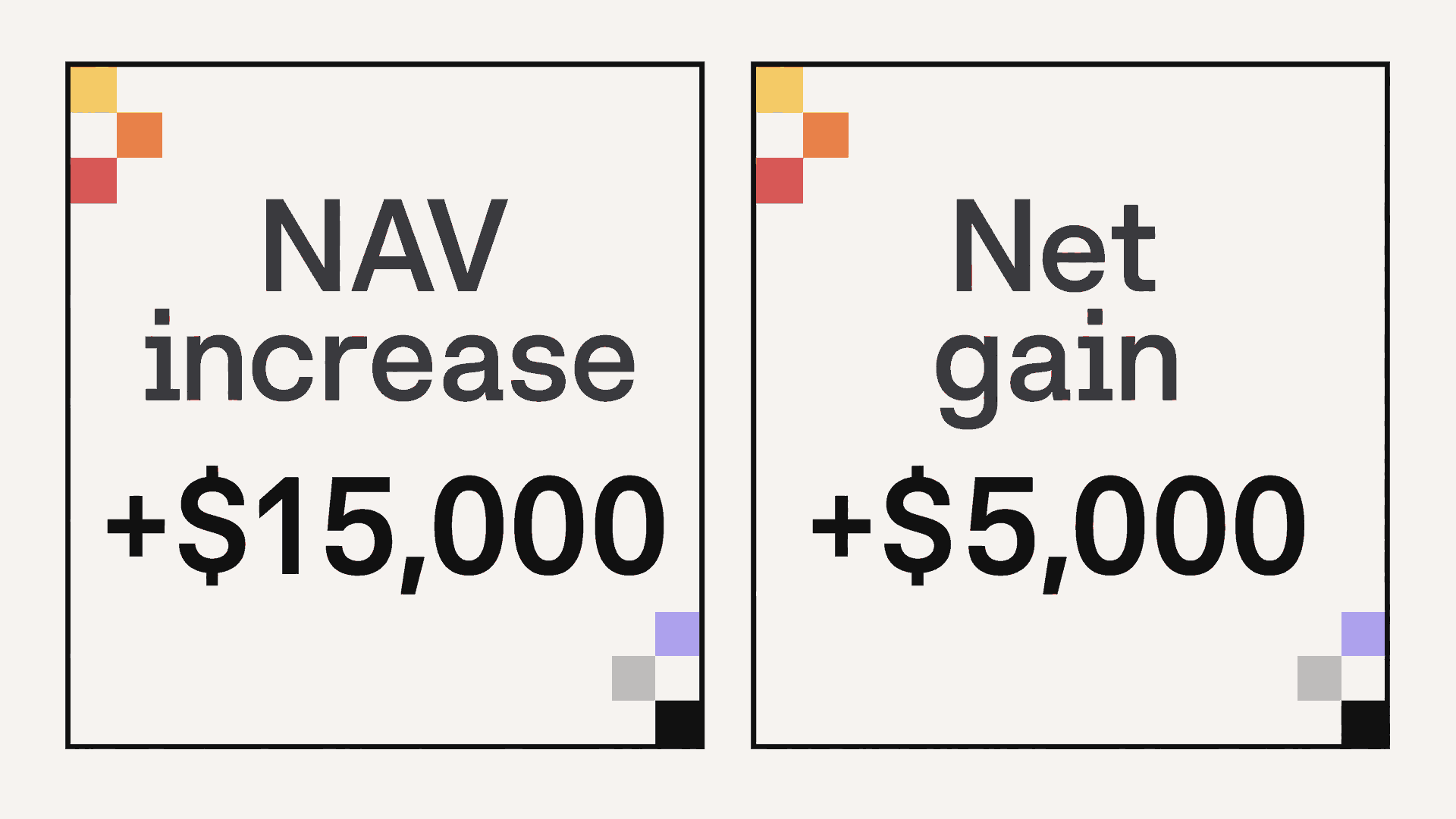
NAV increased by $15,000, while the quarter’s net gain was $5,000. Treating the full balance increase as profit would count part of your new contribution as a gain.
The reverse can happen after a distribution. A lower ending NAV may reflect value moving out of the fund and into investors’ hands. The reconciliation explains whether a decline came from distributions, losses, costs, or some combination.
Compare NAV with DPI and TVPI
Paid-in capital is the capital investors have contributed. NAV describes remaining value. Distributions describe value already returned. Three ratios put those amounts on the same capital basis, using ILPA’s metric definitions.
Using the same hypothetical, simplified LP example as of September 30, 2026, cumulative paid-in capital is $120,000, cash distributions are $10,000, and ending NAV is $115,000. The same net-of-fees, expenses, and accrued-carry basis and before-tax assumptions apply. Rounded to two decimal places:
- Distributions to paid-in capital (DPI). Cumulative distributions ÷ paid-in capital. Here, $10,000 ÷ $120,000 = 0.08x. It measures distributed value per dollar contributed.
- Residual value to paid-in capital (RVPI). Remaining NAV ÷ paid-in capital. Here, $115,000 ÷ $120,000 = 0.96x. It measures remaining value, including any fund cash and unsold holdings, per dollar contributed.
- Total value to paid-in capital (TVPI). Cumulative distributions plus remaining NAV, divided by paid-in capital. Here, ($10,000 + $115,000) ÷ $120,000 = 1.04x.
On a consistent basis, TVPI equals DPI plus RVPI. ILPA’s performance measurement definitions distinguish these investor-level cash flows from transactions between a fund and its portfolio companies. Outside this cash-only example, distributions can include securities.
TVPI includes remaining estimated value and doesn’t capture how long the capital has been invested. Our TVPI reading guide explains the multiple’s limits. The venture capital J curve adds the timing context.
An absolute NAV also says little about comparative performance. A larger fund can have a larger NAV while producing a worse result per dollar contributed. A higher per-share NAV doesn’t, on its own, establish that one fund is a better investment than another.
Understand what supports the private valuations
Private company holdings require valuation judgments when there’s no readily available market price. Fair value estimates what an asset would sell for in an orderly transaction between market participants at the measurement date, using current conditions and risk assumptions. International Financial Reporting Standard 13 describes this basis for fair value measurement.
A recent financing can inform the estimate. Its price doesn’t stay correct by default until another round occurs. The International Private Equity and Venture Capital Valuation (IPEV) 2025 valuation guidelines call for reassessing fair value at each measurement date.
A company’s headline valuation doesn’t assign equal value to every share class. Debt, dilution, and liquidation preferences, which give some holders priority in payouts, can affect your security’s value. IPEV’s guidance also addresses these allocation differences.
ILPA’s valuation adjustment definitions distinguish a write-down, which lowers an investment’s reported value, from a write-off, which reduces it to zero. These losses can reduce NAV without a sale. Weaker company performance, financing problems, and changing market conditions can support a lower valuation; a quiet fundraising calendar doesn’t establish that the old mark remains appropriate.
For a direct angel holding, retain the security type, ownership record, valuation basis, and valuation date alongside the reported value.
Reporting cadence depends on the fund’s governing agreements, applicable requirements, and reporting and valuation policies. A quarterly statement is one possible schedule, rather than a universal promise; ILPA’s reporting template guidance sets out a quarterly framework.
A report’s delivery date can also differ from its valuation date. A statement received in November may describe assets valued at September 30. Later developments don’t become part of that earlier number merely because you’ve heard about them.
NAV isn’t an executable sale price
A buyer of an existing private fund interest may offer more or less than reported NAV. IPEV treats reported NAV as a possible starting point for valuing a fund interest, with adjustments where appropriate. A discount alone doesn’t establish a bargain.
A reported valuation also supplies no buyer or sale deadline. The SEC’s private-placement bulletin explains the risks of illiquidity, limited disclosure, and total loss. Startup investments are speculative and long-term, and most bets may fail.
Build a repeatable NAV review
We’d organize each reporting period around five items:
- Date and scope. Record the valuation date, currency, fund or investor scope, and treatment of fees and carried interest.
- Movement in the balance. Separate contributions, distributions, investment gains or losses, and costs. Keep the cash-flow history alongside the ending balance.
- Support for major changes. Record which holdings moved, the valuation basis, and the company or market developments behind the change. A financing announcement and a valuation of your specific security answer different questions.
- Concentration by current value. Identify the holdings responsible for the largest share of remaining NAV. A portfolio spread across many initial checks can become dependent on one highly marked position.
- Cash obligations. Keep unfunded commitments and other expected payments beside your liquid resources. Don’t build a cash plan that depends on selling an illiquid holding at its reported value.
Concentration deserves attention even when the statement looks healthy. Our co-founder and general partner Elizabeth Yin writes in Democratizing Knowledge (Hustle Fund, 2021), “Don't try to pick a co. Select a portfolio.” Apply that lens to what the portfolio is worth today as well as how you originally divided your checks. Diversification doesn’t eliminate the possibility of losses across the portfolio.
Consistency also helps you distinguish better judgment from a temporarily higher mark. As Elizabeth writes in Democratizing Knowledge (Hustle Fund, 2021), “The more disciplined you are in your thought process/rubric, the more you can improve over time.” Our portfolio management guide explains how to keep those records connected.
To practice evaluating startup investments with context on the company, terms, and investment rationale, apply to Angel Squad. Our angel-investing community combines learning from Hustle Fund’s approach with curated deal flow and peer discussion.
This content is educational and isn’t investment, accounting, valuation, legal, or tax advice. Private investments are speculative, illiquid, and long-term; you can lose your entire investment. Past results and current marks don’t guarantee future results.
Actual outcomes depend on governing documents, fees, carried interest, taxes, capitalization-table ownership rights, valuation policies, and cash-flow timing. Refer to the governing documents and seek independent review from qualified investment, accounting, valuation, legal, and tax professionals for your circumstances.