IPO lock-up period: When your shares become sellable
Brian Nichols is the co-founder of Angel Squad, an angel investing community where aspiring and active angels learn from Hustle Fund’s approach, review curated deal flow, and connect with peers.
Your portfolio company has a ticker, and its public shares have a quoted price. You may still be months away from selling. That gap matters if you’re counting on an exit to fund taxes, another investment, or a major expense. Understanding who is restricted, how releases work, and what happens after expiration makes liquidity planning more realistic.
What is an IPO lock-up period?
An IPO lock-up period is a contractual restriction on selling or transferring covered securities in connection with an initial public offering (IPO). Shareholders typically make that commitment to the underwriters, the investment banks managing the offering.
A 180-day period is common. The Securities and Exchange Commission (SEC) says lock-up terms vary, including limits on how many shares can be sold. There is no universal SEC rule requiring every shareholder in every U.S. IPO to wait 180 days.
Lock-ups hold some existing shares out of the public market while the offering introduces shares to new investors. They constrain potential supply. They don’t guarantee a stable price or protect your investment from a decline.
For an angel, the useful distinction is between a company becoming public and your particular shares becoming available for sale. Our broader guide to listing and liquidity follows the rest of that path.
Who is restricted?
Coverage follows the agreements and the securities they describe. Being an early shareholder is a reason a lock-up may apply; the label alone doesn’t establish its terms.
The covered groups can include:
- Founders, directors, and executive officers. Their agreements may cover shares they hold directly and certain indirect holdings.
- Employees and other service providers. Restrictions can cover existing shares and shares received through equity awards.
- Angels, venture funds, and other pre-IPO investors. A private investor can be bound without having an operating role at the company.
- Other specified holders. Coverage can extend to family members, trusts, entities, or recipients of permitted transfers.
An underwriter agreement may overlap with a “market standoff” clause, an existing promise to the company to limit transfers around an offering. Investor-rights agreements and equity documents can contain these clauses. An unsigned new lock-up letter doesn’t establish that your shares are unrestricted.
Shares bought in the registered IPO or later on an exchange are generally outside the pre-IPO shareholder lock-up. Separate agreements and affiliate restrictions can still apply. An affiliate is someone with a control relationship with the company; the analysis goes beyond a job title or a single ownership percentage.
How long does the lock-up last?
The agreement identifies both when restrictions take effect and how their end is measured. Those can be different reference points.
Figma’s filed lock-up terms, for example, measured the 180-day period in its general release formula from the prospectus date. The formula also included an earnings-linked release.
A usable timeline separates four terms:
- Effective date. When the contractual restrictions begin.
- Measuring date. The event from which the stated day count runs, such as the date of the prospectus.
- Release trigger. A fixed date, an earnings announcement plus specified trading days, a stock-price condition, or a combination.
- Eligible portion. Which holders and how many of their shares qualify for that release.
“Six months after the IPO” loses several of those details. Calendar days and trading days are different, and “after the prospectus date” need not mean after the first exchange trade. A scheduled earnings announcement may also differ from the actual announcement that triggers release.
A real example of different release paths
Figma’s July 2025 prospectus described a general lock-up ending at the earlier of 180 days after the prospectus or the second trading day after a specified later earnings release.
It also described an earlier route for certain employee and service-provider shares, excluding directors and officers covered by the insider rules in Section 16 of the Securities Exchange Act of 1934. That route required an earlier earnings release and a price test: closing prices at least 25% above the IPO price on five days within ten consecutive trading days, including at least one qualifying day after that earnings release.
Those were Figma’s terms. They show why two shareholders in one company can have different release paths.
Early releases and exceptions have narrow boundaries
An early release can follow a trigger already written into the agreement or a discretionary waiver from the party authorized to grant one. A waiver for one holder or transaction doesn’t necessarily release everyone else.
For officer and director restrictions, the Financial Industry Regulatory Authority’s Rule 5131 generally requires the lead manager to notify the issuer and announce a release or waiver at least two business days beforehand. The rule has exceptions for specified transfers where the recipient remains bound. That requirement doesn’t turn every shareholder’s expiration into an identical public-notice process.
A permitted transaction may also leave the shares locked up afterward. Examples include:
- Family, estate, or trust transfers. Ownership may move while restrictions follow the shares to the recipient.
- Equity-award transactions. An agreement may permit an option exercise or award settlement while restricting later sales of the resulting shares.
- Tax sell-to-cover transactions. Permission may cover only enough shares to meet specified tax obligations, leaving the balance restricted.
Figma’s terms included versions of these exceptions. Their existence in one offering creates no entitlement in another.
Lock-ups can also restrict pledges, lending, hedging, and indirect transfers. A hedge is a transaction intended to offset economic exposure. Buying protection or borrowing against shares can fall within restrictions even when no ordinary stock sale occurs.
A Rule 10b5-1 trading plan can provide a conditional defense against insider-trading liability for prearranged trades. The SEC’s trading-plan rules include cooling-off periods and other conditions.
Adopting a plan doesn’t override a lock-up. Figma’s filed plan-adoption exception permitted establishing a plan, while barring transfers under it during the lock-up except for a specified tax-sale exception.
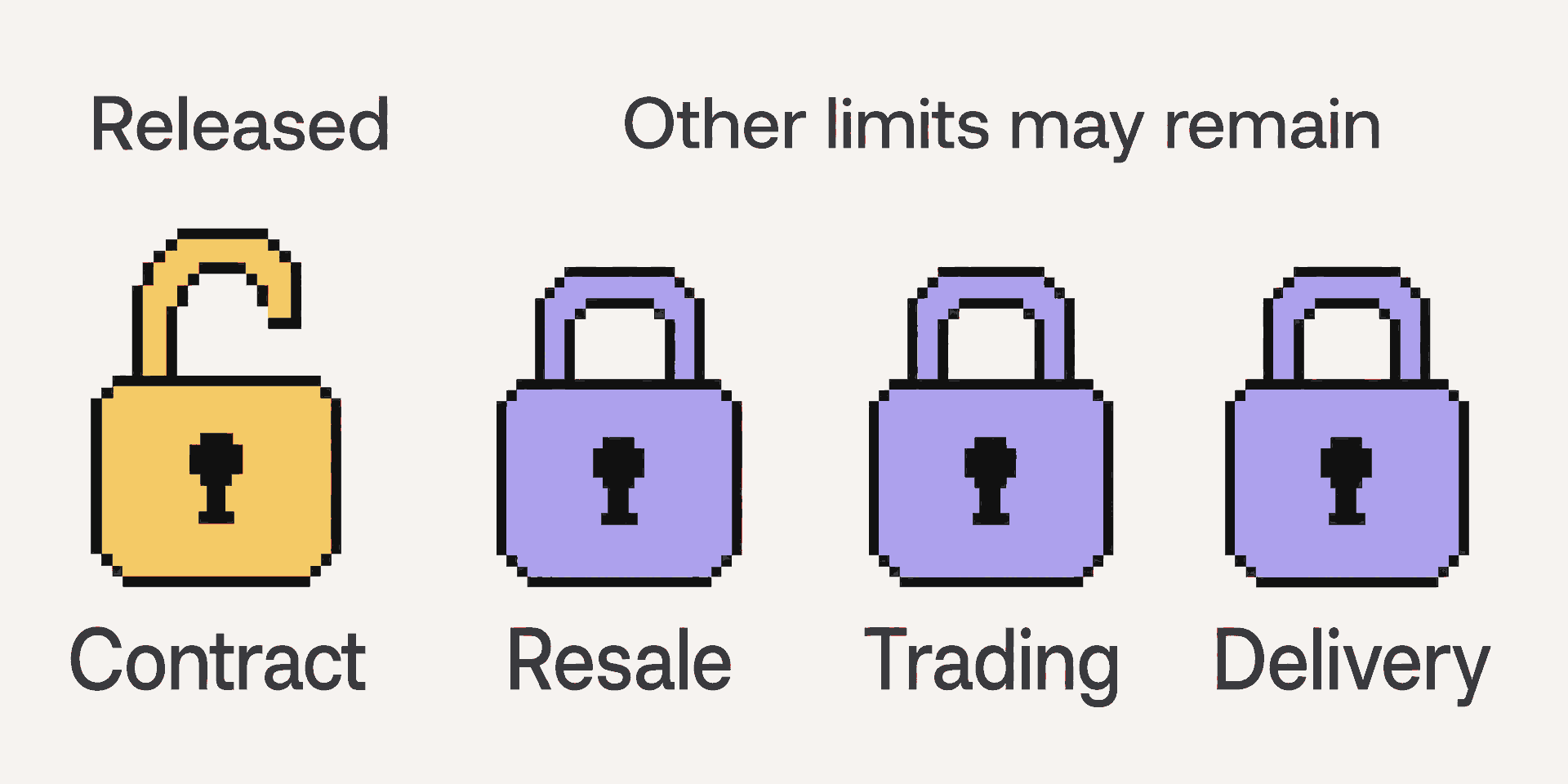
Expiration leaves three other potential barriers
Contractual release removes one restriction. Securities law, trading policies, and the practical ability to deliver shares can each delay a sale independently.
1. A lawful resale route
Private-company stock can remain a restricted security after the company lists. A public resale needs registration covering that resale or an available exemption.
Rule 144 provides a safe harbor for qualifying resales of restricted or control securities. Its conditions depend on the seller, issuer, and securities. Holding periods, public information, sale limits, and filing requirements can matter. Completing a contractual lock-up doesn’t establish compliance with Rule 144, and Rule 144 doesn’t cancel a contractual lock-up.
The SEC’s resale overview explains that separation. Our Rule 144 guide covers the holder-specific questions in more depth.
2. Trading permission
A company trading window is a period when its policy allows covered people to trade, subject to other requirements. A blackout is a period when that policy restricts trades. An open window and an expired lock-up can fall on different dates.
Material nonpublic information is significant information that investors don’t yet have publicly. Insider-trading restrictions remain relevant after contractual release. An open window alone doesn’t clear a person to trade while aware of such information. Pre-clearance requirements and applicable officer or director obligations can remain too.
3. Transfer and vehicle mechanics
A restrictive legend is a notation limiting resale. The transfer agent, which maintains ownership records, may need documentation and issuer consent before removing it. For a brokerage sale, the broker needs acceptable documentation and delivery arrangements. These steps take their own operational time.
An investor in a special purpose vehicle (SPV), an entity that holds an investment for its members, has another ownership layer. The SPV’s ability to sell company shares and your ability to receive cash or distributed shares are separate events. The manager’s authority, distribution terms, expenses, and administration govern that second step.
A lock-up expiration therefore belongs on a liquidity calendar alongside other conditions. It isn’t a guaranteed cash-arrival date.
A release record is more useful than one calendar reminder
Our co-founder Elizabeth Yin writes in Democratizing Knowledge, “The more disciplined you are in your thought process/rubric, the more you can improve over time.” That discipline is useful when planning an exit too. A written record separates contractual facts from assumptions about access to cash.
For a U.S. IPO, the public starting point is the final prospectus, often filed as Form 424B4 or 424B3. Before final terms exist, the latest registration statement and amendments provide preliminary information. The final version can differ.
The sections titled “Shares Eligible for Future Sale” and “Underwriting,” or similar names, contain the relevant disclosure. The Principal and Selling Shareholders section, or its equivalent, identifies the existing holders selling in the IPO and their retained holdings.
Search terms such as “lock-up” and “market standoff” help locate overlapping provisions. Our guide to reading an S-1 explains how the documents fit together.
A holder-specific release record contains:
- Ownership. The legal holder, share class, share count, and whether ownership is direct or through a vehicle. For awards, vested and settled shares are distinct from unvested or unsettled awards.
- Contract. Each applicable agreement, its covered transactions, measuring date, release formula, and eligible share portion.
- Changes. Later issuer announcements, filed amendments, and any applicable written release or waiver, including its conditions.
- Resale route. Registration or exemption, affiliate analysis, and any required sale documentation.
- Trading and delivery. Policy restrictions, approvals, legend removal, broker acceptance, and vehicle distribution steps.
This record also identifies who can resolve each issue. The issuer or stock administrator handles company processes, the transfer agent and broker handle delivery requirements, the vehicle manager handles distributions, and independent securities counsel addresses legal application.
Plan for delayed cash and an uncertain sale price
The SEC calls shares outstanding but unavailable for trading “market overhang.” Its IPO investor bulletin warns that prices may decline as previously restricted shares become available, especially when many become eligible together.
Eligibility doesn’t prove holders will sell. It also doesn’t identify the price available to you. Earnings, demand, market conditions, and expectations about future selling can move the stock before or after release. Expiration alone provides no reliable buy, sell, or hold signal.
Consider a hypothetical, simplified timing example. An angel owns 12,000 shares directly. The agreement releases 25% after a qualifying event, so 3,000 shares clear that contractual restriction and 9,000 remain locked.
The released shares still need a lawful resale route and operational clearance. An employee holding the same number may face a company blackout, while an SPV investor may wait for a manager’s sale and distribution. One company announcement doesn’t give all three investors the same liquidity.
A practical plan separates three decisions:
- Cash needs. Taxes, living expenses, and committed investments have due dates independent of a hoped-for stock sale. A delay scenario belongs beside the expected timeline.
- Concentration. The decision to retain shares after release depends on total exposure and risk capacity. For an operator, salary and equity may depend on the same company.
- Execution and proceeds. A plan includes eligible quantities, applicable approvals, transaction costs, and tax reserves. For vehicle investors, it also includes manager discretion, expenses, and carried interest, the manager’s contractual share of profits where applicable.
Elizabeth writes in Democratizing Knowledge, “Select a portfolio.” We apply that perspective to liquidity planning. The question is how a possible exit affects your whole financial position, including the investments that remain illiquid. Startup investing is risky, most bets may fail, and an IPO is never an assured outcome.
To build your investing judgment alongside other angels, apply to Angel Squad. Our community pairs investor education with curated deal discussions and peer learning, helping you build the portfolio judgment behind decisions like these.
This is general education, not legal, tax, or investment advice. Seek independent review from qualified legal and tax professionals for your securities, agreements, proposed transactions, and personal circumstances. Startup investments are speculative, illiquid, long-term, and can result in total loss.