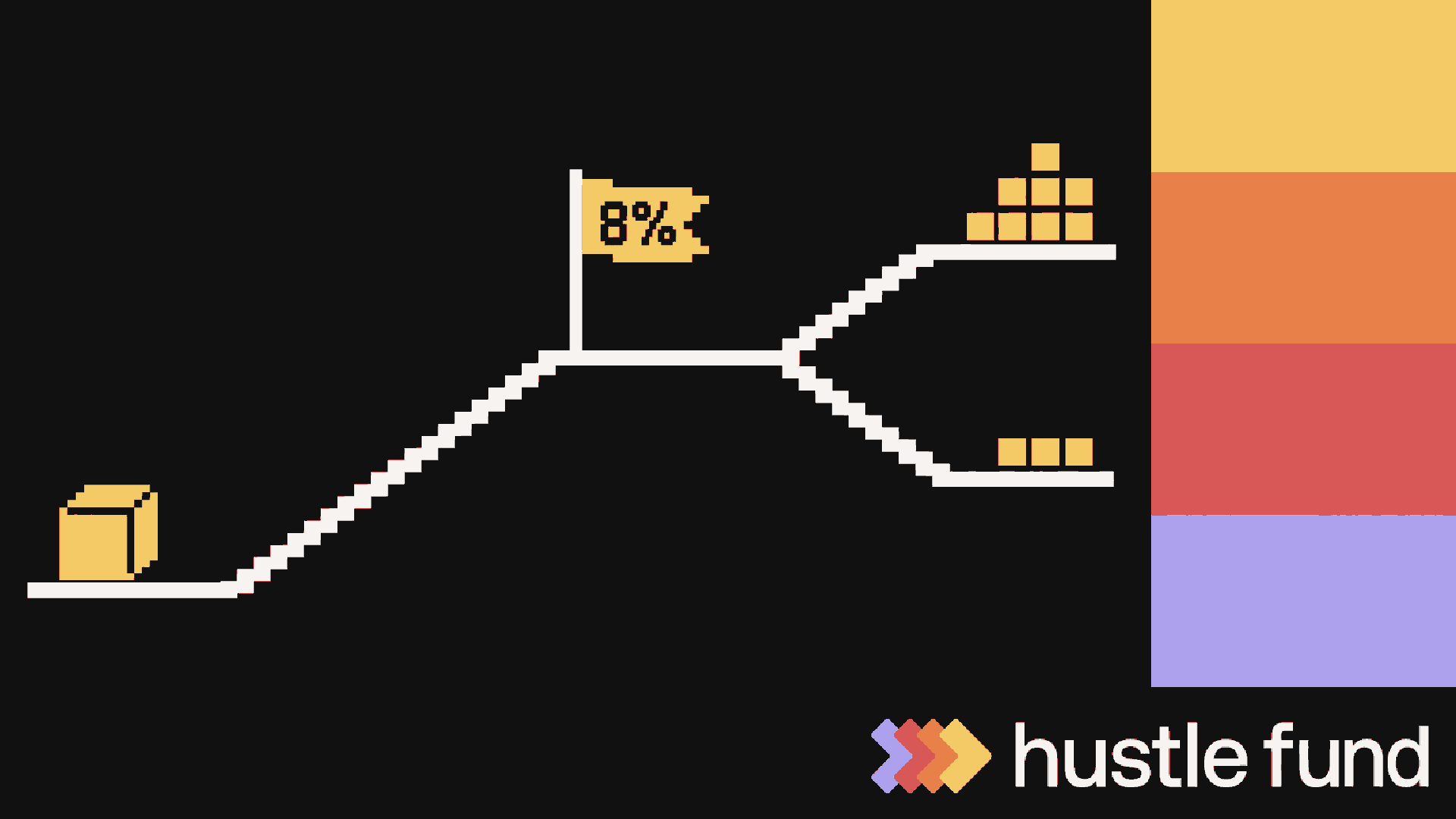
Hurdle rate: The fund terms that change investor returns
Brian Nichols is the co-founder of Angel Squad, an angel investing community where aspiring and active angels learn from Hustle Fund’s approach, review curated deal flow, and connect with peers.
One percentage can change who gets paid, when they get paid, and how much an investor keeps. Yet “hurdle rate” has two different jobs in finance. Here’s how to separate them, read the private-fund version correctly, and question the terms around it.
What is a hurdle rate?
A hurdle rate is a minimum return threshold. What happens at that threshold depends on the context.
- For a project or direct investment, the hurdle rate is a decision benchmark set before capital is committed. A company or investor compares the expected return with that benchmark and may reject an opportunity that falls short.
- For a private fund, the hurdle rate is a contractual threshold in the governing documents. It determines when the general partner (GP), which manages the fund, may start receiving carried interest, its performance-linked share of profits. The investors in the fund are limited partners (LPs).
Hedge funds use the term too, usually as a performance threshold that must be cleared before the manager charges a performance fee. That arrangement may reset periodically and interact with a high-water mark. Investor.gov’s hedge-fund guide treats hurdles and high-water marks as separate fee controls. This is different from a closed-end venture or private equity fund’s distribution waterfall.
What a private-fund hurdle rate actually does
In a private fund, the hurdle sits inside the distribution waterfall, the contractual order for allocating cash between LPs and the GP.
The hurdle rate is often discussed as if it guarantees investors a minimum return. It does not. If a fund loses money, the GP does not write a check merely because the documents state an 8% hurdle. The hurdle limits or delays carried interest. It cannot create profit or protect the LP’s capital from loss.
You will also see preferred return used as a synonym. A useful distinction is that the hurdle rate is the percentage or performance test, while the preferred return is the amount allocated to LPs under that test before carry begins. Fund documents do not always keep the language that tidy, so the limited partnership agreement (LPA) controls.
A common whole-fund waterfall moves through four stages:
- Return of capital: Distributable cash goes to LPs until the capital covered by the waterfall has been returned.
- Preferred return: Cash continues to LPs until the defined hurdle has been satisfied.
- GP catch-up: If the documents include one, some or all of the next dollars go to the GP until its share of profits reaches the negotiated carry percentage.
- Residual split: Remaining profit is divided between LPs and the GP according to the carry split.
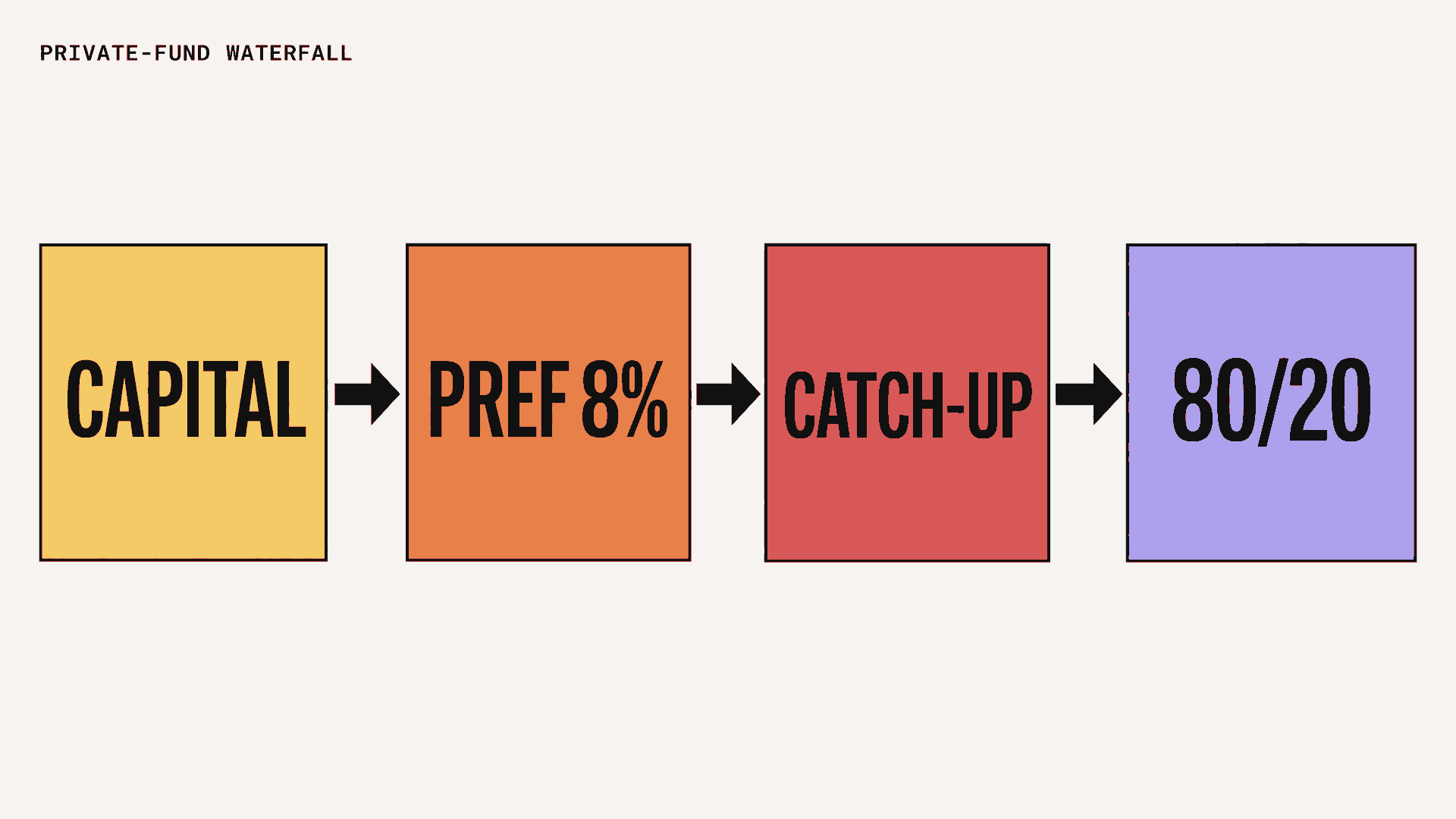
This sequence is an illustration, not a universal template. A waterfall may operate across the whole fund or deal by deal, and every stage can contain exceptions. The ILPA Principles 3.0 recommends an all-contributions-plus-preferred-return-back-first whole-fund model as LP-oriented best practice. It also recommends calculating carry on net profits and making the accrual method transparent and consistent.
A simplified hurdle-rate example
Hypothetical, simplified fund-level example as of September 18, 2026: This example covers one LP in a one-year, whole-fund waterfall. The LP contributed $100 one year ago and the fund now has $140 of fully realized gross distributable proceeds before carry. LP distributions shown below are net of carry and before tax. It assumes an 8% annual preferred return, 20% carried interest, a 100% GP catch-up, and no management fees, fund expenses, taxes, borrowing, recycling, follow-on contributions, recallable distributions, other LPs, interim cash flows, or unrealized investments. The example is educational and is not a projection.
The $140 flows like this:
- The first $100 returns the LP’s contributed capital.
- The next $8 pays the LP’s preferred return.
- The next $2 goes to the GP as catch-up.
- The remaining $30 is split 80/20: $24 to the LP and $6 to the GP.
The LP receives $132 in total. The GP receives $8 of carried interest, which is 20% of the $40 total profit. A full catch-up allowed the GP to participate in profit used to satisfy the hurdle after the threshold was cleared.
Now change one fact. If the fund has only $105 to distribute, all $105 goes to the LP under these assumptions and the GP receives no carry. The LP still falls short of the stated preferred return. That is why “preferred” does not mean “promised.”
Hard hurdle versus soft hurdle
The hurdle’s headline percentage tells you surprisingly little until you know how carry applies above it.
Hard hurdle
Under a hard hurdle, the GP earns carry only on profit above the preferred-return threshold. The profit allocated to satisfy the hurdle stays outside the carry base.
Using the same hypothetical assumptions and $140 of proceeds, but removing the catch-up, the profit above the $8 preferred return is $32. Carry at 20% would be $6.40, leaving $133.60 for the LP. This is an LP-friendlier result than the full-catch-up example.
Soft hurdle
Under a soft hurdle, clearing the threshold can make the GP eligible to share in all profit, including the profit used to satisfy the hurdle. Private funds commonly implement this economics through a catch-up stage.
The catch-up can be 100% to the GP or shared at another ratio. Its endpoint also matters. “8% hurdle and 20% carry” can therefore produce different allocations in two funds.
Terminology is inconsistent across documents and asset classes. Read the actual distribution language and a numerical waterfall model. The label is the beginning of diligence, not the answer.
Hurdle rate versus IRR, WACC, and discount rate
These terms appear together because they all inform return decisions. They are not interchangeable.
- Hurdle rate: The preset benchmark or contractual trigger.
- Internal rate of return (IRR): The discount rate that makes the net present value of a series of cash flows equal to zero. It is a money-weighted result that depends on the size and timing of cash flows.
- Weighted average cost of capital (WACC): A company’s estimated blended cost of debt and equity capital. A company may use WACC as a starting point for its project hurdle rate, then adjust for project risk or strategic considerations.
- Discount rate: The rate used to convert forecast future cash flows into present value. A project hurdle rate may be used as the discount rate in a net present value model.
- Preferred return: In a private-fund waterfall, the return allocated to LPs under the hurdle terms before the GP receives carry, subject to the rest of the agreement.
For project evaluation, a conceptual starting point is:
Project hurdle rate = base cost of capital + project-specific risk adjustment
There is no universal formula. A compliance project, a new factory, and a speculative acquisition do not carry the same risks or strategic value. The chosen rate should fit the cash flows and the decision, rather than create a decorative sense of precision.
Hypothetical, simplified project example as of September 18, 2026: This is one standalone corporate project on a gross, fully realized one-year basis. It assumes a $100,000 initial outlay and one $120,000 cash receipt after one year, with no follow-on capital, financing, fees, taxes, interim cash flows, residual value, or valuation changes. It is educational and is not a projection.
At a 15% hurdle rate, the present value of the $120,000 receipt is about $104,348. After subtracting the $100,000 outlay, net present value is about $4,348. The project’s IRR is 20%, so it clears the 15% hurdle under both tests. That financial screen does not settle whether the underlying forecasts are credible or whether another project is a better use of the money.
As our co-founder and general partner Elizabeth Yin writes in Democratizing Knowledge (2021, p. 287), “Decisions are never in isolation - they are a comparison game.” A hurdle is most useful when it forces a comparison with opportunity cost, portfolio fit, and the option to keep capital available.
How private funds calculate the hurdle
An “8% hurdle” is incomplete information. The agreement must define the calculation method and the cash flows it uses.
Common approaches include:
- Compounding preferred return: The stated rate accrues on a defined capital balance, often daily or annually. The agreement must say when accrual begins, when it stops, how returned capital changes the balance, and whether the return compounds.
- IRR test: The fund applies an IRR threshold to a defined set of contributions and distributions. Timing has a large effect, so the treatment of subscription credit lines, interim distributions, and deemed distributions matters.
- Capital multiple or fixed-return test: The manager receives carry only after LPs receive a stated multiple or percentage of drawn, invested, or committed capital. This reduces the role of timing but makes the capital definition decisive.
A Goodwin fund-terms analysis published in 2024 found that 50% of funds in its private-funds database used a compounding interest-rate approach, 38% used IRR, and 12% used a percentage of amounts drawn or committed. Venture funds in the analysis leaned toward compounding rates and capital-based multiples. The data explains market practice at that time; it does not replace the terms of a particular fund.
The calculation also depends on details such as:
- whether the base is committed, contributed, invested, or unreturned capital;
- whether fees and expenses accrue a preferred return;
- the day-count convention and compounding frequency;
- whether distributions stop or reduce accrual;
- how recycling and recallable distributions are treated;
- when capital funded through a subscription line starts the clock; and
- whether the hurdle applies fund-wide or separately to each investment.
ILPA’s model term sheet illustrates why drafting matters: its preferred-return clause specifies annual compounding, daily calculation, the applicable capital contribution, and start and end dates. A percentage without those inputs cannot tell you the economic result.
Is 8% a typical hurdle rate?
Eight percent is a common private-equity convention, not a universal default for private markets.
Goodwin’s 2023 terms-database analysis found that more than half of funds in its sample used an 8% hurdle and nearly 80% of private equity funds did. It also found that most US venture funds in the database had no hurdle, while hurdles were more common in venture funds outside the US.
That last point matters for startup investors. A venture fund with no hurdle may begin allocating carry once it has distributable profit under its waterfall. That does not make the fund automatically unattractive. A fund with an 8% hurdle is not automatically investor-friendly. Carry, catch-up, fees, waterfall timing, clawback protection, manager track record, strategy, and access all affect the full bargain.
A hurdle-rate checklist for startup investors
Your diligence depends on how you are investing.
For a direct startup check, there is usually no fund manager and no contractual carry hurdle. You can still set a personal required return as a screening assumption. At pre-seed, projected cash flows are fragile, exits are uncertain, and a neat IRR can hide weak inputs. Record the assumption in an investment memo, then assess the founder, market, traction, terms, dilution, and portfolio fit behind it.
For a syndicate or special purpose vehicle (SPV), focus on the vehicle’s governing and offering documents. Identify the carry rate, whether a hurdle exists, administrative or management fees, expenses, distribution timing, and whether carry is calculated deal by deal.
For a venture fund, read the limited partnership agreement and request a numerical waterfall for several outcomes and exit timings.
Ask these questions before treating the hurdle as meaningful:
- What exactly triggers carry? A compounded preferred return, IRR, multiple, or another test?
- Which capital earns the preference? Contributions for investments, fees and expenses, the full commitment, or another balance?
- When does the clock run? From the LP capital call, an earlier credit-line draw, the investment date, or another date?
- Is the hurdle hard or soft? Does the GP receive carry only above it, or can a catch-up apply carry to earlier profit?
- How fast is the catch-up? What share goes to the GP, and when does the residual split begin?
- Is the waterfall whole-fund or deal-by-deal? Can the GP take carry on early wins before later losses are known?
- What corrects overpayment? Examine clawback, escrow, guarantees, interim testing, and the treatment of taxes.
- What else reduces the LP’s net result? Include management fees, organizational costs, fund expenses, taxes, dilution, valuation policy, and the timing of cash flows.
Hurdle diligence is a process question. Elizabeth Yin puts it plainly in Democratizing Knowledge (2021, p. 131): “The more disciplined you are in your thought process/rubric, the more you can improve over time.” Save the answers, model the waterfall, and compare actual distributions with the original terms.
Why a higher hurdle can still disappoint
A higher percentage sounds better for LPs, but the surrounding mechanics can reverse that first impression.
- A full catch-up may narrow the difference. Once the GP catches up, the ultimate profit split can look much like a lower-hurdle structure, although timing and downside outcomes may still differ.
- A generous headline can sit on a narrow base. A high rate applied only to invested capital can produce less preference than a lower rate applied to a broader balance.
- IRR can reward speed. Early distributions can produce a high IRR even when the multiple on invested capital is modest.
- Deal-by-deal carry can arrive before the portfolio is settled. Later losses may create a clawback claim, and recovery depends on the agreement and the people or entities behind the obligation.
- Fees and expenses keep running. A hurdle governs carry. It does not neutralize every other cost.
The reverse is also true. A hurdle-free structure can be an informed tradeoff if the investor understands the manager’s incentives and the rest of the economics. Model complete cash flows, then decide whether the expected alignment fits the risk.
Don’t let one percentage hide the economics
A hurdle rate is useful only when you can explain the capital base, clock, catch-up, waterfall, and carry in dollars. If you want to build that habit alongside investors and operators, apply to Angel Squad. You’ll learn how to evaluate startup opportunities and investment structures, then practice those decisions against curated deal flow.
This material is for educational purposes only and does not constitute investment, legal, tax, accounting, or valuation advice. Every example is hypothetical and simplified, not a projection. Startup and private-fund investments are speculative, illiquid, long-term, and subject to total loss. Past results and current portfolio marks do not guarantee future results. Actual outcomes depend on the governing and offering documents, fees, carried interest, expenses, taxes, cap-table terms, valuation policies, follow-on financing, and the timing and character of cash flows. Review the governing documents and seek advice from qualified independent legal, tax, investment, accounting, and valuation professionals.