
Can you put stocks in a trust? A guide for investors
Trust planning gets complicated when one portfolio mixes public shares, startup stock, Simple Agreements for Future Equity (SAFEs), and special purpose vehicle (SPV) interests. Each has a different owner of record and transfer desk.
Start by identifying what you own. Then match the trust, paperwork, tax analysis, and records to that asset.
Can you put stocks in a trust?
Yes. A trust can hold publicly traded stocks and, in many cases, private-company shares. People often say the trust owns the stock. On account statements and a company's stock ledger, the registered holder is usually the trustee acting for the named trust.
The transfer has to reach the record that proves ownership. Listing shares on a trust schedule or mentioning them in a will does not, by itself, retitle a brokerage account, assign a contract, or change a private company's stock ledger.
A taxable brokerage account can often move to a revocable living trust through an in-kind registration change. Private shares may also require an assignment, company consent, a waiver, a joinder, and an updated stock ledger.
This is general educational information, not legal, tax, or investment advice. Engage independent estate-planning, tax, and securities professionals to review the trust, assets, signed agreements, transfer, and reporting before taking action.
First, identify what you actually own
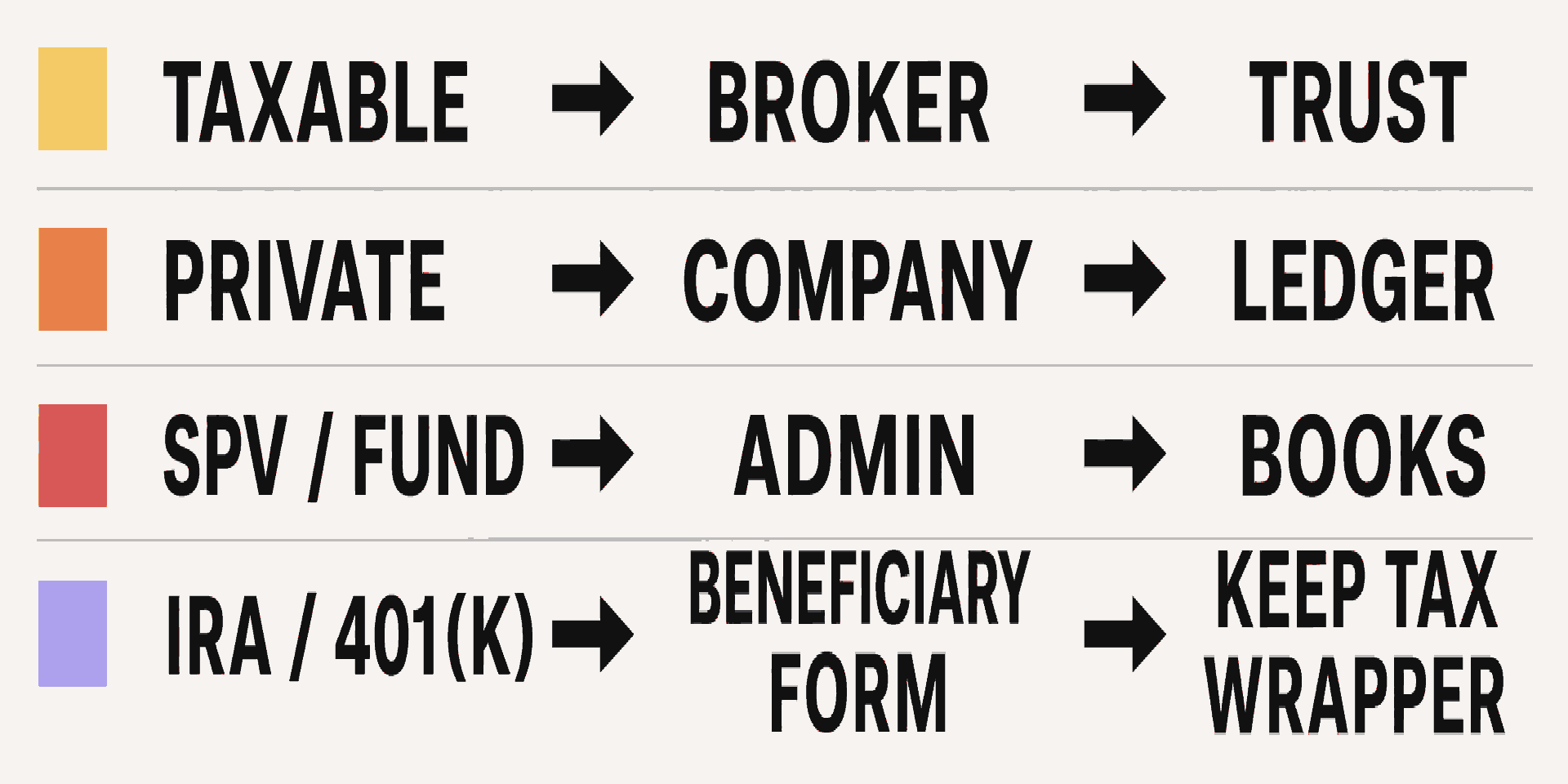
The word “stock” can hide six different assets. That difference decides who can approve and record the transfer.
- A taxable brokerage account. The brokerage holds public stocks, exchange-traded funds, or mutual funds for you. The registration changes to the trustee's name, and positions usually move in kind.
- Public shares held directly. A transfer agent, dividend reinvestment plan, direct registration system, or certificate may carry the record. This path can require a stock power and medallion signature guarantee.
- Direct private-company shares. The company's stock ledger or capitalization-table administrator records you as the shareholder. Transfer restrictions can appear in the certificate, stock purchase agreement, bylaws, voting agreement, or right of first refusal and co-sale agreement.
- A SAFE, note, warrant, or option. These are contracts or securities, not necessarily issued shares. Their assignment clauses control. An incentive stock option is generally nontransferable during the holder's life under Internal Revenue Code Section 422.
- An SPV or fund interest. If you invested through a vehicle, the vehicle may own the startup shares while you own an interest in the vehicle. The operating agreement, limited partnership agreement, platform, and fund administrator govern your transfer.
- Stocks inside an IRA or workplace plan. The retirement account is the tax wrapper. These positions do not follow the taxable-brokerage process. IRA transfers receive tax-free treatment only through permitted routes under the IRS IRA rules. If the estate plan calls for a trust, it generally appears on the account's beneficiary designation form rather than becoming the lifetime owner. That keeps the retirement tax wrapper in place during the account holder's life.
Revocable, irrevocable, grantor, and non-grantor are different labels
A trust's legal flexibility and its federal income-tax status answer different questions.
Revocable living trust
You can usually amend or revoke this trust, serve as trustee, and keep trading. A successor trustee can step in if you become incapacitated. Properly transferred assets can avoid probate and continue under your distribution rules.
A revocable living trust is generally a grantor trust. The IRS treats its income, deductions, gains, and losses as belonging to the grantor for federal income-tax purposes. The Form 1041 instructions also make clear that grantor trust treatment can apply to all or only part of a trust.
Revocable does not mean removed from your taxable estate or protected from your creditors. It does not create automatic estate-tax or asset-protection results.
Irrevocable trust
An irrevocable trust can limit your ability to reclaim or redirect assets. It may be a grantor or non-grantor trust. A transfer may be a completed or incomplete gift, and the assets may be included in or excluded from your estate.
That is why “irrevocable” is not a tax answer. The tax professional needs to map who reports income, whether a gift occurred, whether the assets remain in the grantor's estate, and what basis rules apply.
“Decisions are never in isolation - they are a comparison game.”
Elizabeth Yin, our co-founder and general partner, Democratizing Knowledge, p. 287
Compare the structure against the actual goal. Probate continuity, incapacity planning, a lifetime gift, creditor planning, and estate-tax planning can point to different trust terms.
How to put public stocks in a trust
For ordinary stocks in a taxable brokerage account, use this sequence:
- Define the new registration. The trust name and date, trustee names, powers, and taxpayer identification number must match the legal documents.
- Open or retitle the trust account. A brokerage commonly asks for a trust application, certification or abstract, trustee identification, tax forms, and a registration or transfer form.
- Move the positions in kind. This keeps the shares and tax lots. Margin, open orders, pledged positions, and fractional shares can require separate handling.
- Reconcile the completed account. The final statement should show the new registration and every position, acquisition date, and basis lot. Preserve the last old statement with the first trust statement.
Shares recorded by a transfer agent follow its forms instead. Certificated shares often require a signed stock power plus a medallion signature guarantee, which protects the issuer and transfer agent against an unauthorized signature. Never sign a certificate or stock power until the transfer agent's instructions call for it.
Moving a taxable brokerage account to a revocable grantor trust usually changes registration without creating a sale. A liquidation, fractional-share cash-out, debt assumption, foreign trust, or other unusual feature can change the analysis.
How to put private-company stock in a trust
Private stock adds three gates: the contract, the company, and securities law. Clearing one does not clear the others.
1. Build the ownership file
Collect the stock purchase agreement, certificate or electronic notice, capitalization-table statement, wire record, amendments, investor rights, and tax records. For a SAFE or note, include the original instrument and conversion documents.
The file should show the holder, issuer, security class, share count, acquisition date, basis, repurchase terms, and rights that travel with the security.
2. Map every transfer restriction
Read the certificate legend, bylaws, purchase and voting agreements, right of first refusal and co-sale agreement, and transfer policy. Clauses may require consent, give someone a prior purchase right, prohibit certain holders, or allow an estate-planning transfer only if the recipient signs a joinder.
Many startups are Delaware corporations. Delaware Section 202 expressly recognizes several written stock-transfer restrictions, including prior purchase opportunities and consent requirements. It also contemplates their application to trustees and other fiduciaries.
Our guide to right-of-first-refusal mechanics explains why a family or trust exception can still require notice, a joinder, and written clearance.
3. Obtain approvals and record the transfer
Submit the trust certification, assignment, notices, joinder, investor representations, and tax forms through the company's process. Its board, counsel, transfer agent, or capitalization-table administrator may need to act.
The closing file should contain every consent or waiver, the signed assignment, the canceled and replacement certificate if applicable, and written confirmation that the stock ledger names the trustee. An updated dashboard without an updated legal ledger is weak proof of ownership.
4. Keep the restrictions with the shares
Moving restricted stock into a trust does not make it freely tradable. The SEC's restricted-securities guidance explains the resale conditions and legend-removal process. Rule 144 may provide a resale safe harbor in a later transaction, but it does not override a company consent right, right of first refusal, or contractual lockup.
A platform investment may be an entity interest
An AngelList portfolio entry, for example, may represent an SPV interest rather than startup shares. AngelList lists revocable and irrevocable trusts among its eligible investment entities, subject to the platform's accreditation and verification requirements. Moving an existing investment to another entity starts with AngelList's transfer request form and runs through its transfer process.
The startup's stock ledger does not change when only the SPV interest moves. The SPV's books, transfer agreement, and tax records do.
This distinction is part of the structure-first approach we teach inside Angel Squad, our angel-investing community. Members learn to separate direct securities from vehicles and keep repeatable investment records.
Private shares carry extra tax and entity traps
Qualified Small Business Stock (QSBS). The Section 1202 gift rule treats a qualifying transferee as acquiring the stock in the same manner as the transferor and adds the transferor's continuous holding period. That rule does not prove the shares, transfer, trust, or ultimate taxpayer qualifies. Read our guide to the current QSBS rules, then have qualified tax counsel document the result before the transfer.
S corporation shares. An S corporation cannot have just any trust as a shareholder. Section 1361 permits defined trust categories and elections, including certain grantor trusts, qualified subchapter S trusts, and electing small business trusts. An ineligible trust or missed election can threaten the company's S election.
Private-stock valuation. If the transfer is a completed gift, the gift-tax file needs a supportable fair market value as of the gift date. The federal stock-valuation rule uses market quotations when they are available and, for stock without usable quotations, considers factors such as the company's net worth, prospective earning power, and dividend-paying capacity. A recent financing price is evidence, not an automatic answer for a different share class, date, or restriction. The Form 709 instructions explain the IRS gift-tax valuation and disclosure requirements, including the appraisal or detailed valuation information needed for adequate disclosure.
What happens to taxes and cost basis?
The transfer itself
An in-kind change from your individual taxable brokerage account to your revocable grantor trust generally does not create a sale. A completed transfer to an irrevocable trust may be a gift and may require Form 709 even when no current gift tax is payable; the IRS gift-tax FAQs explain when a return is generally required. Transfers for consideration, transfers involving liabilities, and transfers to foreign trusts require separate analysis.
Income while the trust holds the stock
In a grantor trust, the grantor generally reports the dividends, gains, and losses. A non-grantor trust is a separate taxpayer, may retain taxable income, and may pass distributable income to beneficiaries through Schedule K-1. The trust document and tax rules determine where each item lands.
Basis after a lifetime gift
Gifted appreciated property generally carries the donor's basis for calculating gain under Section 1015. The rule has a separate loss-basis limitation when fair market value at the time of the gift is below the donor's adjusted basis. A completed gift of low-basis appreciated shares can therefore move the built-in gain along with the asset.
Basis at death
Property acquired from a decedent generally receives a basis tied to fair market value at death under Section 1014. Stock in a revocable trust is generally included in the grantor's estate and can qualify. Stock previously given to an irrevocable trust and excluded from the estate may not.
The IRS addressed one common misconception in Revenue Ruling 2023-2: assets in an irrevocable grantor trust that were transferred by completed gift and were not included in the grantor's gross estate did not receive a Section 1014 basis adjustment at the grantor's death.
Consider a conditional example. Dana buys private shares for $25,000. They are worth $400,000 when Dana transfers them by completed gift to an irrevocable trust, and the gift keeps Dana's basis. If the trust later sells for $700,000, the starting gain calculation is $675,000 before adjustments or available exclusions.
If Dana instead keeps the shares in a revocable trust until death, the shares are included in Dana's estate, and a defensible date-of-death value is $400,000, Section 1014 may reset the basis to $400,000. A later $700,000 sale would start with $300,000 of gain. The trust terms, estate inclusion, valuation, state law, and QSBS status can change either outcome.
When putting stocks in a trust makes sense
A revocable living trust is often a strong fit when you have a taxable investment account and want:
- continuity if you become incapacitated;
- probate avoidance for properly titled assets;
- one set of instructions for several beneficiaries;
- delayed or conditional distributions; or
- a durable owner for long-hold private investments.
Pause before transferring when:
- the stocks sit inside an IRA, 401(k), or other tax-advantaged account;
- private-company documents restrict the transfer;
- you hold a SAFE, option, note, or SPV interest instead of direct shares;
- an irrevocable trust is being proposed mainly for tax or creditor results that have not been modeled; or
- a transfer-on-death registration would meet a narrow probate goal with less administration.
A transfer-on-death registration can move a taxable brokerage account to named beneficiaries at death without putting the account in a trust. It does not provide the same ongoing distribution terms or successor-trustee management during incapacity.
A pre-transfer checklist for investors
Build one file that answers these questions before anything moves:
- Goal: Is the transfer for incapacity planning, probate avoidance, controlled distributions, lifetime gifting, estate-tax planning, or another defined purpose?
- Trust: What are the exact name, date, trustees, taxpayer identification number, investment powers, amendment rights, and successor provisions?
- Tax status: Is the trust revocable or irrevocable, grantor or non-grantor, and is the transfer a completed gift? Will the asset be included in the grantor's estate?
- Asset: Who is the current legal owner, and is the holding a brokerage position, direct share, SAFE, note, option, warrant, SPV interest, or fund interest?
- Restrictions: Which consent, right of first refusal, joinder, transfer policy, securities-law condition, or platform approval applies?
- Tax record: What are the lot-level basis, acquisition date, holding period, fair market value, valuation support, gift-tax filing, and possible QSBS or S corporation consequences?
- Closing proof: Do the final brokerage registration, company ledger, SPV books, certificates, tax forms, and dashboards all name the same owner?
- Ongoing administration: Who will receive company updates, vote, sign consents, evaluate pro rata rights, fund capital calls, and maintain records for the trustee and beneficiaries?
“Don't try to pick a co. Select a portfolio.”
Elizabeth Yin, our co-founder and general partner, Democratizing Knowledge, p. 130
A trustee inheriting an early-stage portfolio needs more than a list of company names. Give them the ownership chain, restrictions, tax lots, contacts, future obligations, and authority to manage concentrated, illiquid positions under the trust and applicable law.
Get the structure right before the signature
Public stocks can often move to a revocable trust through an in-kind registration change. Private investments require deeper work because “the stock” may be a contract or vehicle interest, and the issuer's documents can control whether the transfer is recognized.
Clean records make that work manageable. If you want to build disciplined investment files, learn alongside experienced operators, and access curated early-stage deal flow, apply to Angel Squad.













.png)