
Pari passu meaning: equal ranking and startup payouts
Brian Nichols is the co-founder of Angel Squad, an angel investing community where aspiring and active angels learn from Hustle Fund’s approach, review curated deal flow, and connect with peers.
You can back the same startup as a larger investor and still receive a very different payout. Two words in the financing documents, pari passu, help explain where your claim sits. Understanding them makes it easier to follow how a company’s available cash moves through lenders, preferred investors and common shareholders.
What does pari passu mean?
Pari passu means “on equal footing.” In financing documents, it describes claims or rights that rank equally for the purpose specified. If two claims rank pari passu for a specified payout, neither has priority over the other within that group.
Preferred shares can give investors specified payout rights ahead of common stock, shares without those preferred rights. Two series, or groups, of preferred shares can rank equally with each other while both rank behind creditors, those owed money by the company. Pari passu describes the relationship between claims at a given rank.
Three terms make the payout order easier to follow:
- Senior: A claim has priority over another claim for the specified payment.
- Pari passu: The covered claims have equal priority.
- Junior or subordinated: A claim ranks behind another claim.
Equal ranking can produce unequal dollar payments. When the governing terms allocate a shortfall proportionally, a larger amount due receives a larger share of the available cash. The relevant amount might be a loan balance or a preferred investor’s payout claim, rather than the investor’s percentage ownership.
Pari passu also doesn’t make every other term identical. Interest rates, prices for converting into shares, voting rights and payment dates can differ. A clause about payout priority alone doesn’t settle those separate rights.
In Democratizing Knowledge (Hustle Fund, 2021), our co-founder Elizabeth Yin warned crowdfunding investors that “you may not actually be getting IDENTICAL TERMS”. Equal ranking and identical economics are different things, even when investors back the same company.
Pari passu vs. pro rata
Pari passu describes rank. Pro rata describes a proportional allocation.
They often work together. Equal-ranked investors may divide an insufficient payout pro rata according to the amounts due to them. Under that arrangement, each receives the same percentage of their claim, even though their dollar payments differ.
The calculation for a shortfall is:
Your payout = cash available to the equal-ranked group × your amount due ÷ total amounts due to that group.
This formula assumes the group’s governing terms require that proportional allocation. It doesn’t decide who belongs in the group or which claims must be paid first.
In startup investing, pro rata rights usually mean a contractual right to invest more money in a future financing to maintain ownership, subject to the right’s terms. A proportional exit payout doesn’t grant that future-investment right. Likewise, follow-on rights don’t establish equal liquidation ranking.
Pari passu debt: equal-ranked lenders sharing a shortfall
Debt is an obligation to repay money. A creditor is someone the company owes. Loan documents can place specified lenders at the same rank and set how they share recoveries.
The Business Development Bank of Canada describes equal-ranked co-lenders sharing realization proceeds according to their balances due. That is a useful contract example, rather than a rule that every creditor in every country has the same rights.
A debt payout example
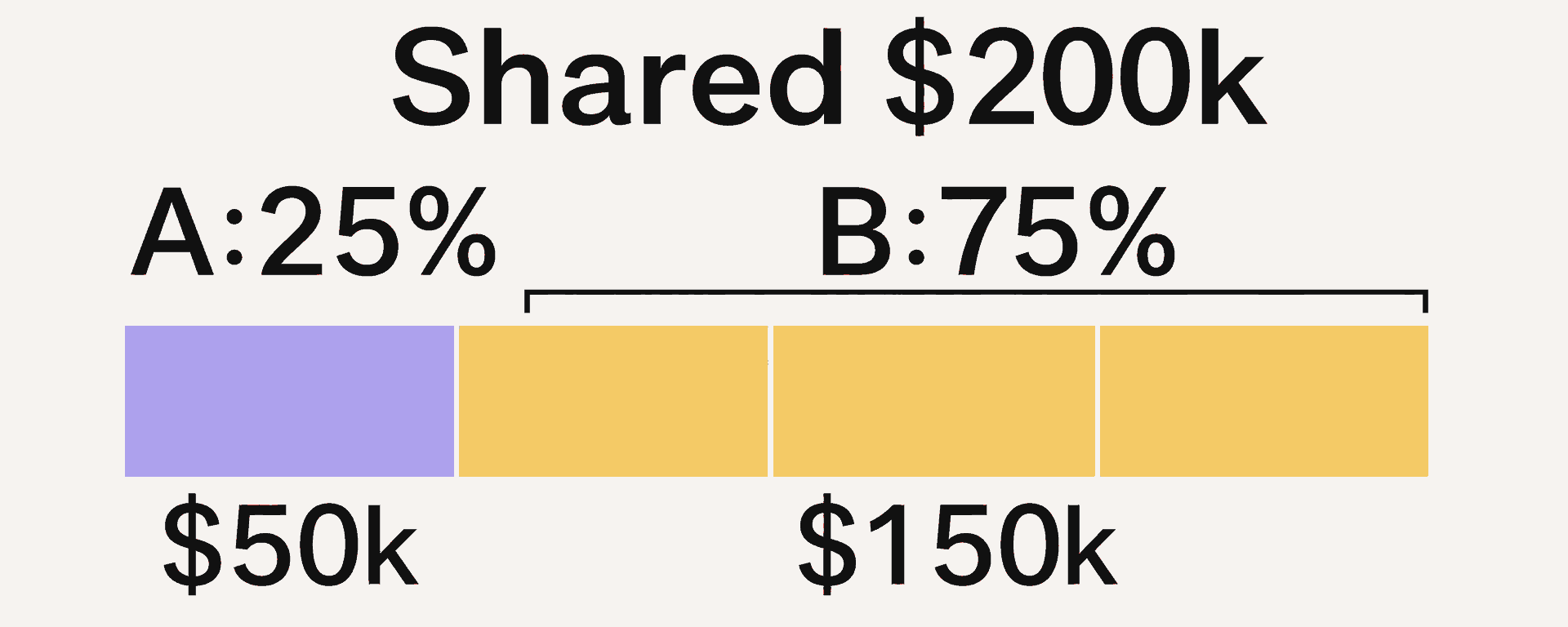
In this hypothetical, simplified deal example, two lenders have claims of $100,000 and $300,000. Their agreement gives them equal rank and proportional shares of recoveries. After all prior claims and costs, $200,000 is legally available to their group.
- Lender A: $200,000 × $100,000 ÷ $400,000 = $50,000.
- Lender B: $200,000 × $300,000 ÷ $400,000 = $150,000.
Each receives 50% of the amount owed. Neither lender jumps ahead of the other, and neither receives full repayment.
These are hypothetical cash distributions at an assumed October 10, 2026 payment date, gross of investor-level fees and taxes. The balances include all amounts due for this example; additional interest, other claims and further loan advances are excluded.
A pari passu clause doesn’t by itself establish identical collateral rights. Collateral is property that secures a debt, and a lien is a legal claim against that property. Security documents, agreements among creditors and applicable law can affect recovery separately from a debt-ranking clause.
U.S. bankruptcy law also has payment categories and exceptions. For example, Chapter 7 distribution rules provide proportional payment within specified categories. They don’t put every creditor in one equal-ranked pool.
Pari passu preferred shares: ranking and preference size
Preferred shares can give investors a liquidation preference, a right to receive a specified amount before common shareholders receive a payout in covered events. A company sale may trigger that right if the documents treat the sale as a liquidation event.
The preference size and the ranking answer different questions. A 1x preference generally starts with an amount equal to the investment, subject to the documents. Pari passu determines how that claim ranks alongside other covered preference claims.
A charter, the company’s certificate of incorporation, sets out its stock rights. The National Venture Capital Association’s model preferred-share charter provides for equal-ranked preferred liquidation payments and allocates a shortfall according to the amounts otherwise payable. Its drafting notes require changes if series have senior or junior preferences. The model offers alternatives, so an actual company’s charter determines the rights.
A preferred-share payout example
In this hypothetical, simplified deal example, Series A investors put in $1 million and Series B investors put in $3 million. Both have pari passu, 1x non-participating liquidation preferences. Non-participating means they receive their preference or the applicable common-stock-based payout, without also taking a second share of the remaining cash after receiving the preference.
Assume taking the preferences gives each series the larger payout, no dividends are owed, and $2 million is legally available to these preferred investors after all prior claims and costs.
- Series A: Its $1 million claim is one-quarter of the $4 million total. It receives $500,000.
- Series B: Its $3 million claim is three-quarters of the total. It receives $1.5 million.
- Common shareholders: They receive $0 because the preference claims exhaust the cash.
These are hypothetical deal-level cash distributions at an assumed October 10, 2026 closing, gross of investor-level fees and taxes. There are no other preferred claims or follow-on investments in the example.
The two series have equal rank, but they receive different dollar amounts. A different preference multiple, participation right, dividend entitlement or conversion outcome could change the allocation even if their ranking stayed equal. Our liquidation preference guide explains those separate mechanics.
Pari passu in Simple Agreements for Future Equity (SAFEs)
A Simple Agreement for Future Equity (SAFE) is a contract giving an investor rights to future shares and specified payments in certain events. It isn’t a loan. Our SAFE agreements guide covers the instrument’s broader structure.
An outstanding SAFE can have different payout ranks depending on the payment involved. A valuation cap limits the valuation used in certain SAFE share-price calculations; it doesn’t establish payout rank. Under Y Combinator’s U.S. valuation-cap SAFE, the purchase-amount payment, called the Cash-Out Amount, is:
- Junior to outstanding debt and creditor claims. Convertible notes, debt that can convert into shares, are included unless they have converted or are treated as converted for the payout calculation.
- On par with other SAFE and preferred-stock cash-out or preference payments, with proportional sharing if the available proceeds fall short.
- Senior to common-stock payments.
In a liquidity event, such as a covered acquisition, the form entitles the investor to the greater of the Cash-Out Amount or the Conversion Amount, subject to its priority provisions. The Conversion Amount is the payout calculated as if the SAFE represented common shares. It shares the common/as-converted payout tier, junior to outstanding debt and creditor claims as well as cash-out and liquidation-preference claims.
That is why “my SAFE ranks equally with preferred stock” is incomplete. The cash-out route and the common-stock-based route occupy different positions. After a SAFE converts in an equity financing, a round in which the company issues shares, the resulting shares’ governing terms determine their rights. Amended SAFEs and forms for other jurisdictions can differ from this U.S. form.
A SAFE dissolution example
In this hypothetical, simplified deal example, a startup winds down with $250,000 available before paying its only creditor $50,000. Two outstanding, unmodified U.S. valuation-cap SAFEs have purchase amounts of $100,000 and $300,000. There are no preferred shares or other claims.
The creditor payment leaves $200,000 for the $400,000 of equal-ranked SAFE cash-out claims:
- SAFE investor A: Receives $50,000.
- SAFE investor B: Receives $150,000.
- Common shareholders: Receive $0.
These are hypothetical deal-level cash distributions at an assumed October 10, 2026 dissolution, gross of investor-level fees and taxes. The available cash is after winding-up costs; no later payments or follow-on investments are assumed.
The priority clause divides what remains. It doesn’t guarantee that the startup will have any cash left after creditors.
How seniority changes the same exit payout
A payout waterfall is the order and method used to distribute proceeds among claims. Pari passu sharing happens within a particular tier of that order.
Consider a hypothetical, simplified all-cash startup sale for $2 million. Assume $500,000 goes to transaction costs and debt, leaving $1.5 million legally available to shareholders. Series A has a $1 million preference claim; Series B has a $2 million preference claim. Both are 1x non-participating, and neither receives a larger payout on a common-stock basis.
If the two series rank pari passu, the $1.5 million is shared in proportion to their $3 million of claims:
- Series A: Receives $500,000.
- Series B: Receives $1 million.
- Common shareholders: Receive $0.
If the charter instead makes Series B’s entire $2 million preference senior to Series A’s preference, Series B receives all $1.5 million. Series A and common shareholders receive $0.
These are hypothetical deal-level cash distributions at an assumed October 10, 2026 closing, net of the stated company costs and debt but gross of investor-level fees, carried interest and taxes. Carried interest is a share of investment profits paid to an investment manager. The example excludes dividends, other securities, follow-on investments and delayed or conditional payments.
The sale price and preference amounts stayed the same. Changing the rank changed who received the cash. Series B’s later financing date alone wouldn’t establish seniority; the governing rights do.
A larger exit can also change whether investors receive preferences or common-stock-based proceeds. Our exit waterfall modeling guide covers those multi-price outcomes and conversion decisions.
What the full clause needs to establish
In Democratizing Knowledge (Hustle Fund, 2021), Elizabeth Yin urged investors to “really understand what exactly you are investing in.” Her point about crowdfunding document diligence applies here: the security’s full rights determine the payout.
A useful explanation of a pari passu provision establishes five things:
- The covered claims: Which loans, SAFE payments or share series rank equally? “All preferred stock” and “Series A preferred stock” describe different groups.
- The covered event and right: Does the clause address liquidation, dividends, debt ranking or security recoveries? Equal rank for one right doesn’t settle every other right.
- The amount due: Is the allocation based on outstanding loan balances, purchase amounts or preferences that include multiples and dividends?
- The claims ahead of the group: Prior payments reduce the pool before equal-ranked claims share it. U.S. law can also recognize contractual subordination agreements, subject to applicable law.
- The shortfall and conversion rules: How is insufficient cash divided, and which investors instead receive common-stock-based proceeds?
A term sheet can summarize the intended deal. The executed documents, later amendments and applicable law determine the enforceable rights.
Even equal ranking offers limited protection when there is little or no money to distribute. Most of your startup bets may fail completely. A successful company sale can still leave a junior investor with nothing.
For more plain-English deal vocabulary, our angel investing terms guide connects these rights to the rest of a startup financing.
If you want to build your understanding of startup deals with investor education and peer learning, apply to Angel Squad.
This is general education, not legal, tax, investment, accounting or valuation advice. Seek independent review of the governing documents and your circumstances from qualified legal, tax and financial professionals. Startup investing is speculative, illiquid and long-term, and you can lose your entire investment.
Hypothetical examples are simplified and are not projections. Actual payouts depend on the documents, cap table (the ownership record), preferences, conversion and participation rights, other claims, fees, carried interest, taxes, valuation policies for non-cash proceeds, escrow and earnouts (held-back or contingent payments), and payment timing.
Past results and current valuations do not guarantee future results.













.png)