
The Disposition Effect: A Startup Investor's Guide
One startup offers you a chance to turn a paper gain into cash. Another, far less healthy company, asks you for a follow-on check. The first decision feels like a chance to win. The second feels like a chance to get even.
That emotional split is where the disposition effect can bend an investor's judgment. Understanding the bias is useful. Building a process for secondary offers, stale holdings, and follow-on rounds is better.
What Is the Disposition Effect?
The disposition effect is an investor's tendency to realize gains more readily than losses. In plain English, investors are often quicker to sell investments that have risen and slower to sell investments that have fallen.
The reference point matters. An investment becomes a “winner” or “loser” relative to something, often its purchase price. If you bought at $10, a sale at $14 closes a winning mental account. A sale at $6 makes the loss final. The expected return from today can get pushed aside by the desire to feel pride or avoid regret.
Hersh Shefrin and Meir Statman named the bias in 1985. Terrance Odean later analyzed trading records from 10,000 discount brokerage accounts. Across the full year, investors realized 14.8% of their available gains and 9.8% of their available losses. A winning stock was more than 50% likelier to be sold on a given day than a losing stock, and the winners sold went on to outperform the losers kept over the following year in that sample. Odean's study covered publicly traded stocks from 1987 through 1993, so its numbers do not describe angel portfolios.
Researchers measure the effect this way because a simple count can mislead. A rising market creates more winners to sell. The relevant question is whether investors sell a larger fraction of the gains they could realize than the losses they could realize.
Selling a winner or keeping a loser is not automatically a mistake. Taxes, concentration, liquidity needs, transaction costs, new information, and portfolio fit can all support that choice. The bias appears when an old gain or loss changes the decision even though today's evidence points elsewhere.
Why the Bias Feels So Convincing
Several forces can pull an investor in the same direction:
- Reference points. Purchase price, the last financing valuation, or an earlier secondary bid becomes the number the investor wants to beat.
- Mental accounting. Each company gets its own scorecard. Selling a winner closes one account in triumph, while selling a loser feels like admitting defeat.
- Regret and self-image. Realizing a loss removes the comforting possibility that the original thesis will still prove right.
- Stories about reversal. A winner feels “due” to slow down and a loser feels “due” to recover, even when the operating evidence does not support either story.
Loss aversion and the disposition effect overlap. They describe different things. Loss aversion describes how losses can weigh more heavily than comparable gains. The disposition effect is the asymmetric selling pattern researchers observe. Prospect theory, realization utility, beliefs about mean reversion, regret, and attention have all been proposed as explanations. No single mechanism explains every case.
Our co-founder and general partner Elizabeth Yin captures why these instincts are especially awkward in startup portfolios:
“Investing in risky/uncertain things (such as startups) is a total mindwarp.”
Elizabeth Yin, our co-founder and general partner
Early-stage outcomes are lopsided. Many companies may return little or nothing, while a small number of winners can carry the portfolio. Reaching for the emotional comfort of an early win can cap the exposure that the portfolio needed most.
How the Disposition Effect Changes in Startup Investing
The classic evidence comes from liquid securities and laboratory trades. A startup investment has no continuous quote, no daily sell button, and often no buyer. The SEC notes that private-company securities are often illiquid and may not be freely traded. Restricted securities can also face federal resale conditions, while contracts may add issuer consent or a right of first refusal. A willing seller and buyer do not guarantee a permitted transaction. The private secondary-market rules and the executed documents control what is possible.
That changes what the bias looks like.
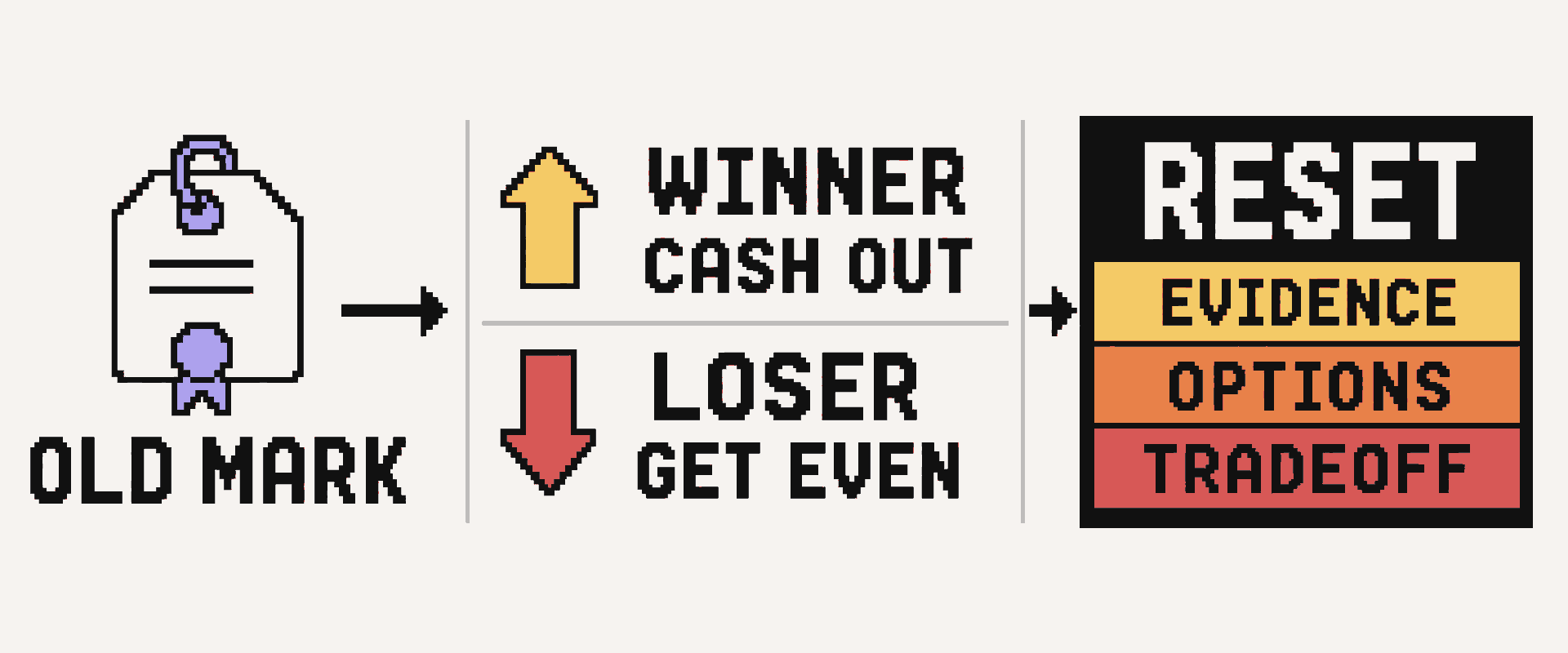
A Secondary Offer Creates a Realization Decision
A strong portfolio company raises at a higher valuation, and a new investor offers to buy your position. The offer turns an abstract paper gain into a concrete choice.
Taking some liquidity can be sensible. Selling can fund a real need, reduce an outsized exposure, or move risk back inside a portfolio limit. The disposition effect enters when “I can lock in an 8x” becomes the whole case. The relevant comparison includes the net proceeds, the security being sold, future dilution, remaining upside, downside, time to liquidity, concentration, and the best alternative use of the cash.
Our guide to selling private shares explains how founder communication, transfer rights, buyers, and timing can shape the practical route.
A Weak Company Creates a Different Trap
A struggling startup may have no market for its shares. Simply continuing to own it is illiquidity, not proof of the disposition effect.
The meaningful decision may arrive as a down round or bridge. An investor can write another check because the company now offers an attractive risk-adjusted opportunity. An investor can also write it to protect the original decision, preserve an ownership percentage, or “get back to even.” That second pattern is more precisely sunk-cost escalation, an adjacent bias that pushes capital toward a prior commitment.
A 2024 venture-capital study examined 30,602 U.S. follow-on decisions from 2009 through 2019. More capital already invested and more intensive monitoring both increased the probability of continued investment. That is direct evidence of sunk costs affecting professional venture decisions. It does not measure the disposition effect in angel portfolios. Its findings still show why a fresh comparison matters at the next round.
Stale Marks Can Hide the Reference Point
Public investors see price changes constantly. Startup investors often see a new mark only when a financing, tender, write-down, acquisition, or shutdown occurs. In between, the last round can linger on a portfolio report long after the company's outlook changes.
A financing valuation is also an imperfect comparison. The new investors may receive a different share class, preferences, information rights, or other terms. Your stake may have been diluted. A higher headline valuation is evidence, not cash and not necessarily the price of your exact security.
The old mark still belongs in the records for performance measurement and tax basis. It should not get to decide the next action.
A Worked Startup Portfolio Example
Assume you invested $5,000 in each of two startups.
Company A is growing, has raised several rounds, and now attracts a secondary buyer. After accounting for your diluted ownership and the exact security, the buyer offers $40,000 gross for your whole position. An 8x realized gain sounds satisfying. It says little by itself about whether selling none, some, or all is the better decision.
You still need to ask:
- What operating evidence supports the remaining upside?
- What does the buyer know, and why is the buyer willing to take the other side?
- Which rights and preferences attach to your security?
- What would you receive after fees and taxes?
- Would rejecting the offer leave the portfolio uncomfortably concentrated?
- Does a partial sale improve the tradeoff without abandoning the whole position?
Company B has missed milestones, has limited runway, and is raising a bridge at a lower valuation. The founder asks you to invest another $5,000. That second check cannot rescue the first $5,000. It buys a new security on today's terms.
Compare that new check with every live alternative: another startup, a follow-on into a stronger portfolio company, a liquid asset, or cash. Company B should win that comparison on current evidence. Loyalty and the desire to recover the original check do not raise its expected value.
Selling Company A solely to feel the win while funding Company B solely to avoid the loss recreates the economic direction of the disposition effect. The follow-on side carries the more precise label of sunk-cost escalation. Naming both biases keeps the diagnosis honest.
This is general education, not legal, tax, or personalized financial advice. Private-share sales, offering eligibility, transfer rights, and tax outcomes depend on the security, holder, documents, and transaction. Have qualified independent legal and tax professionals review an actual deal.
A Six-Step Reset for Sell, Hold, and Follow-On Decisions
No checklist can reveal an unknowable startup outcome. It can stop an old price from silently answering a new question.
1. Move the Old Price Out of the Decision Frame
Record the entry price, last-round mark, and unrealized multiple, then set them aside. Keep them for tax and performance work. Do not use “get back to even” or “lock in the gain” as an investment thesis.
This change has experimental support. In a stock-trading lab, removing the displayed purchase price reduced the measured disposition effect by 25%, though it did not eliminate biased behavior. The purchase-price experiment involved 58 participants and liquid simulated stocks, so the exact effect size does not transfer to startup decisions. The design lesson does: what you place at the top of the page shapes attention.
Put current operating evidence before cost basis in a decision memo.
2. Write the Actual Choice Set
List only actions you can take. A private holding may have no sale route. A secondary offer may allow a full or partial sale. A follow-on round may let you invest, pass, or invest below pro rata.
Write the constraints beside the choices: transfer approval, right of first refusal, allocation, deadlines, fees, taxes, information gaps, and the security on offer. This separates emotional preferences from legal and practical reality.
3. Re-Underwrite the Company From Today
Use the same standard whether the position is up or down. Review:
- revenue quality, retention, and customer evidence;
- burn, runway, financing dependence, and progress since the last round;
- team changes and the founders' ability to learn and execute;
- market, competition, and the company's current edge;
- valuation, security terms, dilution, and senior claims; and
- plausible paths to cash, continued illiquidity, and total loss.
Write what changed since the original memo. A thesis can survive a lower mark, and a higher mark can outrun the business.
4. Compare Forward Outcomes and Opportunity Cost
For a secondary offer, compare the net cash available today with the uncertain future value of the exact stake you would keep. For a follow-on, compare the expected outcome of the next dollar with its best alternative.
Use the counterfactual buy test as a pressure test: if you held the net sale proceeds in cash, would you buy this exact security today at the offered price? The answer is useful, not an automatic trading rule. Taxes, concentration, an illiquidity discount, information asymmetry, and personal cash needs can change the tradeoff.
“Decisions are never in isolation - they are a comparison game.”
Elizabeth Yin, our co-founder and general partner
5. Decide the Rules Before the Outcome Is Personal
At the initial investment, record the evidence that would strengthen or break the thesis, the conditions for a follow-on, and how you would approach a future liquidity offer. Set a total startup budget and concentration limits before a winner becomes exciting.
A short investment memo creates a dated record of what you believed. At the next decision, compare the new evidence with the old thesis instead of rewriting the old thesis to fit the outcome.
6. Invite a Genuine Challenge and Keep the Receipt
Ask someone without ownership of the original decision to argue the other side. Give that person the current evidence before sharing your cost basis or desired answer. Record the final choice, strongest counterargument, and what would prove the decision wrong.
This is one place where our Angel Squad angel-investing community helps. Members can compare how other operators read a company and learn the frameworks our Hustle Fund venture team uses on optional deals. The peer view does not replace individual judgment. It makes a private assumption easier to see.
Make the Next Decision About the Future
The cleanest disposition-effect question is simple: Would I make the same choice if the old gain or loss were hidden?
If the answer changes, slow down. Rebuild the case from current evidence, the exact security, available actions, and opportunity cost. A partial sale can be rational. Holding can be rational. A follow-on can be rational. None earns that label from the original price.
If you want more reps making these calls alongside experienced operators, apply to Angel Squad and bring a repeatable decision process to your next startup opportunity.







.png)