
Deal Flow Management Software for Angel Investors: 5 Practical Options
Brian Nichols is the co-founder of Angel Squad, a community where you’ll learn how to angel invest and get a chance to invest as little as $1k into Hustle Fund’s top performing early-stage startups.
Deal flow gets messy before it looks large. A founder intro sits in email, notes live in three documents, and nobody remembers why a deal was passed six months ago. The right system creates a reliable record from first look through final decision. The wrong one adds data entry and quietly goes stale.
What deal flow management software should do
Deal flow management software is the system of record for investment opportunities. It captures each startup, moves it through a defined review process, connects people and documents, and preserves the reasoning behind an investment or pass.
A useful system answers five questions within seconds:
- What is this company, and who introduced it?
- Where is the deal in our process?
- Who owns the next action, and when is it due?
- What have we learned and decided so far?
- What happened to similar deals?
That last question matters. A list of company names is storage. A searchable decision history is an investing tool.
The Angel Capital Association’s screening guidance describes a longstanding reason to standardize intake: consistent information makes opportunities easier to screen. Software gives that discipline a shared home.
If access is the bottleneck, a tracker is the wrong purchase. Software can organize incoming deals, but it cannot create trusted introductions or sound judgment. Angel Squad is our angel-investing community for people who want education, a network, and access to opportunities screened through Hustle Fund. That solves a different problem from CRM software.
Choose the smallest system that fixes the problem
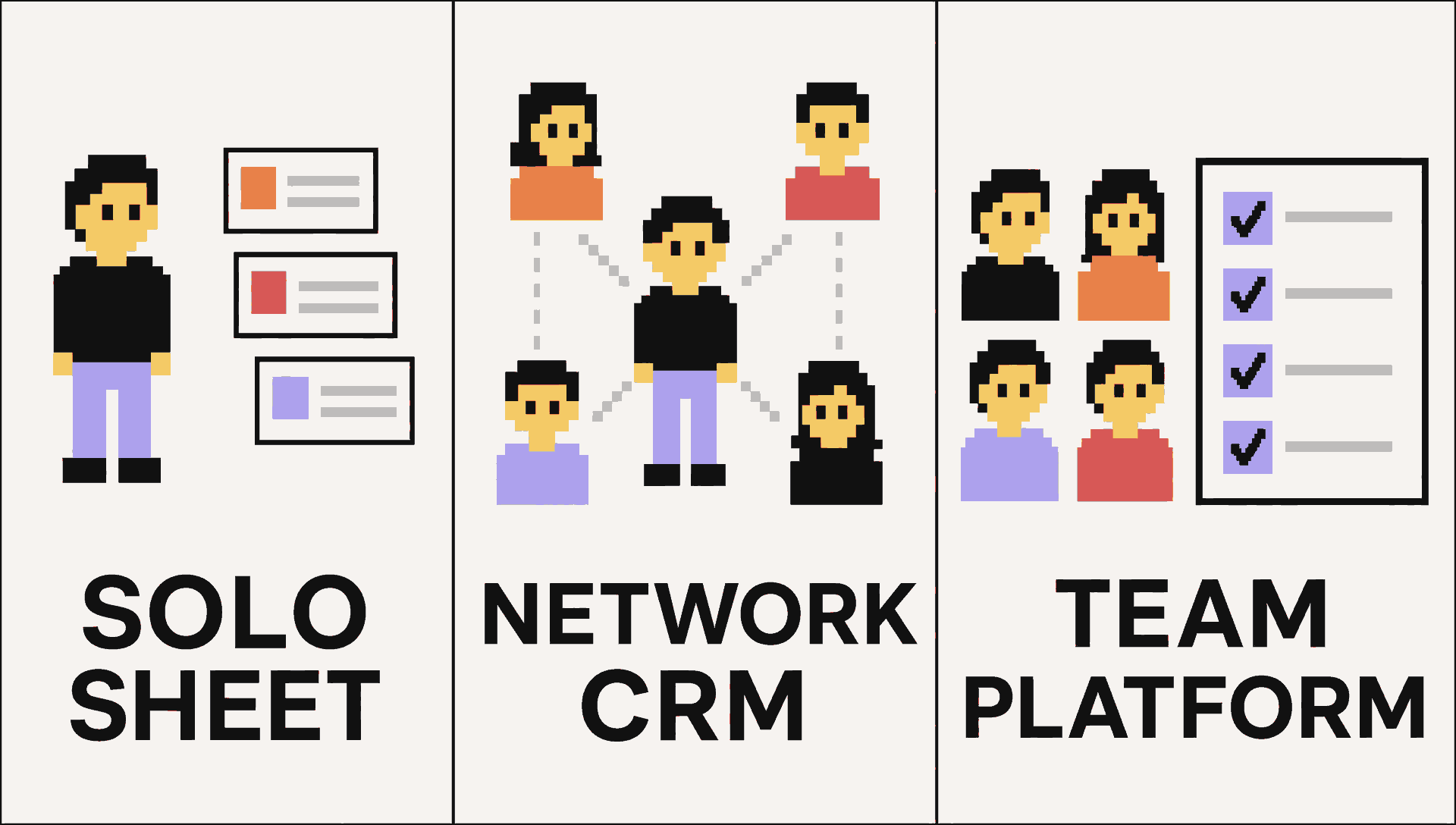
Angel investors usually need one of three setups. More software does not make the process more mature.
A spreadsheet or flexible database
Best suited to: Solo angels reviewing fewer than roughly 20 live deals at once.
Google Sheets, Notion, or Airtable can hold a clean pipeline with very little overhead. This route works when one person makes the decision and the relationships already live comfortably in email.
Its limits appear when the same founder enters twice, notes drift into private inboxes, or several reviewers need different access. Manual follow-up also becomes fragile as volume rises.
A general CRM
Best suited to: Well-connected operators and small investing teams whose deal flow depends on relationships.
A CRM connects companies, founders, referrers, meetings, and messages. It earns its cost when the hard part is remembering who knows whom, keeping correspondence attached to the deal, and following up on time.
General CRMs need customization for investment memos, reviewer scores, pass reasons, and committee decisions. Without that work, a sales pipeline merely gets new labels.
A dedicated investment platform
Best suited to: Angel groups, syndicates, family offices, and funds with formal intake, several reviewers, or post-investment reporting.
Dedicated platforms add application portals, scoring, investment committee workflows, diligence rooms, portfolio monitoring, and stronger permission controls. Those features are valuable once coordination fails regularly. Raw deal count alone is a weak reason to upgrade.
Our rule of thumb is simple: stay with a spreadsheet until missed context becomes a recurring problem, use a CRM when relationships drive the work, and choose a dedicated platform when multiple people and approval steps must follow one process.
Design the pipeline before buying software
Every tool looks organized in a demo. The real work is deciding what your team means by “new,” “in diligence,” or “passed.” Define those rules first.
Use stages that describe a decision
A practical early-stage pipeline has seven stages:
- Inbox: Captured, with no review yet.
- Screen: Compared with the investment thesis and basic criteria.
- Founder meeting: A conversation is scheduled or complete.
- Diligence: Specific questions, references, or documents remain open.
- Decision: Enough information exists to invest or pass.
- Invested: The check is complete and the company moves into portfolio tracking.
- Passed or watch: The reason and any revisit trigger are recorded.
Each deal belongs in one stage and has one named owner. “Waiting” is a status detail, not a hiding place.
Capture the minimum useful record
Require these fields for every deal:
- company, website, founders, and primary contact;
- source and named referrer;
- date received, stage, owner, next action, and next-action date;
- sector, geography, company stage, and fit with your thesis;
- round size, security type, valuation or cap, expected check, and decision deadline;
- memo, pitch deck, notes, references, and open questions;
- decision, decision date, pass reason, and revisit trigger.
The source field deserves special care. Over time, it reveals which founders, investors, communities, and events send deals that reach diligence or investment. “Referral” is too vague to teach you anything.
Preserve the decision record
Meeting counts and email volume show motion. They do not explain why an investor believed the team could win or why a market felt too early.
Use a short decision memo with a consistent rubric. Save the original view before the outcome is known. That record makes later calibration possible and reduces the temptation to rewrite history.
Our general partner Elizabeth Yin explains why this record matters: “The more disciplined you are in your thought process / rubric, the more you can improve over time.”
Our startup evaluation checklist provides a practical starting point for the rubric. Keep the software flexible enough to record disagreement. Early-stage investing is subjective, and a forced average score can erase the one dissenting view worth revisiting.
Five deal flow management software options
These tools serve different operating models. We recommend Airtable for most solo angels moving beyond a basic sheet. Attio fits relationship-heavy workflows, Dealum fits member-led angel groups, and Affinity or Edda fit investment teams with larger operational needs. All public prices below are in U.S. dollars as of August 17, 2026.
1. Airtable: the practical starting point
Best suited to: Solo angels and two-person teams that want structure without an institutional system.
Airtable combines spreadsheet familiarity with linked records, forms, views, interfaces, and automations. A founder intake form can create a company record, an automation can assign a next action, and linked tables can connect founders, referrers, meetings, and decisions.
Public pricing (August 17, 2026): The Free plan supports a basic setup. Team costs $20 per user per month with annual billing, while Business costs $45. Enterprise Scale uses custom pricing.
The value comes from flexibility and quick changes as an investor’s process develops.
That flexibility also creates the main risk. Someone must design the data model, prevent duplicate records, and maintain automations. Airtable offers investor deal-flow and portfolio templates plus general reporting, but it does not provide the automatic relationship intelligence or turnkey investment-committee and fund-reporting workflows of a purpose-built investment platform.
2. Attio: a CRM for relationship-led deal flow
Best suited to: Operators who source through a broad network and small teams that live in email and calendar.
Attio syncs email and calendar activity, enriches contact and company records, and supports custom lists, workflows, reports, and automations. It can model a venture pipeline while retaining the people and interactions around each opportunity.
Public pricing (August 17, 2026): The Free plan allows up to three seats. Plus is $35 per user per month with annual billing or $44 month to month. Pro is $79 with annual billing or $99 month to month.
This makes Attio approachable for a small team that wants automatic context capture before it needs fund operations software.
Attio still requires an investor-specific schema. Reviewer scores, formal committee approvals, cap-table details, and portfolio reporting must be configured in Attio or handled in another system.
3. Dealum: built for an angel group
Best suited to: Member-led angel networks that accept applications and coordinate many reviewers.
Dealum brings startup applications, pipeline management, evaluations, document sharing, investor communication, and portfolio reporting into one platform. Its deal-room member model suits groups where founders submit once and several angels review the same record.
Public pricing (August 17, 2026): Essentials costs $119 per month with annual billing or $149 month to month and includes 50 deal-room members. Pro costs $384 with annual billing or $479 month to month for 150 members. Ultimate costs $719 with annual billing or $899 month to month for 500 members. Dealum lists these prices before value-added tax.
That pricing can make sense for a network, but it is difficult to justify for one investor.
Dealum’s group workflow is the advantage. A solo angel who mainly needs relationship history will carry more process than necessary.
4. Affinity: relationship intelligence for an established team
Best suited to: Venture firms and active family offices that source through a large shared network.
Affinity automatically captures email and calendar activity, maps relationship strength, and connects that context to a customizable deal pipeline. It is useful when an investment team needs to know who has the strongest path to a founder and which relationships are going quiet.
Public pricing (August 17, 2026): Essential costs $2,000 per user per year, Scale costs $2,300, and Advanced costs $2,700. Enterprise uses custom pricing.
Affinity’s automated capture can reduce CRM upkeep, but the annual commitment can outrun the value for a solo investor or an occasional angel.
Affinity fits a sourcing machine with many contacts. It is heavier than needed for a simple review log.
5. Edda: deal flow plus broader investment operations
Best suited to: Emerging funds and family offices that want deal review, relationship management, diligence, and portfolio work in one environment.
Edda combines a customizable pipeline, AI pitch-deck import, collaborative review and scoring, due-diligence support, CRM records, an LP portal, and portfolio management. It covers more of the investment lifecycle than a general CRM.
Public pricing (August 17, 2026): Edda does not publish dollar prices; each plan directs buyers to request pricing.
The scope makes Edda attractive when pre-investment and post-investment work must stay connected. That broader scope may require more implementation and data migration than most individual angels need.
What to require from any deal flow tool
Feature lists blur together quickly. A useful buying decision comes down to eight requirements.
- Fast capture: A form, email forward, browser extension, or integration creates a usable record without retyping the same facts.
- Clear ownership: Every deal has an owner, next action, due date, and stale-deal alert.
- Connected relationships: One founder, company, referrer, and interaction history can appear across several deals without duplication.
- Durable decisions: The tool stores dated memos, reviewer views, pass reasons, and changes to the recommendation.
- Granular permissions: Founders, external specialists, members, and internal reviewers only see the records and documents intended for them.
- Diligence control: Open questions, reference calls, files, and red flags sit beside the deal record with a clear owner.
- Useful reporting: Source conversion, time in stage, pass reasons, decision pace, and thesis fit are available without manual cleanup.
- Data portability and security: Full exports, clear deletion rules, audit logs, encryption, multifactor authentication, and an appropriate independent security report are part of the product and contract.
Email synchronization deserves a deliberate decision. Automatic capture saves time, but it can also pull sensitive messages into a shared workspace. Sync scope, default visibility, private-record rules, and offboarding behavior need explicit settings.
Use one real deal to compare the finalists
A polished product tour hides the awkward steps. A useful vendor session follows one realistic opportunity from intake to decision.
Ask each vendor to show the same sequence:
- create a deal from an inbound founder email or application;
- connect the company, founder, and referrer without making duplicates;
- assign an owner and next action;
- attach a pitch deck and record two reviewers’ different opinions;
- restrict one document to a smaller group;
- record a pass reason and a six-month revisit trigger;
- report which referral sources produced deals that reached diligence;
- export the complete deal, people, activity, and decision history.
The winning tool is the one your actual users can keep current. A feature that requires an operations specialist for every change is a liability for a small angel team.
Our general partner Elizabeth Yin also captures the right purchasing mindset: “Decisions are never in isolation - they are a comparison game.”
Apply that idea to the software purchase too. Compare each subscription with the simplest viable setup and with the opportunity cost of maintaining it. A database priced at $20 per user per month with annual billing that stays current beats a CRM priced at $2,000 per user per year full of stale records.
Make the system improve your investing
The tool only becomes valuable when it changes behavior. Use a short weekly review to clear the inbox, move stalled deals, assign next actions, and close decisions. Review source conversion and pass reasons quarterly. Archive dead automations and unused fields before they turn data entry into homework.
Once a company is funded, move it into a separate portfolio workflow. Deal flow answers “Should we invest?” Portfolio management answers “What do we own, what changed, and where can we help?” Keeping those records connected is useful. Treating them as the same process creates clutter.
Software gives active angels memory and coordination. Repeated exposure to good deals, thoughtful peers, and real decisions builds judgment. Our investor community combines those ingredients with Hustle Fund-screened opportunities. Apply to Angel Squad to build your investing practice with us.







.png)