
Investing your emergency fund: an angel investor checklist
Brian Nichols is the co-founder of Angel Squad, a community where you’ll learn how to angel invest and get a chance to invest as little as $1k into Hustle Fund’s top performing early-stage startups.
Investing an emergency fund can leave you selling at the moment you need cash. The stakes rise when your income and wealth already depend on the startup market. This checklist separates emergency cash from investable surplus and sets a financial gate for angel checks.
This is general U.S. education, not individualized investment, legal, tax, or accounting advice or a recommendation to buy or sell a security. Investments can lose value. Private startup investments are speculative, illiquid, long term, and can result in a total loss.
Should you invest your emergency fund?
Do not invest the part of your emergency fund that must be available at full value on short notice. Stocks, bond funds, crypto, and private-company shares can fall in value. Some assets also take time to sell, settle, and transfer into a spendable bank account.
That creates two ways to come up short:
- Value risk: In a hypothetical market drop, your $20,000 reserve is worth $15,000 when a layoff or medical bill arrives.
- Access risk: The money still exists, but market hours, settlement, maturity, redemption, or transfer steps may delay access, depending on the asset, account, and timing of the emergency.
Emergency cash has a different job from investment capital. Its job is to absorb a bad surprise without forcing you to borrow, sell an asset at a bad price, or abandon a long-term plan.
The distinction matters in real households. In the Federal Reserve's 2025 survey, 63% of adults said they would cover a hypothetical $400 expense exclusively with cash, savings, or a credit card paid off at the next statement. Separately, 55% said they had set aside money for three months of expenses in an emergency savings or rainy-day fund. The full Federal Reserve findings show how different a small bill is from an income shock.
Calculate your emergency-fund target from your risks
Three to six months of living expenses is a common starting range, and the Financial Industry Regulatory Authority (FINRA) says the reserve should be liquid and easily accessible. Treat that range as a starting point rather than a magic answer.
Build your target in four steps:
- Find your essential monthly outflow. Include housing, utilities, basic food, insurance, health care, transportation, minimum debt payments, and essential support for dependents. Leave vacations, optional subscriptions, and regular investing out.
- Choose a runway. Start with three to six months. Move toward the high end or above it when one income supports the household, pay varies, job searches in your field run long, you support dependents, or a health or housing risk could raise costs.
- Add an immediate-shock buffer. Include a realistic same-week expense that monthly spending misses, such as an insurance deductible or urgent repair. Avoid stacking every possible disaster into one enormous number.
- Separate predictable bills. Annual taxes, insurance premiums, tuition, planned travel, and routine home maintenance belong in sinking funds. A bill does not become an emergency because it arrives once a year.
Founders and startup employees should add a correlation check. If your salary, bonus, stock options, and professional network depend on one company or sector, a downturn can hit your income and existing wealth together. A larger cash runway can offset that concentration. Our investment risk tolerance guide explains why your financial capacity can set a lower risk ceiling than your personality.
Use three money buckets instead of one
A single undifferentiated balance cannot show which dollars must stay safe and which can take risk. Give each dollar one job.
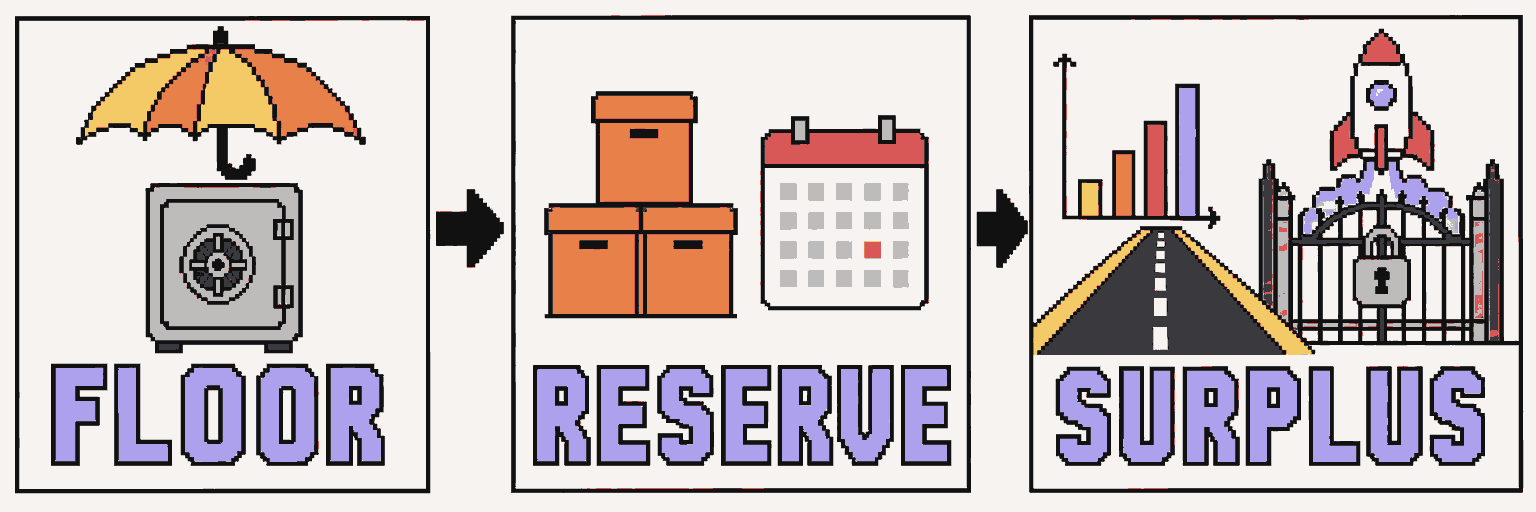
1. Cash floor
The cash floor is the portion of your emergency target that you may need on the shortest notice, including a likely immediate shock. Keep it somewhere you can reach without selling a security, depending on a maturity date, or risking an early-withdrawal penalty.
An interest-bearing savings account or bank money market deposit account can fit this job when it has appropriate deposit insurance and usable transfer or withdrawal access. The Consumer Financial Protection Bureau describes an emergency fund as a cash reserve that should be safe and accessible. That is the standard for this first bucket.
2. Cash reserve
The reserve holds the rest of your emergency target. A high-yield savings account is the clean default. You can consider a bank money market deposit account, short certificate of deposit (CD) ladder, or maturing Treasury-bill ladder for part of this layer when the cash floor already covers immediate needs.
Every extra step can add friction. Accessing a CD before maturity may trigger an early-withdrawal penalty, depending on its terms. A Treasury bill held to maturity returns its face value on schedule, while selling before maturity depends on where it is held and may produce more or less than face value. Money market mutual fund shares must be redeemed. Whether the proceeds then need to be transferred to another account before spending depends on the account's cash-management features. Those tradeoffs can be reasonable in the reserve layer. We would not rely on them for the dollars needed on the shortest notice.
3. Investable surplus
Surplus is what remains after your emergency target, sinking funds, near-term goals, and known obligations are covered. Only this bucket is a candidate for investments that can fall or stay illiquid.
If you are still funding the first two buckets, you can build knowledge without putting cash at risk. In Angel Squad, our angel-investing community, we help aspiring and active angels learn from the process our team uses at Hustle Fund and from other investors. Joining the community does not require accredited-investor status. Investing in relevant offerings does, and every deal is optional.
Where should you keep an emergency fund?
Choose based on safety, time to spendable cash, and account terms. Yield comes after all three.
High-yield savings account
This is the simplest fit for most cash floors and reserves. The balance does not fluctuate with markets, interest rates can change, and access depends on the bank's transfer network and withdrawal terms.
At a Federal Deposit Insurance Corporation (FDIC)-insured bank, eligible deposits are automatically insured up to the applicable limit. The standard coverage is $250,000 per depositor, per insured bank, for each ownership category. Read the FDIC coverage rules carefully when combined balances approach that limit.
Bank money market deposit account
This is a deposit account, despite the investment-sounding name. It can offer check or debit access and may pay a competitive rate. Minimum-balance and transaction terms vary. Eligible balances at an FDIC-insured bank receive deposit insurance under the same coverage framework as other insured deposits.
Money market mutual fund
A money market mutual fund is a security commonly held in a brokerage account. It is different from a bank money market deposit account. Government and Treasury money market funds generally seek a stable $1 share price, but they are not FDIC-insured and their yields change. Shares must be redeemed for cash. Whether you must then transfer the proceeds to another account before spending them depends on the account.
The U.S. Securities and Exchange Commission's (SEC) money market fund bulletin explains that these funds can lose value and may use liquidity fees or other tools during stress. That makes a money market fund a possible reserve-layer tool, rather than a substitute for every dollar in the cash floor.
Certificates of deposit
CDs can fit the outer reserve when maturities are staggered and the immediately accessible floor is already full. Early access may trigger a penalty, depending on the CD's terms. A slightly higher yield is a poor trade when too much of the emergency fund depends on one maturity date or a costly early exit.
Treasury bills
Holding a short-term Treasury bill to maturity creates a known date for cash to return at face value. If the emergency arrives first, you may need to sell at the current market price, and the steps and timing depend on where the bill is held. TreasuryDirect says a bill held there must be transferred to a bank, broker, or dealer before it can be sold before maturity. We would not rely on a TreasuryDirect-held bill for the dollars needed on the shortest notice.
Stocks, bond funds, crypto, and private investments
These do not belong in an emergency fund. A short-term bond fund can lose value when rates or credit conditions move. Stocks and crypto can fall sharply. Startup equity may have no usable resale market at all.
The emergency-fund checklist before you invest
Answer each question with a clean yes:
- Is your full emergency target funded with cash or reserve assets that match the required access time?
- Does that target reflect essential spending today, rather than an old budget?
- Have you adjusted for variable income, dependents, health needs, homeownership, and the likely length of a job search?
- Is enough available for a same-week expense without selling a security?
- Are predictable taxes, annual bills, repairs, and planned purchases funded separately?
- Can the proposed investment fall substantially without reducing your emergency target?
- Can you leave the investment alone for its full time horizon without depending on a sale?
- Would a downturn hurt both your income and this investment at the same time?
One “no” identifies a boundary to fix. It does not mean you can never invest. It means the proposed dollars are still doing emergency work.
Angel investing needs a stricter gate
Public stocks can usually be sold on a trading day, even if the price is painful. A private startup investment may offer no practical exit for years, or ever. The SEC warns that private placements can involve less disclosure, high risk, a potential total loss, and very limited liquidity.
That is why an emergency fund is only the first gate for an angel investor. Startup capital should also pass four tests:
- Total-loss test: Losing the full check would not affect housing, health care, debt payments, dependents, retirement needs, or another core goal.
- Indefinite-hold test: You do not need a distribution or secondary sale by a certain date.
- Concentration test: The check does not compound an already large exposure to your employer, industry, geography, or private assets.
- Portfolio-budget test: You have defined a total startup-investing budget and pace before evaluating one exciting company.
Our co-founder and general partner Elizabeth Yin writes, “Investing in risky/uncertain things (such as startups) is a total mindwarp.” That psychological shift is easier to manage when the money has already passed clear financial tests.
An emergency fund protects your life from the startup portfolio. A portfolio budget protects your startup strategy from one deal. The two boundaries solve different risks.
Elizabeth Yin puts it plainly: “Don't try to pick a co. Select a portfolio.” We apply that idea in our equity crowdfunding guide, which shows how check size and portfolio construction interact in another form of private startup investing. Diversification can reduce the damage from one company failing. It cannot make an unaffordable check affordable, prevent a whole portfolio from losing money, or create liquidity.
When those gates are clear, our community helps members build judgment through investor education, a network of operators and investors, and optional curated deal flow sourced by our team at Hustle Fund. That can improve your process. It cannot turn emergency cash into surplus capital.
A simplified hypothetical stress test
Alex has $40,000 in cash, essential expenses of $5,000 a month, variable startup income, and a $5,000 tax payment due soon. Alex chooses a six-month runway and a $3,000 immediate-shock buffer.
- Emergency target: $5,000 × 6 + $3,000 = $33,000
- Known tax obligation: $5,000
- Cash left after both: $40,000 − $33,000 − $5,000 = $2,000
The $40,000 balance looks large. Only $2,000 is unassigned after the emergency target and known bill. A $10,000 angel check would pull $8,000 back out of the emergency fund, so it fails the gate.
This simplified hypothetical is a household cash-allocation example, not a return projection or a recommendation. It ignores interest, inflation, taxes on earnings, investment fees, account restrictions, and changes in Alex's expenses or income.
What if you already invested the emergency fund?
Do not let a gain or loss decide what the money is called. Rebuild the buckets from current values and current needs.
- Recalculate the cash floor and full emergency target.
- Move enough into appropriate cash or reserve accounts to fill any gap, using a plan that accounts for market conditions and transaction consequences.
- Assign the remaining investments to long-term goals.
- Pause new startup checks until the emergency and sinking-fund layers are restored.
If selling would create material tax, legal, or financial consequences, get independent advice from qualified professionals who can review your accounts and circumstances. The need for tailored help does not change the destination: emergency money must become accessible and reliable again.
Emergency-fund questions investors ask
Is $10,000 enough for an emergency fund?
The dollar amount alone says very little. Compare it with your essential monthly spending, immediate-shock buffer, income stability, dependents, and job-search risk. $10,000 could be a solid runway for one household and less than a month for another.
Can I invest half of my emergency fund?
Only when the half left in cash still covers your complete emergency target. At that point, the invested half is surplus capital and should be renamed. A percentage split cannot replace the dollar amount your risks require.
Does available credit count as an emergency fund?
No. A credit card or home-equity line creates debt, may charge a high or variable rate, and can have its limit reduced. Credit can be a backup tool. It is not cash you control.
Protect the floor, then take risk on purpose
Your emergency fund should be boring, liquid, and dependable. That stability gives your long-term investments time to work and keeps a bad month from dictating a bad sale. Once the floor and reserve are fully funded, you can take risk with money that truly has no near-term job.
If your cash boundaries are in place and you want to build early-stage investing judgment with experienced operators and investors, apply to Angel Squad.















.png)