
MOIC: How Startup Investors Calculate and Read It
A startup investment can be “up 3x” while the investor receives much less. The multiple may use a paper mark, exclude fees, or omit a follow-on check. MOIC is simple division. The inputs determine whether the answer means anything.
Here is how to calculate and label MOIC for direct startup deals and portfolios, then connect it to LP fund economics, time, and liquidity.
Important: This is educational information, not investment, legal, tax, accounting, or valuation advice. Every example is hypothetical and simplified, not a projection or expected return. Private investments are speculative, illiquid, long-term, and can lose all invested capital. Past results and current marks do not guarantee future results. Actual outcomes depend on governing documents, fees, expenses, carried interest, taxes, cap-table and contract terms, valuation policy, and timing. Review the relevant deal or fund documents and consult qualified independent advisers.
What does MOIC mean?
MOIC stands for multiple on invested capital. At the deal or investment-portfolio level, the clean lead definition is:
Gross MOIC = (cumulative realized proceeds or distributions + measurement-date unrealized fair value) ÷ cumulative capital invested
Capital invested includes the initial check and every follow-on check in the chosen deal or portfolio. The numerator combines cash received from investments with the fair-value estimate of investments still held. This follows the portfolio-level definition in ILPA's granular performance definitions.
The word Gross matters. This deal or portfolio formula uses investment-level cash flows before fund or special purpose vehicle (SPV) fees, expenses, carried interest, and investor taxes. Fund and limited-partner reports can use different cash-flow scopes and denominators. An LP's all-paid-in net economics are generally reported as Net TVPI, not automatically as the same MOIC.
For a hypothetical, fully realized Gross deal MOIC measured after exit on December 31, 2031, using all initial and follow-on capital and excluding fees, carry, and taxes:
- 0.0x means no value came back.
- 0.7x means 70 cents came back per dollar invested, a 30% loss.
- 1.0x means one dollar came back per dollar invested, before excluded costs and taxes.
- 3.0x means three dollars came back per dollar invested. Because the three dollars include the original dollar, profit is 200% of cost.
That last distinction catches people. A 2.0x MOIC represents a 100% profit on cost, not a 200% profit.
How to calculate Gross MOIC
Use three inputs on one consistent basis:
- R, cumulative realized proceeds: Cash or qualifying distributions already received from the investment.
- V, measurement-date unrealized fair value: The estimated value of the remaining position on a stated date.
- I, cumulative invested capital: Initial and follow-on capital invested within the selected scope.
Then calculate:
Gross MOIC = (R + V) ÷ I
The same denominator lets you show what is cash and what remains estimated:
Realized contribution to total MOIC = R ÷ I
Unrealized contribution to total MOIC = V ÷ I
Total Gross MOIC = realized contribution + unrealized contribution
Hypothetical partial-realization example
- Status and scope: Hypothetical, simplified direct startup deal; Gross deal MOIC.
- Measurement date: December 31, 2030.
- Capital basis: $25,000 invested on January 1, 2027, with no follow-on checks.
- Realization mix: $15,000 cumulative cash proceeds plus a $35,000 measurement-date unrealized fair-value estimate.
- Fees and taxes: Before SPV or fund fees, expenses, carried interest, and taxes.
The calculation is:
($15,000 + $35,000) ÷ $25,000 = 2.0x Gross deal MOIC
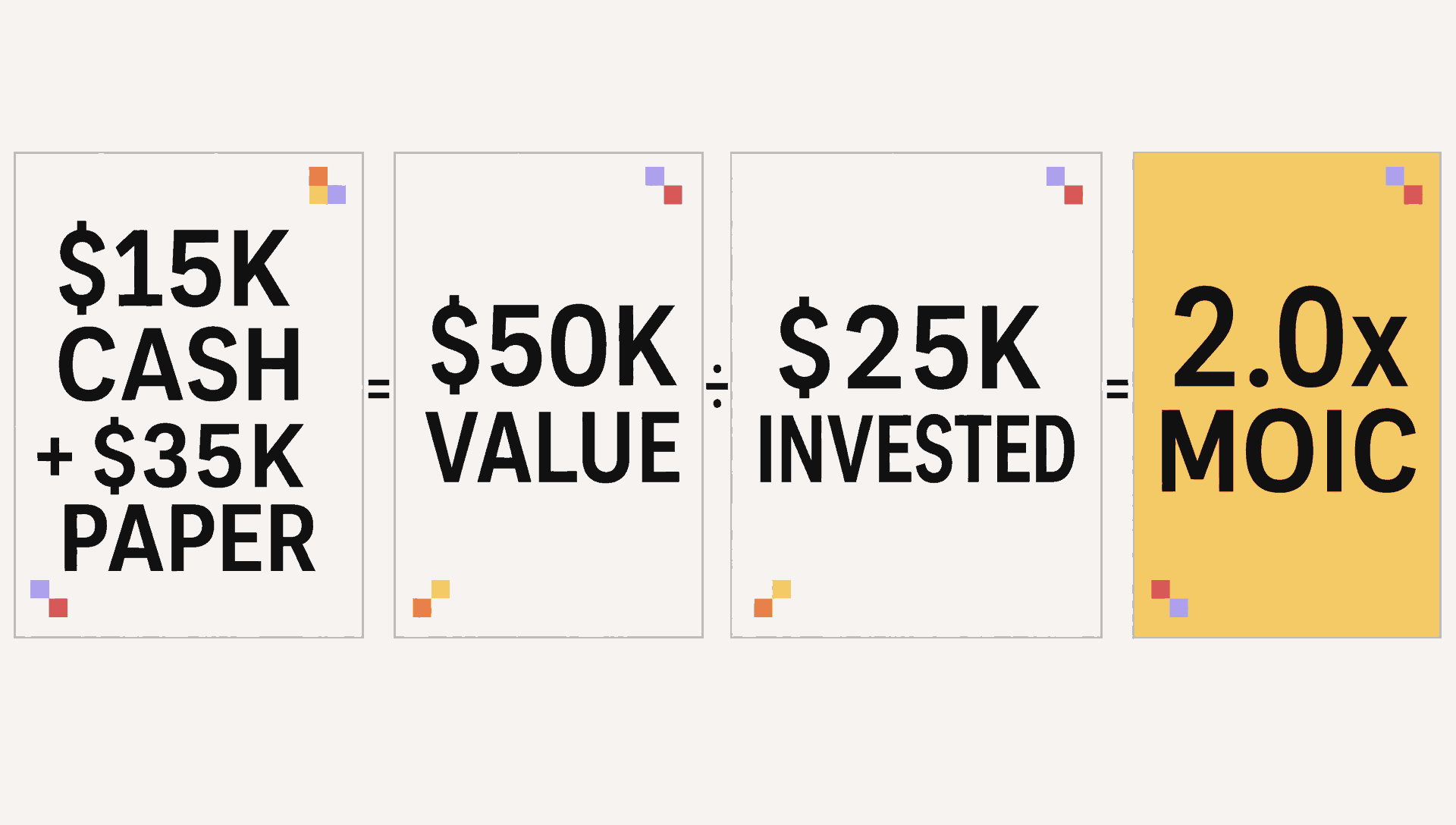
The realized contribution to total MOIC is 0.6x. The unrealized contribution is 1.4x. Calling the whole 2.0x “returned” would turn a fair-value estimate into cash that has not arrived.
Keep distributions and remaining value separate. If stock is distributed in kind and counted at its value under the report's distribution convention, remove it from residual value. Counting the distributed stock in both places inflates the numerator.
Dilution and follow-on capital change different parts of MOIC
Dilution changes ownership and therefore affects value or exit proceeds. A follow-on check also increases invested capital in the denominator. One investment decision can raise absolute proceeds while lowering the combined multiple.
Hypothetical dilution and follow-on example
- Status and scope: Hypothetical, simplified direct startup deal; Gross deal MOIC.
- Measurement date: December 31, 2031, at a full cash exit with no unrealized value remaining.
- Capital basis: $4 million initial investment on January 1, 2027; the follow-on case adds $2 million on January 1, 2029.
- Realization mix: Fully realized cash proceeds at exit.
- Fees and taxes: Before transaction costs, vehicle fees, expenses, carried interest, and taxes.
- Cap-table assumptions: Simplified all-common-equity calculation. It excludes option-pool changes, convertibles, Simple Agreements for Future Equity (SAFEs), notes, warrants, debt, liquidation preferences, and other cap-table, security, and contract terms.
At seed, the investor puts $4 million into a $16 million pre-money, $20 million post-money round and owns 20%. The company later raises $10 million at a $40 million pre-money, $50 million post-money valuation. It eventually exits for $75 million of equity value.
Without a follow-on check, ownership dilutes to 16%:
20% × ($40 million ÷ $50 million) = 16%
The investor receives $12 million. Gross deal MOIC is:
$12 million ÷ $4 million = 3.0x
If the investor uses sufficient pro rata rights to maintain 20%, the follow-on check is $2 million. Exit proceeds rise to $15 million, while cumulative invested capital rises to $6 million:
$15 million ÷ $6 million = 2.5x Gross deal MOIC
Omitting the follow-on would falsely report 3.75x. The example also shows why company enterprise value is not investor proceeds. Actual proceeds depend on ownership, debt, preferences, conversion, transaction costs, and the governing documents.
“In terms of portfolio construction, the size of the fund dictates its strategy. The check size, entry valuation, and follow-on investments all impact potential returns.”
Shiyan Koh, our co-founder and General Partner, on fund strategy and portfolio construction
This is also how we frame follow-on decisions in Angel Squad, our angel-investing community. We combine early-stage education, curated deal flow from Hustle Fund, and peer discussion. Joining the community does not require accredited-investor status. Investing in relevant private offerings does. Every investment is optional, and membership does not guarantee an allocation or a return.
Gross portfolio MOIC versus LP Net TVPI
Gross and net results are not related by one flat haircut. Management fees and expenses can add to LP paid-in capital without adding to portfolio cost. Carried interest usually applies to profit through the fund's contractual waterfall, rather than to every dollar of gross value.
Hypothetical gross-to-net fund example
- Status and scope: Hypothetical, simplified private fund; Gross portfolio MOIC compared with LP Net TVPI and DPI.
- Measurement date: January 1, 2032, after a full cash exit and LP distribution, five years after all contributions on January 1, 2027.
- Capital basis: LPs contribute $110 million at time zero, consisting of $100 million for investments and $10 million for fees and expenses.
- Realization mix: The portfolio exits for $180 million; all value is realized, with no residual NAV.
- Waterfall and exclusions: Whole-fund return-of-capital waterfall with 20% carry. No hurdle, preferred return, catch-up, clawback, GP commitment, taxes, foreign exchange, recycling, subscription line, or interim cash flow.
The investment portfolio's gross result uses the $100 million actually invested:
$180 million ÷ $100 million = 1.80x Gross portfolio MOIC
For the simplified LP waterfall, return the full $110 million of contributed capital first. That leaves $70 million of profit. Carry is 20% of $70 million, or $14 million. The LPs receive $166 million:
$180 million − $14 million = $166 million
The LP result uses all $110 million paid in:
$166 million ÷ $110 million = 1.5091x, or 1.51x Net TVPI
Because the fund is fully realized in this example, Net DPI is also 1.51x and RVPI is 0.0x.
Multiplying 1.80x by 80% would produce 1.44x, which is wrong. Carry applies to profit under the stated waterfall, fees expand the LP denominator, and real fund terms can change both calculations.
MOIC versus IRR: amount and speed
IRR accounts for timing. MOIC does not contain cash-flow dates. With exactly one initial outflow and one terminal inflow after T years, the shortcut is:
IRR = MOIC^(1 ÷ T) − 1
Hypothetical timing comparison
- Status and scope: Hypothetical, simplified fully realized direct deal; Gross deal MOIC and gross IRR.
- Measurement dates: One case exits January 1, 2029; the other exits January 1, 2035.
- Capital basis: $1 invested on January 1, 2027, with no follow-ons or interim cash flows.
- Realization mix: One $2 cash payment at exit, with no unrealized value.
- Fees and taxes: Before vehicle fees, expenses, carried interest, and taxes.
Both cases produce a 2.0x Gross deal MOIC. The two-year case has about a 41.4% IRR. The eight-year case has about a 9.1% IRR.
Interim distributions, follow-ons, or capital calls break the shortcut. Use all dated cash flows and terminal NAV to calculate IRR. MOIC still belongs beside it because IRR can reward speed while hiding how few total dollars were created.
MOIC versus TVPI, DPI, and RVPI
Our TVPI guide explains why paper-heavy fund results need scrutiny. The core LP formulas are straightforward when every line uses one reporting basis:
- DPI: Cumulative LP distributions, including appropriately valued in-kind distributions under the report convention, divided by cumulative LP paid-in capital.
- RVPI: Net LP-attributable residual NAV divided by the same paid-in capital.
- Net TVPI: Cumulative LP distributions plus net LP-attributable NAV, divided by the same paid-in capital.
Net TVPI = DPI + RVPI
That identity requires the same fee-paying investor cohort, currency, as-of date, contribution denominator, distribution and NAV convention, and subscription-line treatment. A post-distribution NAV prevents the same cash or distributed security from appearing in both distributions and NAV.
Do not assume Net TVPI, “net MOIC,” and Gross MOIC are interchangeable. ILPA's granular method labels LP all-paid-in economics Net TVPI. It uses Gross MOIC for other scopes with investment-purpose capital in the denominator. Other reports may use different labels. The printed definition controls.
Commitment is another different number. Paid-in capital is cash contributed. Invested capital is cash deployed into deals. Commitment includes capital that may remain uncalled. Dividing value by commitment does not produce deal MOIC or TVPI.
What is a good MOIC?
There is no context-free “good MOIC.” A line you can evaluate looks like this:
Hypothetical 3.0x Gross deal MOIC as of December 31, 2031, fully realized in cash, on all initial and follow-on capital invested from January 1, 2027, before vehicle fees, expenses, carried interest, and taxes.
That statement names the year, deal scope, invested-capital convention, follow-ons, realization status, and excluded costs. It still needs IRR, risk, and an appropriate comparison set before anyone can call the outcome attractive.
Judge any reported multiple across these dimensions:
- Cash versus estimate: How much is realized, and how much is a fair-value mark?
- Time: How long did the result take, and when did cash move?
- Scope: Direct deal, investment portfolio, fund, or LP cohort?
- Capital convention: Invested capital, all paid-in capital, or commitment?
- Costs: Which fees, expenses, carry, and taxes are inside or outside the number?
- Comparison set: Same stage, strategy, vintage, currency, and valuation date?
IPEV's valuation guidelines define fair value at the measurement date and say a recent investment price is not automatically fair value. A 2025 study of U.S. buyout and venture investments also found that mark history added information beyond the latest value. Staler marks and more frequent markdowns tended to precede worse results in the interim valuation study.
Private investments can also end in a total loss and may be difficult to resell. The SEC's private-placement guidance makes both risks explicit. A high paper MOIC does not remove either one.
Calculate each deal's contribution to portfolio MOIC
One startup can drive nearly the whole portfolio. That is the power-law pattern in a line of arithmetic.
Hypothetical five-position portfolio
- Status and scope: Hypothetical, simplified Gross startup portfolio MOIC.
- Measurement date: December 31, 2035.
- Capital basis: Five equal $10,000 investments made January 1, 2027, with no follow-ons.
- Realization mix: No cash proceeds. Every position value is an unrealized fair-value estimate at the measurement date.
- Fees and taxes: Before vehicle fees, expenses, carried interest, and taxes.
The five positions are marked at 0x, 0x, 0.5x, 2.0x, and 12.5x. Their unrealized values are $0, $0, $5,000, $20,000, and $125,000.
The portfolio holds $150,000 of estimated fair value on $50,000 invested:
$150,000 ÷ $50,000 = 3.0x Gross portfolio MOIC
The median position is marked at 0.5x. It has not returned 0.5x because the example has no distributions. The 12.5x position contributes 2.5x of the portfolio's 3.0x Gross MOIC.
Calculate deal contribution on the same portfolio denominator:
Deal contribution to portfolio MOIC = (deal realized proceeds + deal measurement-date unrealized fair value) ÷ cumulative portfolio capital invested
“Everything is really riding on your excellent returners, which you won’t have many of.”
Elizabeth Yin, our co-founder and General Partner, on her angel portfolio
In Angel Squad, we teach members to calculate and discuss portfolio results on one consistent basis. Diversification cannot guarantee a profit. It can keep one miss from deciding everything and give you more decisions to learn from.
Keep a MOIC record you can audit
A useful tracker needs one row per position or investment tranche and these fields:
- Company, fund, or SPV name
- Security or vehicle
- Investment and follow-on dates
- Initial and follow-on capital invested
- Cash and in-kind distributions, with dates and report values
- Measurement-date unrealized fair value
- Source, method, and date of the current mark
- Realized contribution to total MOIC
- Unrealized contribution to total MOIC
- Total Gross MOIC or the report's exact metric label
- Gross or net basis and included costs
- Currency, investor cohort, and subscription-line treatment where relevant
- Notes on dilution, stale marks, shutdowns, or pending exits
For an in-kind distribution, follow one documented convention. If distributed stock enters cumulative distributions at its distribution-date value, take it out of residual NAV. A later sale needs an offsetting starting value or cash-flow treatment. Adding both the distribution value and full later sale proceeds counts the same asset twice.
Preserve each reporting snapshot rather than overwriting markdowns with later markups. Then connect the result to the original investment memo. MOIC tells you the outcome so far. Your memo shows whether the facts developed as expected.
What MOIC leaves out
MOIC does not tell you:
- how long value creation took;
- when cash went in or came out;
- how likely the current mark is to become cash;
- how concentrated the result is;
- whether the position can be sold;
- what an LP receives after all fund economics;
- how taxes affect the investor; or
- whether the risk justified the result.
Use MOIC for what it does well: one comparable statement of value per dollar invested on a defined basis. Pair it with IRR for timing, realized and unrealized contributions for cash certainty, Net TVPI and DPI for LP economics, and the underlying documents for actual rights and costs.
MOIC FAQ
Can MOIC be negative?
Under the usual equity-investment formula, the floor is 0.0x because realized proceeds and remaining value cannot fall below zero. A zero or negative invested-capital denominator makes MOIC undefined rather than 0.0x. Separate liabilities can create losses beyond the original check, but they sit outside the basic formula.
Does MOIC include dividends and distributions?
Deal or portfolio Gross MOIC includes cumulative proceeds or distributions from the investments plus remaining fair value. Use one distribution convention and avoid counting the same cash or security again in residual value.
Is MOIC annualized?
No. MOIC ignores time. Pair it with dated cash flows, holding period, and IRR.
Is a 3x MOIC a 300% return?
No. A 3.0x MOIC includes the original capital and represents a 200% profit on cost. A 300% profit on cost would equal 4.0x.
Make every multiple explain itself
MOIC works when the label travels with the number. Name the scope, denominator, date, realization mix, follow-ons, and cost basis. Then calculate the same way across the portfolio.
If you want to build that discipline alongside other operators and investors, apply to Angel Squad.















.png)