
Stock Warrants: A Practical Guide for Startup Investors
Brian Nichols is the co-founder of Angel Squad, a community where you’ll learn how to angel invest and get a chance to invest as little as $1k into Hustle Fund’s top performing early-stage startups.
This is general education, not investment, legal, tax, accounting, or valuation advice. Startup investments are speculative, illiquid, long-term, and subject to total loss. Every example is hypothetical and simplified, and past results or current marks do not guarantee future results. Actual outcomes depend on governing documents, fees, carry, taxes, the cap table, valuation policy, transaction timing, and other facts. Read the controlling documents and use qualified independent legal, tax, accounting, and investment advisers for your situation.
A warrant can look like a small financing sweetener. Its share count, exercise price, deadline, settlement method, and exit clauses can make it meaningful, worthless, or surprisingly expensive to use. Here’s how startup investors can read the instrument, model its dilution, and keep a valid right from disappearing in the paperwork.
What is a stock warrant?
In startup financing, a stock warrant is a company-issued contractual right to acquire specified shares at stated terms. The right may be exercisable at the holder’s election, automatically exercised after a defined event, cash-settled, or terminated under its own provisions. Holding the warrant alone usually does not make the holder a stockholder.
For a Delaware corporation, Section 157 of the Delaware General Corporation Law authorizes rights or options to acquire company stock. It places the number, timing, consideration, and exercise terms in the certificate of incorporation or board resolutions. That statutory framework is current in the Delaware Code as of September 8, 2026. The company’s approvals and the signed warrant supply the deal-specific answer.
Publicly traded and cash-settled warrant products can operate differently. A private-startup warrant usually has no active resale market, and both the warrant and resulting shares can face contractual and legal transfer limits. The SEC’s private-placement guidance tells investors to expect limited disclosure and restricted resale.
How stock warrants work
Start with four variables:
- Underlying security. Name the company, stock class, and series. Common and preferred stock can have different rights and exit proceeds.
- Share count. The number may be fixed or tied to a loan, milestone, financing, or future share price. Some warrants vest over time.
- Exercise price. Also called the strike price, it can be fixed, nominal, or formula-based.
- Exercise period and events. The warrant states when exercise is available, when the right ends, and whether a sale, IPO, or redemption changes the process.
Do not confuse the three prices
Warrant questions often go sideways because three different numbers get treated as one:
- The warrant’s acquisition price is what the holder paid to acquire the warrant, if anything. In a bundled financing, separate consideration may be nominal or allocated under the transaction documents.
- The exercise price is what must be satisfied for each underlying share.
- The share value is the market, transaction, or contract-defined value of the stock.
Buying a listed warrant for $0.45 does not usually mean the underlying share costs $0.45. If its exercise price is $5.00, that separate $5.00 term still drives exercise.
Cash exercise and cashless exercise
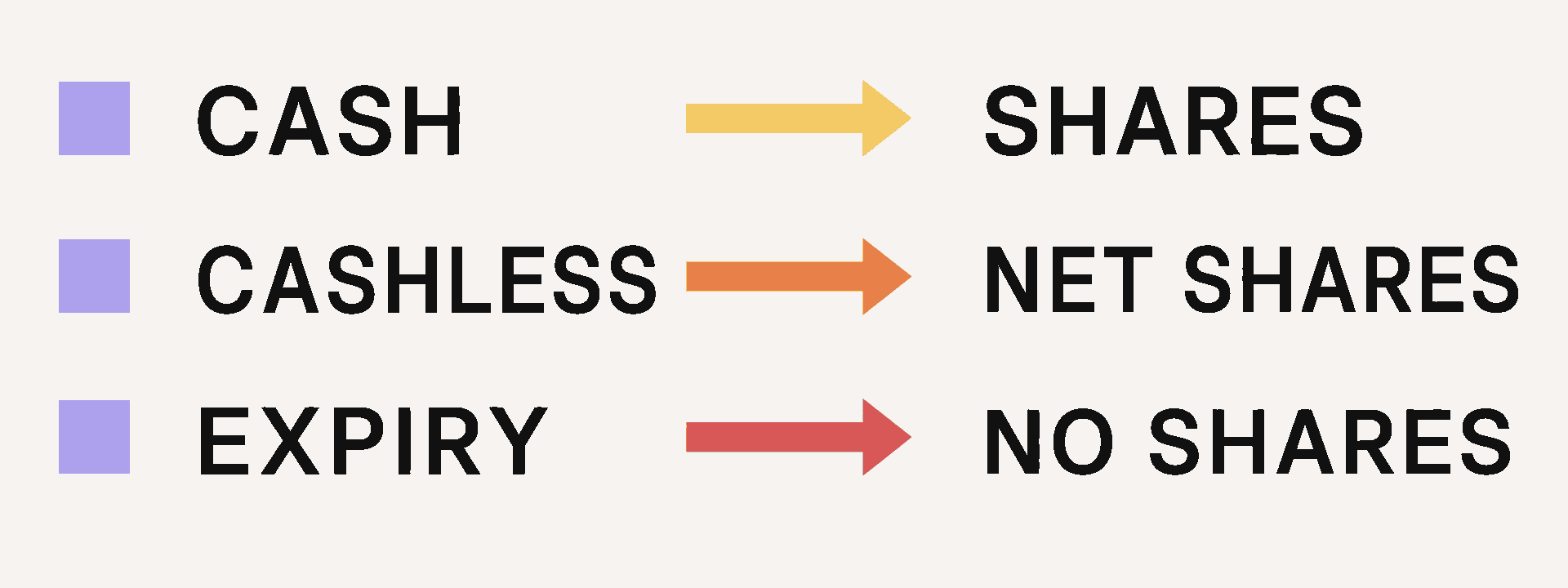
With a cash exercise, the holder submits the required notice and satisfies the aggregate exercise price in cash. The company then issues the exercised shares.
With a cashless exercise, also called a net exercise, the contract may let the holder satisfy the aggregate exercise price by surrendering or withholding part of the warrant’s intrinsic value. That route produces fewer shares. It does not mean taxes, fees, or every other cash obligation disappear.
When the contract-defined share value exceeds the exercise price, one common formula is:
Net shares = warrant shares × (share value − exercise price) ÷ share value
If share value is equal to or below the exercise price, that formula produces no positive net shares. The warrant may remain outstanding, terminate, be canceled, or receive other treatment under its terms.
A filed warrant form from March 2022 shows how specific the mechanics can get. It permits cash payment, withholding warrant shares with equivalent fair market value, surrendering previously acquired securities, or a combination. It defines fair market value through a good-faith board determination. That is one real contract, not a universal template.
Hypothetical, simplified startup-level example as of September 8, 2026. This shows contractual and cap-table mechanics, not projected performance. Figures are gross and wholly unrealized, with no follow-on capital, fees, carry, taxes, liquidation preferences, transaction costs, or later dilution. Assume a $6.00 common-share value under the warrant, a $1.50 exercise price, 100,000 warrant shares, a 10.0 million fully diluted total before adding this warrant, and sufficient authorized shares.
- A cash exercise satisfies $150,000 of aggregate exercise price and produces 100,000 shares.
- A cashless exercise under the formula produces 75,000 net shares: 100,000 × ($6.00 − $1.50) ÷ $6.00.
- Adding the full warrant to the fully diluted model takes the total from 10.0 million to 10.1 million. The warrant represents about 0.99% of that new total: 100,000 ÷ 10.1 million.
- A later cash exercise increases shares outstanding by 100,000. It does not increase an already-modeled fully diluted total again solely because the warrant moved from an outstanding right to issued shares.
A cashless exercise would increase shares outstanding by 75,000 in this example. The surrendered 25,000 shares would no longer remain as potential issuance, subject to the exact agreement and the cap-table convention used.
Why startups issue warrants
A warrant can give a counterparty potential equity upside while preserving the original structure of the main transaction. Common uses include:
- Venture debt or bank financing. A lender receives its loan economics plus an equity purchase right.
- Bridge or equity financing. A warrant can change the investor’s economics when risk, price, or timing makes the primary security harder to agree on.
- Strategic relationships. A company can tie warrant vesting to revenue, distribution, purchases, or another commercial milestone.
Shares remain unissued until a share-settled exercise, yet the warrant belongs in a fully diluted cap table when the relevant fully diluted definition includes it. Leaving it out can understate potential ownership promised to other parties.
Read warrant coverage as a formula
Suppose a venture loan defines warrant coverage as 10% of a $1 million commitment. The coverage amount is $100,000. If the agreement then divides that amount by a $1.00 share price, the warrant covers 100,000 shares.
The $100,000 is a sizing input. It is not necessarily the warrant’s purchase price, and 10% coverage does not mean 10% ownership in the company. Another agreement could use funded principal, later draws, a valuation formula, or a fixed share count. Read the definition, numerator, denominator, and adjustment clauses.
What happens when a warrant is exercised or the company exits?
A private warrant is an operating process as much as a security:
- Confirm the live right. Check vesting, share count, price, deadline, event clauses, and permitted settlement paths.
- Follow the mechanics. Send the signed notice to the designated place, then deliver the required payment or calculation.
- Confirm and record the result. Save evidence of the share issuance, cash settlement, or termination with the warrant, amendments, valuations, notices, and payment proof.
An acquisition does not guarantee a payout. The warrant may be net exercised before closing, paid based on its spread, assumed by the buyer, converted into a replacement right, or terminated. An out-of-the-money warrant may receive nothing. The March 2022 filed form above, for example, allows notice before cancellation, payment based on warrant value, or cancellation without consideration when the exercise price equals or exceeds the deal price.
Put every expiration date and notice address into your portfolio system when the warrant is signed. Record amendments and company events as they arrive. A generous warrant that expires unseen is worth zero.
Stock warrants vs. options, SAFEs, notes, and shares
These instruments can all lead to equity, but the route and current rights differ.
- Warrant vs. startup stock option. Both can provide a right to buy company shares at an exercise price. A startup option is usually compensation for an employee or service provider under an equity plan. A warrant is often part of a financing or commercial deal. Either can result in new share issuance.
- Warrant vs. exchange-traded call option. A listed call option is a market contract handled through clearing infrastructure. A company-issued warrant is an issuer obligation. A private warrant generally lacks a liquid market.
- Warrant vs. Simple Agreement for Future Equity (SAFE). A warrant may require a holder election, provide for automatic or deemed exercise, or use another settlement path. A SAFE follows its financing, liquidity, and dissolution provisions and does not use a warrant-style exercise price. YC’s current standard SAFE documents provide for automatic conversion in an equity financing. Our SAFE investing guide goes deeper on valuation caps, discounts, and ownership.
- Warrant vs. convertible note. A convertible note is debt, usually with interest, a maturity date, and conversion terms. A warrant is a separate right that can sit beside the note or loan. Our convertible-note guide explains the debt mechanics.
- Warrant vs. common shares. A common stockholder owns shares now and receives the rights attached to those shares and related agreements. A warrant holder usually waits for share issuance before gaining stockholder rights.
A stock warrant diligence checklist
A one-line cap table entry is not enough. Read the warrant alongside the financing documents, charter, relevant stockholder agreements, amendments, and board approvals.
Our co-founder and general partner Elizabeth Yin puts the practice plainly: “The more disciplined you are in your thought process/rubric, the more you can improve over time.” Use the same checklist for every warrant.
Economics
- What class and series can you acquire, and is the share count fixed or formula-based?
- What does any coverage percentage multiply?
- How do financings, splits, dividends, recapitalizations, or down rounds adjust the share count and exercise price?
- What does the pro forma fully diluted cap table show before and after adding the warrant?
Exercise mechanics
- When is the warrant exercisable, does it vest, and is partial exercise allowed?
- What is the expiration date, time, and time zone?
- Is net exercise available at any time or only during an exit?
- How is fair market value determined?
- Where must notices and payments go, and when are they effective?
Exit and rights
- What happens in an acquisition, IPO, dissolution, or asset sale, and does the holder receive advance notice?
- Can the buyer assume the warrant? Can the issuer force exercise, cash-settle, redeem, or terminate it?
- What stock class is issued, and how does it participate in the exit waterfall?
- What rights exist before exercise, and can the warrant or shares be transferred?
Records and professional review
- Do the board approval, authorized-share reserve, cap table, and signed agreement match?
- Are amendments, notices, and milestone evidence in one record, and who owns the exercise calendar?
- Have independent legal, tax, accounting, and investment advisers reviewed the instrument and exercise decision?
Members of Angel Squad learn to turn deal terms into repeatable diligence questions and compare their reading with other investors. The goal is independent judgment with better inputs, never borrowed conviction.
U.S. tax treatment depends on why the warrant exists
The word “warrant” does not settle the tax result. Investment warrants acquired as part of a financing and rights issued for services can enter different federal tax frameworks.
As of September 8, 2026, the Office of the Law Revision Counsel states that its pages for Section 1234 and Section 83 reflect laws in effect through September 7, 2026.
- Investment route. When a purchased warrant is treated as an option to acquire stock that would be a capital asset for the holder, Section 1234 generally ties the character of gain or loss from sale or exchange—and loss from lapse—to the underlying property. The corresponding Treasury regulation treats a loss from failure to exercise as occurring when the option expires. Exceptions and loss limits can change the result.
- Service route. Section 83 covers property transferred in connection with services. Treasury’s option rule addresses nonstatutory options granted to employees or independent contractors. When such an option lacks a readily ascertainable fair market value at grant, the regulation generally applies Section 83 at exercise or other disposition. A qualified adviser must determine whether a particular service-related warrant falls within that rule and how other provisions apply.
Cashless does not mean taxless. Exercise, settlement, transfer, expiration, and sale can have different reporting, income-character, basis, withholding, and timing effects. Preserve the acquisition documents, valuations, notices, payments, and disposition records, then get advice for the actual instrument and jurisdiction before acting.
Are stock warrants good or bad for investors?
A warrant is attractive when its incremental economics fairly compensate for the main deal’s risk or concession and its mechanics are usable. Be skeptical of vague formulas, short terms, unavailable net exercise, weak stock-class economics, and sharp later dilution. A missed deadline can turn good economics into zero.
Our co-founder and general partner Elizabeth Yin writes, “Going back to first principles is super important since the market always changes and evolves.” For a warrant, first principles means modeling the actual shares, cash, time, rights, and exit outcomes. The word “sweetener” does none of that work.
Stock warrant FAQs
Can you sell a stock warrant?
A listed warrant may trade if a market exists. A private-startup warrant is often transferable only with company consent or to specified affiliates, and securities laws can restrict resale. The governing documents control.
Do stock warrants always dilute shareholders?
No. Issuance of a share-settled warrant creates potential dilution and may increase a modeled fully diluted total. Exercise dilutes shares outstanding only to the extent the company issues shares. A cashless exercise usually issues fewer shares than a full cash exercise. A warrant that expires, terminates, or settles entirely in cash adds no shares outstanding.
How long do stock warrants last?
The contract sets the term. Use its exact expiration date, time, and time zone. An acquisition, IPO, redemption, or notice clause may create an earlier practical deadline.
A warrant rewards the investor who reads past the headline and manages the right after closing. If you want to build that habit across real early-stage deals, apply to Angel Squad.






.png)








.png)