
Why Write an Investment Memo? An Angel’s Guide
Brian Nichols is the co-founder of Angel Squad, a community where you’ll learn how to angel invest and get a chance to invest as little as $1k into Hustle Fund’s top performing early-stage startups.
A sharp founder, a hot market, and a round that’s filling can turn “I’m curious” into “I’m in” before you’ve explained the bet to yourself. An investment memo slows that moment down. It gives you a place to test the case now and preserve it for later, when the outcome will make the past look more obvious than it really was.
What is an investment memo?
A startup investment memo is a dated, internal record of why you decided to invest, pass, or wait based on the information available at the time. Angel investors and venture capital firms often call it a deal memo.
An investment-committee memo makes a case to a firm’s partners. A syndicate memo informs possible co-investors. A founder’s fundraising memo markets the company. Your personal memo serves a different reader: you, including the version of you who will look back after the story has changed.
This content is educational and does not constitute investment, legal, or tax advice. Review the governing deal documents and seek guidance from qualified independent legal, tax, and financial advisers.
A private placement memorandum (PPM) is different from a personal investment memo. A PPM is a formal offering document prepared for prospective investors; your personal memo is your own internal analysis and decision record. A personal memo is not a contract, cannot substitute for a PPM, and does not replace startup due diligence.
A solo angel’s memo can fit on one or two pages. It needs enough detail to preserve:
- your decision: invest, pass, or wait;
- the investment thesis and strongest counterargument;
- the evidence you checked and where it came from;
- founder claims that remain unverified;
- your assumptions and known unknowns;
- the risks you are accepting; and
- the evidence that would change your mind.
For a starting rubric, use our Deal Assessment Framework to identify what you care about, then adapt it to your strategy and the company’s stage.
Our investment memo template gives you a copyable structure and worked example. The bigger question is why the exercise deserves your time in the first place.
Why write an investment memo if no one else will read it?
The memo is useful before a decision and after it. Beforehand, it forces your reasoning into the open. Later, it lets you review that reasoning without quietly replacing it with a cleaner story.
1. It makes you finish the sentence
“Great founder in a huge market” sounds like conviction until you try to explain what, specifically, you believe.
Consider a hypothetical business-to-business software startup. A vague thesis says, “The team will execute well.” A useful assumption says, “At least three of the eight current pilots will convert to annual contracts within 90 days, without the company adding implementation headcount.”
That sentence gives you something to investigate. How many pilots are active as of the memo date? Has a customer confirmed its buying process? How much custom work does each pilot require? What result would weaken the thesis?
Writing exposes the point where evidence ends and optimism begins. That is where your next diligence question lives.
2. It separates evidence, claims, and assumptions
A pitch can make every statement sound equally solid. It isn’t.
Label the inputs in your memo:
- Verified evidence: what you checked against a primary source, customer reference, product test, or document.
- Founder claim: what the company told you but you have not independently confirmed.
- Investor assumption: what you believe may happen and the reasoning behind it.
- Unknown: what is too early, unavailable, or impossible to know today.
These labels prevent an attractive narrative from turning a forecast into a fact. They also tell future you whether the original thesis failed, the evidence changed, or the input was weak from the start.
Fear of missing out and market hype often borrow conviction from urgency: the round is filling, a respected investor is in, and everyone seems to be talking about the company. Writing forces those signals into separate line items. Would you make the same decision if the round stayed open for 30 days and the investor list were hidden? Scarcity and syndicate quality may affect the opportunity, but neither proves customer demand, retention, or distribution.
A memo does not eliminate FOMO. It makes you name where urgency is influencing the decision and which business evidence, if any, supports it.
3. It forces a downside pre-mortem
Give the positive case a break. Assume the startup is struggling 18 months from now and write three plausible reasons why.
This exercise is a form of prospective hindsight: explaining a future event as if it has already happened. For each failure mode, record the earliest signal you could see and the question you can ask now.
For the hypothetical software company, the failure story might be that pilots love the demo but require so much custom setup that the product cannot scale. The early signal is growing implementation time per account. The decision-changing question is whether customers can reach value through the standard product.
A pre-mortem cannot predict failure or remove unknown risks. It can surface a dependency that excitement pushed to the edge of your thinking.
4. It makes a pass or wait decision useful
Memos are not just paperwork for checks you write. A pass records what failed your bar. A wait decision records the missing evidence and the trigger that would reopen the case.
That matters because vague passes teach you very little. “Too early” could mean no proof of demand, no repeatable distribution, unclear founder-market fit, or a price that does not fit your view of the risk. Name the real reason.
If the company later succeeds, you can ask whether your original concern was reasonable given what was knowable. If it later struggles, you can ask whether you identified the actual risk or simply got the outcome you expected. Either way, the memo gives you a decision to examine.
5. It puts one exciting deal in portfolio context
A company can look compelling in isolation and still be the wrong use of your next check. The memo should ask what the investment adds to your portfolio, which risks it repeats, how much follow-on capacity it could require, and what else you would forgo. As our co-founder and general partner Elizabeth Yin writes in Democratizing Knowledge (2021, p. 287), “Decisions are never in isolation - they are a comparison game.”
This comparison is wider than “startup A versus startup B.” It includes the choice to keep capital available, make a smaller check, or pass because the opportunity falls outside your strategy.
6. It protects the original story from the outcome
Once you know what happened, it is hard to judge the earlier decision on the information that existed then. A preregistered replication of outcome-bias research found that people rated identical decisions more favorably when they produced successful outcomes than when they produced failures. The effect persisted among people who said outcomes should not affect the evaluation.
Startup investing makes that trap especially tempting. A weak process can get lucky. A careful process can meet an unforeseeable event. A company can succeed for a reason that never appeared in your thesis.
Your memo freezes the inputs, assumptions, and recommendation before the result is known. It does not remove bias, but it makes revisionist history harder.
Turn each memo into a learning loop
A memo that disappears into a folder is only half-used. Build the review into the decision process from the start.
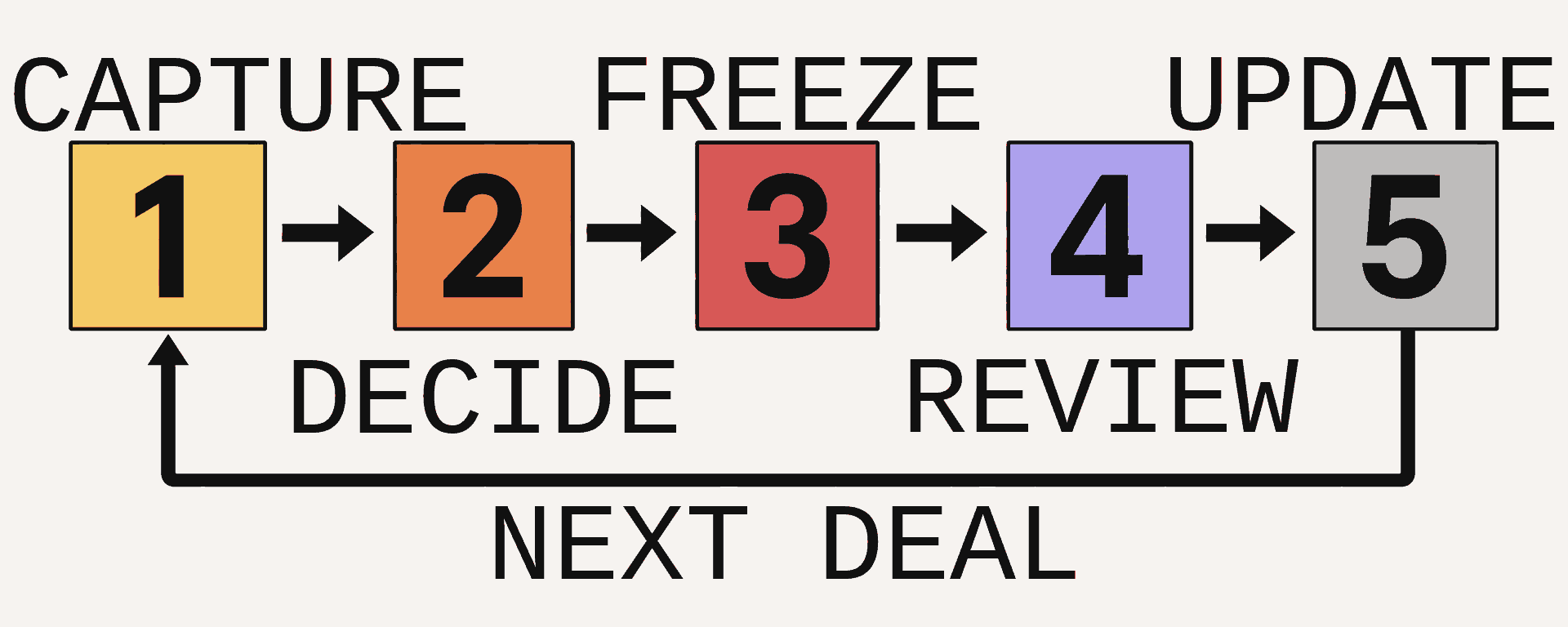
1. Write before you commit
Finish the memo while a pass is still possible. If you write after wiring the money, your brain already has a position to defend.
State the decision in plain language. If it is a wait, name the missing evidence, owner, and trigger. If it is an investment, record why this company and check fit your portfolio now.
2. Freeze the original
Save the version used for the decision with a date. Do not edit an old assumption until it looks smarter. Add dated notes underneath it when facts change.
The distinction matters: “We expected X” and “We learned Y” should remain visible at the same time.
3. Set review triggers
There is no universal six-month rule. Review the memo when evidence can test the thesis: a product launch, pilot conversion, financing, key hire, customer cohort, major pivot, or a portfolio-review cadence you can sustain.
Pick the triggers before you know whether the news will be good. Otherwise, you may revisit only the companies that demand attention and ignore assumptions that are quietly drifting.
4. Score the process separately from the result
Ask two different sets of questions.
Process review: Did you seek disconfirming evidence? Did you label the sources and assumptions honestly? Did you compare alternatives? Did you identify the key dependency and portfolio tradeoff? Was the decision reasonable with the information available?
Evidence review: Which assumptions now look supported, contradicted, or unresolved? What important factor did the memo miss? Is the company progressing for the reason you expected? Has the risk changed?
The frozen thesis is also useful if you advise the company or hold a board role. If the original case depended on retention before scaling sales, compare new cohort evidence with that assumption and ask what the team is learning. The memo gives those questions a starting point. It does not give you control, promise influence, or guarantee that the company will follow the original plan.
Do not collapse those answers into “winner” or “loser.” Company performance and decision quality are related, but they are not the same thing.
5. Update the rubric, then use it on the next deal
The final step is one small change to your process. Add a question to your diligence checklist. Tighten a definition. Remove a proxy that proved meaningless. Keep a sector-specific lesson where it belongs instead of turning one experience into a universal rule. That habit reflects a point our co-founder and general partner Elizabeth Yin makes in Democratizing Knowledge (2021, p. 131): “The more disciplined you are in your thought process/rubric, the more you can improve over time.”
The memo does not create the improvement by itself. It creates a record you can inspect, discuss, and use to change the next decision.
Reasoning also gets stronger when another investor can question it. In Angel Squad, our angel-investing community, members learn alongside peers and practice evaluating screened opportunities. The goal is not consensus. It is noticing the question someone else asked that you missed.
Keep the memo honest
An investment memo can become sales copy with more paragraphs. Avoid that trap.
- Write for a decision, not applause. State the strongest case against your preferred answer.
- Use stage-appropriate evidence. A pre-seed company may not have retention history, but “too early to know” is more accurate than a confident guess.
- Keep confidential information private. A personal decision record does not belong in a public post, and access should match the sensitivity of the underlying material.
- Do the diligence. Clear prose cannot rescue weak sources, missing customer work, or unread deal documents.
- Accept an unresolved answer. “Wait until X” is a valid decision when one answer would materially change the case.
Most important, do not treat the memo as a machine for predicting winners. Early-stage outcomes remain uncertain. The memo improves the visibility of your process, not the odds of any individual investment.
Investment memo FAQ
Is an investment memo the same as a pitch deck?
No. The founder creates a pitch deck to explain and promote the company. The investor writes an investment memo to evaluate the opportunity, document diligence, challenge the thesis, and record a decision. A useful memo draws from the deck but does not inherit its point of view.
How long should an investment memo be?
For a solo angel, one or two focused pages can be enough. Use the shortest format that still records your decision, evidence, assumptions, risks, counterargument, portfolio fit, and review triggers. A formal investment-committee process may require more detail.
Can AI write an investment memo?
AI can organize notes, compare a draft with your rubric, or point out a missing section. It should not supply your conviction. If the model invents the thesis, assumptions, or counterargument, you have skipped the thinking the memo is meant to expose. Keep confidential company information out of any tool that is not approved for that data.
Writing your first memo may feel slow. That is fine. The value comes from making the decision inspectable before time, luck, and outcomes rewrite it.
If you want to build that practice with our team and other angels, apply to Angel Squad. Accreditation is not required to join for education and community. Some private investment opportunities require it, and every investment is optional.







.png)