Tax implications of selling shares in a private company
Brian Nichols is the co-founder of Angel Squad, an angel investing community where aspiring and active angels learn from Hustle Fund’s approach, review curated deal flow, and connect with peers.
A private-company share sale can put cash in your account after years of waiting. The offer price leaves several tax questions unresolved. For US individual investors, the useful starting point is a record of each block of shares, its purchase history, and the proposed sale terms.
Start with what you own and who is buying
When you sell stock held as an investment in a taxable account, you generally recognize a capital gain or loss. A company being private doesn't create a separate federal tax rate. Your basis, holding period, eligibility for exclusions, and other income determine the result.
The ownership chain matters. If you invested through a special purpose vehicle (SPV), a separate entity that holds the startup investment, you may own a partnership interest rather than the startup's shares. A partnership-taxed SPV generally reports its sale results to you on Schedule K-1.
Selling your SPV interest is a different transaction and can include ordinary income for the portion attributable to assets such as unrealized receivables or inventory under partnership sale rules. Our K-1 tax guide explains why an allocation of taxable income can differ from a cash distribution.
Also identify the buyer. A third-party investor buying your stock and the issuing company buying it back can produce different tax treatment. A tender offer describes a sale process; it doesn't settle the tax classification.
This framework focuses on individual US taxpayers selling investment stock in taxable accounts. Retirement accounts, foreign shareholders, gifts, inheritances, and sales of business assets require different analysis.
Calculate the gain for each block of shares
A tax lot is a block of shares acquired in one transaction. Separate purchases in different funding rounds can have different costs, holding periods, and tax benefits, even when they appear under one company name.
Adjusted basis is your tax investment in the shares after applicable adjustments. For a cash purchase, it generally starts with the purchase price plus eligible acquisition costs. Stock splits, reorganizations, and other events can change it.
The latest fundraising valuation or an SPV's quarterly mark doesn't establish your tax basis. The IRS's stock basis guidance also distinguishes specifically identified shares from shares sold under default ordering rules.
For a straightforward cash sale, gain is net sale proceeds minus adjusted basis. Selling costs reduce the proceeds used in that calculation.
Consider a hypothetical, simplified sale of one direct startup investment, as of October 12, 2026. Assume one cash purchase with a $30,000 adjusted basis, no follow-on investments, no other basis adjustments, and a completed sale of all those shares:
- Gross sale proceeds: $100,000.
- Selling costs: $2,000, with no other fees or carried interest, the manager's share of investment profits.
- Net proceeds before income taxes: $98,000.
- Realized capital gain: $68,000, calculated as $98,000 minus $30,000. No unrealized holdings are included.
Assume the gain is long-term, no qualified small business stock exclusion applies, and the entire gain falls within the 15% federal capital-gains bracket. Regular federal capital-gains tax would be $10,200. The calculation excludes the net investment income tax, state taxes, other gains or losses, and any other return items.
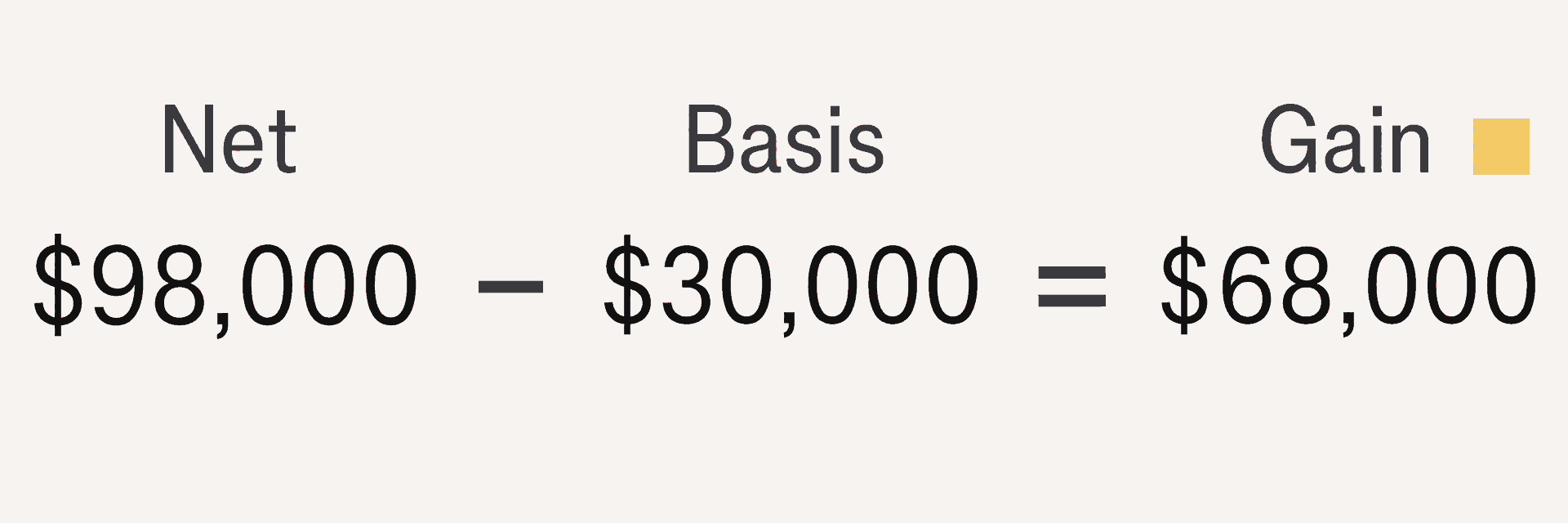
The $100,000 offer price and the $68,000 gain are different numbers. A tax reserve based on the full offer price can be as misleading as one based on an unsupported basis estimate.
If you sell only part of your position, the transaction documents need to identify the shares being sold. Your earliest purchase and your latest purchase may produce very different after-tax cash.
Apply the holding period and federal tax rates
The normal capital-gains holding period starts the day after acquisition and includes the disposal date. A holding period of more than one year generally produces long-term treatment; one year or less produces short-term treatment.
Short-term gains generally use ordinary income-tax rates. Most long-term stock gains use federal rates of 0%, 15%, or 20%, depending on taxable income. The IRS explains these capital-gains rules.
For 2026, the 0% long-term capital-gains bracket ends at $49,450 of taxable income for single filers and $98,900 for married couples filing jointly. The 15% bracket ends at $545,500 and $613,700, respectively. These are taxable-income thresholds, and gains sit above your other taxable income. One sale can span more than one bracket under the 2026 federal thresholds.
Higher-income investors may also owe the 3.8% net investment income tax (NIIT). It applies to the lesser of net investment income or modified adjusted gross income above $200,000 for single or head-of-household filers, $250,000 for joint filers, or $125,000 for married taxpayers filing separately. Taxable stock gains generally enter the calculation under the NIIT rules.
These rules make the sale date and your full-year income relevant. Waiting for long-term treatment also means continuing to hold an illiquid, risky investment. A lower potential tax rate doesn't guarantee another buyer or a better future price.
QSBS needs a separate eligibility file
Qualified small business stock (QSBS) is stock that meets Section 1202's requirements. Eligible taxpayers other than corporations can exclude some or all qualifying gain. Private-company stock, startup stock, and QSBS are different categories.
The core requirements include original issuance by a domestic C corporation, an eligible acquisition, the applicable corporate gross-assets limit, and an eligible active business during substantially all of the holding period. At least 80% of the corporation's assets, measured by value, generally must be used in qualifying active businesses, with exclusions for specified industries.
Certain stock redemptions can disqualify shares. The IRS eligibility instructions describe these requirements.
Buying existing shares from another shareholder generally fails the original-issuance requirement. Selling shares that you originally received from the company can still qualify if your shares and sale meet the rules.
Acquisition and issuance dates control different tests
The July 2025 law changed QSBS. For eligible stock acquired after July 4, 2025, the exclusion percentages are:
- At least three years held: 50% of eligible gain.
- At least four years held: 75%.
- At least five years held: 100%.
For qualifying stock acquired after September 27, 2010, through July 4, 2025, the 100% exclusion generally requires a holding period of more than five years. The newer three-year tier doesn't automatically apply to older lots. Carried-over holding periods can affect the tax acquisition date under the 2025 statutory changes.
For example, newly issued shares first acquired in 2026 cannot reach a three-year holding period in 2026. That follows from the dates, even if the company calls the shares QSBS-eligible.
The issuer's gross-assets ceiling is a separate test tied to issuance. It is $50 million for stock issued on or before July 4, 2025, and $75 million for stock issued after that date. The relevant gross-assets history includes the period before issuance and the amount immediately afterward. A fundraising valuation is a different measure.
The exclusion percentage comes after the issuer limit
The Section 1202 limits determine how much gain can receive the exclusion. The limit generally uses the greater of an applicable dollar ceiling or ten times the aggregate adjusted basis of qualifying shares from that issuer sold during the year, subject to special basis rules.
The dollar ceiling is generally $10 million for the older acquisition regime and $15 million for stock acquired after July 4, 2025. Prior eligible gains from the same issuer, mixed older and newer lots, and married-filing-separately rules affect the calculation. These are gain limits, not tax credits or automatic exemptions for every sale.
A partial exclusion also doesn't mean the remaining eligible gain automatically uses the usual 20% maximum rate. The taxable QSBS portion left by a 50% or 75% exclusion can enter the special 28%-rate category. Gain above the issuer limit requires its own treatment.
Our current QSBS guide goes deeper into the acquisition dates, limits, and supporting records. The company file needs issuance evidence, gross-assets history, business activity, and relevant redemptions. A founder's “QSBS eligible” email alone cannot establish all those facts.
A separate Section 1045 election can defer qualifying gain on QSBS held for more than six months when replacement QSBS is purchased within the required 60-day window. Full deferral generally requires reinvesting the sale proceeds, not merely the gain. The IRS rollover guidance describes the conditions. A replacement investment creates fresh risk and needs professional planning before the deadline.
Company buybacks and employee shares need extra care
A company repurchase can be a distribution
When the issuer buys back your shares, the stock-redemption rules determine whether you receive sale-or-exchange treatment. A redemption that doesn't meet those tests can be treated as a distribution, potentially a dividend to the extent of corporate earnings and profits, a tax measure of corporate earnings. Your remaining ownership and ownership attributed from related parties can matter under Section 302.
A tender offer from the company therefore needs a different review from a straightforward sale to an unrelated investor. Legal transfer approvals also remain separate from the tax analysis; our private-share sale process covers that workflow.
Compensation can change both income and basis
Employee equity can involve tax before the sale. With many nonstatutory stock options, the difference between the stock's value and the exercise price is compensation income at exercise. That recognized income generally becomes part of the shares' basis; omitting it can tax the same economic amount twice.
Incentive stock options (ISOs) have separate rules. A qualifying sale generally requires holding the shares beyond both one year after exercise and two years after the grant. Earlier sales can create ordinary compensation income.
Exercise can also affect alternative minimum tax (AMT), a parallel federal tax calculation, and the AMT basis can differ from regular-tax basis. The IRS compensation guidance explains these distinctions.
Restricted stock, vesting, and Section 83(b) elections add other timing questions. Give your adviser the grant, exercise, vesting, election, and wage-reporting documents along with the sale agreement. An option grant date, exercise date, capital-gains holding period, and QSBS holding period aren't interchangeable.
Report the sale even without a 1099
For a direct capital-asset sale, individuals generally use Form 8949 and Schedule D. The absence of Form 1099-B doesn't remove the reporting obligation. The Form 8949 instructions provide categories for transactions that weren't reported on a broker form and explain reporting proceeds and basis.
QSBS exclusions require their own reporting adjustment, generally code Q on Form 8949. An eligible exclusion doesn't make the sale disappear from the return. For an SPV investment, your preparer needs the complete K-1 package and supporting sale information rather than a guess based on the distribution notice.
Payment timing also matters. A private-stock sale with a payment after the sale year may qualify for installment reporting, generally using Form 6252.
Interest is separately taxable, and escrow or contingent payments require analysis of the agreement. An irrevocably funded escrow can count as payment before a later cash wire. The installment-sale rules govern when gain is recognized; the wire date alone doesn't decide it.
Losses, state taxes, and estimated payments affect the cash you keep
A realized capital loss generally offsets capital gains first. If total capital losses exceed gains, individuals can generally deduct up to $3,000 against other income for the year, or $1,500 if married filing separately, and carry the remaining loss forward.
A lower valuation doesn't create a realized loss. Completely worthless stock has a separate deemed-sale rule, generally treating the loss as occurring on the final day of the year it became worthless. Qualifying Section 1244 stock can receive limited ordinary-loss treatment under separate IRS requirements. None of these rules reimburses a failed investment.
State taxes can remain even when federal QSBS treatment excludes the gain. California, for example, doesn't conform to the federal Section 1202 exclusion or Section 1045 rollover under its state reporting instructions. Residence changes and multistate facts belong in the review before the sale.
A large gain may also require estimated tax payments during the year. Waiting until the return is due can cause an underpayment penalty. Your tax adviser can set the reserve and payment schedule using expected income, withholding, prior-year tax, and any applicable annualized-income method under the estimated-tax rules.
Put the tax file beside the offer before you sign
We favor comparing the actual choices with their costs visible. Our co-founder and general partner Elizabeth Yin writes in Democratizing Knowledge (Hustle Fund, 2021), “Decisions are never in isolation - they are a comparison game.” For a shareholder, that comparison includes after-tax cash today, continued company risk, and the concentration left in your portfolio.
Give a qualified independent tax professional the following before a binding sale decision:
- Lot records: Issuer, share class, share count, acquisition and issuance dates, purchase agreements, payment evidence, and basis adjustments.
- Transaction terms: Buyer identity, specific shares sold, price, selling costs, closing date, installments, escrow, and contingent payments.
- Tax-benefit evidence: QSBS company records, ownership history, and prior exclusions or rollover elections involving the same issuer.
- Ownership and compensation records: SPV documents and full K-1 packages, or grant, exercise, vesting, wage, and election records for employee shares.
- Your wider return: Filing status, residency, other income and gains, loss carryforwards, withholding, and estimated payments.
Qualified securities counsel should address transfer restrictions and the sale documents. Tax review and legal permission to transfer solve different problems.
Yin also writes in Democratizing Knowledge (Hustle Fund, 2021), “Portfolio construction is how you win championships.” Our focus is the portfolio decision, with no promise of a winning outcome.
A sale can reduce concentration, while holding can preserve exposure to a company you still believe in. Startup investing is risky, and most bets may fail.
Apply to Angel Squad to learn how we assess early-stage investments and discuss portfolio decisions alongside other angels. Bring the tax and legal conclusions to independent professionals who can review your complete facts.
General US education only, not legal, tax, investment, accounting, or valuation advice. Seek independent review from qualified legal and tax professionals and consult the governing documents. Startup investments are speculative, illiquid, long-term, and can result in total loss. Past results and current marks do not guarantee future results. Outcomes depend on transaction documents, fees, carried interest, taxes, cap-table rights, valuation policies, and timing. Neither Hustle Fund nor our community provides the independent professional review described here.