How to Create a Market Map for Startup Deal Sourcing
Brian Nichols is the co-founder of Angel Squad, an angel investing community where aspiring and active angels learn from Hustle Fund’s approach, review curated deal flow, and connect with peers.
You’ve found an interesting startup, then discovered six others making a similar pitch. Understanding the differences takes more than collecting names. A useful market map gives you a way to organize the customer problems, evidence, and unanswered questions so your next founder conversation starts somewhere specific.
What a startup market map should contain
A startup market map organizes companies and alternatives within a defined market. Categories explain who solves which customer problem. Connections show the suppliers, platforms, and distribution channels those businesses depend on.
An investor’s ecosystem map can include startups, established competitors, open-source projects, and manual workarounds. A geographic sales map plots locations. A positioning map compares offers on two attributes, such as price and implementation effort. For sourcing within a niche, start with the ecosystem.
Keep three connected outputs:
- Company register: A spreadsheet with one record per company, its sources, dates, and open questions.
- Category view: A readable diagram showing the structure of the market and representative examples.
- Conversation queue: A short list of founders, buyers, and operators to contact, with a reason for each conversation.
The register holds the detail. The diagram helps you see relationships. The queue turns what you’ve learned into further research. Inclusion in any of them says nothing about whether a company is raising, whether you can invest, or whether you should.
1. Set a boundary around one customer problem
Write down the decision you want the map to support. “Understand fintech” leaves almost everything open. “Find early-stage companies helping U.S. service businesses collect unpaid invoices” gives you a buyer, a job, and a sourcing direction.
For a hypothetical invoice-to-cash map, define:
- Customer and job: Finance teams at U.S. business-to-business service firms, from issuing an invoice through receiving and recording payment.
- Inclusion rule: Products with a dedicated capability for that workflow. Record established accounting platforms as competitive context.
- Exclusions: Consumer budgeting, payroll, tax preparation, and generic productivity software without a dedicated invoice workflow.
- Sourcing filter: Private, early-stage companies. Apply this filter after discovery so you still understand the incumbents and alternatives.
- Evidence cutoff: A stated date for the map’s underlying observations, plus the date of each individual input.
Keep an exclusion log with a short reason for each borderline company. It prevents the same irrelevant names from returning every time you search.
Add one provisional hypothesis, such as “service firms will buy a separate collections tool despite already owning accounting software.” Record what would weaken it: buyers may prefer an existing bundled feature or may lack a budget for another tool. Leave full thesis writing to your investment process; the map’s job is to make its assumptions visible.
2. Build categories around the job customers buy
A taxonomy is a set of categories with placement rules. Choose one primary organizing principle for each view: customer workflow, value-chain layer, buyer type, or business model.
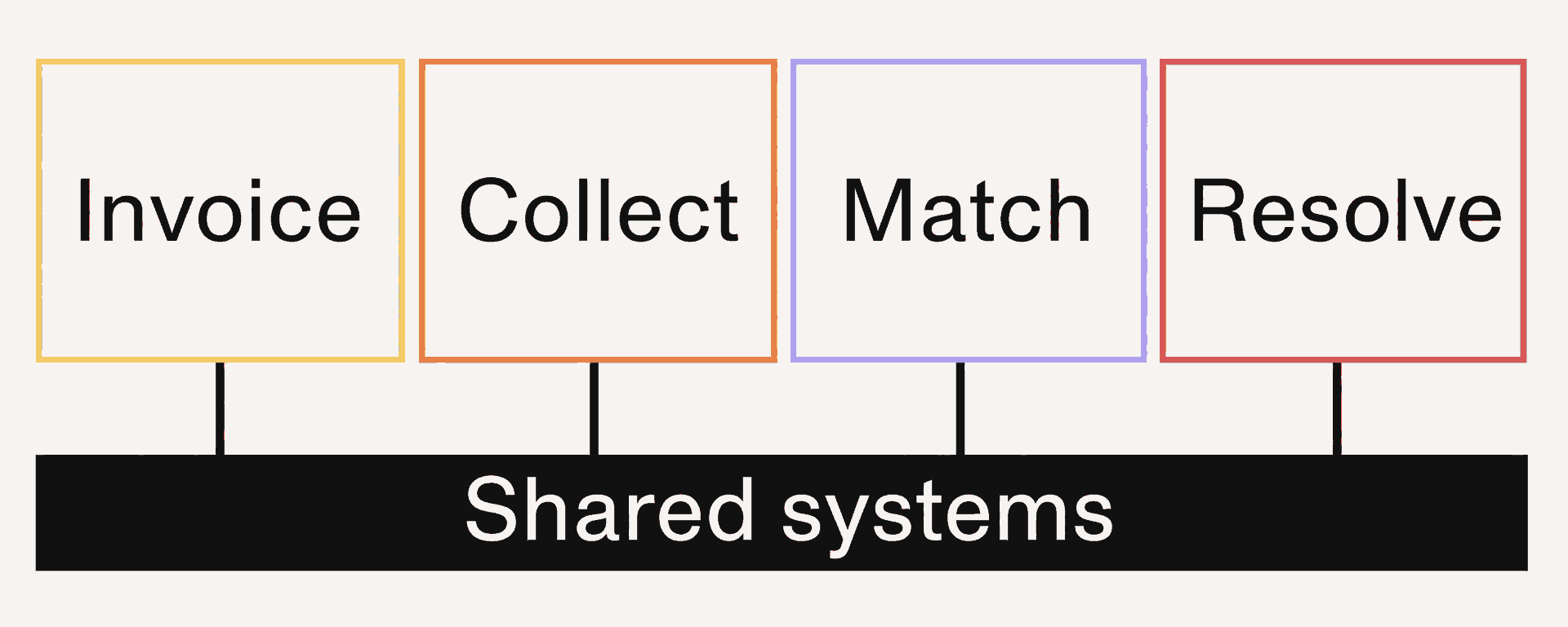
Workflow categories work well for the invoice example:
- Invoice creation: Generate and deliver invoices with the information customers need to pay.
- Collections: Send reminders and manage follow-up on overdue balances.
- Cash application: Match incoming payments to the correct invoices and accounting records.
- Dispute resolution: Handle discrepancies, missing documents, and payment exceptions.
These are related jobs, not a mandatory sequence. A dispute can happen before payment, and one product may handle several jobs.
Give each company one primary category based on its clearest supported customer use case. Add secondary tags for adjacent capabilities. Put artificial intelligence, geography, revenue model, and customer size in separate fields rather than mixing them into the same category list.
If the main use case is unclear, mark placement as provisional. A company’s broad “finance platform” description doesn’t establish which problem drives adoption or revenue.
Add shared dependencies below the categories: accounting systems, payment providers, data access, and distribution partners. Two startups in different boxes may still depend on the same platform.
Our fintech market map shows how customer jobs and underlying infrastructure fit together. Our voice AI map uses technical layers because the dependencies differ.
3. Gather names from sources with different blind spots
Start with several companies you already know. Follow their integrations, customer alternatives, partners, and former names outward. Search the customer’s language as well as the industry label: “chasing overdue invoices” can surface a different set of products from “accounts receivable automation.”
Use several source types, each for a specific purpose:
- Company materials: Product documentation, release notes, integration directories, and customer stories establish what the company publicly offers or claims. Marketing promises remain company claims until supported by customer or operating evidence.
- Accelerators and industry communities: Y Combinator’s startup directory, other batch lists, university spinout directories, trade associations, and conference exhibitors surface names outside your network. Accelerator membership describes one selected population, not the whole market.
- Funding and ownership records: Company announcements, investor portfolio records, corporate registries, and securities filings help resolve identity and financing history. The U.S. Securities and Exchange Commission’s Form D notice separates the offering amount from the amount sold. Neither field alone establishes a completed round or current operating health.
- Technical evidence: Repositories, documentation, package releases, and developer discussions can reveal emerging products and technical dependencies. GitHub’s explanation of stars describes bookmarking, appreciation, and popularity. Treat star counts as an attention signal, separate from paid adoption.
- Buyer evidence: Interviews, public procurement records where relevant, reviews, and practitioner forums show buying language, alternatives, and implementation problems. Keep the speaker’s role, context, and date with each observation.
- Commercial databases and published landscapes: Use them to expand discovery and compare category choices. Follow material claims back to their underlying sources, and retain the database’s coverage limits.
Deduplicate by company identity and domain, with fields for aliases, products, and parent companies. An acquired product and its new owner should have a recorded relationship. Counting both as independent startups distorts the landscape.
AI tools can suggest search terms, extract candidate fields, and flag possible duplicates. Treat generated names and summaries as leads. A record needs a traceable source before it enters the supported company set.
4. Separate observations from investor judgment
For each company, record its name, domain and aliases, primary category, secondary tags, buyer and job, revenue model, latest disclosed financing and date, operating status, and key dependencies. A subscription product and a service business can solve the same job with different economics. Unknown fields stay unknown; an old seed announcement doesn’t establish today’s fundraising stage.
An evidence ledger is the part of the register that connects each claim to its source. Keep these fields for every material input:
- Claim and subject: What the input says, and which company, product, or category it concerns.
- Evidence type: Company-reported, independently reported, directly observed, investor inference, or unknown.
- Source: The original URL or a private document reference, with a short supporting excerpt or note.
- Dates: Publication date when available, the period the claim describes, and the date you accessed or received it. Mark undated sources as undated.
- Limits: Contradictions, missing context, and what the source does not establish.
- Next action: The question or conversation that could resolve the uncertainty.
One source can support one field and leave another unknown. Product documentation may establish that an integration is offered while saying nothing about how many customers use it.
Here’s a hypothetical record for Fictional Company A:
- Company-reported observation: Its October 1, 2026 release note describes an accounting integration; received October 8, 2026.
- Buyer observation: In an October 9, 2026 interview, one finance lead describes manually matching payments. That observation applies to that buyer’s workflow.
- Investor inference, recorded October 10, 2026: Matching payments may be a useful entry point for this customer segment.
- Unknown: Integration depth, repeat usage, customer retention, and willingness to pay across other firms.
- Next conversation: Ask finance leads how often matching fails, who fixes it, and which budget would fund a replacement.
Our co-founder and general partner Elizabeth Yin writes in Democratizing Knowledge, “Investors use their life perspective to assess.” Your operator experience helps you notice problems. Labeling your interpretation keeps another investor free to disagree with it.
Keep confidential decks, customer names, contact details, and private interview notes in a restricted version. Share only material you have permission to share.
5. Challenge the categories and document coverage limits
Bring the draft to people who do the work: a buyer, an implementer, and a founder will often notice different omissions. Use concrete prompts:
- Which products did you consider together for the same purchase?
- Which part of this workflow still happens in email or a spreadsheet?
- Which company is in the wrong category, and what job explains its placement?
- Who approves the purchase, owns the data, and can block implementation?
- Which dependency would make this product difficult to replace or easy to copy?
In Angel Squad, our angel-investing community, peer learning and curated deal reviews give you opportunities to hear how other investors frame a company. Bring a specific category assumption or unresolved buyer question to that discussion.
An empty category can reflect missing research, absent demand, a bundled incumbent feature, or a difficult business. Record it as an open question. A crowded category also needs buyer evidence before you infer demand, pricing pressure, or attractive economics.
For a first pass, set a research stopping rule. For example, finish after searching each planned source type and completing two additional discovery passes that add no new eligible names. Record the sources and dates of those passes. This shows diminishing discovery within your search process; it does not prove you found every company.
Use a scope label such as “representative companies identified through the listed sources.” Record known blind spots, including undisclosed startups, regions you haven’t researched, and companies without public financing announcements.
6. Draw a readable view and build a conversation queue
Create the visual after the register is coherent. Use category boxes for a workflow or clearly labeled layers for a technology stack. Add connectors only where they represent an actual dependency or relationship.
Keep names equally sized unless you have a consistent, supported metric for sizing them. Funding, revenue, and market share measure different things. A logo’s size or position shouldn’t imply an unsupported ranking.
Put the scope, evidence cutoff, and category definitions beside the map when you share it. If the full register is too dense, show representative names and preserve the rest in the underlying file. A two-axis positioning view can help with a specific comparison, provided each axis has an explicit, evidence-based definition.
Then choose a handful of conversations based on the questions that matter most. For each candidate, record:
- Fit: The customer problem and stage that make the company relevant to your research.
- Reason to talk: A specific product capability, buyer observation, or unresolved dependency.
- Evidence gap: What you still need to understand.
- Next step: Founder introduction, buyer interview, or technical discussion, with an owner and date.
“Understand whether this integration removes manual matching” is a useful next step. “Invest in the least crowded box” is an unsupported leap. Team quality, customer demand, economics, financing terms, and portfolio fit require separate diligence.
7. Give the map an owner and an update routine
Use a cadence you can maintain. We recommend this starting routine for an actively researched niche:
- Weekly: Triage new names and conversation notes. Resolve duplicates and add newly discovered sources.
- Monthly: Refresh the priority conversation queue, public product claims, ownership, and operating-status evidence. Flag stale or unresolved fields.
- Quarterly: Revisit the market boundary, category definitions, dependencies, and the evidence for your original hypothesis.
- After a material event: Update affected records when a company pivots, is acquired, announces a closure, or loses an important platform relationship.
Retain prior versions. A change log should say what changed, when, which evidence supported it, and whether the change affected your interpretation. An inaccessible website alone warrants an unresolved status, not a shutdown label.
Keep category changes separate from company changes. If you split collections into two categories, record the new definitions and reclassify the previous version before comparing counts. Otherwise, your own taxonomy change can look like market growth.
Elizabeth writes in Democratizing Knowledge, “The more disciplined you are in your thought process/rubric, the more you can improve over time.” A dated record lets you see which assumptions survived customer conversations and which ones you abandoned.
If you want to practice evaluating early-stage companies with investor education, curated deal flow, and peers who bring different operating experience, apply to Angel Squad.
This is general educational content, not an investment recommendation or legal or tax advice. Startup investments are speculative, illiquid, and long-term; most bets may fail, and you can lose all invested capital. Investment decisions require separate diligence and independent review from qualified legal, tax, and financial professionals.