Private placement memorandum: an angel’s reading guide
Brian Nichols is the co-founder of Angel Squad, an angel investing community where aspiring and active angels learn from Hustle Fund’s approach, review curated deal flow, and connect with peers.
A private placement memorandum (PPM), often called a private placement memo, is a disclosure document describing a private securities offering, its issuer, terms, and risks. For an angel investor, reading it means connecting the startup’s story to the evidence and the rights you’re buying.
What is an offering memorandum?
An offering memorandum introduces an investment and discloses information about the business or fund raising money. In a private securities offering, “offering memorandum” and “private placement memorandum” often refer to the same document. The issuer is the entity selling the securities, which may be the startup or an investment vehicle. Outside that context, an offering memorandum can also mean a real-estate or business-sale marketing package.
A PPM usually brings together the business overview, management, offering terms, use of proceeds, capitalization, financial information, risks, conflicts, and subscription instructions. Exhibits may contain the agreements and financial statements behind those summaries. The issuer prepares it, typically with securities counsel.
Keep these documents’ jobs separate:
- Pitch deck: Presents the business and its growth case.
- PPM: Discloses the offering, including its risks and limitations.
- Public-offering prospectus: Provides required disclosures for a registered U.S. public offering and forms part of the issuer’s registration statement. A PPM describes a private offering relying on an exemption from registration.
- Regulation Crowdfunding filing: An issuer using this exemption from registration files a public offering statement on Form C and sells through an online platform run by a registered broker-dealer or funding portal. Filing it, or registering a public offering, doesn’t mean the regulator endorses the investment.
- Investment memo: Records an investor’s analysis and decision. Our investment memo template helps organize that reasoning.
- Governing documents: Establish the investment’s contractual and corporate terms. Depending on the deal, these include a stock purchase agreement, corporate charter, investors’ rights agreement, or vehicle operating agreement.
A PPM’s summary can leave out qualifications found in those agreements. Conflicting language needs resolution from counsel before you commit.
Is a private placement memo required?
A document with the title “PPM” isn’t universally required for a U.S. private offering. Disclosure obligations depend on the exemption and participating investors. Under Rule 506(b), specified disclosures and financial information are required for participating non-accredited investors. Those specified disclosure documents aren’t required for accredited investors. Antifraud rules still apply to private offerings. State and non-U.S. requirements can also affect a transaction.
An accredited investor meets defined financial or other eligibility criteria. Accreditation doesn’t establish that a particular investment suits your finances.
The absence of a standalone PPM calls for understanding what information is supplied elsewhere. Refusal to supply meaningful information is a different problem. The Securities and Exchange Commission’s (SEC) private placement bulletin also warns that these documents generally receive no regulatory review and may present an unbalanced picture.
A Form D is a notice filing for a Regulation D offering. Its presence in the SEC’s public filings database doesn’t mean the SEC approved the investment. A PPM appearing there as an exhibit doesn’t establish approval either.
How to read a PPM as an angel investor
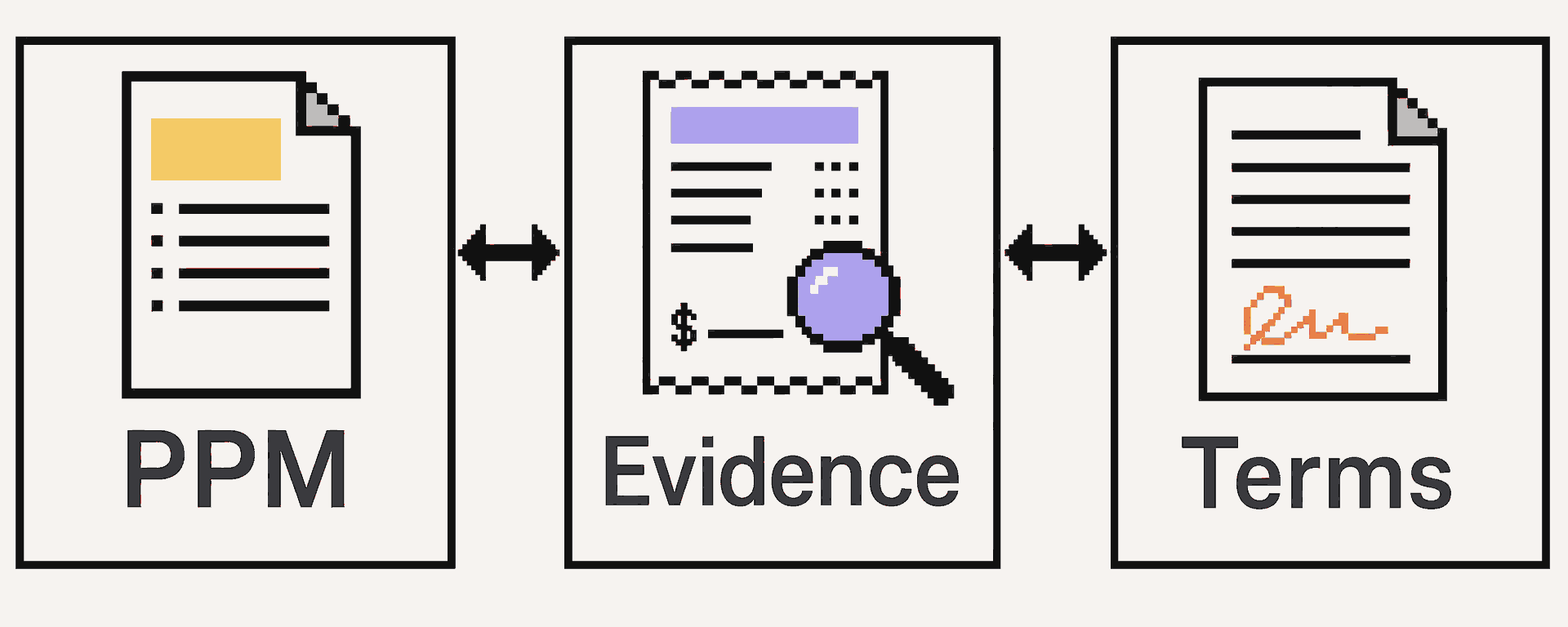
Start with the summary to orient yourself, then read the full document and exhibits. For every material claim, keep three things together: what the PPM says, the evidence behind it, and the agreement that establishes any promised right.
Our co-founder and general partner Elizabeth Yin writes in Democratizing Knowledge: “The more disciplined you are in your thought process/rubric, the more you can improve over time.” A consistent reading process gives you specific questions to resolve across deals.
1. Identify the issuer and what you’re buying
The executive summary should make the business and financing understandable. Name the legal entity receiving your money and the security you’ll receive.
Investing directly in startup preferred stock differs from buying an interest in a special purpose vehicle (SPV), an entity that holds an investment. An SPV adds another set of expenses, decision-makers, and agreements. The vehicle’s manager may exercise rights that you don’t hold individually. Either route may leave you unable to sell your interest or recover cash for an indefinite period.
Ask:
- What business milestone is this financing intended to fund?
- Am I buying startup shares, a convertible security, or an interest in a vehicle?
- What investor qualifications does this offering require?
- Who can accept my subscription, and when does my commitment become binding?
2. Translate the offering terms into rights and obligations
Record the amount being raised, price, minimum check, closing conditions, and any minimum fundraising threshold. Distinguish a fundraising target from a condition that must be met before money can be used.
Then follow the terms into the governing documents. The National Venture Capital Association’s model financing documents illustrate how a priced venture financing can distribute provisions across several agreements.
For preferred stock, focus on:
- Liquidation preference: The payment priority and amount preferred holders receive in a sale or liquidation, subject to available proceeds and senior claims. It doesn’t guarantee recovery.
- Participation and conversion: Whether preferred holders share in additional proceeds after their preference, or can convert to common stock instead.
- Voting and consent rights: Who controls board seats and which actions require investor approval.
- Information and pro rata rights: What reporting you’re entitled to receive and whether you may invest in later rounds to maintain ownership. Minimum-holding thresholds may exclude smaller checks.
- Transfer and amendment provisions: Limits on selling your interest and who can approve changes that bind you.
For a Simple Agreement for Future Equity (SAFE), focus on the conversion, liquidity, and dissolution provisions, plus any valuation cap or discount. A cap affects conversion pricing; it isn’t a promised exit value. A convertible note also requires attention to interest, maturity, repayment, and conversion terms.
3. Connect use of proceeds to runway
Use of proceeds explains where the money goes. Separate cash available to operate the startup from offering expenses, commissions, debt repayment, insider payments, and other deductions.
Runway is the time available before cash runs out at an assumed spending rate. Read the financing plan alongside the current cash balance and net burn, the cash the company consumes after receipts. A hiring plan can make next quarter’s burn very different from last quarter’s.
Ask what happens if the company raises less than its target. A financing that closes in stages may leave the startup with too little cash to reach the milestone used to justify the round.
4. Reconcile capitalization and dilution
The capitalization table, or cap table, records ownership and equity-related interests. A fully diluted presentation generally accounts for shares plus specified options, warrants, and convertible instruments; the precise denominator matters.
Have the financing model explain:
- Which existing SAFEs and notes convert, and on what terms.
- Whether the employee option pool expands before or after the investment.
- How outstanding warrants and promised equity are treated.
- Which holders have senior payment rights.
A headline valuation alone can’t answer how much you’ll own or what you might receive. Future financing can dilute ownership and add securities with different rights. These constraints are part of the broader risks of venture investing.
5. Turn risk factors into diligence questions
Focus on risks that could break the investment case: customer concentration, dependence on one founder, cash shortages, regulatory exposure, intellectual property ownership, security failures, and dependence on another financing.
For each material risk, write the possible consequence, the available evidence, and the uncertainty you’d still accept. “Customer concentration” becomes more useful when translated into a question about contract termination rights and cash collections.
A long risk section doesn’t establish that the disclosures are complete. A disclosed risk also remains your economic risk after you sign.
6. Read management, conflicts, and financials together
Management biographies are starting points for reference conversations. Understand founder roles, outside commitments, compensation, ownership, and any related-party transactions, such as payments to a founder-owned service provider.
Identify who gets paid for bringing you the deal and whether that person invests on the same terms. For an SPV or fund, examine management fees, expenses, carried interest, and allocation conflicts. Carried interest is the manager’s contractual share of investment profits.
In the financials, distinguish historical results from projections and audited statements from unaudited statements. Look at reporting dates, cash, liabilities, revenue recognition, customer concentration, and notes explaining unusual items. Booked revenue, signed contracts, and cash collected can tell different stories.
Ask what changed after the financial statements’ reporting date. A recent customer loss can matter more than a clean-looking historical income statement.
7. Finish with subscriptions and exhibits
The subscription agreement records your purchase and representations about matters such as eligibility and risk understanding. Read every representation you’re asked to make. Don’t sign an acknowledgment that describes information or review opportunities you haven’t received.
The packet may also include an investor questionnaire, charter, purchase agreement, side letters, vehicle agreement, financial statements, and supplements. A side letter grants terms to a particular investor; determine which rights apply to your investment.
One historical issuer PPM hosted by the SEC includes subscription documents, a registration-rights agreement, and financial statements as exhibits. It illustrates a document packet, rather than serving as a current compliance template.
Resolve missing exhibits, inconsistent dates, and material changes before signing. Handle confidential documents through authorized channels. Any changed payment instructions warrant a pause and independent confirmation through an established contact.
A hypothetical startup PPM example
Consider RelayOps, a fictional software startup selling scheduling tools to regional logistics companies. Every figure below is hypothetical and simplified. This is a direct-company financing example, not an investment recommendation or return projection.
RelayOps’ hypothetical offering has these terms:
- Financing: A $2 million target raise in preferred stock at an $8 million pre-money valuation, the value assigned before the new money.
- Investor check: $25,000 invested directly in the company.
- Ownership assumptions: No outstanding convertibles, warrants, or option-pool increase; all shares relevant to the calculation are included.
- Cash: $300,000 of unrestricted cash before closing and assumed offering expenses of $100,000.
- Operating plan: Net burn of $120,000 per month after closing, with a product milestone planned for month 15.
- Closing terms: The company can accept and spend subscriptions without raising the full target.
- Commercial exposure: One customer accounts for 40% of revenue and can terminate on 30 days’ notice.
At a full close, the simplified post-money valuation is $10 million: $8 million plus $2 million. The $25,000 check represents 0.25% immediately after that financing under the stated assumptions. That percentage is ownership, not a promised share of sale proceeds or an investment return.
With the full raise, cash available after assumed expenses is $2.2 million: $300,000 plus $2 million minus $100,000. At constant monthly net burn of $120,000, that is about 18.3 months of runway. The 15-month milestone has a limited cushion.
If only $500,000 closes, and expenses and burn remain unchanged, available cash is $700,000. Runway falls to about 5.8 months. Those calculations assume no other cash changes and don’t model a customer departure. They show how much the operating plan depends on the amount raised.
The next diligence questions follow directly:
- What funded operating plan applies if only $500,000 closes?
- Is there an enforceable minimum raise or escrow condition, and what happens if it isn’t met?
- What is the largest customer’s current relationship with the company, and what would losing that contract do to collections and burn?
- Which document establishes the preferred shares’ payment priority, and what debt or securities rank ahead of them?
- Does a $25,000 holder qualify for the information and pro rata rights described in the summary?
A decision could remain “wait” because the partial-close plan is unresolved. Another investor might accept the financing risk with a smaller check. The PPM has helped identify the tradeoff; it hasn’t decided whether the tradeoff fits either investor.
Red flags that should stop the signing process
Startup losses, illiquidity, and uncertainty belong in the investment case. Misleading statements and obstruction require a different response. The SEC identifies guaranteed high returns, aggressive sales pressure, and problems with written materials among its offering fraud warnings.
Pause when you encounter:
- Approval claims: Someone presents a Form D filing or an SEC-hosted document as government endorsement.
- Unresolved contradictions: The deck, PPM, financials, and agreements describe different financing terms or business facts without an explanation.
- Missing economics: Nobody can explain the cap table, fees, insider payments, or who receives money first.
- Evidence withheld: Material customer or financial claims have no supporting information, and reasonable requests receive evasive answers.
- Pressure to bypass advice: You’re discouraged from involving your own lawyer or tax adviser, or pushed to sign inaccurate representations.
- Payment anomalies: The recipient differs from the issuer or authorized closing arrangements, or instructions change unexpectedly.
A typo alone doesn’t prove fraud. A polished document doesn’t prove legitimacy. Unanswered material questions are enough reason to defer a decision.
When independent advice belongs in the process
Engage advisers before a commitment becomes binding, with enough time for their review to affect the decision.
- Independent securities counsel: Appropriate when rights are unclear, documents conflict, the security is unfamiliar, or the deal involves an SPV, unusual liability provisions, transfer restrictions, or cross-border rules. The issuer’s lawyer represents the issuer. A platform’s involvement doesn’t establish that its lawyers represent you.
- Qualified tax professional: Appropriate when choosing an investing entity or account, investing through a partnership or cross-border structure, assessing reporting obligations, or relying on a claimed tax benefit. Ask about the possibility of taxable income without a matching cash distribution. A generic tax section doesn’t resolve your personal treatment.
- Independent financial adviser: Appropriate when deciding whether the check fits your loss capacity, liquidity needs, concentration, and long-term plan. Consider existing startup exposure and employer stock alongside the proposed investment.
- Accountant or valuation specialist: Useful when the decision depends on financial-statement quality, unusual revenue recognition, complex capitalization, or a valuation you can’t substantiate.
Keep the decision in your own investment memo: the security, evidence supporting the case, unresolved questions, accepted risks, and why the check fits your portfolio. Elizabeth Yin’s advice in Democratizing Knowledge is direct: “Don't try to pick a co. Select a portfolio.” Most startup bets may fail, and diversification cannot eliminate the possibility of substantial losses.
For more practice evaluating deals alongside other investors, apply to Angel Squad. Our community combines Hustle Fund-led investing education, curated deal reviews, and peer learning. It doesn’t replace independent professional advice.
This guide is educational and does not constitute legal, tax, investment, financial, accounting, or valuation advice. Seek independent review from qualified legal and tax professionals and other advisers appropriate to your circumstances. Private startup investments are speculative, illiquid, long-term, and can lose their entire value. Past results and current valuation marks do not guarantee future results. Actual ownership and outcomes depend on the governing documents, cap table, future financing, fees, carried interest where applicable, taxes, valuation policies, and timing. The hypothetical example is simplified and is not a projection.