High conviction investing: evidence before certainty
Brian Nichols is the co-founder of Angel Squad, an angel investing community where aspiring and active angels learn from Hustle Fund’s approach, review curated deal flow, and connect with peers.
A compelling pitch can leave you ready to call an investment “high conviction” before you can explain what would change your mind. The term carries different expectations in public stocks and private startups. Understanding that difference gives you a more useful way to examine a promising company, the evidence behind it, and the uncertainty you’d be accepting.
What high conviction investing means
In public markets, high conviction investing usually describes an approach that puts more weight behind a manager’s strongest investment ideas, often through a relatively concentrated portfolio. Their holdings can look quite different from the market index used to judge their performance. FactSet describes this public-equity usage while cautioning that greater concentration is no universal route to better performance.
There’s no universal number of holdings that establishes conviction. A portfolio label also tells you little about whether the underlying judgment is sound. Greater exposure to a single company makes a mistake in that company matter more to the portfolio.
For startup decisions, we use conviction to mean a reasoned commitment to an investment thesis, the explanation for why an investment could work, with explicit conditions for revising it. Three concepts belong in separate parts of the decision:
- Confidence: How certain you feel about your judgment.
- Conviction: A commitment grounded in supporting evidence, explicit unknowns, and conditions for changing your view.
- Concentration: How much of your capital depends on a particular company or shared source of risk.
This is a practical way to use the word conviction, rather than a scientific measure. You can have a carefully supported thesis and still decline an investment because the exposure doesn't fit your circumstances.
Our co-founder and general partner Elizabeth Yin puts the portfolio responsibility plainly in Democratizing Knowledge (Hustle Fund, 2021, p. 130): “Select a portfolio.” Belief in one company doesn’t settle how much risk belongs in your portfolio. Most startup bets may fail, and diversification cannot guarantee a profit or prevent losses.
Confidence can outrun the evidence
Overconfidence can include being excessively certain that your beliefs are accurate. Don Moore and Paul Healy call this form overprecision in their 2008 paper The Trouble With Overconfidence (p. 502). A detailed forecast can feel reassuring even when its range of possible outcomes is too narrow.
In their 2013 study Managerial Miscalibration, Itzhak Ben-David, John Graham, and Campbell Harvey examined more than 13,300 stock-market forecast distributions from financial executives. The ranges intended to contain 80% of possible one-year S&P 500 returns captured the realized return only about 36% of the time. That finding concerns public-market forecasts, rather than startup selection, but it illustrates how professional experience can coexist with excessive precision.
Conviction in our framework includes explicit uncertainty and conditions for revision. Overconfidence in the form Moore and Healy describe understates that uncertainty.
“The product could work, but we haven’t seen it run without the founders” gives you a specific unresolved question. “I’m highly confident in the technology” leaves the limits of your knowledge unclear.
Public-stock evidence has limits for startup investors
Public-market research can inform your thinking without supplying a rule for private investments.
Brad Barber and Terrance Odean’s study of 66,465 brokerage households during 1991–1996 associated frequent common-stock trading with worse performance after trading costs. Their brokerage-account study was historical and observational. It didn’t test startup investing or establish that holding a private investment longer improves its outcome.
The choices available to you are different, too. An investor in a liquid public stock can generally respond to a changed thesis by trading. A startup investment may offer no practical exit when your view changes.
The U.S. Securities and Exchange Commission’s private-placement risk guidance warns of possible total loss, limited disclosure, and highly illiquid investments that may need to be held indefinitely.
Holding under those conditions says little about conviction. You may be unable to sell a company you no longer believe in. Your revised view can still inform whether you commit more money later, what questions you ask, and how you assess similar opportunities.
A high-conviction framework for startup evidence
Build a short evidence-update note around the particular claim your decision depends on. Keep it within your broader investment memo. These steps organize that note; they don’t produce a success score or replace diligence, the work of examining a company and investment.
1. Bound the claim and the unknown
Choose one important claim from the thesis. Explain what you believe, why it matters, and what remains unresolved.
“Customers need this” is too broad. “This team can install its inspection system at another factory without a founder working there full-time” names a claim that future evidence could support or undermine.
At the early startup funding stages known as pre-seed and seed, our co-founder and general partner Eric Bahn explains, “Pre-seed investing and seed investing is largely an exercise of assessing the potential of the founders.” Early evidence may concern how a team learns and executes. It cannot establish operating results the company hasn’t had time to produce.
Write the gap plainly. Unproven installation, uncertain customer demand, and unknown costs are different uncertainties.
2. Separate the observation from its interpretation
Record the source, date, and limits of the evidence. Preserve distinctions such as:
- Observed fact: You watched a demonstration under specified conditions.
- Founder claim: The founder says the same result occurs at customer sites.
- Investor assumption: You expect the installation process to become repeatable.
- Unknown: You haven’t seen records of how much founder intervention each installation requires.
A demonstration on selected images supports performance under those conditions. Production reliability remains unresolved. Several investors repeating the founder’s account still represent one underlying source.
3. Name the evidence that would weaken the claim
Disconfirming evidence is information that makes your explanation less plausible. Write a concrete example before a favorable result gives you a reason to soften the standard.
For the installation claim, repeated dependence on founder intervention at unrelated sites would weaken the case for repeatability. A founder’s credible plan to fix the problem can matter, but the plan and the demonstrated fix belong in separate entries.
Give the strongest countercase a fair hearing. In Angel Squad, our angel-investing community, peer learning and shared deal context give you ways to encounter other investors’ reasoning. A useful disagreement identifies the observation someone thinks you’ve misread or the assumption you haven’t supported. Agreement doesn’t establish that the claim is true.
4. Set a milestone that can change the answer
A milestone is a specific observation expected by a date or event. Tie it to the uncertainty you named.
“Raise another round” may show financing progress. It doesn't, by itself, resolve whether customers can use the product without intensive help. Choose evidence that bears directly on the claim, and describe both a supportive result and a contradictory one.
Also define the unresolved outcome. A delayed pilot may provide no new operating evidence. The delay can create other concerns, including cash pressure, but the original technical question remains open. Missing evidence deserves its own label rather than an automatic pass or failure.
5. Update the belief before deciding what to do
Keep the original note. Add the new observation, its source, and the part of the claim it changes.
You might strengthen the claim, narrow it to a particular customer type, weaken it, or leave it unresolved. Explain the change in words. A decimal-point confidence score can suggest more precision than the evidence supports.
Then consider any available decision separately. Stronger evidence doesn’t automatically justify a larger check. Weaker evidence doesn’t create a buyer for an illiquid investment.
A worked example of evidence changing conviction
Consider a fictional pre-seed company developing a camera system to detect packaging defects. This is a hypothetical, simplified operating example, not a performance projection or an investment recommendation. None of the customers or results described here is real.
Suppose the team demonstrates a prototype at one factory on a selected set of images. Your narrow claim is that a second, unrelated factory can operate it without a founder stationed on the line. The demonstration supports further investigation of the technology. It leaves independent operation unresolved.
For this example, your next evidence milestone is six scheduled production shifts at the second factory within 90 days, with records of false alarms, missed defects, and every manual intervention. Acceptable operating limits would be defined for that site's requirements before the pilot begins. The shift count and timing are illustrative, not investing benchmarks.
The possible updates are different:
- Support: Factory staff run the system within the defined limits without founder intervention. That supports independent operation at this site. Installation cost, customer willingness to pay, and performance elsewhere remain open.
- Contradiction: The system repeatedly needs founder intervention to stay within those limits. The claim of independent operation weakens, even if the founder gives an impressive presentation about the next version.
- Unresolved: The pilot hasn't started. You still lack the operating evidence. You can assess the delay and its consequences without pretending the original claim has been tested.
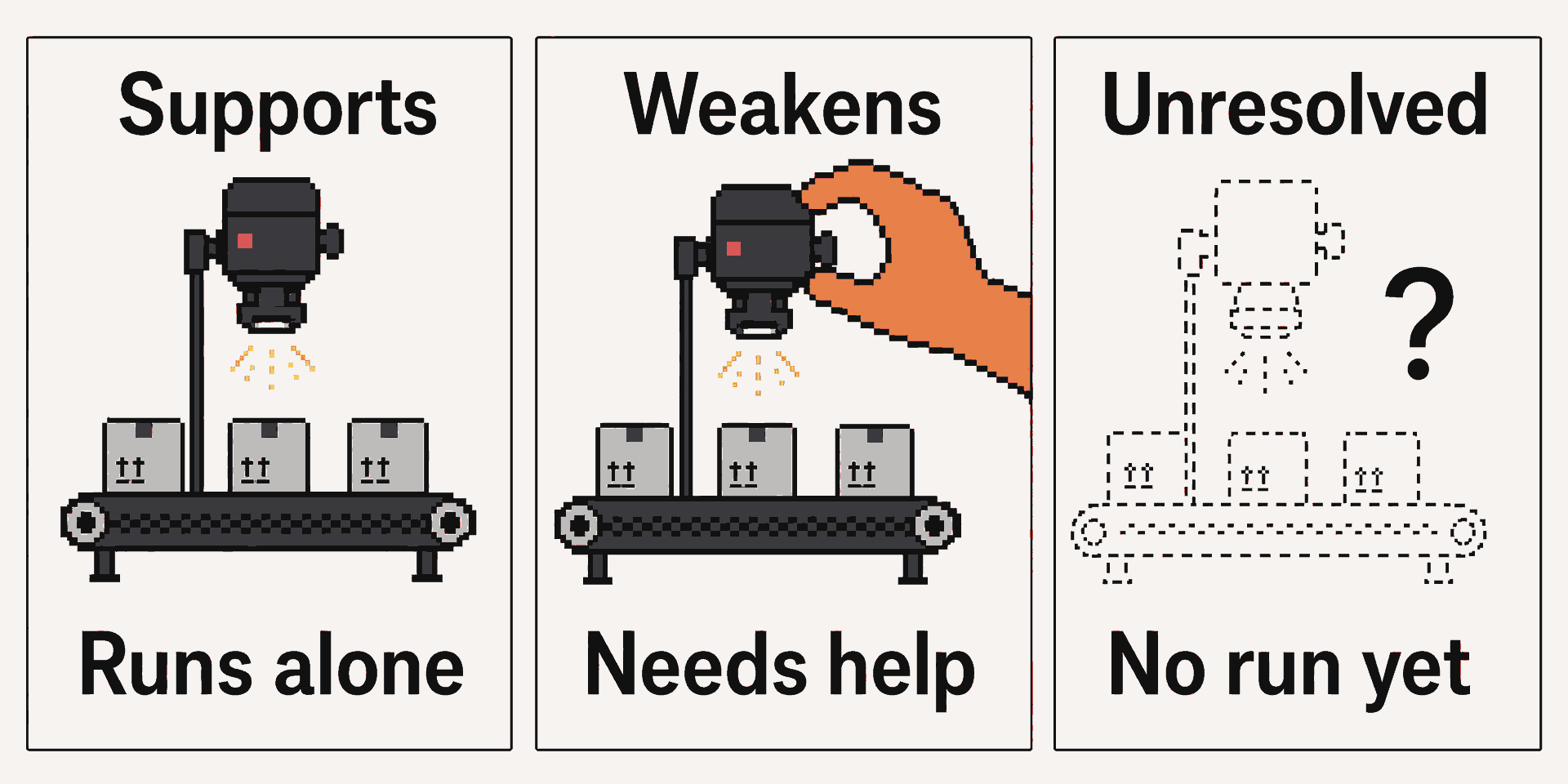
One favorable pilot would support a narrower conclusion than “this business will succeed.” A failed pilot could lead to a revised product or customer focus. Either way, the note preserves what changed and what you still don’t know.
Keep conviction separate from the next check
An additional investment in a company you already own is a follow-on investment. It deserves a fresh decision about the company, the offering, your existing exposure, and the money you can afford to lose and leave inaccessible.
A new milestone can reduce one uncertainty while leaving others intact. It also cannot make a particular investment suitable for everyone. Two thoughtful investors can interpret the same evidence differently or reach different decisions because their portfolios and financial circumstances differ.
Maintaining a beginner’s mindset leaves room for those revisions. A well-supported decision can still lose money. Luck and developments you couldn't anticipate remain part of startup investing. A completed checklist doesn’t remove that risk.
To practice evaluating startup evidence alongside other investors, apply to Angel Squad.
This material is educational and does not provide individualized financial, investment, legal, or tax advice. The framework is a process aid, not a validated predictor of returns. Startup investments are speculative, illiquid, long-term, and can result in a total loss. Seek independent advice from qualified financial, legal, and tax professionals for your circumstances.