
When to Pass on a Startup Investment: 3 Easy-No Tests
Brian Nichols is the co-founder of Angel Squad, a community where you’ll learn how to angel invest and get a chance to invest as little as $1k into Hustle Fund’s top performing early-stage startups.
Early-stage deals arrive faster than any angel can investigate them. Spend hours on each pitch and your calendar disappears. Reject them on instinct and you risk confusing familiarity with quality. Our Easy-No screen gives you a consistent way to choose which deals deserve more work, with Cold Water Inc. as a running example.
The three Easy-No tests
- Recurring demand: Will customers face the problem, use the solution, or buy again often enough for the business model to work?
- Market room: Can a focused initial market lead to an outcome large enough for your investment strategy?
- Founder must-have: Does this team bring, or show the ability to acquire, the capability the business needs most?
A clear no on any test is an easy no. Three plausible yes answers mean the opportunity may deserve full diligence. They are never a reason to invest by themselves. If an answer is unknown, write down the missing evidence instead of quietly turning uncertainty into a yes.
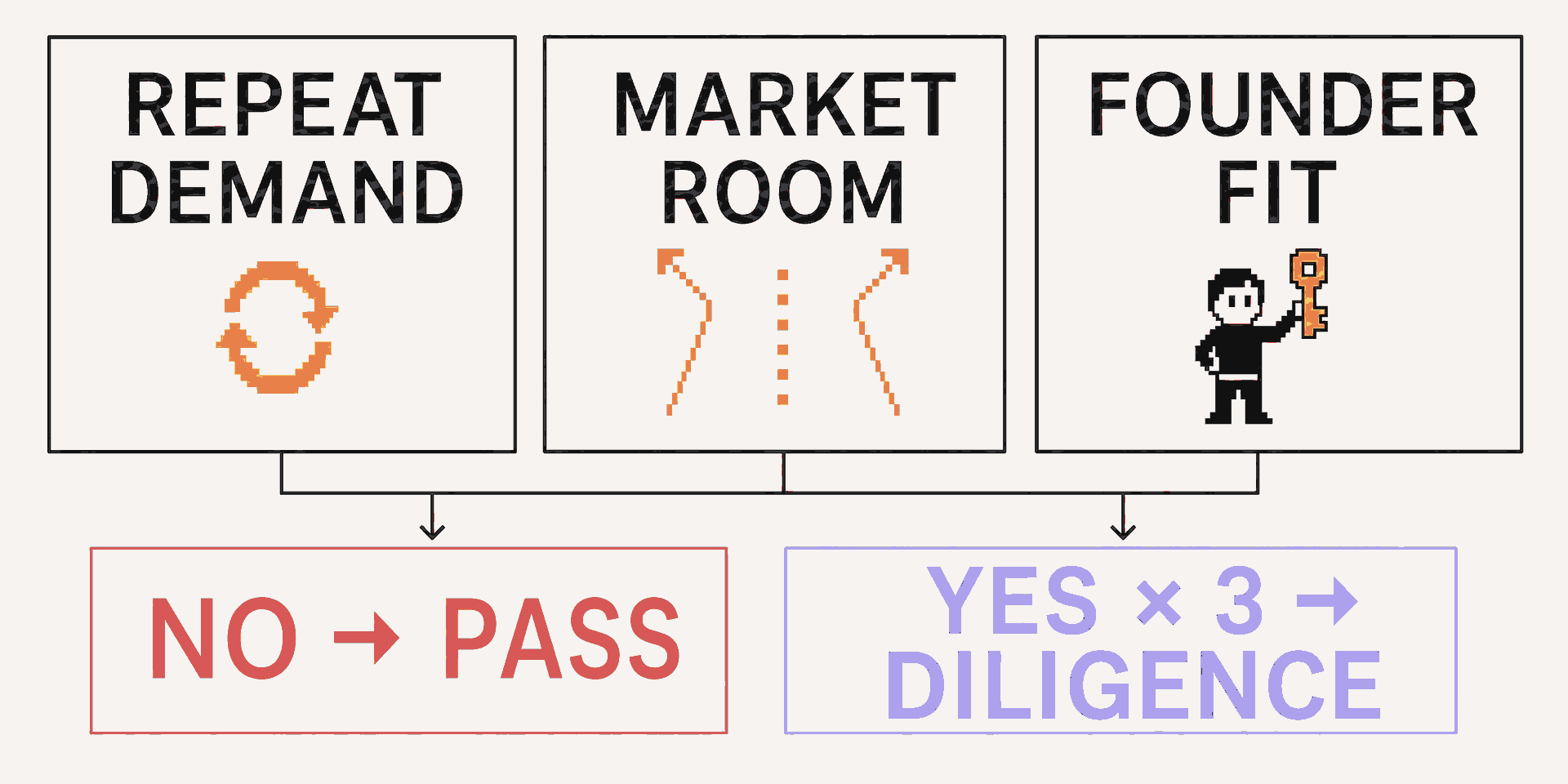
Quick screening stops before full diligence
This screen tests three reasons to stop early. It leaves product claims, traction, customer references, competition, the cap table, deal terms, legal documents, portfolio fit, and check size for the next stage.
If a deal clears the screen, use our startup diligence checklist to verify the story and the paperwork. Our startup investment criteria guide helps you compare that evidence across deals. Clearing either process still cannot remove the speculative, illiquid, and total-loss risks of startup investing.
In Angel Squad, our angel-investing community, members can compare first-pass notes before deciding which opportunities deserve more time. The goal is sharper judgment, not consensus.
Put Cold Water Inc. through the screen
Imagine a founder pitches Cold Water Inc. The company plans to build a global community for cold-water swimmers and host polar-bear-plunge events.
You may know instantly that it falls outside your thesis. If it fits your strategy and still sounds interesting, start the clock.
Test 1: Does demand recur?
Recurring demand means customers experience the need, repeat the behavior, or buy again often enough to support the model. For Cold Water Inc., ask what happens after the first icy plunge. Do attendees book the next event, bring friends, buy coaching, or keep participating once the novelty fades?
The first-pass evidence can be simple:
- Repeat attendance from the earliest event cohorts
- Advance reservations for another event
- Customers paying for ongoing coaching or community access
- Referrals that bring in similar customers without heavy discounts
Monthly events, coaching, branded gear, or a subscription could make revenue recur. A subscription drawn on a slide proves nothing. The founder needs evidence that customers want the recurring offer.
Repeat behavior also makes the relationship between customer acquisition cost, the cost to win a customer, and customer lifetime value, the revenue collected across that relationship, more plausible. Precise economics belong in full diligence. During triage, pass when the model depends on repeat attendance and every sign points to a one-time thrill.
This is why our co-founder and general partner Elizabeth Yin says, “Of course, a great team matters, but an amazing idea matters way more.” A gifted founder can improve an offer. They cannot talk customers into caring forever. In a quick screen, observed repeat behavior carries more weight than charisma.
Test 2: Could the market become big enough?
Cold-water swimming can attract a committed niche. The useful question is whether that niche can lead somewhere large enough for your strategy.
There is no universal total addressable market cutoff that settles the answer in 10 minutes. Market estimates are uncertain, and investors have different check sizes and return requirements. A focused wedge can be attractive when customers care deeply and the company has a credible expansion path.
Ask three questions:
- Who is the first customer segment the company can win?
- Which adjacent customer, product, or use case comes next?
- Why will this company have the right to win that adjacency?
Cold Water Inc. might begin with local enthusiasts, then expand into swim fitness, recovery, coaching, or a broader wellness community. That path needs more than a list of large industries. Look for shared customers, a repeatable channel, or a product advantage that makes the next step believable.
Pass when the market case jumps from a handful of plunge events to “one percent of global wellness” with no mechanism in between. Continue when the founder can connect the niche wedge to a larger market through specific customers and behavior.
Test 3: Does the founder bring the must-have?
The founder must-have is the capability, access advantage, or learning speed the business needs to clear its biggest near-term bottleneck. It is specific to the company. A regulated startup may need regulatory fluency. A technical product may need rare engineering depth. Cold Water Inc. may need community distribution, retention skill, and safe event operations.
The founder does not need a perfect résumé. Look for evidence that the team already has the must-have, learns it quickly, or recruits someone who does. If customer acquisition is the bottleneck and nobody on the team has ever built an audience, run a channel test, or sold to this community, that gap can justify a pass.
Our co-founder and general partner Eric Bahn puts the early-stage challenge plainly: “Pre-seed investing and seed investing is largely an exercise of assessing the potential of the founders.” Potential should show up in what the founders have learned, built, sold, or recruited with limited resources. A famous name is one form of advantage, not a substitute for the other two tests. If Michael Phelps pitched Cold Water Inc., his credibility and reach would earn attention. The company would still need recurring demand and room to grow.
Keep this test tied to the business bottleneck. Integrity issues, contradictory claims, pressure tactics, and evasive answers belong in a broader review of founder red flags. Confidence, accent, eye contact, and similarity to founders you already know are weak proxies for ability.
Run the screen in 10 minutes
Use the same short process for every deal:
- Minute 0 to 1: Write one sentence naming the customer, the recurring behavior, and what the company sells.
- Minutes 1 to 4: Record the strongest evidence that demand repeats. Mark it yes, no, or unknown.
- Minutes 4 to 7: Name the initial wedge and one credible expansion path. Mark it yes, no, or unknown.
- Minutes 7 to 10: Name the business's next bottleneck and the founder evidence that addresses it. Mark it yes, no, or unknown.
Then make the triage decision:
- Any clear no: Pass and record the decisive reason.
- Three plausible yes answers: Start full diligence.
- One or more unknowns: Ask for the single missing fact most likely to change the decision. Wait only when that evidence is expected on a real date. Otherwise, pass.
This record matters. “Pass because I did not like the pitch” teaches you very little. “Pass because the model requires repeat attendance and only 2 of 30 first-time attendees booked again” gives you a decision you can audit later.
Decline clearly and treat receptiveness carefully
Send the no promptly. State the deciding factor without presenting your view as a universal verdict. For Cold Water Inc., you could write, “Thanks for walking me through Cold Water Inc. I am going to pass. My main concern is repeat demand: I did not see enough evidence that first-time attendees return often enough for the current model. That is the deciding factor for my strategy. Would direct feedback beyond that decision be useful?”
Ask permission before offering more direct feedback. If the founder says no or does not respond, respect that choice. Declining unsolicited advice tells you little about their ability to learn.
If they say yes, share one or two specific observations. Receptiveness can become a small data point when a founder invites feedback and engages with the evidence. Agreement is not the standard. Strong founders should challenge advice that conflicts with customer data. Watch for repeated evasion, personal attacks, or changing facts rather than treating a reasoned disagreement as defensiveness.
Leave the door open only when a real condition could change your answer, and name it. “Happy to revisit after three events with repeat-attendance data” is useful. A vague “keep me posted” creates false hope.
A fast no protects your time. A documented no improves your judgment. A respectful no preserves the relationship.
To practice this screen on real pitches, compare notes with experienced operators, and learn how Hustle Fund evaluates early-stage teams, apply to Angel Squad.







.png)