
Direct vs. Syndicate Investing: Which Startup Path Fits You?
The same startup can reach you through two very different routes. You can invest directly, own the company’s security yourself, and manage the relationship. Or you can join a syndicate, pool capital through a shared vehicle, and rely on a lead for part of the work.
That choice changes more than convenience. It affects what you own, who makes decisions, what you pay, how you support the founder, and how quickly you can build a portfolio.
.png)
Brian Nichols is the co-founder of Angel Squad, our community for people learning to invest in startups.
The core difference between direct and syndicate investing
In a direct startup investment, you or your investment entity signs the financing documents with the company. You fund the company directly and hold its Simple Agreement for Future Equity (SAFE), convertible note, preferred shares, or other security.
In a syndicate investment, several backers join one deal under a lead investor. The group commonly invests through a special purpose vehicle (SPV) created for that company. You own an interest in the SPV, and the SPV owns the startup security. Our separate syndicate investing guide explains the full deal process.
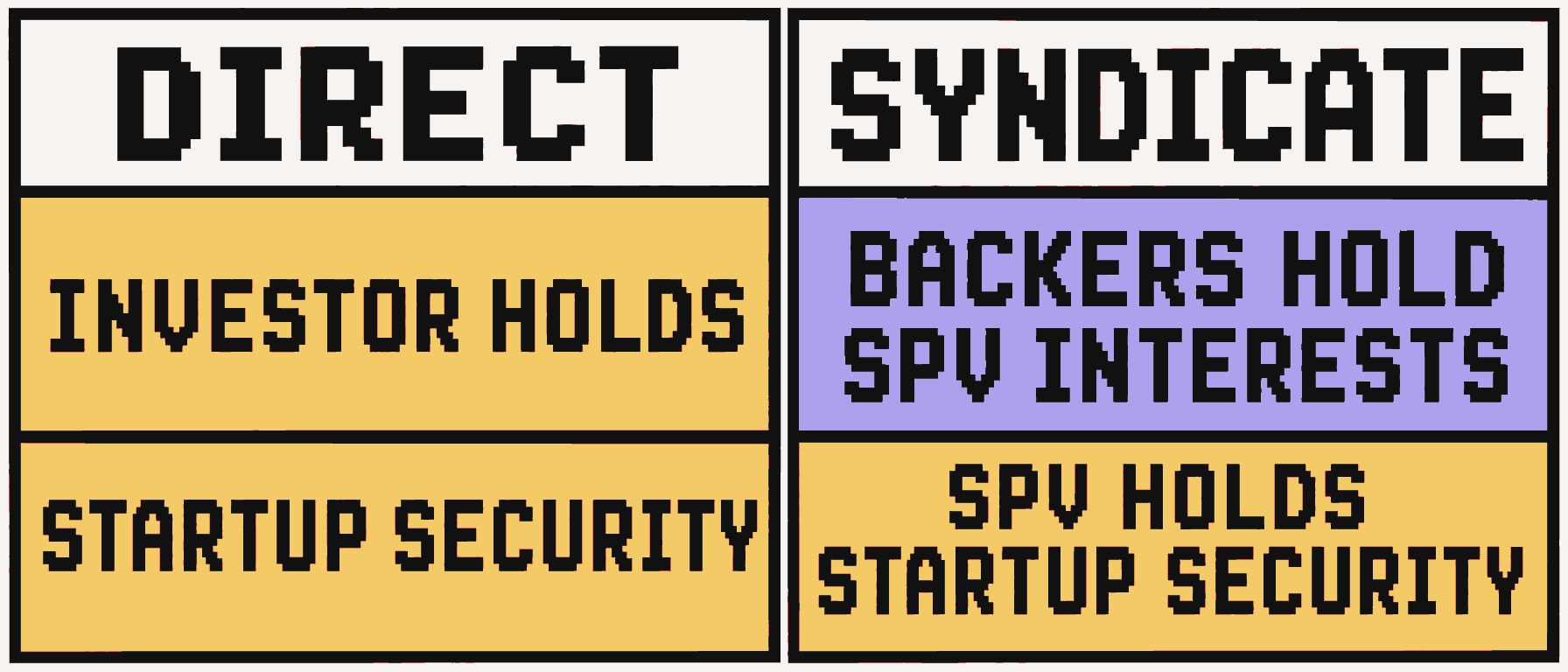
Both routes leave you exposed to the same underlying startup. A syndicate can reduce your check size and administrative load. It cannot make a weak company strong or turn an illiquid security into cash on demand.
Direct vs. syndicate investing across nine decisions
The route mechanics are simple. Their effects show up across the life of the investment.
1. What you own
Direct: You hold a security issued by the startup. If you buy equity, or a SAFE or note later converts, your name or investment entity may appear on the capitalization table. Your economic, information, voting, and pro rata rights come from the financing documents you signed.
Syndicate: You usually hold an interest in the SPV. The SPV appears as the investor in the company’s records and holds the startup security. Your rights against the vehicle come from its operating agreement, limited partnership agreement, subscription documents, and related terms. The SPV manager exercises the rights the company granted to the SPV.
That extra ownership layer matters. A promise that the SPV “gets pro rata” does not tell you whether the manager must exercise it, whether backers can contribute to a follow-on, or how any resulting allocation will be divided.
This discussion is educational. It is not legal advice and not tax advice. Securities, entity, and tax consequences depend on the offering, documents, investor, and jurisdiction. Seek independent review from qualified legal and tax professionals before investing.
2. How much control you have
Direct investing gives you full control over your own yes, no, and check size. It does not guarantee control over the deal terms. A founder or institutional lead may set the SAFE cap, valuation, liquidation preference, and closing schedule, leaving a small direct angel to accept or pass.
A deal-by-deal syndicate also lets you accept or pass on each company. Once you subscribe, you delegate many later decisions to the SPV manager. Those may include voting, consents, information requests, follow-ons, transfers, litigation, and distributions.
The useful question is specific: Which decisions will I still make after the wire?
3. Where the deal comes from
Direct investors build their own sourcing engine. Founders, operators, accelerators, other investors, industry events, and portfolio referrals all become part of the pipeline. That work can create proprietary access, especially when your operating background gives you credibility in a niche.
Syndicate backers borrow part of the lead’s network. A good lead can bring an allocation you could not secure alone, filter a large pipeline, and explain why the deal fits their strategy. Access is still only the start. Popularity, speed, and a familiar name are weak substitutes for an investment case.
4. Who does the diligence
With a direct investment, you own the diligence process. You decide which founder, customer, product, market, financial, cap table, and legal questions matter. You also own the gaps when a deadline arrives before the answers.
With a syndicate, the lead usually performs initial screening, meets the founders, reviews company materials, and writes a memo. Treat that work as an additional lens. Your job becomes two linked decisions:
- Would you invest in this company on these terms?
- Would you delegate the SPV decisions to this lead under these economics?
A polished memo can hide the difference between evidence the lead tested and claims copied from a deck. Our startup evaluation checklist helps turn the memo into questions of your own.
5. Where your time goes
Direct investing includes finding companies, taking pitches, running diligence, reviewing documents, wiring funds, tracking signatures, collecting updates, handling tax records, deciding on follow-ons, and helping founders. Some service providers can remove pieces of that work. The investor still owns the system.
Syndicates compress sourcing and administration. You still need time to read the memo and documents, form an independent view, size the check, and track the position. The lead and administrator can handle the vehicle, banking, signatures, reporting, tax documents, and distributions according to the deal terms.
Think of this as a shift in workload. Direct investors spend more time building the pipeline and managing each relationship. Syndicate backers spend more time judging leads and choosing among curated deals.
6. What you pay
A direct investment normally has no syndicate lead taking carried interest. You may still face legal review, entity, banking, platform, accounting, and tax costs. Small direct checks can also be rejected when the founder wants fewer names to manage.
A syndicate may charge or pass through setup, legal, regulatory, administration, banking, tax, or management costs. The lead may receive carried interest, usually called carry, which is a share of investment profit. The exact cost stack and distribution waterfall belong in the deal documents.
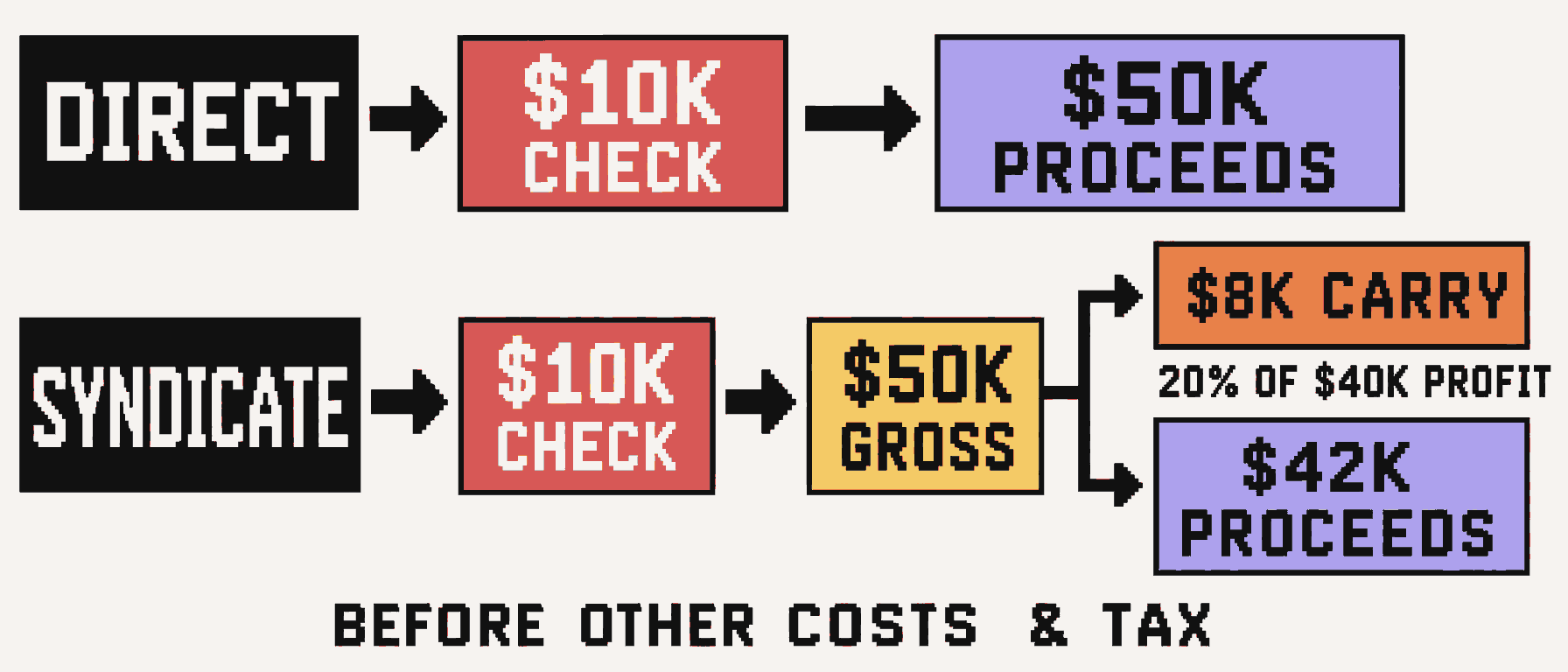
Suppose you commit $10,000 and the underlying security returns $50,000 before tax. The gross profit is $40,000. If an SPV charges 20% carry on that profit, $8,000 goes to the carry recipient and $42,000 remains for you before other expenses and tax. Different carry bases, hurdles, fees, and waterfalls produce different results.
“Show me the incentives, and I’ll show you the outcome.”
Shiyan Koh, our co-founder and general partner
Apply that principle to the lead. How much personal capital is at risk? Who receives carry or fees? Did the lead receive advisory equity, a board role, a side allocation, or other compensation? Clear economics make the relationship easier to judge.
7. How close you are to the founder
A direct check can create a direct line to the founder, especially when you bring relevant customers, candidates, expertise, or future capital. It creates no automatic claim on the founder’s time. A small investor who sends vague “How can I help?” messages may receive the same updates as everyone else.
A syndicate gives the founder one vehicle to manage instead of dozens of small holders. The lead may become the main point of contact. Backers can still help when the community and lead create a path for specific requests, but founder communication usually flows through the vehicle.
Decide whether a direct relationship is part of your investing goal. If your edge depends on product feedback or industry introductions, distance can reduce both your learning and your value to the company.
8. How the route affects portfolio construction
Direct deals often require a larger check because the company has a minimum allocation worth administering. A syndicate can combine smaller checks into one larger investment. Smaller checks may let a limited annual budget reach more companies, sectors, and vintages.
The vehicle itself adds no diversification. One single-company SPV is one startup exposure.
“Don’t try to pick a co. Select a portfolio.”
Elizabeth Yin, our co-founder and general partner, in Democratizing Knowledge
Work backward from your total startup budget, intended number of initial checks, pace, and follow-on reserves. Then compare the check sizes you can actually access through each route. The goal is a repeatable portfolio plan, not the largest possible stake in the first exciting company.
9. What happens after the round
Direct investors receive whatever reporting and rights their documents provide. They track conversions, financing rounds, consents, pro rata notices, secondary offers, shutdowns, and exits themselves or through their chosen system.
Syndicate investors rely on the lead and administrator to pass along updates and act for the SPV. This can make recordkeeping easier. It also creates key-person and communication risk. A silent lead can leave backers with little practical visibility even when the SPV technically has information rights.
Ask how the lead handled a struggling company, a down round, a pro rata decision, and a distribution. Those examples reveal more than a dashboard full of marked-up valuations.
Three ways the choice looks in real life
“Direct” and “syndicate” describe structures. Your actual investing style can sit anywhere from curated and low-volume to fully self-sourced.
When we interviewed three investors from our Angel Squad community, each had chosen a different operating model.
- Curated, then useful: Arti Villa invested through syndicates and spent roughly one to two hours reviewing the short list she took seriously. She read the deck, tried the product, and watched or attended the pitch. Her check came through a shared vehicle, while her product expertise let her advise developer-tool founders directly.
- A system-heavy hybrid: At the time of our interview, Andy Louis-Charles reviewed thousands of deals a year using automated filters. He also sourced outside formal channels. After hearing the founder of Pressed Roots on a podcast, he reached out and became the company’s first check. Syndicates expanded his pipeline; direct outreach created a relationship that no feed could supply.
- Active and self-sourced: Mike MacCombie treated deal flow as part of his social life. Calls, community building, and dozens of startup WhatsApp groups kept him close to founders and other investors. That model can create proprietary access, and it demands ongoing attention.
The lesson is practical: the legal route does not decide how helpful, thoughtful, or active you are. A syndicate backer can contribute deep expertise. A direct investor can write a check and disappear.
How to choose your route
Choose based on the constraint that is hardest for you to solve.
Direct investing fits you when:
- You already receive credible founder referrals or can build a focused sourcing network.
- You have sector or operating expertise that improves diligence and helps founders.
- You want a direct founder relationship and are prepared to earn it.
- You can meet the company’s allocation and manage a slower portfolio-building pace.
- You have time and systems for documents, updates, rights, tax records, and follow-ons.
- Avoiding a carry layer matters enough to justify the extra work and potentially larger check.
Best suited to: Well-connected founders, sector specialists, active operators, family offices, and angels building a visible direct investing track record.
Syndicate investing fits you when:
- Your network does not yet produce enough relevant deal flow.
- Smaller deal minimums would help you follow a multi-company portfolio plan.
- You value the lead’s access, judgment, negotiation, or administration.
- You can evaluate both the company and the person managing the vehicle.
- You accept indirect ownership, delegated control, the disclosed cost stack, and the lead’s communication process.
- You want to learn from real deals before taking on a full sourcing operation.
Best suited to: First-time angels, busy operators, investors outside major startup networks, and specialists who want curated opportunities while keeping their day job.
A blended approach is often more durable
You do not need to choose one route forever. Use each where it earns its place.
Consider an investor with a $30,000 annual startup budget. They might place eight $2,000 checks through syndicates and reserve $14,000 for one or two direct opportunities where their network, expertise, and founder relationship create a real edge. That is an illustration, not a recommended allocation. The right number of investments depends on your resources, access, thesis, and risk tolerance.
The blend creates two learning loops:
- Syndicates expand the sample. You see how different leads frame markets, evaluate founders, negotiate terms, and communicate risk.
- Direct deals deepen the work. You practice sourcing, build founder relationships, take responsibility for the full diligence process, and learn what support is genuinely useful.
Keep one decision log for both routes. Record the thesis, evidence, risks, terms, lead assessment where relevant, check size, and reason for the decision before the outcome is known. Review direct and syndicate deals under the same standard.
Questions to answer before each investment
For a direct deal, answer these five questions:
- Why did this opportunity reach me, and what access or insight do I have that others may lack?
- What security am I buying, on which terms, and which rights are actually in the signed documents?
- Which claims have I tested through product use, references, customer evidence, financials, or other diligence?
- What does the founder expect from me after the investment?
- How does this check affect my pace, concentration, and follow-on reserves?
For a syndicate deal, add six more:
- What did the lead personally investigate, and which important gaps remain?
- How much is the lead investing, and what fees, carry, equity, or other compensation do they receive?
- What do the lead’s realized outcomes, losses, and difficult portfolio situations show about their judgment and communication?
- Which entity owns the startup security, and who controls its voting, information, pro rata, transfer, and distribution decisions?
- How much of my payment reaches the company after expenses, and how will profit be distributed?
- What happens if the company raises again, needs consent, offers a secondary sale, shuts down, or exits?
Private placements can provide limited information, be difficult to resell, and result in a total loss. The SEC’s private-placement guidance explains those risks. Many U.S. startup offerings also restrict participation to accredited investors. Eligibility depends on the offering and investor.
Membership in our angel-investing community does not require accredited-investor status. Investing in relevant private offerings does. The community gives you education, peer discussion, and curated optional deal flow from Hustle Fund, so you can build your own process before choosing either route.
Direct investing rewards access, ownership, and involvement. Syndicates reward disciplined delegation. The better path is the one that strengthens your portfolio process without asking you to fake time, expertise, or deal flow you do not have. If you want to learn alongside operators making these decisions deal by deal, apply to Angel Squad.







.png)