
Board observer: A practical guide for angel investors
Brian Nichols is the co-founder of Angel Squad, a community where you’ll learn how to angel invest and get a chance to invest as little as $1k into Hustle Fund’s top performing early-stage startups.
A board observer gets unusually close to a startup’s hardest decisions. The title sounds passive, but the work isn’t. You need to understand the company, ask useful questions, protect sensitive information, and support the founder without pretending you run the place. Here’s how the role works and how an angel investor can do it well.
This guide discusses common U.S. venture practices for general education. It is not investment, legal, or tax advice. Observer rights, duties, liability, insurance, and information access depend on the governing documents, applicable law, and the facts. Companies and investors should use qualified independent investment, legal, and tax advisers to review their situation and agreements.
What is a board observer?
A board observer is a person whom a company permits to attend some or all board meetings in a nonvoting capacity. An investor may negotiate the right to appoint the observer. The observer can usually listen, ask questions, and offer a perspective, but cannot cast a director’s vote or approve a written board consent.
The role usually exists by contract or board invitation. Owning shares alone does not make someone an observer. Written terms should say who may serve, which meetings they may attend, what materials they receive, and when the company may exclude them.
For an angel investor, the job combines two kinds of work:
- Monitoring: Understand performance, cash, risks, and the decisions facing the company.
- Contributing: Add relevant pattern recognition, questions, introductions, or operating experience when the founder and board can use it.
A good observer reads the metric, helps the room understand what it means, and avoids adding noise.
Board observer vs. board member
A board member, also called a director, is part of the company’s formal governing body. Under Delaware corporate law, the board manages the corporation’s business and affairs, directly or through its oversight. Directors vote on board actions and generally owe fiduciary duties under applicable law.
A board observer sits outside that formal body. The practical differences are:
- Vote: A director votes. An observer does not.
- Authority: A director participates in formal board action. An observer advises and influences through discussion.
- Information: Delaware Code section 220 gives a director the right to examine corporate records for a purpose reasonably related to the director’s position. An observer does not receive that director right merely by holding the title. If the observer is also a stockholder, separate stockholder inspection rights under section 220 carry their own requirements. Observer access otherwise comes from the agreement and the board’s ground rules.
- Duties and liability: A director’s fiduciary position follows from the role. An observer’s potential fiduciary or similar exposure is fact-dependent and can turn on the agreement, conduct, control, and applicable law. Confidentiality and securities-law obligations may also apply. The title alone is never a liability shield.
- Removal and term: Corporate documents and law govern a director’s seat. The observer agreement governs an observer’s designation, replacement, and termination.
Board observer rights come with limits
There is no universal bundle of board observer rights. A broad agreement may cover meeting notices, board packets, minutes, written consents, and committee meetings. A narrow one may cover only quarterly board meetings and the materials chosen for those meetings.
The current NVCA model agreement shows how negotiated these rights are. Its optional observer provision contemplates attendance, materials, confidentiality, an ownership threshold, and exclusions for privilege, trade secrets, highly confidential information, competitive harm, and conflicts.
Expect the company to ask you to leave for part of a meeting when:
- company counsel is protecting attorney-client privilege
- the board is discussing a conflict involving you or the appointing investor
- the topic involves a company that competes with your employer or portfolio
- highly sensitive personnel, litigation, financing, or transaction details require a smaller group
A recusal is a governance control, not a personal insult. Step out promptly and do not press directors afterward for the details you were meant to miss.
Access also creates responsibility. Board packets can contain forecasts, customer names, employee matters, fundraising plans, and other material nonpublic information. Keep them in approved systems, share them only as the agreement allows, and never use or pass along confidential company information for another deal. For misappropriation insider-trading cases, 17 C.F.R. § 240.10b5-2 recognizes an agreement to keep information confidential as one circumstance that creates a duty of trust or confidence. Do not trade the company’s securities or tip others while holding material nonpublic information.
Competitor information needs one more guardrail. Nonvoting status does not remove antitrust risk when an observer’s access lets competitively sensitive information flow between rivals. Current DOJ and FTC guidance specifically considers minority investments that provide board-observer access or access to competitively sensitive information. Disclose competitive overlaps before the appointment, then have counsel define the conflicts, exclusions, and information-sharing limits.
Decide whether you should take the role
An observer title is not a merit badge for making an investment. Accept when the company needs what you bring and you can meet the commitment.
Ask five questions before saying yes:
- What problem does this role solve? The answer might be fundraising pattern recognition, sector knowledge, financial discipline, recruiting, or continuity for a major investor. “More visibility” is too vague.
- Can I make the time? Budget for packet review, meetings, follow-up, urgent calls, and relationship building. Attendance without preparation is theater.
- Where could I be conflicted? Map your employer, advisory work, investments, and planned deals against the startup’s market. Our conflict-of-interest guide gives you a process for disclosure and recusal.
- Can I support the founder without directing them? Advice is an input. Management owns day-to-day decisions, and directors own board votes.
- Do the documents match the handshake? Counsel should reconcile the term sheet, investors’ rights agreement, confidentiality terms, company policies, and any indemnification or insurance language.
As our co-founder and general partner Elizabeth Yin writes in Democratizing Knowledge, “Who should be on your Board? Only people you trust.” An observer may lack a vote, but they still hear the conversations that shape it.
For most angels, ordinary investor updates and founder-requested support are enough. If your check is small relative to the round, asking for permanent meeting access may create more burden than value. Pursue an observer role only when the access serves the company as well as the investor. Our guide to portfolio company board meetings explains how to contribute without a formal board role.
Inside Angel Squad, our angel-investing community, members learn from Hustle Fund’s early-stage experience and other operators. That shared pattern recognition is useful when you need to pressure-test a governance situation without pretending one investor has every answer.
Read the board observer agreement closely
The agreement should turn “you can sit in” into usable operating rules. Focus on these terms:
- Appointing right: Which investor holds the right, who may be designated, and whether a substitute may attend.
- Eligibility and end date: Whether the right depends on an ownership threshold and what happens after a transfer, acquisition, public offering, or other termination event.
- Meeting scope: Whether the observer may attend regular, special, and committee meetings, in person and remotely.
- Notice and materials: When notices, agendas, packets, minutes, and written consents arrive. “Same time as directors” is clearer than “promptly.”
- Participation: Whether the observer may speak, propose agenda items, and receive follow-up materials.
- Exclusions: The reasons the company can withhold information or excuse the observer, and who makes that call.
- Confidentiality and use: Which information is protected, who may receive it, how it may be used, and what happens to records when the role ends.
- Conflicts: What must be disclosed and how the board handles competitive, employment, personal, and portfolio conflicts.
- Liability protection: Delaware Code section 145 addresses indemnification, expense advancement, and insurance for directors, officers, employees, and agents, but the observer title alone does not confirm any of those protections. Confirm express indemnification and advancement terms in the agreement, then confirm that the actual directors and officers insurance policy covers the observer and the work they will perform.
- Costs and compensation: Whether travel is reimbursed and whether any fee or equity is paid. Investor-appointed observers often serve as part of their investment role, but compensation is entirely deal-specific.
Online forms are starting points. Use counsel to tailor the agreement to the company, investor, regulatory, and competitive facts.
How to be useful before, during, and after a board meeting
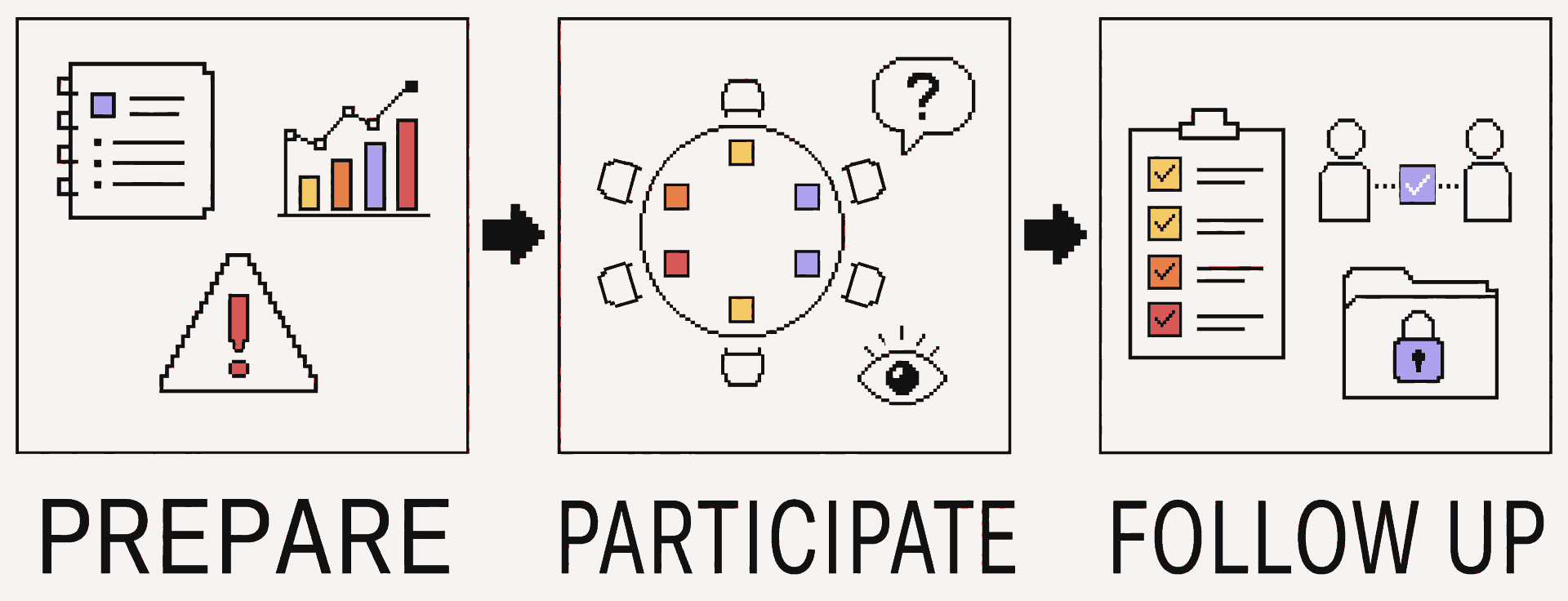
The best observers follow a rhythm: prepare before the meeting, improve the discussion in the room, and close the loop afterward.
Before the meeting
Read the packet early enough to think. Compare actual performance with the prior plan, then note the few changes that matter. For an early-stage company, that often includes cash runway, hiring, product milestones, revenue or usage, pipeline quality, and the next financing plan.
Prepare three types of notes:
- Clarifying questions: What does this number or claim mean?
- Decision questions: What choice does the team need to make, and by when?
- Help offers: Which one or two introductions or experiences are relevant if the founder wants them?
Send agenda requests to the chair or CEO before the meeting. Surprising the room with a new strategic debate wastes everyone’s prep.
Run a conflict check too. If the packet raises a topic involving your employer, another portfolio company, or a personal interest, disclose it before the meeting so the chair can decide how to handle it.
During the meeting
Listen long enough to understand the issue before offering a fix. Ask short questions that expose assumptions:
- What changed since the plan was set?
- Which constraint matters most right now?
- What evidence would change this decision?
- What does success look like by the next meeting?
- What help would be useful from investors?
State which hat you are wearing. “From my experience leading enterprise sales…” is better than presenting a preference as universal truth. Separate facts, inferences, and suggestions.
When the point may be hard to hear, ask permission to be candid and make your intent clear. Our co-founder and general partner Eric Bahn uses this framing: “I’m going to be brutally honest with my feedback but I want you to know that it’s coming from a good place.”
Do not vote, speak for the board, or turn your opinion into an instruction. The chair runs the meeting. The directors govern. The founder and team operate.
After the meeting
Complete the commitments you made. Ask permission before every introduction, use a double opt-in, and give both sides enough context to decline. Our post-investment support playbook goes deeper on making help specific and wanted.
Send corrections to the designated person if a factual point needs to be fixed. Avoid circulating your own shadow minutes or forwarding the packet into personal email and messaging threads. Store or destroy materials according to the agreement and company policy.
Between meetings, build trust without manufacturing a standing call. A focused conversation around a real decision beats a recurring hour with no purpose.
What good board observation sounds like
Imagine a startup missed its quarterly sales target by 30%, has nine months of cash left, and plans to hire two account executives.
A weak observer jumps straight to a command: “Freeze hiring and replace the sales lead.” That conclusion may be right, but the observer has skipped diagnosis and acted like management.
A useful observer asks:
- Which part of the sales plan missed: qualified pipeline, win rate, deal size, or sales cycle?
- Does the hiring plan address that constraint, or add cost before the team understands it?
- Which milestone must the company reach before its next fundraise, and how much runway protects that attempt?
- What decision does management want from the board today?
After the meeting, the observer can offer a call with an experienced sales leader, if the founder wants it. The questions improve the decision. The follow-through creates value. The founder still owns the call.
Boundaries that keep the role healthy
Good board observer responsibilities include knowing when to stop.
- Do not become a shadow executive. Help management think. Do not assign work to employees or run a function through side messages.
- Do not make the meeting about your portfolio. Another company’s confidential metrics, pricing, and plans stay out of the room.
- Do not build a faction. Work through the chair and the full board process instead of collecting private votes before a discussion.
- Do not confuse access with entitlement. Accept exclusions and document requests that fit the agreement.
- Do not promise your network. Make specific, permission-based offers you can complete.
- Do not disappear when things get hard. Cash crises, founder conflict, missed targets, and shutdown decisions are when calm preparation matters most.
Influence without formal authority can be an asset. It forces you to earn attention through judgment, clarity, and follow-through.
Board observer FAQ
Can a board observer speak in meetings?
Usually, yes, when the agreement and chair permit it. Observers commonly ask questions and offer input. They cannot vote, and the chair can manage participation so directors can complete the agenda.
Do board observers get paid?
There is no automatic board observer salary. An investor representative may serve without separate pay because the work is part of managing the investment. An independent observer may negotiate cash, equity, expense reimbursement, or no compensation. Put the answer in writing and have advisers review the tax and securities consequences.
How do you become a board observer?
The usual route is a negotiated investor right or a designation by an investor that already holds that right. Founders grant access because they trust the person and value their contribution, so sector expertise, sound judgment, and a record of useful founder support matter more than collecting board titles.
Can a board observer become a director later?
Yes, through the company’s formal appointment or election process. The observer right itself does not convert into a board seat. The person should review the new fiduciary duties, time commitment, conflicts, indemnification, and insurance before accepting.
Board observation is a service role. Prepare like the decisions matter, speak from real expertise, and leave operating authority with the founder. If you want to build that judgment alongside experienced early-stage investors and operators, apply to join Angel Squad.















.png)