
Angel Investing vs. Venture Capital: 6 Differences
Brian Nichols is the co-founder of Angel Squad, a community where you’ll learn how to angel invest and get a chance to invest as little as $1k into Hustle Fund’s top performing early-stage startups.
Angel investors and venture capitalists can back the same startup in the same round, yet they may reach different decisions for sound reasons. The distinction affects how you select deals, build a portfolio, support founders, and spend your time. Here are the six differences that matter when you choose your own investing path.
The information here is general education, not investment, legal, tax, or accounting advice. Startup investments are speculative, illiquid, and long-term, and you can lose the full amount invested. Review the governing and offering documents with qualified independent legal, tax, accounting, and investment advisers before acting.
1. Angels usually invest personal money; VCs manage a fund
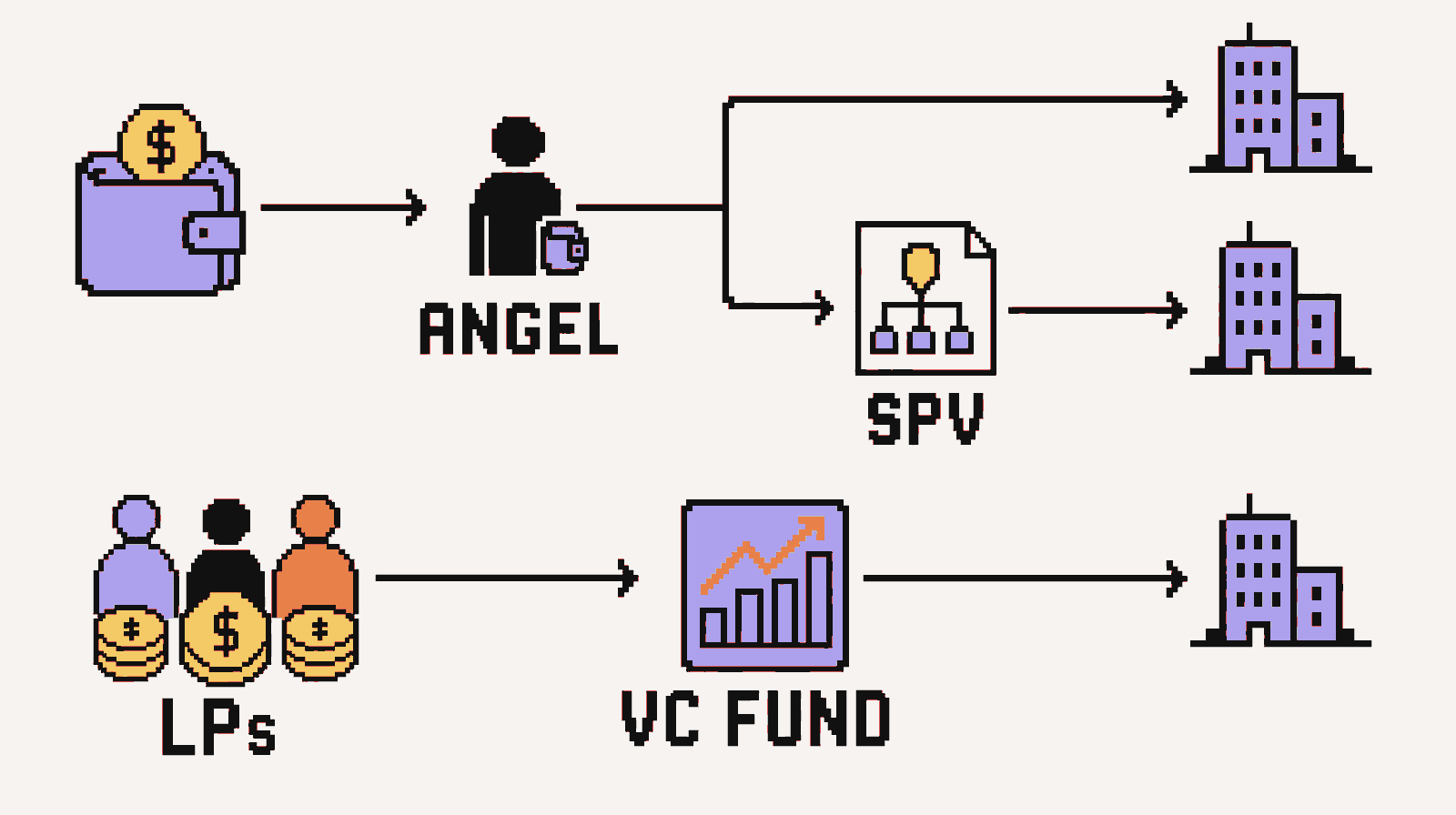
An angel may invest directly in a startup or through a special purpose vehicle (SPV). In a direct investment, the gain or loss belongs to that individual, subject to the security terms, taxes, and any deal expenses. In an SPV, the investor owns an interest in the vehicle, and the vehicle owns the startup security.
A venture firm raises a fund from investors commonly called limited partners. The fund then owns the portfolio investments. The general partner or fund manager makes investment and fund-management decisions under the fund's governing documents. Fees, carried interest, the fund's term, and the timing of distributions depend on those documents rather than one universal formula.
The SEC's overview of early-stage investors draws the same broad distinction while noting that angels and venture funds can both invest early, provide expertise, and invest alongside others.
Check size alone does not define either category. A prolific angel can write a large check and lead a round. A small pre-seed fund can invest a modest amount without taking a board seat. Look at the capital source, decision process, legal structure, incentives, and rights behind the label.
Fund sponsors may commit their own capital to a fund. Angels may invest through syndicates or SPVs whose managers and investors have duties under their agreements. The practical question is: Whose money is being invested, through which entity, and under what rules?
2. Angels may decide alone; VC decisions follow a fund process
An individual angel can often decide without a committee. That flexibility can shorten the process, but speed should never replace diligence. A smaller check can still lose its full value.
A VC usually has more process around a decision. The investor may need to show that the company fits the fund's stage, sector, geography, ownership goals, and return model. Depending on the firm, a partner, investment committee, or wider partnership may approve the deal. The team also has to decide how much capital to reserve for later rounds.
Neither pattern is absolute. Angel groups can vote together. A syndicate lead can select the deal for participating investors. Some venture firms give individual partners significant authority.
If you are investing through a vehicle, learn what happens inside an SPV. The governing documents, fees, carried interest, voting rights, tax treatment, and distribution rules can matter as much as the startup itself.
Our angel-investing community, Angel Squad, helps members learn our evaluation approach and discuss deals with peers. Participation in an available investment is optional deal by deal and depends on eligibility and the offering terms. A stronger process improves the quality of your questions. It cannot remove the risk of loss.
3. Angels are common in early rounds, but specialist VCs invest early too
Angels are often active at pre-seed and seed, when a company may have little operating history. A smaller check can be useful while the startup is testing a product, finding customers, or preparing for a larger round.
VC funds operate across the full company lifecycle. Some specialize in pre-seed. Others focus on seed, Series A, growth, a particular industry, or a particular geography. Funds often write larger checks than individual angels, but there is plenty of overlap.
Stage changes the evidence available. At pre-seed, an investor may be judging a founder's speed, insight, adaptability, and ability to learn with limited customer or revenue data. Later-stage investors can usually inspect more operating history, though more data does not remove the risk.
Our co-founder and general partner Eric Bahn writes in Investment Thesis, “Pre-seed investing and seed investing is largely an exercise of assessing the potential of the founders.” Founder potential is bigger than pedigree or pitch polish. Compare the founder's claims with the product, customer evidence, market, terms, and demonstrated ability to execute.
4. Check size affects ownership and influence, but the terms decide your rights
A larger investment can support a larger ownership position, but the security and financing terms determine what the investor actually receives. Direct shares, a Simple Agreement for Future Equity (SAFE), a convertible note, and an SPV interest do not carry the same rights.
A lead VC may negotiate a board seat, information rights, pro rata rights, or approval rights over specified company actions. Those rights can give the fund more access and influence. They also add time and governance responsibilities.
An angel's role varies. Some angels make introductions or advise a founder without formal rights. Others lead rounds, negotiate information rights, or serve on boards. A small check often brings less influence, but the word “angel” says nothing definitive about the investor's rights. The documents do.
Support differs too. An angel may bring highly relevant operating expertise, such as help with one hire, a customer introduction, or a market question. Availability varies from person to person. A venture firm may have a broader network or dedicated resources for recruiting, customers, communications, or follow-on fundraising. That support can come with more formal oversight and stronger opinions about growth.
5. Angels and VCs build portfolios under different constraints
Startup outcomes are uneven. Some companies fail, some continue for years without producing liquidity, and a small number of outliers may drive much of a portfolio's value. Security preferences, dilution, fees, and vehicle economics can also change what reaches an investor after an exit.
The Angel Capital Association's April 2026 summary reports that roughly 70% of investments returned less than invested capital while a small percentage of outliers drove 70% to 85% of total portfolio gains. Those aggregate figures describe the association's analysis rather than a forecast for an individual portfolio.
An angel decides how much personal capital to allocate, how quickly to invest it, how many companies to back, and whether to keep money available for follow-ons. The investor also bears the work of finding and selecting each deal.
A VC builds a portfolio for a fund. The manager must consider the fund's size, target ownership, number of initial investments, reserves, follow-on strategy, and time horizon. A promising company still has to be capable of mattering within that fund's return model.
Our co-founder and general partner Elizabeth Yin gives new investors a blunt reminder in Democratizing Knowledge, page 130: “Don't try to pick a co. Select a portfolio.” Diversification can reduce dependence on one company. It cannot remove startup, valuation, selection, or liquidity risk. A collection of overpriced or poorly understood deals is still a weak portfolio.
Before allocating money to private companies, test your startup risk capacity. Set a personal loss budget, decide how you will pace checks, and leave room to pass. Access to another deal is never a reason to ignore your plan.
6. Angels can have mixed goals; venture funds have a financial mandate
Both angels and VCs seek financial returns. An individual angel may also value learning, relationships, helping a founder, or supporting a market or mission they understand. Those motivations are legitimate, but they do not make an unaffordable loss acceptable.
A venture capitalist works within a fund's mandate and economics. The manager is responsible for sourcing, diligence, portfolio work, fund operations, investor reporting, fundraising, and ultimately returning capital to the fund's investors. Even when a firm has a mission or sector thesis, fund performance remains central.
That is why the same startup can produce different decisions. A small outcome might matter to an individual angel but be too small to affect a large fund. A company might fit an angel's domain expertise but fall outside a VC fund's mandate. Neither decision proves that the other investor is wrong.
Where angel investing and venture capital overlap
The boundary gets blurry in practice:
- An angel can lead a round, manage an SPV, negotiate rights, or serve on a board.
- A small venture fund can write early checks, move quickly, and take a light-touch role.
- Angels and VCs can invest in the same financing on the same security.
- A person can angel invest personally while also working at a venture firm, subject to the firm's policies and conflicts rules.
When the label stops being useful, ask five questions:
- Who supplies the capital?
- Who owns the startup security?
- Who makes the investment decision?
- What fees, carried interest, rights, and obligations apply?
- What portfolio and time-horizon constraints shape the decision?
Those answers tell you more than “angel” or “VC” ever will.
Which path fits you?
Well-connected founders, sector specialists, and experienced operators may have an edge in direct deals. Busy investors may prefer to delegate selection to a fund manager. Professionals who want sourcing, diligence, and founder support to fill their working week may prefer a venture-capital career.
Direct angel investing may fit well-connected founders, sector specialists, and operators
A well-connected founder may discover promising teams through trusted peers. A sector specialist may recognize customer pain or market shifts before a generalist does. An operator may bring useful experience in hiring, product, sales, or go-to-market strategy. Angel investing can fit alongside another career, and each profile can choose which companies to consider, how much diligence to do, whether to help after investing, and whether to participate at all.
That control comes with responsibility. You need the time and judgment to assess companies and terms, the capital to withstand total losses and long holding periods, and a process that can survive excitement and fear of missing out. Eligibility depends on the specific offering and jurisdiction. Legal eligibility does not make a deal suitable for you.
Venture-fund exposure may fit busy investors who want delegated selection
A busy investor who wants startup exposure but cannot source and assess every company may prefer fund exposure. Investing as a limited partner gives the fund manager responsibility for sourcing, selecting, and managing the portfolio. In exchange, you accept the fund's strategy, fees, carried interest, capital-call mechanics, reporting, and long timetable. Access and minimum commitments vary.
This is different from becoming a venture capitalist. If your goal is startup exposure rather than an investing job, compare direct deals and funds before choosing a route.
A VC career may fit professionals who want startup investing as a full-time job
A venture-capital role is typically full-time work and may fit professionals who want sourcing, diligence, and founder support to fill their working week. The role can include research, partnership discussions, founder references, portfolio support, board work, fundraising, investor relations, and fund operations.
Angel investing can help you practice evaluating companies, record decisions, and build founder relationships. It does not guarantee a VC job, a strong track record, or the ability to raise a fund.
You can combine routes, but count the total exposure
Some people invest directly in a few startups and also commit to a venture fund. That can combine deal-level learning with delegated portfolio exposure. It can also create hidden concentration in the same stages, industries, or companies.
Count direct checks, SPV interests, unfunded capital commitments, fees, and fund exposure together. Different wrappers do not make the underlying startup risk disappear.
Choose based on capital, control, and responsibility
Angel investors usually deploy personal capital and choose deals for themselves. Venture capitalists usually manage pooled fund capital under an institutional strategy. The two can overlap in stage, check size, and support, but their decision processes, incentives, responsibilities, and career demands are different.
Choose the structure that fits your capital, time, desired control, and ability to absorb loss. If you want education and peer discussion while you build your own process, apply to Angel Squad. Any available investments are optional and governed by their offering and vehicle documents.







.png)