
VC Business Model: How Venture Funds Work
Venture capital looks simple from the outside: raise money, buy startup equity, wait for an exit. The real model has several entities, two different income streams, delayed cash flows, and a portfolio in which a few companies can determine the result. Understanding those mechanics helps investors evaluate a fund and helps founders understand the incentives across the table.
This is general educational information, not investment, financial, legal, tax, regulatory, or accounting advice. Seek independent review from qualified legal, tax, and financial professionals for decisions specific to a fund, company, or investment.
The VC business model in plain English
In business, “VC” can mean venture capital, a venture capitalist, or a venture capital firm. Here, the VC business model means how a firm sponsors a fund, invests the fund's capital, and earns fee revenue and a share of investment profits.
A common U.S. venture fund structure separates the pool of capital from the entities that control and operate it. The governing and offering documents determine the actual structure, authority, fees, expenses, and profit split.
- The venture firm or sponsor organizes the fund and raises it. The brand founders see usually belongs to this broader organization.
- The fund is the investment pool. Limited partners (LPs) commit capital to it, and it owns the startup investments.
- A separate general partner entity controls a limited partnership fund and makes decisions under the limited partnership agreement (LPA).
- An affiliated manager or investment adviser may employ the team, source and monitor investments, and receive management fees under a management agreement.
- An affiliated carry vehicle may receive carried interest before allocating it among eligible partners and employees.
Fund I and Fund II are separate numbered funds. A vintage year is a timing label, often based on the year of first closing or when management fees begin. It is not another name for Fund I or Fund II.
LPs commit capital to the fund, then transfer portions when the GP issues capital calls under the fund documents. The SEC's private fund guide explains that venture funds typically accept commitments, call capital as needed, invest in illiquid private companies, and limit investor withdrawal rights.
“Show me the incentives, and I'll show you the outcome.”
Shiyan Koh on fund incentives, our co-founder and General Partner
The distinction among the fund, GP, manager, and carry vehicle shows why “the fund charges 2 and 20” is incomplete. Different entities receive each stream, at different times, under different conditions.
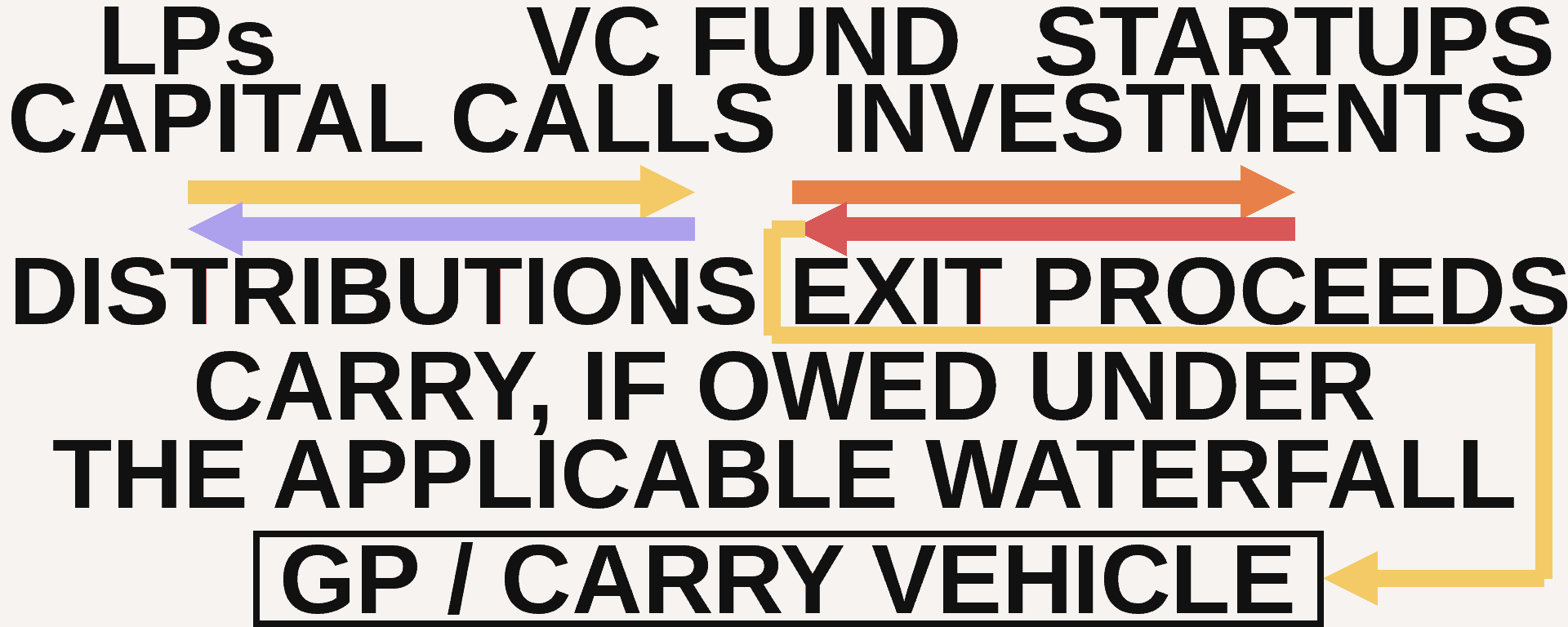
How a VC fund works from commitment to distribution
The classic closed-end fund moves through six overlapping phases.
- The sponsor raises commitments. LPs sign subscription documents and commit an amount to the fund. A $5 million commitment is an obligation to supply as much as $5 million over time. It is rarely wired in full on day one.
- The GP calls capital. When the fund needs cash for an investment, management fees, or fund expenses, the GP calls part of each LP's unfunded commitment. The cash moves into the fund under the schedule and procedures in its documents.
- The fund makes initial investments. During the investment period, the team sources companies, conducts diligence, negotiates terms, wins allocation, and builds the portfolio. This period is often the first several years of the fund.
- The fund holds reserves. Many funds set aside part of their investable capital for follow-on rounds. Every follow-on check competes with the option to fund a new company.
- The team supports and monitors the portfolio. Work can include recruiting, customer and investor introductions, strategy, governance, and future fundraising. In a large VC decision study, 60% of the 469 respondents to the interaction question reported interacting with portfolio companies at least weekly during the first six months after investment.
- Liquidity events can produce distributions. An acquisition, secondary sale, or buyback may produce cash. An initial public offering usually creates a path to liquidity rather than immediate cash because sale restrictions, lockups, and trading decisions can delay proceeds. A fund may later sell public shares or distribute securities in kind. A shutdown usually returns little or nothing. When the fund has distributable cash or securities, it applies the contractual waterfall before sending distributions to LPs and any carry recipient.
Many venture funds are designed to run for roughly a decade, with extensions possible under the LPA. That term is a framework, not an exit schedule. A fund can distribute proceeds while it still holds several private positions.
Venture funds and direct startup investments are speculative, illiquid, and long-duration. Private-company valuations are estimates until a transaction establishes a price. LPs must be able to meet capital calls even when markets or personal liquidity change. Investors can lose all contributed capital, and missed calls can trigger remedies under the fund documents. Diversification can reduce dependence on one company, but it cannot eliminate correlated market, sector, stage, manager, or liquidity risk.
How venture capital firms make money
Management fees fund the investing operation
A management fee creates gross revenue for the manager or adviser according to the contractual fee rate and fee base. The base may be committed capital during the investment period, then step down or switch to invested capital, acquisition cost, or another defined measure later.
“2%” is familiar shorthand, not a universal lifetime calculation. If a $20 million fund charges 2% of commitments while that base applies, it produces $400,000 of annual gross fee revenue. Payroll, professional services, technology, insurance, travel, and overhead still come out of the manager's business.
Formation costs and broken-deal expenses borne by the fund reduce the capital available for startup investments. A portfolio company may also pay transaction, monitoring, director, or other fees. Those amounts offset the management fee only when the governing documents require an offset.
The ILPA Principles 3.0 recommend that managers show LPs a lifetime fee model, explain the calculation basis, and reduce fees as the investment period ends or the fund term is extended. Read the full fee schedule and expense allocation. Multiplying the opening rate by fund size answers only the first-year fee question.
Carry rewards profitable outcomes after the waterfall
Carried interest is a contractual share of fund profits. The GP or an affiliated carry vehicle may receive it, then allocate it among participants. Twenty percent is common shorthand, but the fund documents control the rate and calculation.
Four terms determine when carry becomes real money:
- Waterfall. A whole-of-fund waterfall generally returns contributed capital and any contractual preferred return before carry is paid. A deal-by-deal waterfall may pay carry after individual realizations while other investments remain unresolved.
- Hurdle or preferred return. Some funds require LPs to receive a defined return before carry begins. Some do not.
- Catch-up. After a hurdle, the carry recipient may receive a larger share of the next distributions until the agreed profit split is reached.
- Clawback. If early carry distributions exceed the final lifetime entitlement after later losses, a clawback can require money to be returned.
Carry can take years to arrive, and it may never arrive. “The fund earned carry” also says nothing about the amount allocated to the individual who sourced or led a particular investment.
Our guide to fees versus carry examines what each income stream rewards.
A $100 million VC fund example
Consider a simplified fund with these assumptions:
- LPs contribute the full $100 million they committed.
- Management fees use $16 million over the fund's life.
- Formation, audit, legal, broken-deal, and other fund expenses use another $2 million.
- The remaining $82 million goes into 25 companies, with $50 million in initial checks and $32 million in follow-ons.
- Portfolio realizations return $250 million in cash to the fund.
- The fund uses a whole-of-fund waterfall with 20% carry, no hurdle, no recycling, and no separate GP commitment in this example.
The waterfall first returns the $100 million of LP contributions. That leaves $150 million of net profit. Twenty percent carry equals $30 million. LPs receive the remaining $120 million of profit, plus their returned $100 million, for $220 million in total distributions.
The result is a 2.2x net multiple of paid-in capital for LPs. The manager or adviser received $16 million of gross management fee revenue over the fund's life, before its operating costs. Other service providers and obligations consumed the separate $2 million expense budget. The GP or affiliated carry vehicle received $30 million of carry before allocating it among participants.
Taxes, timing, recycling, credit facilities, a preferred return, the GP's own commitment, and the actual fee and expense terms could all change a real fund's result. The example also shows why gross and net returns stay separate. The startup portfolio returned about 3.05x the $82 million invested, while LPs received 2.2x the $100 million they paid in.
Why the VC model depends on outliers
Venture outcomes are widely dispersed. Among the 410 respondents to the exit-multiple question in the VC decision study, the average reported mix included 9% of exits above 10x, 12% from 5x to 10x, and 24% below 1x. Those historical survey results describe respondents' portfolios. They do not predict a new investment.
Imagine the $250 million in our example came from three buckets:
- 20 companies returned $15 million combined.
- Four companies returned $60 million combined.
- One company returned $175 million.
One investment produced 70% of the fund's proceeds. That concentration makes portfolio construction part of the VC business model.
“Don't try to pick a co. Select a portfolio.”
Elizabeth Yin, our co-founder and General Partner, Democratizing Knowledge (Hustle Fund, 2021), p. 130
Our guide to power-law returns explores this pattern in more depth. Diversification and disciplined selection are the takeaway. A larger portfolio never guarantees an outlier.
How fund economics shape VC decisions
Fund size affects the outcome that matters
Suppose a $100 million fund invests $2 million for 10% of a startup, then later dilution reduces its stake to 6%. For this illustration, assume a stated exit value is net equity proceeds after debt, liquidation preferences, and transaction costs, and the fund receives exactly 6%.
A $500 million exit sends $30 million to the fund. That is a strong company result, but it returns only 0.3x the fund's committed capital. A $3 billion exit sends $180 million to the fund.
This is the logic behind “Can this return the fund?” A larger fund usually needs larger checks, more ownership, larger exits, or some combination of the three. A profitable company can be excellent and still fall outside a particular fund's model.
The same fund math explains why VCs press founders on market size, pricing, unit economics, acquisition, retention, and scalability. The company needs a credible operating engine that can grow into the investor's required outcome. Our fundability scorecard shows how to test that founder-level business model without confusing it with the VC firm's business model.
“When it comes to markets, you always need to factor in: is something that is true today going to be true tomorrow?”
Eric Bahn on market assumptions, our co-founder and General Partner
That question matters when the exit is years away. A return case built on today's market size, growth, or valuation multiple can weaken long before the fund sells its position.
Reserve policy affects follow-on behavior
A fund with large reserves can keep investing in later rounds. Whether it will do so depends on price, progress, ownership, portfolio concentration, and the opportunity cost of that capital. Pro rata participation is a new investment decision. It is never an automatic vote of confidence.
Fund age affects timing
A fund early in its investment period may have room for new deals and follow-ons. An older fund may focus on existing positions and distributions. Two partners at one firm can also invest from different funds with different mandates.
Fee terms and carry create different incentives
Management fees generate revenue from the contractual fee base while the fee applies. Carry depends on profitable outcomes and the waterfall. A large fee base can support a capable team, and it can produce income before investments succeed. Fees that are too lean can leave a manager without the resources to execute. LPs should assess the rate, base, step-down, budget, offsets, and carry together.
Ownership affects attention and governance
Partner time for board work, governance, reporting, and portfolio support is finite. A fund may prioritize companies where it has more capital at risk or more governance responsibility. Founders should understand the specific partner's role after the check. A firm's logo alone does not guarantee support.
How LPs, founders, and angels can evaluate the model
An LP should ask for the LPA, private placement memorandum, subscription documents, management agreement, fee model, track record, and portfolio-construction plan, then trace cash flows under weak, base, and strong outcomes. Five questions expose much of the model:
- What percentage of commitments is expected to reach portfolio companies after management fees and fund expenses?
- How much is reserved for follow-ons, and who decides when to use it?
- When can carry be distributed, and how do the waterfall and clawback work?
- How are gross multiple, net multiple, total value to paid-in capital (TVPI), distributions to paid-in capital (DPI), and internal rate of return (IRR) reported?
- Who owns the manager and carry vehicle, and how are investment-team members rewarded?
Paper value deserves its own caution. TVPI includes cash already distributed and the estimated remaining value of private holdings. DPI measures distributions relative to paid-in capital. A fund can show a healthy TVPI while returning little cash, so read TVPI, DPI, remaining value, and valuation policy together.
Founders should ask a different set: Which fund is investing? How large is it? What is its initial check range? What ownership does it seek? Is follow-on capital reserved? Who makes the decision? Where is the fund in its investment period? What outcomes fit its return model? Who will work with the company after closing?
Angels do not have to copy a VC fund's portfolio model. They should still use fund math as context and turn it into a personal policy:
- Set a portfolio budget before the first check. Size the total amount you can afford to lose across several years, then account for vehicle fees and any future commitments.
- Choose a deployment pace. Spreading initial checks over time creates more opportunities to learn and reduces the chance that one market window consumes the whole budget.
- Separate initial checks from reserves. Decide in advance whether you will keep capital for follow-ons, how much, and what evidence earns another check.
- Model dilution. Estimate the ownership that may remain after future financing rounds, whether or not you expect to exercise pro rata rights.
- Assume a long holding period. Startup shares may remain illiquid for years, and an IPO announcement does not create instant cash.
- Use fund math as context. A VC's required outcome can explain its behavior. Your own check size, goals, and portfolio may support a different decision.
In Angel Squad, our angel-investing community, members learn how to examine startup opportunities and investment terms alongside peers. Joining does not require accredited-investor status. Investing in relevant offerings does, every investment is optional, and membership does not guarantee access or allocation.
Other venture investment models
The closed-end LP fund is common, but it is only one version of venture investing.
- Evergreen funds have no fixed end date and may recycle realized proceeds into new investments. They reduce some deadline pressure, while liquidity and valuation rules still matter.
- Corporate venture capital usually invests from a company's balance sheet or a dedicated vehicle. Strategic goals can sit beside financial return goals.
- Syndicates and special purpose vehicles (SPVs) pool investors for one company. Participants choose deal by deal, and each vehicle can charge its own fees and carry.
- Direct angel investing lets an individual choose and hold investments personally. The angel controls pacing and selection while taking on more sourcing, diligence, administration, and portfolio risk.
- Funds of funds invest in venture funds rather than directly in startups, adding manager selection and another economic layer.
Our overview of venture investment routes compares access, discretion, diversification, fees, and workload.
VC business model FAQs
Where does venture capital money come from?
Most fund capital comes from LP commitments. LPs can include institutions, family offices, companies, funds of funds, and qualified individuals. The GP or its owners may also commit capital according to the fund documents.
Do startups pay venture capital back?
The answer depends on the security:
- Conventional equity has no scheduled repayment of principal and interest. Investors seek proceeds from an acquisition, share sale, buyback, or other liquidity event.
- Convertible notes are debt. They typically accrue interest, have a maturity date, and are designed to convert into equity when specified conditions occur. Repayment rights and outcomes depend on the note.
- Simple Agreements for Future Equity (SAFEs) are contractual rights to receive equity when specified triggers occur. They generally have no interest or maturity date and are not conventional repayment obligations.
- Preferred stock is equity with negotiated economic and control rights. It has no loan-style payment schedule, although dividends, redemption rights, and liquidation preferences can affect what investors receive.
The financing documents control in every case.
Do most VC funds fail?
There is no useful universal percentage because “fail” can mean losing principal, missing a target return, trailing public markets, or failing to raise another fund. Venture returns take years to mature, and interim values include estimates. Evaluate a fund by vintage, strategy, net cash flows, remaining value, and risk rather than a single failure-rate claim.
Is 1% startup ownership good for a VC fund?
The percentage alone says very little. Entry price, dollars invested, dilution, follow-on capital, net exit proceeds, fund size, and portfolio concentration determine its effect on the fund. A small stake can matter to a small fund at a large outcome and barely move a much larger fund.
Learn the incentives before you invest
The VC business model converts LP commitments into a portfolio, then converts uncertain liquidity events into distributions. Fees support the manager's operation. Carry rewards profits after the applicable waterfall. Fund size, ownership, reserves, and time determine which opportunities fit.
If you want to build your own judgment by studying real early-stage opportunities with other investors, apply to Angel Squad.







.png)