The rise of impact investing and what changed for angels
Brian Nichols is the co-founder of Angel Squad, an angel investing community where aspiring and active angels learn from Hustle Fund’s approach, review curated deal flow, and connect with peers.
A founder’s mission can make a startup interesting. It still leaves you with hard investment questions. As impact investing grows, more capital and clearer expectations are reaching businesses that aim to solve social or environmental problems. Understanding how this market developed helps you see where an angel’s money and experience can matter.
What qualifies as impact investing
Impact investing seeks a financial return alongside intentional, measurable social or environmental benefits. The Global Impact Investing Network (GIIN) describes a practice that includes using evidence, managing impact performance, and learning with other investors in its core characteristics.
A business can have a useful product or a generous donation program without its investors pursuing and measuring an impact objective.
Environmental, social, and governance (ESG) analysis can help an investor understand risks and opportunities affecting a company. Impact investing adds an explicit outcome the investor intends to help produce. Philanthropy can pursue the same social goal without seeking a financial return. These approaches can work together, but they answer different questions.
For an angel, an impact investment might fund a company that makes essential services more affordable or reduces industrial waste. The business still needs a credible customer, a way to earn money, and a team that can execute. A worthwhile problem alone doesn't pay the bills.
The numbers behind the rise
In October 2024, the GIIN estimated worldwide impact investing assets under management at $1.571 trillion, managed by more than 3,900 organizations. Assets under management, or AUM, is the value of investments an organization manages. This estimate covers directly invested impact capital across public and private markets, far beyond startup investing.
The market-sizing report also found 21% compound annual growth in impact AUM among repeat organizations included in its studies since 2019. That is the constant yearly rate that would produce their five-year AUM increase. It measures managed assets, not investment returns.
The GIIN cautions against comparing its separate point-in-time market estimates to calculate growth. Coverage, definitions, and estimation affect those totals. The repeat-organization analysis offers a more useful view of expansion than subtracting two headline numbers.
More capital pursuing impact creates a larger field of potential partners and financing approaches. It tells you nothing about the return, risk, or available funding for one startup.
How impact investing became a field
Investing for social benefit existed before the current label. Foundations and community lenders had already financed businesses and services with social goals. Development finance institutions, investors that support economic development, also had a history of this work. The newer field built a shared identity and infrastructure around that work.
Three developments help explain the evolution:
- 2007–2009: investors organized around a shared purpose. Rockefeller Foundation gatherings at Bellagio in 2007 and 2008 brought financial innovators together around profit-seeking investment for social and environmental good. The GIIN launched in 2009. Investors had a network through which they could exchange ideas and develop common practices.
- 2015: global goals gave investors common reference points. The United Nations adopted the Sustainable Development Goals, 17 goals covering areas such as health, education, poverty, and clean energy. These helped organize conversations about which problems capital could address. Aligning a pitch with a goal still leaves the company responsible for demonstrating an outcome.
- 2019: measurement and management became more structured. The GIIN launched IRIS+, a system combining impact metrics, evidence, and guidance. That year, the International Finance Corporation (IFC) announced that 60 investors managing more than $350 billion in impact assets had adopted the Impact Management Principles. The principles cover the investment lifecycle, including disclosure and independent verification of alignment.
The field developed ways to describe both the purpose of an investment and how investors would manage it. An angel can now borrow that vocabulary without building an institutional reporting department.
What's driving impact investing's growth
Customer needs, investor objectives, and better investment infrastructure reinforce each other. Their importance varies by sector and investor.
Social problems can also be business problems
A company that reduces wasted materials can save a manufacturer money. A product that lowers the cost of delivering healthcare can help a provider reach more patients. Customers may buy these products because they improve operations, even when impact is absent from the purchasing conversation.
Consider a hypothetical startup that helps grocery stores reduce food spoilage. Stores pay because they lose less inventory. If the product works, a growing customer base could support both revenue and waste reduction. That connection gives the founder a commercial reason to keep improving the environmental outcome.
The connection can also break. A food-access business could increase revenue by serving wealthier customers while drifting away from the people it intended to help. Understanding who pays, who benefits, and how growth affects both is part of understanding the opportunity.
Institutional investors bring capital and different constraints
The GIIN's 2024 sizing analysis reports pension funds at 29% and insurance companies at 19% of impact AUM in Figure 2. That breakdown covers 920 organizations with known types and excludes investors whose type is unknown. It shows the weight of institutional capital, without establishing a complete allocation of the report's modeled $1.571 trillion market estimate.
Large institutions can finance assets and businesses at a scale most angels can't. They also have their own requirements for investment size, risk, reporting, and how readily an investment can be sold. A pension fund's interest in affordable housing doesn't automatically translate into a check for a housing startup that hasn't earned revenue yet.
Investor objectives differ, too. Some impact investors target competitive market-rate returns. Others accept below-market returns to pursue a particular outcome. Treating all of them as one kind of investor hides the financing choices a founder will face.
Shared standards make the work easier to evaluate
The early measurement problem was a shortage of consistent, credible information. The history of IRIS+ describes how investors built common metrics to make communication and comparison more useful, then expanded them into a system for measuring and managing impact.
Those tools give a founder and investor a starting point for defining progress. They also make vague claims easier to challenge. Reporting how many people used a product is different from showing whether their lives improved.
Standards haven't eliminated disagreement or poor data. They have made impact a more explicit part of the investment conversation. Investors can discuss an intended outcome, the evidence behind it, and what happens when performance falls short.
A bigger impact market still leaves room for angels
Early startups occupy a small corner of this market. The GIIN defines seed/startup businesses as companies that haven't earned revenue yet, where an idea exists but little is established operationally. In its 2025 market survey, seed/startup companies accounted for 2% of reported impact AUM within a 359-investor subset, even though 36% of those investors reported investing at that stage. The subset excludes outlier organizations and investors without impact AUM data.
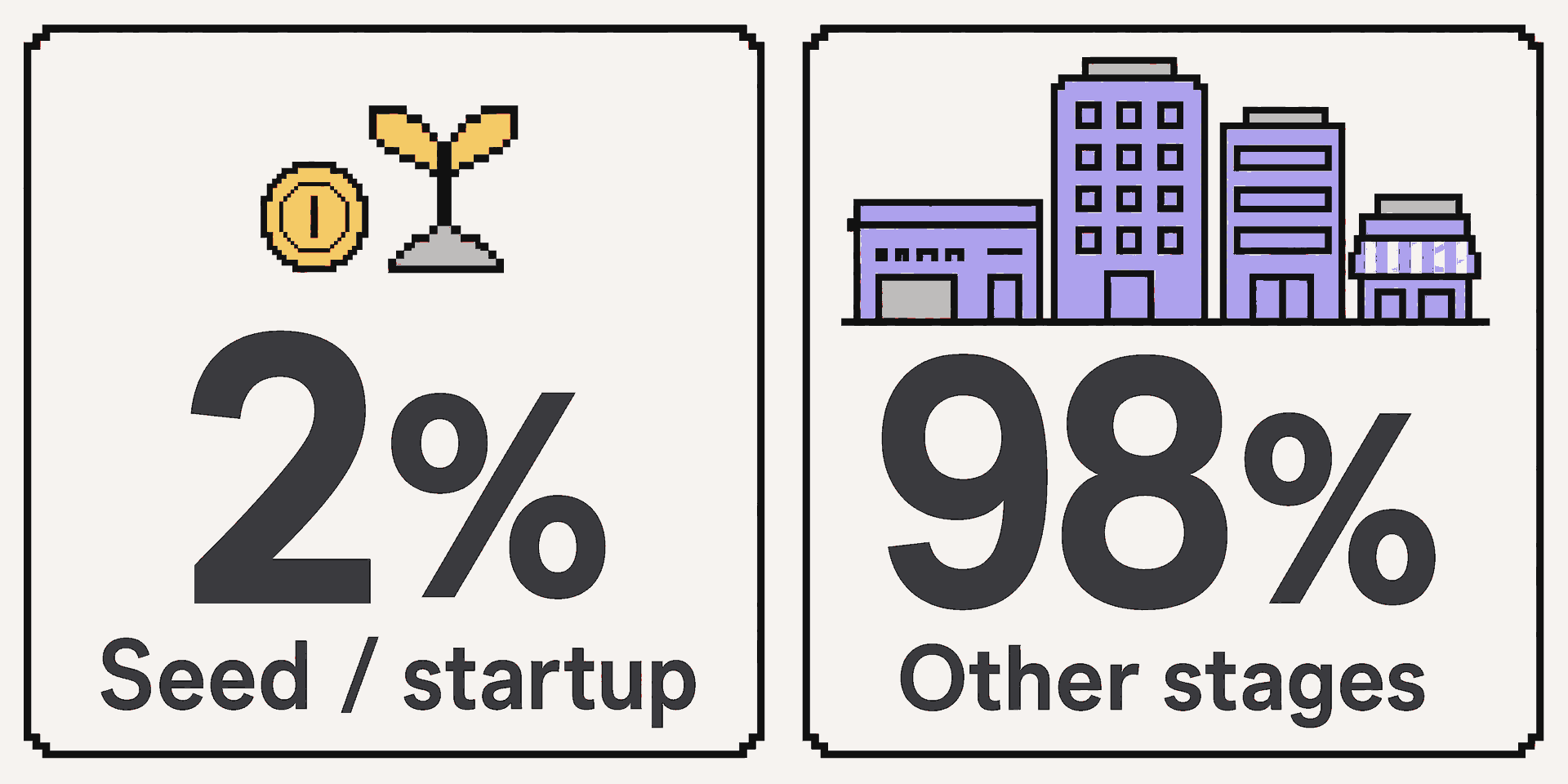
Those figures describe the survey group, not every impact investment worldwide. They do show why a trillion-dollar market headline can coexist with difficult early-stage fundraising. In this survey, participation at the seed/startup stage was much broader than the share of capital held at that stage.
An angel can help a company get from a promising idea to evidence that a larger investor can evaluate. That might mean funding a first deployment, introducing a relevant customer, or helping a founder understand a difficult purchasing process.
Our co-founder and general partner Elizabeth Yin writes in Democratizing Knowledge, “At the end of the day, money is a commodity.” Her discussion of investor value includes expertise, networks, and support for founders. Your experience can make you useful before a startup has the scale or track record to attract a larger check.
For the hypothetical grocery startup, an angel with retail experience might help secure a pilot and identify which inventory data stores can reliably provide. The pilot could produce evidence about waste reduction, customer savings, and willingness to pay. The founder and team still have to build and deliver the product.
That help is a possible investor contribution, sometimes called additionality. It is what your participation enables beyond what would likely happen without it. It needs an honest account. An introduction that leads nowhere isn't a customer win, and all of a company's later progress can't be credited to your check.
Growth raises expectations without removing risk
A larger impact market gives founders more potential financing paths. It also raises expectations for evidence. A compelling mission becomes harder to defend when the reported result is disconnected from the customer's experience.
Impact-washing happens when claims overstate or misrepresent the impact of an investment. A startup can contribute to it by reporting activity as an outcome, overlooking people excluded from the product, or ignoring negative effects. An investor can contribute by repeating those claims without a sound basis.
At the same time, an effective solution can be a poor investment. Sales can stall, delivery can cost too much, and follow-on funding can disappear. Startup investments are speculative, difficult to sell, and long-term. Most bets may fail, and you can lose the entire amount invested.
Elizabeth's portfolio advice in Democratizing Knowledge is brief: “Don't try to pick a co. Select a portfolio.” A mission you care about deserves the same financial discipline as any other investment. Several companies exposed to the same customer budget or funding source can share risks, even when their products differ.
Our practical impact-investing guide walks through the deal-level work of evaluating outcomes, evidence, incentives, and potential harm alongside ordinary startup diligence.
The next phase is about affordability and evidence
In his 2026 industry outlook, GIIN co-founder Amit Bouri points to affordability, pension participation, place-based investing, and a stronger focus on impact measurement and management. These are his expectations for the field, rather than measured growth results.
For angels, those priorities make customer knowledge valuable. A healthcare product needs a workable path to adoption. A local housing solution needs a paying customer and a financing model that fits its growth. Better measurement helps explain progress, while affordability determines whether the intended customer can benefit at all.
You can build that judgment with other investors. In our angel-investing community, you can learn from Hustle Fund's approach, discuss curated startup opportunities, and compare how peers evaluate a business. To practice connecting a founder's ambition with the investment case, apply to Angel Squad.
This is educational information, not investment advice. Startup investing involves substantial risk, including the possible loss of your entire investment.