Venture Capital Trends 2026: 7 Shifts to Watch
Brian Nichols is the co-founder of Angel Squad, an angel investing community where aspiring and active angels learn from Hustle Fund’s approach, review curated deal flow, and connect with peers.
The 2026 venture capital market can look great or grim depending on which number you read. Record dollars are flowing into U.S. startups while many founders still face a selective financing market. These venture capital trends matter because headline activity can distort the price, follow-on, and liquidity assumptions behind an early-stage check.
Venture capital trends in 2026: the market in one view
PitchBook-NVCA's Q2 Venture Monitor reported that U.S. startups raised $412.7 billion in the first half of 2026, more than the total invested during all of 2025. The same Q2 Venture Monitor found that rounds of at least $100 million captured 87.5% of that capital. Record funding and tough ordinary financing conditions are happening at the same time.
VC funding is speeding up at the top and thinning elsewhere. PitchBook-NVCA's Q2 Venture Monitor shows that total value has surged while the share reaching sub-$100 million rounds has fallen and corporate investors appear in fewer deals; Carta's pre-seed report shows that pre-seed capital on its platform is spread across fewer instruments. The 2026 venture capital outlook is selective rather than broadly easy.
That split also appears in 2026 angel investing trends. Angels need stage-specific evidence because the companies setting market records have little in common with a typical pre-seed startup.
1. Record funding is concentrated in mega-rounds
The headline funding total hides a steep concentration curve. In the first half of 2026, rounds below $100 million received $51.4 billion, or 12.5% of U.S. deal value, according to the Q2 Venture Monitor. Their share was 33.1% in 2025, based on the PitchBook-NVCA data as of June 30, 2026.
The denominator matters. A $100 million round is already far outside the market where most angels invest. Huge late-stage financings can lift total venture funding without making the next seed round easier to raise.
For an early-stage investor, a founder's next financing should stand on its own evidence. Look at the milestones this check can fund, the investors who typically lead the next stage, and the time available if fundraising takes longer than planned. Market-wide dollar growth is a weak substitute for a financing plan.
As our co-founder Elizabeth Yin wrote in Democratizing Knowledge, “Going back to first principles is super important since the market always changes and evolves.” In this market, first principles start with the company's capital needs and progress, not the aggregate funding chart.
2. AI dominates dollars more than deal count
The Q2 Venture Monitor reports that artificial intelligence companies received $355.9 billion in the first half of 2026, equal to 86% of U.S. VC deal value while accounting for 43.2% of deal count. Capital concentration is much sharper than company concentration.
Valuation data need the same care. On Carta in Q1 2026, the median Series A valuation was $300 million for foundational-model AI companies and $55 million for non-AI companies, according to its private-markets report. Carta explicitly treats these as different markets. That premium describes foundational-model companies on Carta. It doesn't establish a benchmark for every startup with an AI feature.
An angel should identify which part of the stack a company occupies, what it costs to build and serve the product, and whether distribution or proprietary data can defend the business. Our AI startup market map can help organize those layers. The “AI” label alone says little about an appropriate entry price.
3. Pre-seed capital is moving through fewer, larger instruments
A Simple Agreement for Future Equity (SAFE) gives an investor the right to receive equity later under specified terms. At pre-seed, founders often combine several SAFEs or convertible notes rather than close one priced equity round.
Carta recorded $3.19 billion across 11,546 U.S. pre-seed transactions in Q2 2026, compared with $3.22 billion across 14,825 instruments a year earlier, according to its pre-seed report. The average SAFE or note was $276,000, up 27% year over year, according to the same pre-seed report.
Those are instruments recorded on Carta, not unique companies or complete rounds. One startup can issue many instruments, and Carta said in its pre-seed report that Q2 volume would rise as more data entered its system. The figures describe Carta's platform rather than the entire U.S. market.
Larger instruments can give a founder more runway, but they can also raise the bar for the next round. Review every outstanding SAFE or note, the valuation caps and discounts, the expected dilution at conversion, and the milestones the full financing is meant to buy. An angel due diligence checklist keeps those questions attached to the actual deal.
4. Corporate investors appear in fewer deals
Corporate venture capital, or CVC, is startup investing done by an established company through a dedicated venture group or balance sheet. CVC investors participated in 21.1% of U.S. VC deals with known investors in the first half of 2026, their lowest share in a decade, according to the PitchBook-NVCA report.
Participation means at least one corporate investor joined a deal. It doesn't reveal the size of that investor's check, its ownership, or whether it will invest again.
A corporate name on the cap table can bring customer access, technical help, or credibility. It can also come with changing strategic priorities. Assess the investor's decision process, follow-on history, commercial relationship, information rights, and potential conflicts. Treat strategic value as a specific diligence question, not a logo premium.
5. Fundraising favors established, very large managers
Limited partners, or LPs, provide capital to venture funds. The Q2 Venture Monitor reports that U.S. venture funds raised $72.4 billion across 405 vehicles in the first half of 2026. The same PitchBook-NVCA report found that 16 funds of at least $1 billion collected $49.5 billion, while established managers received 89% of all capital. First-time funds raised $3.4 billion across 53 vehicles, based on the PitchBook-NVCA data.
These are fundraising commitments to funds, not dollars already available to every startup. Fund size, stage mandate, ownership targets, reserves, and sector focus determine how that capital can be deployed.
The concentration matters to angels because a startup's future investor pool may be narrower than the aggregate fundraising number suggests. Map likely next-round investors by stage and thesis. Then ask whether the company can reach a financing milestone without relying on a large generalist fund to change its strategy.
6. Exit values improved, but one listing distorts the headline
PitchBook-NVCA's Q2 Venture Monitor recorded $1.8288 trillion in U.S. VC-backed exit value as of June 30, 2026; SpaceX's IPO accounted for about $1.7 trillion of that value, and the report says the broader market still struggled to unlock IPOs.
Exit value is the reported value of companies at an acquisition or public listing. It isn't cash distributed to every fund investor. Even a large IPO can involve lockups, gradual sales, fund-level expenses, and holdings spread across a limited set of portfolios.
For angels, exit headlines are evidence that some routes are open for exceptional companies. They don't shorten the holding period of an unrelated startup. Underwrite several plausible outcomes, including a smaller acquisition, a secondary sale, a long private holding period, and a total loss. Our guide to how angels realize returns explains the mechanics behind those paths.
7. Paper value still exceeds cash returned to LPs
Distributed to paid-in capital (DPI) compares cash returned with capital contributed by LPs. Total value to paid-in capital (TVPI) adds the estimated value of unrealized holdings to those distributions.
Carta's fund-performance data show that, at the end of Q2 2026, median DPI was 0.37x for 2017 funds, 0.15x for 2018 funds, and 0.04x for 2019 funds. The same fund-performance data show that 90th-percentile TVPI for 2017 funds rose to 4.14x from 3.31x two years earlier.
The figures cover funds on Carta's platform. TVPI includes unrealized marks that can change before an exit, while DPI measures cash already distributed. A strong paper mark and limited cash return can coexist for years.
That gap affects the whole financing chain. LPs with fewer distributions may concentrate new commitments, fund managers may protect reserves, and portfolio companies may wait longer for liquidity. Angels should treat current marks as estimates and plan check pacing around cash they can commit for a long time.
The market becomes easier to read when you separate the headline, the financing conditions most startups face, and the decision you control.
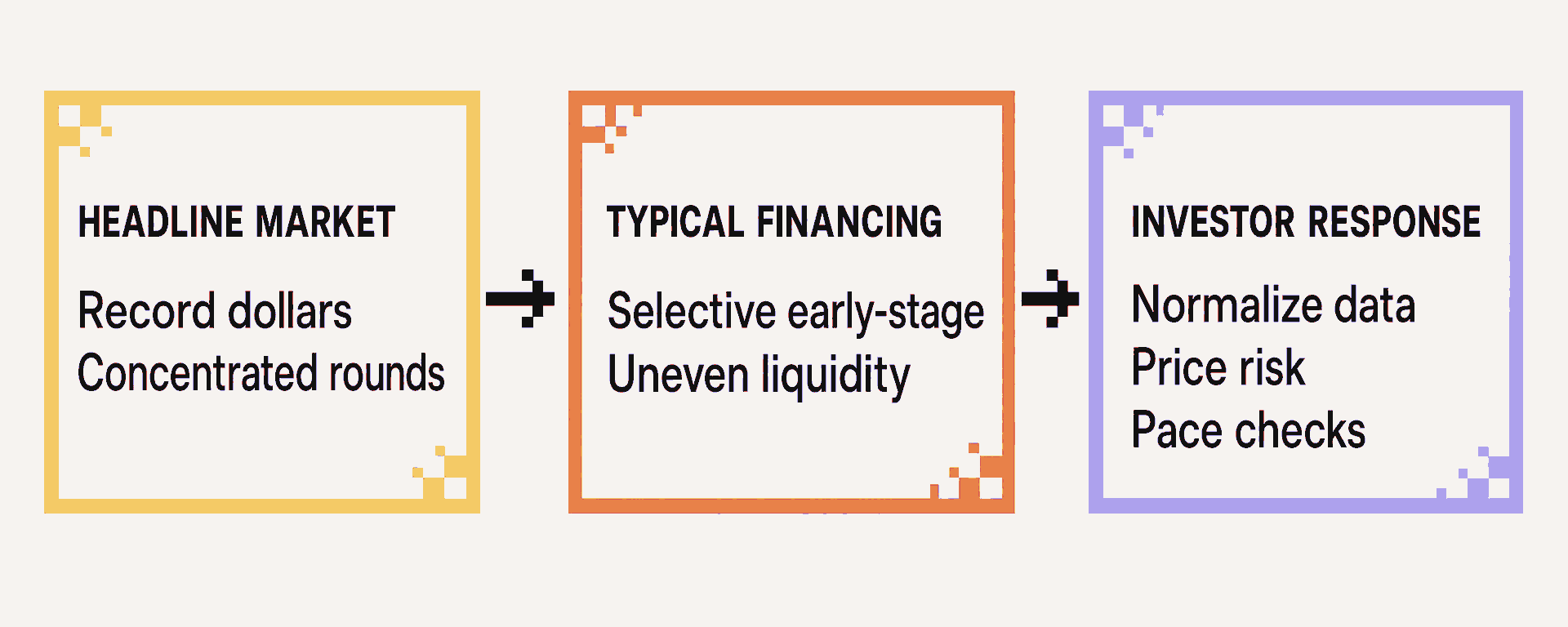
What these venture capital trends mean for angel investors
The data can improve your process without turning a market update into a buy list. Five habits make the trends useful at deal level.
- Normalize every headline. Write down the geography, reporting period, stage, sector, deal-size threshold, and whether a figure measures value or count. Compare a pre-seed company with pre-seed evidence rather than the full venture market.
- Compare valuations by stage and sector. AI foundation models, applied software, hardware, biotech, and consumer companies have different capital needs and comparable sets. A hot category can explain a premium without proving that a specific price is sensible.
- Assess financing and dilution risk. Model what the current instruments could convert into, what milestones the round funds, and who could lead the next financing. Include a slower fundraising case and a no-new-capital case.
- Plan reserves and check pacing. Decide in advance whether you will make follow-on checks, what evidence they require, and how much of your annual budget remains uncommitted. A small-check portfolio blueprint can help turn that rule into a repeatable plan.
- Record what would change your mind. Note the strongest supporting evidence, the largest unresolved risk, and the milestone that would disprove your thesis. Yin's advice in Democratizing Knowledge still holds: “The more disciplined you are in your thought process/rubric, the more you can improve over time.”
Startup investing remains risky, and many individual bets will fail. Market trends should sharpen your questions while your budget, diligence, and portfolio rules control the decision.
If you want to review curated deals and practice this process with other aspiring and active angels, apply to Angel Squad.
This content is for educational purposes only and is not investment, legal, tax, accounting, or valuation advice. Startup investments are speculative, illiquid, long term, and can result in total loss. Reported market figures, past results, and current marks may change and do not guarantee future results. Seek independent professional review from qualified legal, tax, investment, accounting, and valuation advisers where appropriate.