
Syndicate investing: how startup deals work, what you pay, and what to check
Syndicate investing lets several people back one startup through a shared investment vehicle. It can lower the check size and reduce the administrative work of investing alone, but it adds another layer of fees, documents, and decision-makers.
This guide explains the startup version of syndicate investing: how money and ownership move, what the lead does, and what to review before you commit.
What is syndicate investing?
A startup investment syndicate is a group of investors who pool capital for one company, usually under a lead investor. The group commonly invests through a special purpose vehicle (SPV), a legal entity formed for that deal.
The backers buy interests in the SPV. The SPV buys the startup's shares, Simple Agreement for Future Equity (SAFE), or other security. That means the SPV, rather than every individual backer, usually appears on the startup's capitalization table.
“Syndicate” can also describe groups in real estate, banking, and insurance. Here, we're talking about investors joining one private-company deal.
How a startup investment syndicate works
The exact process and documents vary, but a typical deal follows five steps.
- The lead sources and evaluates the deal. The lead meets the founders, reviews the company, negotiates allocation and terms, and decides whether to bring the opportunity to backers.
- An SPV is formed. The lead or an administrator creates a legal vehicle for that investment. Its documents set the economics, governance, expenses, and investor rights.
- Backers review and subscribe. Each investor sees the deal materials, decides whether to participate, completes eligibility and identity checks, signs the subscription documents, and funds a commitment.
- The SPV invests in the startup. Once the deal closes, pooled capital moves from the SPV to the company. The startup manages one SPV entry instead of many small investors on its cap table.
- The lead and administrator manage the vehicle. They handle updates, tax documents, follow-on decisions, and eventual distributions according to the SPV agreement.
The ownership chain matters: you usually own an interest in the SPV, and the SPV owns the startup security. AngelList's SPV explainer covers that structure in more detail.
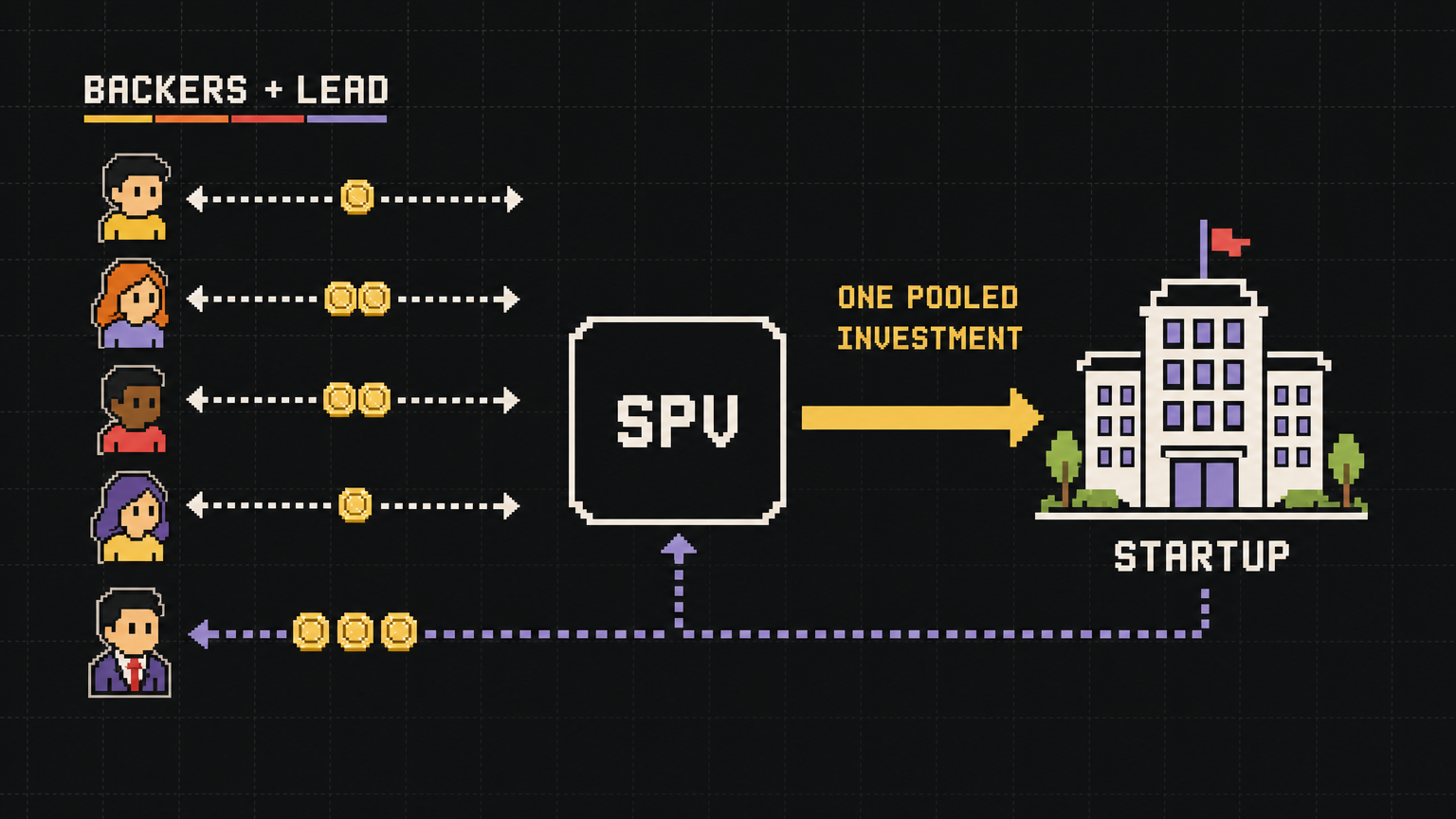
What pooled checks look like in practice
Suppose a lead has a $125,000 allocation in a startup. The lead commits $25,000, and 40 backers each commit $2,500. Together, the SPV reaches the $125,000 target and makes one investment.
That example is intentionally simple. Real deals may deduct setup or operating expenses, require a higher minimum, close below the target, or allocate ownership differently under the governing documents. A smaller check changes your dollar exposure; it does not make the underlying company less risky.
Minimums also vary by platform, lead, and deal. Treat any advertised minimum as a starting point, then read the specific offering documents.
Why investors use syndicates
Syndicate investing can solve a few practical problems for angels:
- Access to an allocation. A lead may have a founder relationship or allocation that an individual investor could not secure alone.
- Smaller starting checks. Pooling can make a startup's direct minimum easier to reach, which may help an investor spread a limited angel budget across more companies over time.
- A second investment lens. The lead's memo, diligence, and founder conversation can improve your review, as long as you still make your own decision.
- Less administration. The SPV administrator can handle formation, signatures, banking, tax documents, and distributions.
- Peer learning. A real investing community gives members people to compare notes with, ask questions of, and learn alongside.
Community can extend that second investment lens beyond a single lead. In Angel Squad, members learn how we evaluate early-stage companies, compare notes with other operators and investors, and choose deal by deal whether an eligible opportunity fits their own thesis. The value is the education and peer review, not an automatic yes.
Hustle Fund co-founder and general partner Elizabeth Yin makes the portfolio point directly:
“Don't try to pick a company. Select a portfolio.”
Source: Elizabeth Yin, Hustle Fund co-founder and general partner
Syndicates may make smaller checks possible, but one syndicate is still one company. Diversification comes from how the investment fits into the rest of your portfolio.
.jpeg)
Costs and trade-offs to understand
The convenience of a syndicate is not free. Review the whole economic stack before you compare it with investing directly.
Fees and expenses
An SPV may pass formation, administration, legal, banking, tax, or regulatory expenses to investors. These costs can be charged on top of your investment or deducted from the capital that reaches the company. The offering documents should show which method applies.
Carried interest
Carried interest, or carry, is the share of profits paid to the lead or manager. If you invest $5,000 and your share of the SPV later returns $15,000, your profit is $10,000. With 20% carry on profits, $2,000 would go to the carry recipient and $13,000 would remain for you before any other expenses or taxes.
That is only an illustration. Carry rates, calculation methods, hurdles, and distribution waterfalls vary. Read the documents rather than assuming the headline percentage tells the whole story.
Indirect ownership and limited control
You generally hold an interest in the SPV, not the startup security directly. The lead or SPV manager may control voting, consents, information flow, follow-on participation, and the timing of distributions. Make sure that delegation is clear and acceptable to you.
Illiquidity and loss risk
Private placements can be hard or impossible to resell, provide less public information than registered securities, and result in a total loss. The SEC's private-placement bulletin recommends investing only money you can afford to lose and being prepared to hold indefinitely.
Dependence on the lead
A strong lead can improve access and diligence. A weak or conflicted lead can make a bad deal look easier to trust. You need to evaluate the lead's incentives, track record, time commitment, communication, and personal investment alongside the startup itself.
Syndicate vs. direct investment vs. fund
These routes solve different problems.
- A syndicate is deal by deal. You decide whether to join each SPV, but you accept that vehicle's costs and delegate some control to its manager.
- A direct investment puts your name or entity on the company's cap table. You may have a closer founder relationship and avoid an SPV layer, but you must source the deal, meet the minimum, review the documents, and manage the investment yourself. Our direct vs. syndicate comparison goes deeper on the trade-offs.
- A venture fund pools commitments across a portfolio chosen by a manager. It offers built-in portfolio exposure, but you generally do not opt into individual companies and may commit capital for years.
An angel group or community can use any of these structures. The community is the network; the syndicate or SPV is the deal vehicle. Read our SPV practical guide if the legal and administrative layer is your main question.
What to review before joining a syndicate deal
Discipline matters more than a one-off impression. As Elizabeth Yin writes in Hustle Fund's Democratizing Knowledge:
“The more disciplined you are in your thought process/rubric, the more you can improve over time.”
Source: Elizabeth Yin, Hustle Fund co-founder and general partner
Use the same checklist every time.
- The lead. What relevant deals has this person led? How much are they investing? Have they disclosed compensation, allocations, and conflicts?
- The company and security. What are you buying, at what valuation or cap, and with which preferences, conversion terms, or side letters?
- The investment case. What would need to be true for the company to become much more valuable? Which evidence supports that case, and what could break it?
- Total costs. What will you pay in setup expenses, ongoing expenses, management fees, and carry? Does your stated commitment equal the amount invested in the company?
- The legal vehicle. Which entity holds the startup security? Who manages it? What voting, information, transfer, and removal rights do backers have?
- Follow-ons and dilution. Can the SPV exercise pro rata rights? Would you need to contribute more capital? What happens if you do not?
- Reporting and taxes. How often will you receive updates? Who prepares tax documents, and when are they normally delivered?
- Liquidity and downside. Can the interest be transferred? Could you hold it indefinitely? Can you afford a complete loss?
- Portfolio fit. Does the check fit your total startup-investing budget, pace, sector exposure, and reserves for future deals?
A polished memo is not a substitute for your own questions. If the lead cannot explain the economics, conflicts, or ownership chain clearly, do not wire until you understand them.
Do you need to be an accredited investor?
Many U.S. startup syndicates rely on private-offering exemptions that limit participation to accredited investors. Eligibility depends on the specific offering and investor.
Under the SEC criteria updated in April 2026, an individual may qualify through, among other routes:
- net worth over $1 million, excluding a primary residence, individually or with a spouse or partner;
- income over $200,000 individually or $300,000 with a spouse or partner in each of the prior two years, with a reasonable expectation of the same in the current year; or
- certain professional credentials held in good standing, including Series 7, Series 65, or Series 82.
The SEC's accredited-investor guide lists additional individual and entity criteria. Joining an educational community does not itself make someone eligible to invest, and an investor should confirm status for each offering.
Where community fits
The SPV handles the legal pooling. A useful community adds education, peer discussion, and a clear decision process around it. It should help members ask better questions without treating access as a recommendation to invest.
If you want a structured way to learn the mechanics and build your judgment with other investors, apply to Angel Squad.
Common syndicate investing questions
Is a syndicate the same as an SPV?
No. A syndicate is the group and deal process. An SPV is the legal vehicle the group may use to make the investment. A syndicate can create a new SPV for each company.
How does a syndicate lead make money?
The lead may receive carried interest, management fees, deal fees, or other compensation disclosed in the offering documents. Some leads invest without charging all of these. Review the exact terms and conflicts for each deal.
Does one syndicate investment diversify my portfolio?
No. A single-company SPV is exposure to one company. Smaller minimums may make it easier to build a broader portfolio across multiple deals, but they do not diversify the risk inside one syndicate.
Can I sell my syndicate interest?
Do not assume so. Private securities and SPV interests often have legal or contractual transfer restrictions, and there may be no willing buyer. Plan for a long or indefinite hold unless the documents say otherwise.













.png)