
AngelList Alternatives: 3 Routes for Investors
Last updated August 7, 2026.
For individual startup investors, AngelList alternatives are not limited to another website. The practical choice is how you want to find deals, build judgment, complete investments, and manage the work after a check.
A curated investing community, AngelList, and direct investing put those jobs in different hands. They can also overlap. A community may provide the learning and deal context while AngelList handles the investment vehicle and paperwork.
The three routes solve different problems
Before comparing features, decide what you want help with. The three routes are different operating models:
- A curated investing community combines some mix of education, peer discussion, screened opportunities, and investing support.
- AngelList gives accredited investors access to general partner (GP)-led special purpose vehicles (SPVs) and funds through its current Meridian investor experience, with administration built into the platform.
- Direct or solo investing leaves sourcing, evaluation, terms, professional support, and follow-through primarily with you.

The right route depends less on which logo you prefer and more on which work you want to do yourself.
Three adjacent models are easy to confuse. A lead-driven syndicate lets a general partner source and structure individual deals while each investor decides whether to participate. A self-directed deal platform presents opportunities but leaves more of the evaluation to the investor. An education-first community centers learning and peers and may or may not offer investments. The curated-community route in this comparison is an integrated model that combines education with selected deal flow.
A curated investing community
A curated startup investing community can fit a smart beginner or busy operator who wants a repeatable learning cadence, peers to compare notes with, and opportunities they would not consistently source alone.
The useful parts can include:
- Education: frameworks for reviewing founders, markets, customer evidence, terms, and portfolio decisions.
- Curation: a smaller set of opportunities sourced or screened by an experienced team.
- Discussion: other investors who can challenge assumptions or contribute domain knowledge.
- Access: a steadier opportunity flow than one person's immediate network may provide.
- Operations: depending on the community, support with the vehicle, documents, wires, updates, and tax reporting.
Those benefits do not transfer the investment decision to the community. Curation is a first filter, not proof that a startup is good, fairly priced, or right for your portfolio. You still need to understand the company, security, fees, conflicts, and downside.
The economics also deserve a full reading. A community may charge for membership, take carried interest on profitable investments, pass through vehicle costs, or use some combination. Ask what you pay even if no investment succeeds.
Angel Squad, our angel-investing community, is one example of the integrated model. It combines Hustle Fund's investing education, curated deal flow, and peer community. Members choose each opportunity independently, and the current process uses AngelList for commitments, legal paperwork, wires, and tax documents. You do not need to be accredited to join for education and community, but you must meet the applicable eligibility requirements to invest in relevant offerings.
AngelList and GP-led vehicles
AngelList is no longer best described as a simple directory of syndicates. Its current investor platform, Meridian, lets eligible investors discover or receive invitations to GP-led SPVs and venture funds. Broader discovery requires the Meridian Investor Application, verified accreditation, and enough private-market experience for platform access.
Even after approval, investors do not see one universal catalog. Opportunities can be matched to a profile, sent by a GP, restricted to a Firm (AngelList's term for a GP's investor network), or gated behind GP approval. Joining a Firm does not guarantee access to every deal.
For a deal-by-deal SPV, the typical roles look like this:
- A GP or lead finds a startup and sponsors an SPV for that investment; AngelList handles entity formation and administration.
- Investors review the information available on the deal page, often a deck and deal memo, along with disclosed terms, risks, the fund lead's investment, carry, and closing documents. Details vary by deal.
- AngelList handles parts of the subscription and administration process, including identity, anti-money-laundering, and accreditation checks.
- The SPV pools the commitments and sends one investment to the startup.
That last point changes what you own. In an AngelList SPV, you own an interest in the vehicle, not direct shares in the startup. Voting, information, and other rights may differ from the rights held by a direct shareholder.
AngelList does not charge investors to browse or use Meridian. That does not make every opportunity free. The lead sets the minimum and carried interest, and the vehicle can pass through administrative and regulatory costs. AngelList says 20% carry is standard on its SPVs, but the actual percentage is set by the manager and disclosed for the opportunity. Some deal minimums are as low as $1,000; there is no single minimum for the whole platform.
AngelList can fit an accredited investor who wants GP-led opportunities and centralized execution without joining a broader learning community. It places more weight on selecting the right GP and reviewing each vehicle. A good memo is useful context, not independent diligence.
Rolling Funds are a separate AngelList product and are not currently included on Meridian. They pool exposure across investments made during an active subscription period, and limited partners cannot opt out of individual deals made during that period when the deals align with the fund's stated thesis. Do not assume the control you have in a deal-by-deal SPV carries over to every AngelList product.
Investing directly or solo
Direct investing gives you the most control because you choose how to source the startup, what to investigate, which terms to accept, and what relationship to build with the founders.
It can fit a sector specialist, well-connected founder or operator, or experienced investor with a clear investment thesis. Domain expertise can help you ask better questions and recognize evidence that a generalist might miss. A strong network can also produce opportunities that never appear in a platform feed.
The tradeoff is that no one supplies the operating system for you. A solo investor may need to:
- develop a reliable source of relevant deals;
- screen opportunities before committing hours to them;
- run a startup due diligence process;
- compare the security, valuation, rights, and other terms;
- arrange qualified legal, tax, or financial help when needed;
- coordinate signatures and funds;
- store documents, monitor updates, and keep records; and
- decide whether and when to make follow-on investments.
Solo does not have to mean isolated. You can still build a peer network, hire advisers, use an SPV provider, or invite co-investors. It means the responsibility for assembling those resources stays with you.
It is also risky to call direct investing the cheapest route without pricing the work. There may be no membership fee or GP carry, but legal help, administration, tax work, and your own time still have value. Direct ownership can offer rights that an SPV interest does not, yet those rights depend on the actual documents and your negotiating position.
Compare the work, not just the access fee
Every route needs to cover the same basic jobs. The difference is who performs them, how they get paid, and how much you can inspect.
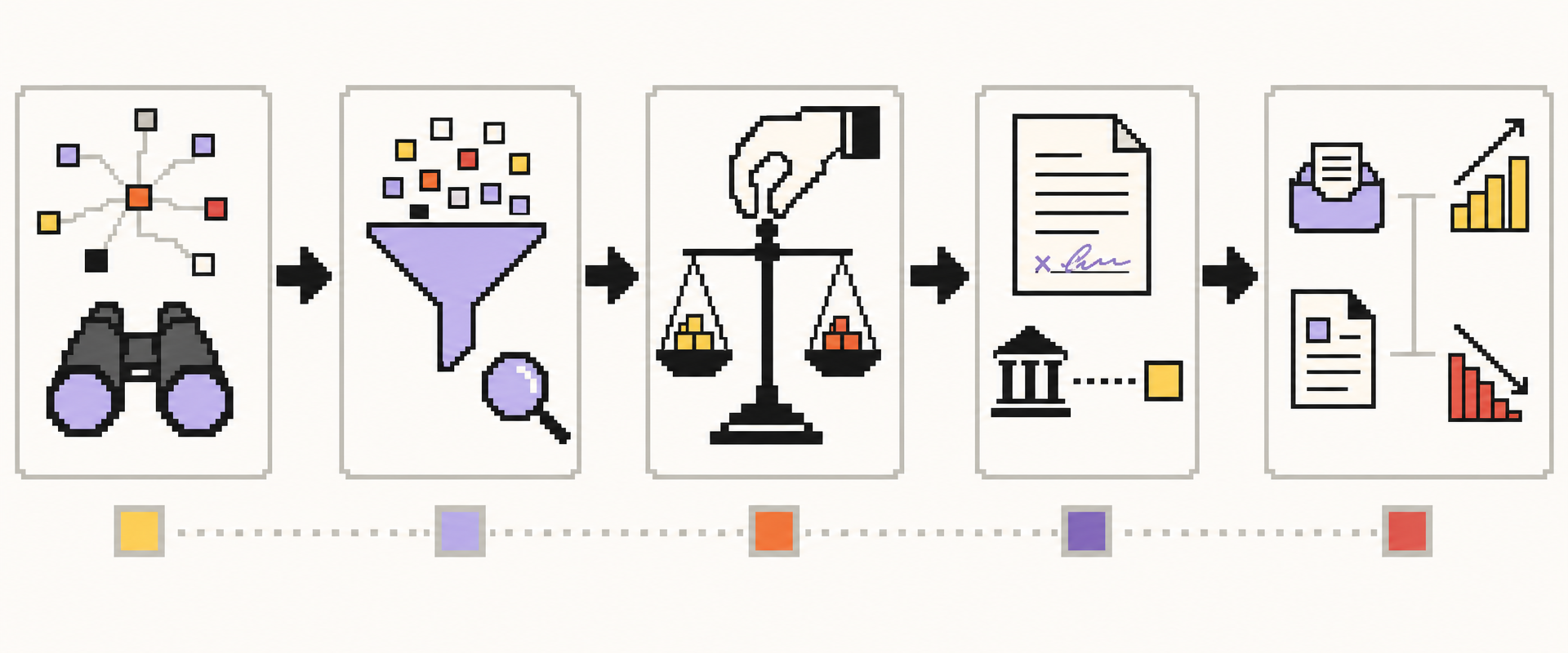
- Deal source and fit: A community supplies selected opportunities through its sourcing process. AngelList access comes from GP invitations and Meridian matching. A solo investor builds a personal founder and investor network.
- Screening and diligence: A community may run an initial screen, while an AngelList lead presents its thesis and materials. A solo investor performs or commissions the whole review. None removes the investor's responsibility for the final decision.
- Decision ownership: In a deal-by-deal SPV, you can accept or skip the deal. In a pooled fund, the manager chooses the companies. In a direct investment, you own both the decision and the process.
- Economics: A community can add membership economics to deal costs. An AngelList vehicle can include carry, management, administration, or regulatory costs. A solo route can replace those with legal, tax, vendor, and time costs.
- Portfolio cadence: A community can create a recurring review rhythm. Meridian access depends on matches and invitations. Solo flow depends on the network you maintain. No route should pressure you to invest just because a deal is available.
- Ongoing support: A community may add peer discussion and education. AngelList can manage vehicle documents, tax reporting, and distributions. A solo investor assigns each job to personal systems or outside professionals.
- Control and rights: Community or AngelList deals commonly use vehicle interests, while a direct investor may hold the startup security. In every case, the documents determine voting, information, transfer, and distribution rights.
Our co-founder and general partner Shiyan Koh offers a useful lens for the economics:
"Show me the incentives, and I'll show you the outcome."
- Shiyan Koh, co-founder and general partner of Hustle Fund, What makes a fund stand out
A fee does not make a route bad, and free access does not make one good. Trace who gets paid, when they get paid, what behavior that rewards, and what work you receive in return.
Portfolio access is useful only when the process is sound
Consistent deal flow can make a portfolio plan easier to execute. It cannot turn risky assets into safe ones.
The SEC describes early-stage investing as particularly risky. Investors may diversify across businesses, industries, investment types, time, stages, and asset classes. Diversification cannot guarantee against losses if the market drops, replace due diligence, or change a private security's transfer restrictions.
That is why our co-founder and general partner Elizabeth Yin frames the job as a comparison across opportunities:
"Every company looks great in isolation, but if you have 100 companies, who are the 5-10 you're going to pick?"
- Elizabeth Yin, co-founder and general partner of Hustle Fund, Angel investing Q&A
There is no universal number of startup investments that guarantees a good outcome. Start with the amount you can lose, the years you can wait, and the process you can follow. Then consider how power-law outcomes and accidental concentration affect the whole portfolio.
How to evaluate a startup investing community
A community is worth considering when its process fits the work you want help with. Six questions expose most of the difference between a useful community and an expensive feed.
1. Where does the deal flow come from?
Ask how opportunities are sourced, how often members see them, and whether the sectors and stages match your thesis. A high volume is useful only if you can understand and evaluate the opportunities.
2. What does screening include?
Find out who performs the initial review and which evidence they examine. Ask what is not checked. A clear answer should distinguish screening from legal, financial, technical, customer, and reference diligence.
3. How is education structured?
Look for a coherent progression rather than a folder of recordings. Ask how often sessions run, whether you can ask questions, whether remote members can participate asynchronously, and how the material stays current.
4. What are the complete economics and conflicts?
Request the membership cost, carry, vehicle and administrative charges, investment minimums, refund terms if any, and any compensation tied to an investment. Ask whether the community, affiliated fund, or presenter invests on the same terms.
5. Which operational jobs are handled?
Clarify who forms the vehicle, manages signatures and wires, stores documents, provides tax reporting, communicates updates, and administers distributions. If another platform handles the work, identify it and review its terms too.
6. Will you use the community?
Talk to current members. Ask what they use each month, what remains frustrating, how candid deal discussions are, and whether experienced members contribute. For a remote investor, verify time zones, recordings, and actual access rather than accepting "global" as a feature label. Confirm that the relevant offerings and platform support your jurisdiction, accreditation route, investing entity, and banking setup.
Do not judge a community by a promised return. Startup outcomes take years, and membership cannot guarantee a profitable investment. Evaluate the learning, access, process, support, and cost on their own terms.
You can combine the routes
You do not have to choose one route forever. An investor might use a community for education and peer review, accept selected GPs' direct invitations through Meridian, and invest directly when a startup falls inside a genuine area of expertise.
The overlap can be practical. Angel Squad supplies community, education, and Hustle Fund-sourced opportunities, while AngelList currently handles commitments, legal paperwork, wires, and tax documents. The investor still decides whether to participate.
Use one thesis and recordkeeping process across every channel. Otherwise a hybrid approach can hide repeated exposure to the same company, founder network, sector, or market risk.
Which route fits your situation?
- Consider a curated community when you want education, peers, and selected deal flow, and you will participate enough to use those resources.
- Consider AngelList or Meridian access when you are accredited, want GP-led opportunities and centralized administration, and are prepared to evaluate the lead, vehicle, fees, and underlying startup.
- Consider direct or solo investing when you have a real sourcing or domain edge, enough time for diligence and follow-through, and qualified help for legal, tax, and administrative questions.
For AngelList specifically, the company says all funds and SPVs on its platform accept only accredited investors. Across private-investing routes, private-placement securities are highly illiquid, may be difficult to resell, and may need to be held indefinitely.
If Hustle Fund education, curated opportunities, and an active peer group address the gaps in your current process, apply to Angel Squad. Review the program and eligibility separately from any investment, and make every deal decision on its own evidence and terms.
This guide is for general educational and informational purposes only. It is not legal, tax, financial, or individualized investment advice and is not an offer, solicitation, or recommendation to buy or sell any security or investment product. Startup investing is speculative, involves a high degree of risk, can result in a complete loss of principal, and may remain illiquid indefinitely. Eligibility, fees, and terms vary by offering. Review the applicable offering documents and consult qualified legal, tax, and financial advisers for your situation.







.png)