
Startup Burn Rate: An Investor's Guide to Cash Runway
Startup burn rate is how quickly a company uses cash to fund operations, usually expressed per month. For investors, the number matters because it converts a startup's spending plan into time and forces a harder question: what will that cash buy before the company needs more?
A founder can spend aggressively and use capital well, or spend modestly and drift. Read burn beside cash, milestones, revenue quality, hiring commitments, and fundraising timing to tell the difference.
Startup burn rate takeaways for investors
- Gross burn shows cash outflows. Net burn subtracts operating cash inflows and is the figure used for a basic runway calculation.
- A one-month result is a snapshot. A multi-month average smooths timing noise. A forward cash forecast captures planned hires, renewals, taxes, collections, and other changes that history misses.
- There is no universal good burn rate. The useful test is whether the company can reach a valuable milestone, preserve options, and explain the evidence each dollar is buying.
- Burn belongs in a dashboard. Track it with plan-versus-actual spending, revenue and retention, unit economics, hiring commitments, scenarios, and fundraising timing.
- Investors should create clarity, not run the company. Ask consistent questions, help founders find expertise, and resist turning every expense into a permission request.
Gross burn vs. net burn
Gross and net burn answer different questions.
Gross burn = operating cash outflows during the period
Gross burn shows the cash cost of running the company before customer receipts. It reveals the size of the cost base and where fixed commitments sit.
Net burn = operating cash outflows − operating cash inflows
Net burn shows how much cash operations consumed after customer collections. It is the starting point for runway.
Some reporting uses revenue in the net-burn formula. For cash planning, use cash actually collected. Revenue recognized on an income statement may not arrive in the bank during the same month.
You can also calculate historical net burn from bank balances:
Net burn = opening cash balance − closing cash balance
Remove fundraising proceeds, loan draws, transfers between company accounts, and other financing flows first. Otherwise a new round can make an unprofitable month look cash-flow positive.
What to include and exclude
Keep the historical metric consistent from month to month.
Include operating cash payments such as payroll, benefits, contractors, cloud infrastructure, software, rent, marketing, insurance, and professional services. Include operating cash receipts from customers.
Exclude non-cash accounting entries such as depreciation and stock-based compensation. Exclude uncollected invoices, financing proceeds, and transfers between the company's own accounts. Use unrestricted cash that is available to operate the business in the runway numerator.
Separate unusual payments, such as an annual insurance bill or a one-time equipment purchase, from normalized burn. Do not make them disappear. Every expected cash payment, including debt service and one-time purchases, belongs in the forward cash forecast. This two-view approach keeps the operating trend readable while protecting the actual cash balance.
A simple startup burn rate example
Assume a startup begins the month with $1.38 million in operating cash. During the month, it pays:
- $105,000 for payroll and benefits
- $30,000 for marketing
- $20,000 for cloud and software
- $25,000 for rent, insurance, and professional services
Total cash outflows are $180,000, so gross burn is $180,000.
The company collects $60,000 from customers. Net burn is:
$180,000 − $60,000 = $120,000
The closing cash balance is $1.26 million. The bank-balance method reaches the same result:
$1.38 million − $1.26 million = $120,000
That reconciliation matters. If the operating calculation and bank movement do not agree, ask which financing flow, one-time payment, or timing difference is missing.
How to calculate cash runway
The basic formula is:
Runway in months = available cash ÷ monthly net burn
Using the example above:
$1.26 million ÷ $120,000 = 10.5 months of runway
Treat 10.5 months as a static estimate. It assumes cash inflows and outflows stay flat, which they rarely do.
Suppose net burn over the last three months was $80,000, $100,000, and $120,000. The three-month average is $100,000, producing a 12.6-month historical estimate. That average reduces the effect of billing dates and irregular payments. Mercury's current cash-burn guide likewise recommends at least three months of data and a rolling cash forecast.
History still cannot see the two engineers starting next month, a $60,000 annual renewal, or a large customer expected to pay late. A forward model should plot the cash balance month by month using committed hiring, realistic collections, contract dates, and scenario assumptions. For a volatile or tight cash position, a rolling 13-week cash forecast adds weekly precision.
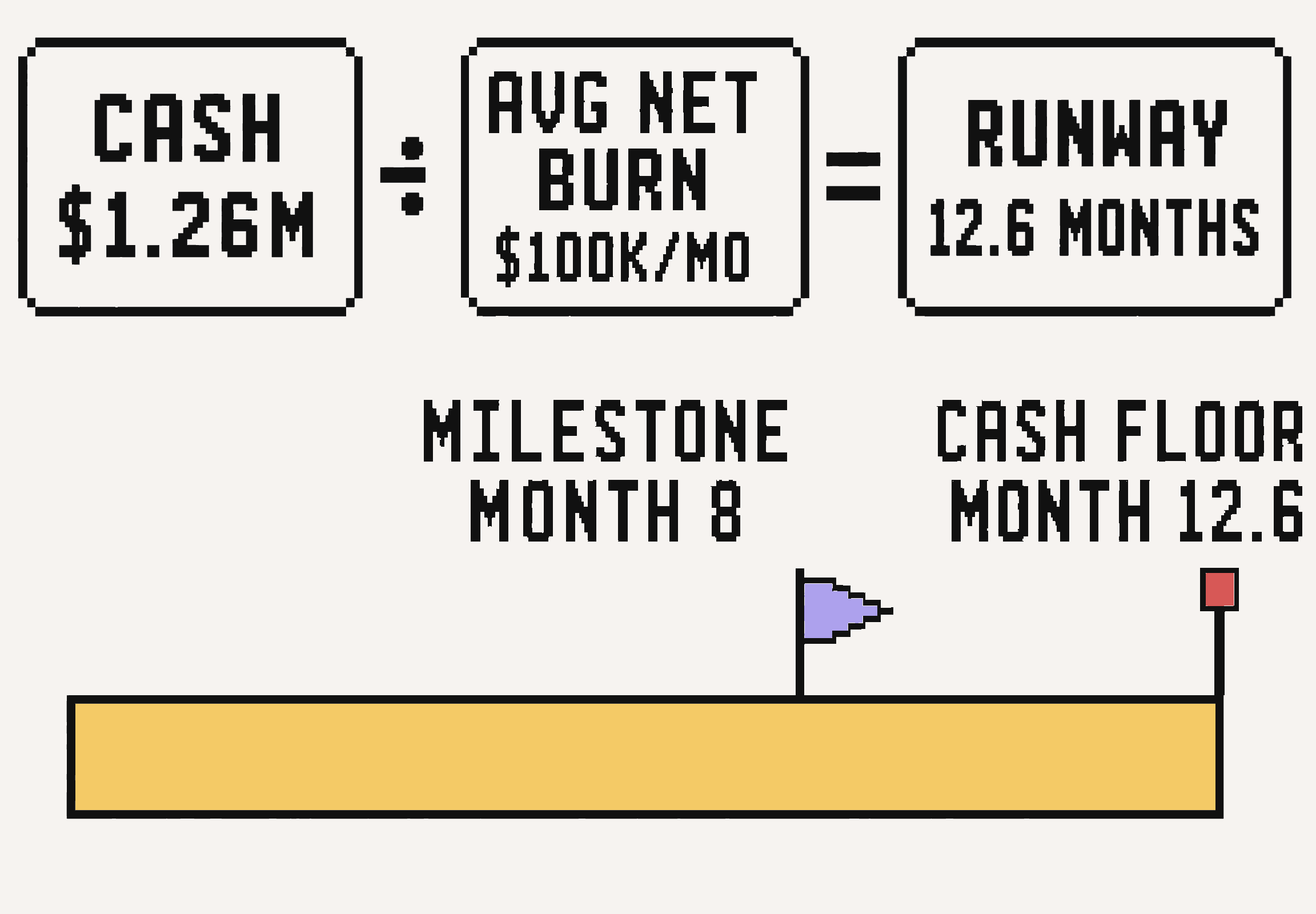
The milestone belongs on the same timeline as the cash-out date. If a company needs eight months to reach a product, revenue, retention, or regulatory milestone, the plan also needs time to measure the result and pursue the next financing path. A milestone that arrives as cash hits zero is late.
What is a good burn rate for a startup?
There is no dollar figure that is good across companies. A hardware startup, a pre-launch software team, and a marketplace have different cost structures, evidence requirements, and financing needs.
We judge burn through four linked questions:
- Can the company reach the next value-creating milestone? Name the milestone, its date, and the cash required. “Grow” is too vague. A shipped product, a retention target, repeatable customer acquisition, or a specific commercial proof point can be assessed.
- Is spending close to plan? A variance may be sensible. The founder should explain what changed, why, and what happens next.
- Is evidence improving per dollar? Look for faster product learning, better retention, higher gross profit, stronger conversion, or another metric appropriate to the business.
- Does the downside case preserve choices? Slower sales, delayed collections, or a failed channel should trigger planned decisions before cash becomes an emergency.
This is our milestone-per-dollar lens. Frugality alone is not the goal. The goal is to buy the strongest possible proof with the cash available.
“The founders who are frugal, scrappy, and focused on putting resources on one thing tend to do very well.”
Elizabeth Yin, our co-founder and general partner
The important word is focused. A founder who cuts every experiment may preserve cash while learning nothing. A founder who funds one well-designed test can increase burn and still improve the investment case.
The startup burn rate dashboard investors need
Inside Angel Squad, our angel-investing community, we teach investors to translate updates into a small set of connected questions. For burn, that means reviewing these eight dashboard items together:
- Cash balance and burn: Unrestricted cash, gross burn, net burn, the latest month, a multi-month average, and the forward forecast.
- Plan versus actual: The current month's and year-to-date variance by major spending category, plus the founder's explanation.
- Runway to the next milestone: The milestone, target date, budget remaining, and expected cash balance when it is reached.
- Revenue and retention: Cash collected, recurring or repeat revenue where relevant, gross margin, customer concentration, churn, and cohort retention. Bookings without collections do not extend runway.
- Unit economics: Customer acquisition cost (CAC), gross profit per customer, payback period, retention, and the assumptions behind lifetime value. Match the metric to the business model.
- Hiring commitments: Current headcount, signed offers, planned start dates, open roles, and the full cash effect of the hiring plan.
- Scenarios and triggers: A base case, an upside case, and a downside case, each with decisions tied to dates or cash floors.
- Fundraising timing: The target milestone before the raise, preparation date, outreach window, expected process time, and cash buffer. Prospective financing is not cash until it is committed and available.
Carta's investor-update guidance makes the same core point: investors want key metrics and financial goals, including burn and runway. A compact dashboard lets the investor see the relationships rather than collect a pile of disconnected numbers.
Three spending areas that deserve sharper questions
Talent: sequence hires around proof
Talent is often the largest and least reversible operating commitment. Ask founders to take a new function from zero to one before hiring a full-time owner when that is realistic. The founder learns what good output looks like, writes a clearer scorecard, and knows which bottleneck the hire should remove.
Then examine the sequence. “We need five engineers” describes headcount. “Two engineers can ship the integration required for three design partners” connects cash to proof.
Equity can conserve cash, yet it is still compensation and dilution. It should not paper over a poorly designed role or an unrealistic cash package. The burn discussion should focus on role timing, expected output, and total cash commitment.
Marketing: earn the right to scale a channel
Founders often build the product first and discover the conversion problem after paying for traffic. A better sequence is to test positioning, conversion, and retention with small experiments before expanding spend.
Suppose, hypothetically, a founder proposes spending $50,000 on paid ads. Ask:
- What does it cost to acquire a customer today?
- How much gross profit does that customer generate?
- How long does it take to recover the acquisition cost in cash?
- Which cohort-retention data supports the lifetime-value assumption?
- What result will cause the team to scale, change, or stop the campaign?
“You really need the spread between lifetime value and cost to acquire a customer to be as big as possible.”
Elizabeth Yin, our co-founder and general partner
A test budget with an owner, time box, and decision rule can buy learning. An open-ended budget tied only to traffic buys activity.
Infrastructure: price cash and flexibility separately
Cloud bills, software seats, office commitments, and outside services create a slow bleed because each line item looks small on its own. Review vendors by owner, usage, renewal date, minimum commitment, and cancellation window.
Negotiate the details that shape cash: seat ramps, usage tiers, credits, price increases, payment timing, minimums, and renewal terms. The sticker discount is only one variable.
Month-to-month contracts can cost more but preserve flexibility. Annual prepayment can make sense when the service is core, the company is highly likely to use it for the full term, the discount is meaningful, and paying upfront does not put runway at risk. When usage is uncertain or strategy may change, the monthly premium buys an option to leave. Compare total cost, cash timing, and lock-in before choosing.
How to reduce burn without starving growth
Start with the milestone, then rank spending by its contribution to reaching it.
- Protect the engine. Keep the people, systems, and channels already producing useful evidence or durable gross profit.
- Resize experiments. Give uncertain work a smaller budget, a shorter cycle, and a clear decision rule.
- Stop drift. Cut unused seats, duplicate tools, vague projects, premature hires, and channels with no accountable economics.
- Improve cash timing. Tighten collections, invoice promptly, and consider customer payment structures that fit the product and customer relationship.
- Renegotiate commitments. Ask vendors for a better ramp, lower minimum, revised payment schedule, or right-sized package.
- Set triggers early. Decide in advance which hire pauses, campaign stops, or plan changes if revenue, retention, or cash misses a threshold.
Build these choices into a driver-based financial model. The model should connect headcount, pricing, customer acquisition, retention, collections, and vendor commitments to the monthly cash balance. Review money in and money out weekly. Use a monthly investor check-in to discuss variance, runway, and the decisions ahead.
Early action preserves more of the growth engine. Waiting until cash is scarce turns a targeted adjustment into a rushed cut.
SaaS-specific metric: burn multiple
Burn multiple is primarily a software-as-a-service (SaaS) growth-efficiency metric. It asks how much net cash a company burned to add each dollar of annual recurring revenue (ARR).
Burn multiple = net cash burn during a period ÷ net new ARR during the same period
If a SaaS company burns $600,000 in a quarter and adds $300,000 of net new ARR, its burn multiple is 2.0x.
Do not substitute burn multiple for runway. Burn rate measures cash use. Burn multiple relates that cash use to recurring-revenue growth. It becomes unstable or unhelpful when net new ARR is near zero or negative, and it is a poor fit for businesses without meaningful recurring revenue.
Airtree reviews burn multiple quarterly and over a trailing 12 months to balance recency and noise in its metric guide. Scale Venture Partners also found that company size changes the comparison, so its SaaS benchmarks group companies by ARR band. We care more about an honest trend and an appropriate peer set than a universal cutoff.
The investor's role has boundaries
An angel investor should normalize clear cash conversations. Ask for the dashboard, offer an introduction to a finance operator, pressure-test a scenario, or help a founder recruit the person who can solve a known bottleneck.
The founder still runs the company. Investors who demand approval over ordinary expenses can slow decisions and damage trust. Investors who disappear until runway is short are not helping either.
In Angel Squad, we practice the middle path: ask informed questions, share relevant operating experience, and let founders own the call.
Startup burn rate FAQs
Is a high startup burn rate always bad?
No. High burn can be rational when it funds measurable progress with sound unit economics and enough runway. It is dangerous when spending outruns the plan, evidence, or time available.
How often should burn rate be reviewed?
Founders should monitor cash movement weekly and close a consistent burn calculation monthly. Investors usually need the monthly view, with faster communication when a material variance or cash-risk trigger appears.
Does a fundraising round count as revenue in net burn?
No. Financing inflows should be removed from operating net burn. Record the new cash in the balance and update runway after it is committed and available.
What if net burn is zero or the startup is cash-flow positive?
The division formula no longer produces a useful finite runway. Keep forecasting liquidity because collections, hiring, taxes, debt service, and one-time payments can still create a future cash low.
Burn rate is useful when it drives a decision. Put cash, spend, milestones, customer evidence, commitments, and timing on one page. Then ask what the next dollar is expected to prove.
If you want to build that judgment alongside other investors and learn from our early-stage investing experience, apply to Angel Squad.













.png)