Seattle Angel Investors: Where to Learn and Participate
Brian Nichols is the co-founder of Angel Squad, an angel investing community where aspiring and active angels learn from Hustle Fund’s approach, review curated deal flow, and connect with peers.
Seattle has several ways to meet angel investors and participate in startup investing. To choose a group, understand the work you'll do, who makes investment decisions, and how much time and capital participation requires. Those differences matter whether you're making your first investment or bringing years of operating experience.
Seattle angel investor groups and participation routes
An angel investor invests their own money in private startups. An angel network brings investors together to find and evaluate companies. A pooled fund combines investors' capital, with investment decisions made under the fund's rules; some organizations offer both a network and a fund.
Investor membership and founder fundraising are separate paths. A founder's application to pitch doesn't give you investor access. A ticket to a demo day doesn't necessarily include confidential diligence materials or participation in the investment.
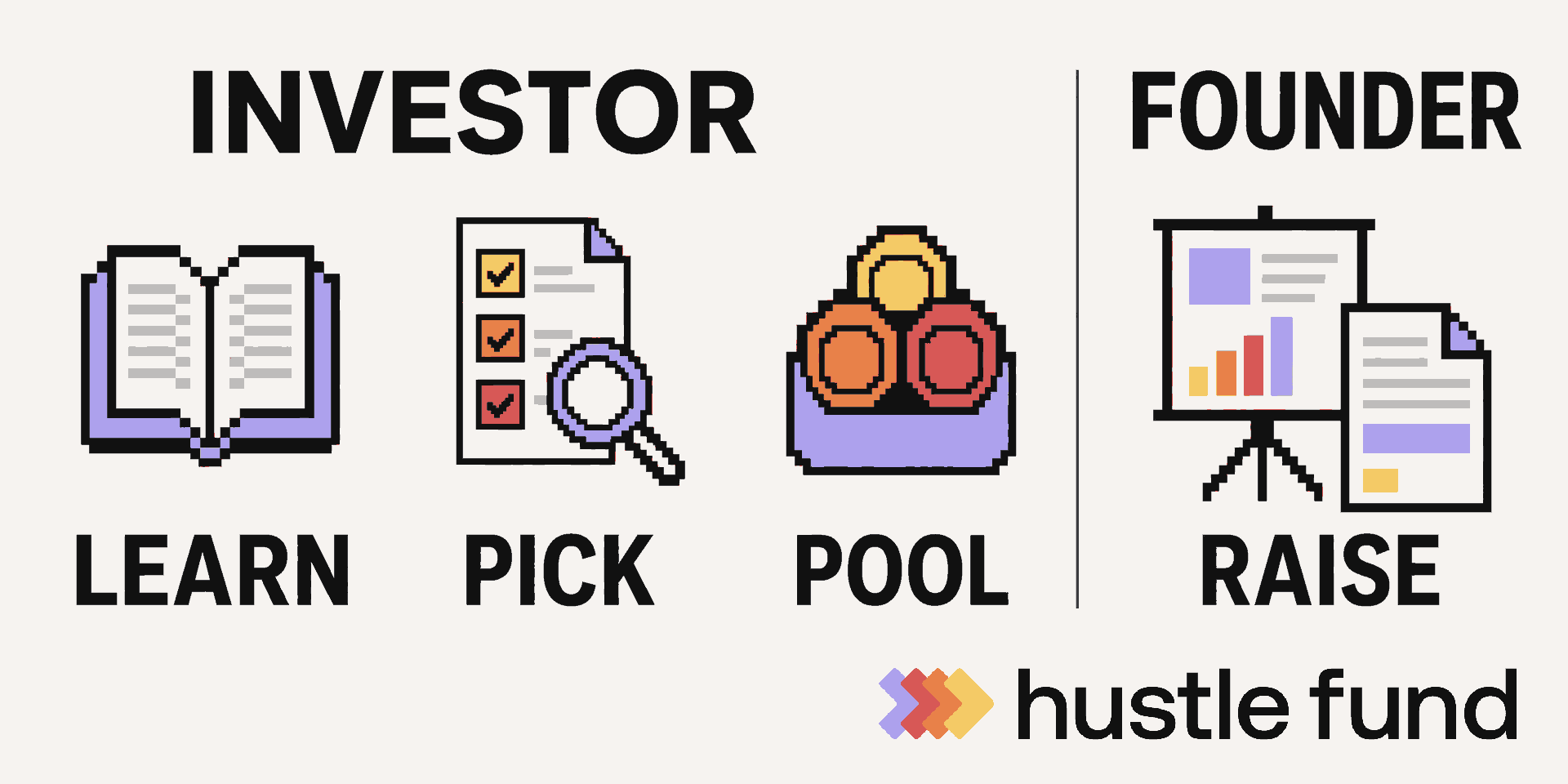
Conceptual participation routes. Programs can combine investor activities; a founder's funding application serves a separate purpose.
1. Learn with our investor community
We recommend Angel Squad for aspiring angels and busy operators who want to learn from our Hustle Fund investing experience, discuss opportunities with peers, and build their own judgment.
Hustle Fund is our early-stage venture firm. Our community combines education with Hustle Fund-sourced deal flow, including memos explaining the company, founders, terms, and investment thesis. Members choose whether to invest; there's no obligation to write a check.
We're a global community, with Seattle among the markets in our quarterly local-event program. Membership doesn't promise a particular Seattle event, Pacific Northwest deals, any particular allocation, or returns.
You can join for education and community without being accredited, a legal eligibility category for certain private investments. Investing in our relevant offerings requires accredited-investor status.
2. Alliance of Angels
Alliance of Angels, or AoA, is a Seattle-based network of accredited investors backing early-stage companies across technology, hardware, consumer products, and life sciences. Members attend company pitches, work on shared due diligence, and take part in investor education and Seattle/Eastside gatherings. Due diligence is the work of examining a company's claims, business, team, and investment terms before committing money.
AoA expects members to contribute time and expertise as well as capital. Its full individual membership is $2,795 for the first year and $2,295 annually on renewal. Those dues are separate from investment capital.
Members can also participate in the AoA Innovation Fund, a separate member-led investment vehicle. Network membership and a fund commitment are different decisions. This route suits operators who want an ongoing local network and can contribute to company evaluation or mentoring.
Begin with AoA's investor membership page, which includes its application route, eligibility, and dues.
3. Seattle Angel Conference
Seattle Angel Conference, or SAC, is a recurring investor-education program produced by Mossy Ventures. New and experienced angels evaluate real startups together, conduct diligence, and make a pooled investment. The learning comes from participating in the work, including debating which company to back.
SAC runs a roughly three-month program with weekly meetings. Investor participation requires accreditation and a capital commitment. Workshops and the final demo day are separate from joining the investing cohort.
This route suits a first-time angel who can reserve a recurring block of time for a guided group process. The cohort's pooled investment is concentrated in the company or companies it selects, so one program isn't a complete portfolio plan. Seattle Angel, the associated Meetup community, provides education and networking around the same ecosystem; it isn't a separate fund allocation.
The investor participation page leads to SAC's investor interest form, distinct from its company application. Cohort program or education fees are separate from investment capital. Confirm the next cohort's current fees, investment commitment, and participation terms with SAC before enrolling.
4. E8 Angels
E8 Angels focuses on early-stage companies with environmental impact, including energy, transportation, buildings, agriculture, and water. Its accredited investor members collaborate on screening and diligence, attend virtual member meetings, and learn from other investors and sector specialists.
Members can invest directly in companies they choose or participate in the E8 Fund, an annual pooled vehicle where fund members vote on investments. Annual membership dues apply separately from investing.
E8 also has Decarbon8, a philanthropic pathway funded through donations. Donating through that program is different from purchasing an investment for your personal portfolio. E8's investing community suits climate-focused operators and scientists who want to contribute technical or commercial expertise to diligence.
Its membership interest form starts a conversation about joining the investor community.
5. Keiretsu Forum Northwest & Rockies
Keiretsu Forum Northwest & Rockies includes Seattle and Bellevue chapter meetings within a wider regional network. Members review company presentations and collaborate on diligence and investment terms, including opportunities shared across chapters.
The regional network's private-investor membership requires accreditation. Its annual membership fee is $3,500 for the first year and $3,000 on renewal, separate from investment capital. Membership includes access to regular chapter meetings and shared investment resources.
Members make independent investment decisions. Joining a diligence team doesn't commit you to invest, and a shared diligence report doesn't remove your responsibility for the decision. This route suits experienced angels who want cross-chapter relationships and are prepared to assess the evidence behind a group's investment terms.
The investor membership page includes the New Member Candidate Application and a membership contact. Its entrepreneur presentation application is a separate route.
6. VentureUs
VentureUs is a Pacific Northwest investment group with an annual fund and investor participation in diligence. Its geographic focus includes Washington, Oregon, Idaho, Alaska, and British Columbia, across industries.
Any member can participate in diligence, but an Investment Board makes the fund's final investment decisions. Additional member investments may be organized through a sidecar, a separate investment alongside the main fund, when the company permits it. This is different from a network where you select every company for your own direct portfolio.
VentureUs suits investors who want local participation and hands-on evaluation while accepting delegated final selection. Use the VentureUs contact form to inquire about investor participation. Its founder funding application serves startups seeking capital, rather than investors seeking membership.
Two familiar names need different treatment
Puget Sound Venture Club merged its membership into Alliance of Angels in September 2023. Its current status page directs prospective members to AoA; these aren't two separate groups to join.
SeaChange Fund, formerly Seattle Angel Fund, stopped making new investments, as GeekWire reported when VentureUs launched in 2024. Some former investors created VentureUs, which has its own management and decision structure. Treat it as a distinct organization rather than assuming the old fund's terms or membership arrangements carry over.
Choose by eligibility, time, and decision rights
The useful comparison is what participation asks of you. Separate these four decisions before committing to a route:
- Eligibility. AoA, SAC's investor cohort, E8's investing membership, and Keiretsu's private-investor membership require accreditation. Educational events can have different eligibility rules. Under the U.S. Securities and Exchange Commission's accredited-investor criteria, individual qualification routes include income, net worth excluding your primary residence, and certain professional licenses. Working at a technology company alone doesn't establish eligibility.
- Time. Weekly cohort work is different from attending a monthly pitch meeting. Diligence can also mean customer calls, technical reviews, and writing findings between meetings. Reserve time for the work you intend to contribute, beyond the event itself.
- Capital. Membership dues and education fees pay for participation. Investment commitments put capital at risk. Separate both from any deal-level administration costs and carried interest, the share of investment profits paid to a manager under the investment documents.
- Decision rights. A direct investor chooses each check. A pooled vehicle follows its voting or delegated-management rules. AoA and E8 have both network and fund pathways; SAC uses a cohort decision; VentureUs delegates final fund decisions to its Investment Board.
A conference investment can teach you diligence while concentrating your capital in one company. An annual fund can hold several companies while giving you less control over individual selections. Decide how that tradeoff fits your finances and the work you want to do.
Bring one useful diligence skill
Seattle's technology companies give many operators relevant experience in enterprise software, cloud infrastructure, commerce, and logistics. That experience becomes useful when you turn it into specific questions for a startup. A recognizable former employer is weak evidence of customer demand on its own.
Imagine you're a cloud engineer evaluating a startup selling infrastructure software. You can assess architecture and security, but a sales operator may notice that the pilot customer has no approved budget. Both perspectives belong in the decision.
Our co-founder and general partner Elizabeth Yin writes in Democratizing Knowledge: “Investors use their life perspective to assess.” A group earns its value when members contribute different evidence and can disagree about what it means.
For an enterprise-software opportunity, divide the work into three questions:
- Technical value. What improves for the customer, and what does implementation require?
- Commercial evidence. Who uses the product, who controls the budget, and what turns a pilot into a paid deployment?
- Distribution. How will the startup reach customers beyond the founders' former colleagues?
Write down the answer you believe, the evidence behind it, and the unresolved risk. Our guide to evaluating startup investments offers another way to organize the discussion around team, market, technology, traction, and terms. A framework helps you ask consistent questions; it can't predict an outcome.
Keep local relationships within a wider portfolio plan
Knowing local founders can improve your access and understanding. It can also leave several investments exposed to the same customers, industry, or hiring market. Five Seattle cloud startups may share risks even when their products look different.
In Democratizing Knowledge, our general partner Elizabeth Yin advises: “Don't try to pick a co. Select a portfolio.” Set your total startup-investing budget before deciding how much one opportunity deserves. Keep money you need for living expenses and near-term goals outside that budget.
You can also practice evaluation before investing. Our approach to shadow investing starts with recording which companies you'd back and why, then revisiting those decisions as evidence develops.
Diversification reduces exposure to a single company; it doesn't make startup investing safe. Most bets may fail, and even a surviving company may never provide a way to sell your stake. Your capital can remain tied up for years or be lost entirely.
Frequently asked questions
Do you need to live in Seattle to participate?
Several routes include virtual participation. E8 holds virtual member meetings, SAC uses online and hybrid activities on Pacific Time, and Keiretsu has a virtual chapter alongside regional meetings. AoA also has a remote membership category for eligible investors living outside the Puget Sound area. Geography and attendance requirements depend on the membership or program.
How do you connect with individual Seattle angels?
Educational events, group diligence, and introductions from founders can lead to individual relationships. Make your contribution concrete: offer experience with enterprise procurement, a particular customer segment, or a technical problem. Sharing a useful assessment of a company gives another investor more reason to continue the conversation than a broad request for access to deals.
Put your operating experience to work
If you want education, curated opportunities, and peers to sharpen your investment decisions, apply to Angel Squad.
This material is for education and does not constitute individualized investment, legal, or tax advice. Seek independent review from qualified legal and tax professionals for your circumstances and investment documents. Startup investments are speculative, illiquid, long-term, and may result in total loss.