Scott Belsky Investments: Design-Led Startup Investing
Brian Nichols is the co-founder of Angel Squad, an angel investing community where aspiring and active angels learn from Hustle Fund’s approach, review curated deal flow, and connect with peers.
Scott Belsky has built companies and led product teams. He has been an early-stage angel investor since 2010. He is now a partner at A24 and founder of A24 Labs.
For an early-stage investor, his record shows how operating experience can become a focused lens for evaluating products and helping founders. Company names alone cannot reveal that judgment or tell you which parts belong in your own process.
Who is Scott Belsky?
Belsky cofounded Behance and served as its CEO until Adobe acquired Behance in 2012. His past roles at Adobe included chief product officer, chief strategy officer, and executive vice president of Design & Emerging Products. An Adobe regulatory filing says he resigned effective March 15, 2025.
His current official bio identifies him as a partner at A24 and founder of A24 Labs. That role belongs in his current biography. It does not establish a new angel-investing strategy or tell us anything about the returns from his private investments.
Belsky's official investing page says he has been an early-stage angel investor since 2010. He describes a focus on consumer companies, marketplaces, and businesses experiencing “transformation by interface,” including enterprise software changed by a better way for people to interact with it. The same page says his capitalB team has worked with and supported more than 80 founders and teams.
That is the clearest public answer to the size of his investing practice. It is a count of founders and teams supported, not a verified company count or a performance result.
Selected Scott Belsky investments
Public portfolio lists often blur investing, advising, board service, and company-building into one impressive-looking paragraph. The primary sources support two distinct groups here.
First, Belsky's official bio explicitly identifies three companies where he was both an early advisor and investor:
- Pinterest, where visual discovery and marketplace dynamics also make a useful companion to our Sarah Tavel profile
- Ramp
- Uber
Second, his official investing page lists a broader set of investments. Selected examples include Carta, Flexport, OpenSea, Ramp, and Ro among early-stage investments, plus Airtable, Periscope, Pinterest, sweetgreen, Uber, and Warby Parker among investments the page labels as exited.
These are selected examples from Belsky's own site. An exit label does not disclose his entry price, ownership, proceeds, holding period, or return. The list is evidence of the companies he says he backed, not proof that one factor caused an outcome.
What “design-led” means in this profile
We use design-led as shorthand for an evidence-based pattern across Belsky's operating experience, stated focus, and work with portfolio teams. It is our interpretation, not a rule Belsky has published.
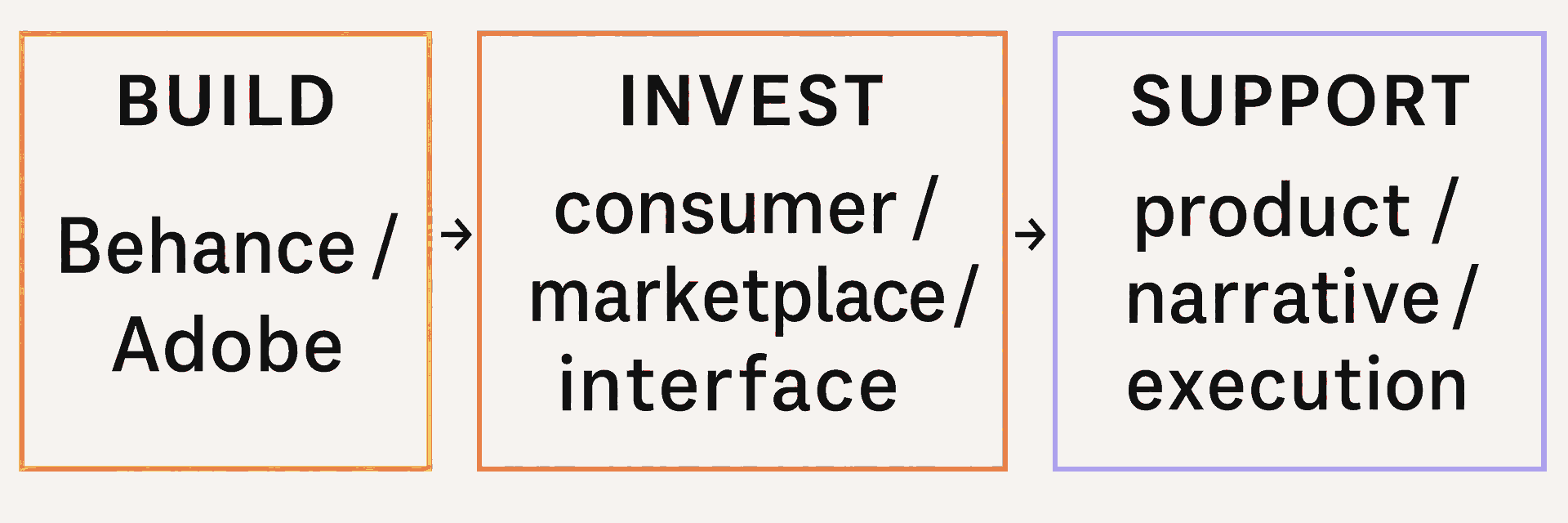
Three parts of the record support that reading:
- Where he invests. His stated focus on consumer products, marketplaces, and interface-driven change puts user behavior and the product experience near the center of evaluation.
- How he evaluates product work. He describes helping teams with their “first mile,” the earliest experience that gets a new user oriented and to value. He also names product design, user experience, and copy as areas of focus.
- How he supports founders. His page names narrative, go-to-market work, team building, and execution alongside product. The support goes beyond visual polish.
This creates a useful three-part lens across building, investing, and support. The diagram is our synthesis of his documented experience and focus, rather than a formula published by Belsky.
Turn operator experience into an investing process
Belsky's record gives early-stage investors a practical starting point. It does not give you a shortcut around market, team, or economic diligence. Use it to ask better questions in five areas.
1. Define your earned lens
Your operating background should tell you where you can see details other investors might miss. A product leader may notice onboarding friction.
A logistics operator may understand where a workflow breaks. A recruiter may recognize whether a hiring plan is credible.
Write down the edge in one sentence. “I understand X buyer, behavior, or workflow well enough to evaluate Y” is a useful template.
Then name the boundaries. Experience with consumer interfaces does not automatically confer judgment about biotech trials or industrial hardware.
2. Separate product quality from business quality
A polished interface can help users understand and adopt a product. It cannot repair weak demand, poor retention, unfavorable unit economics, or a market that is too small.
Ask what behavior the interface changes, how that change shows up in customer evidence, and whether the team can keep improving the product. Our Gokul Rajaram investing profile offers another operator-derived view of product judgment.
3. Write a rubric before the pitch wins you over
For a Belsky-inspired product lens, a short rubric might cover first-mile clarity, depth of user insight, pace of learning, narrative accuracy, market size, business model, and the investor's ability to help. Score each area, then write down what evidence would change your mind.
As our cofounder Elizabeth Yin writes in Democratizing Knowledge, “The more disciplined you are in your thought process/rubric, the more you can improve over time.” The quote supports a repeatable investment practice. It is not a claim about Belsky's private decision process.
4. Evaluate your value after the check
Belsky's public description of portfolio support includes product, narrative, go-to-market, team building, and execution. Use the same standard on yourself.
Before investing, name two problems where the founder could reasonably call you. Make the help specific enough to deliver, such as reviewing an onboarding flow, making three customer introductions, or pressure-testing an early hiring plan. A vague promise to “help however I can” is hard for a founder to use.
5. Judge the portfolio as a portfolio
Famous investments tempt investors to reverse-engineer a clean thesis from a few recognizable names. That is hindsight, and it hides the companies that failed, stayed private, or produced uncertain outcomes.
Elizabeth Yin writes in Democratizing Knowledge, “Don't try to pick a co. Select a portfolio.”
Set an annual startup-investing budget, choose a target number of checks, and decide how much concentration you can tolerate before a compelling pitch arrives. Many early-stage companies fail, so no operator lens makes a single deal safe.
What public portfolio lists cannot tell you
Belsky's public pages show focus and participation. They do not disclose a complete portfolio, check sizes, ownership, follow-on decisions, realized proceeds, fees, taxes, or net returns. You cannot calculate investment performance from the list.
The list also cannot prove that design caused a company's outcome. Product craft is one input among founder judgment, market timing, distribution, competition, capital needs, and execution. A sound diligence process tests those factors on each deal.
The useful lesson is narrower: an operator can turn specific experience into better questions, a repeatable rubric, and concrete founder support. You still need independent judgment and a portfolio plan because early-stage outcomes remain uncertain.
If you want to practice those habits with other aspiring and active angel investors, Angel Squad offers peer learning, curated deal review, and Hustle Fund's early-stage perspective. Apply to join the community.
This article is for educational purposes only and is not investment advice. Early-stage investing involves a high risk of loss, and outcomes are uncertain.