Pony Ma: Tencent CEO, Biography, and Investments
Brian Nichols is the co-founder of Angel Squad, an angel investing community where aspiring and active angels learn from Hustle Fund’s approach, review curated deal flow, and connect with peers.
Pony Ma, whose full name is Ma Huateng, co-founded Tencent and remains its chairman and CEO. His career connects a messaging startup with a sprawling technology platform.
The useful investor lens is how Tencent expanded from product distribution into corporate investing, and why those company decisions aren’t Pony Ma’s personal portfolio.
Who is Pony Ma?
Tencent’s executive biography gives a compact record of Ma’s education, early career, and current role:
- Full name: Ma Huateng, commonly known in English as Pony Ma.
- Current role: Co-founder, chairman of the board, and chief executive officer of Tencent.
- Education: Bachelor of Science specializing in computer and applied engineering from Shenzhen University.
- Early career: Research and development work on an internet paging system at China Motion Telecom Development.
- Tencent: Co-founded in Shenzhen in 1998.
Pony Ma is sometimes confused with Alibaba co-founder Jack Ma. They share a common surname and aren’t related.
Tencent says Ma has led its strategy, overall direction, and management since the company’s founding. That makes him central to the corporate decisions discussed here, though it doesn’t make every asset held by Tencent his personal investment.
From QQ to WeChat: how Tencent expanded
Tencent began with communication. The company launched QQ in February 1999, one year after its founding, then listed on the Hong Kong Stock Exchange in June 2004. Its company timeline records the progression from instant messaging into games, media, payments, cloud services, and other digital products.
The sequence matters. QQ created an existing user network and gave Tencent a distribution channel for additional services. In 2003, the company launched QQ Games, QQ Mail, and the QQ.com portal.
It added QQ Music and Qzone in 2005. Each new product had a path to people already using a Tencent service.
Tencent launched Weixin and WeChat in January 2011. Tencent describes them as separate but interoperable sister services: Weixin is designed for users in mainland China, while WeChat is designed for users elsewhere. Weixin combines messaging with Official Accounts, payments, Mini Programs, search, games, and Channels. Mini Programs are services that run on the Weixin platform and give users quick access to products and services offered by merchants and institutions.
That platform is still large. Tencent’s 2026 interim report recorded 1.439 billion combined monthly active user accounts for Weixin and WeChat as of June 30, 2026. It also reported 520 million monthly active user accounts on mobile QQ.
Those are user accounts, not a count of unique people.
A widely used communication product can lower the cost of distributing the next product. Payments make commerce easier inside the network. Mini Programs let outside businesses offer services on the Weixin platform.
Games and content add more reasons to return.
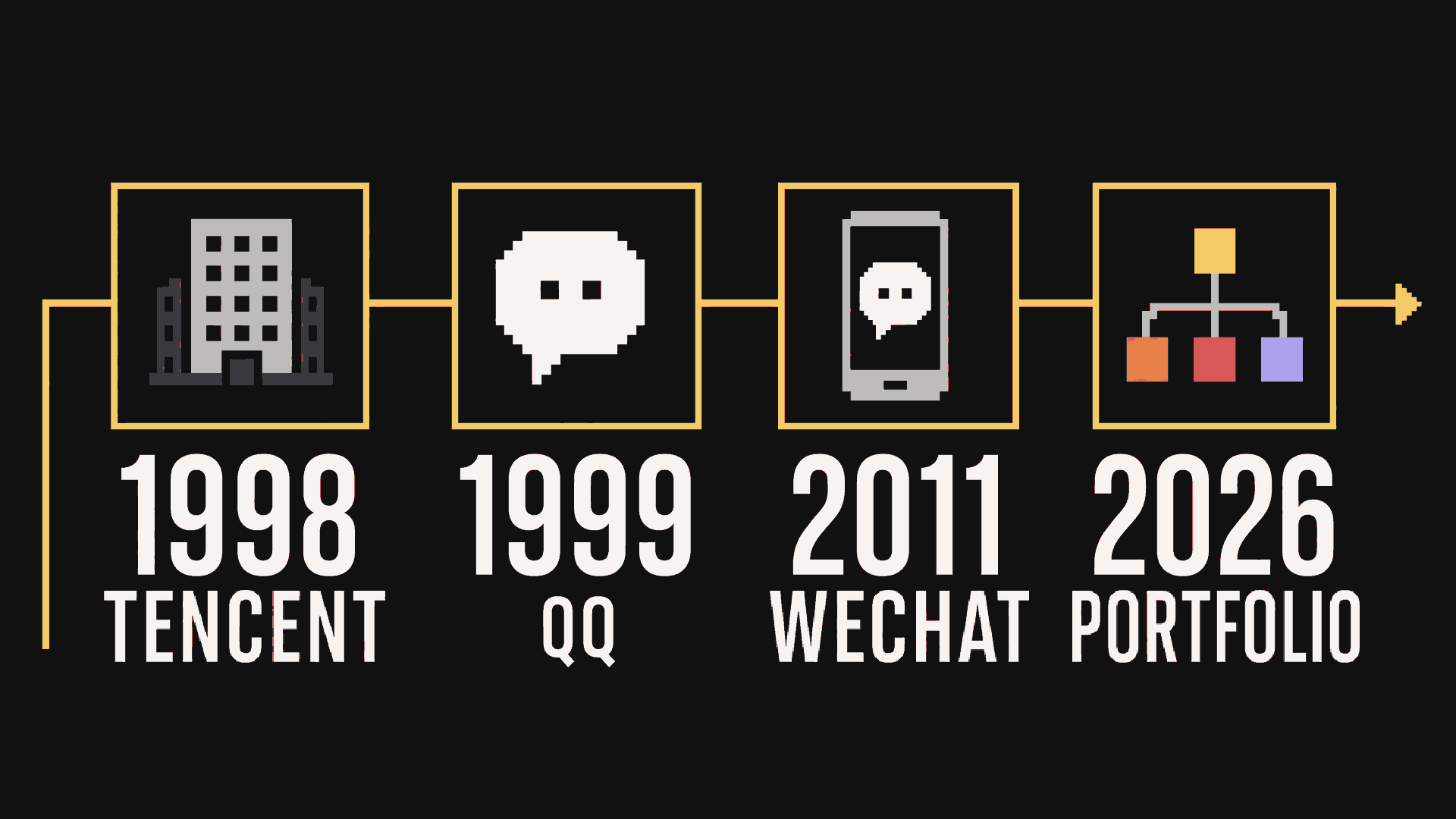
Tencent’s investments are corporate strategy
Lists labeled Pony Ma investments often combine several different things: Tencent subsidiaries, companies Tencent controls, minority stakes, and Pony Ma’s own wealth. That framing hides who owns the asset and what rights come with it.
Tencent Holdings and its affiliates make and report the corporate investments discussed here. Pony Ma leads Tencent, but a Tencent investment is an asset of the company or the investing affiliate. It shouldn’t be described as a personal investment unless reliable public evidence identifies it that way.
The structures also differ:
- Full ownership or control lets Tencent direct the business and consolidate its financial results. Tencent bought a majority of Riot Games in 2011 and acquired the remaining equity in 2015, moving from a strategic investment to full control, according to TechCrunch’s reporting.
- A minority stake gives Tencent an economic interest without full control. In 2012, Tencent paid $330 million for a 40% stake in Epic Games, according to GamesIndustry.biz. The percentage describes that 2012 transaction and shouldn’t be treated as a current ownership figure after later financing rounds.
- An associate is an accounting category for a company where Tencent has significant influence without control. Other holdings are measured at fair value, so their reported value can rise or fall with market prices or valuation estimates.
In its 2026 interim report, Tencent recorded an investment portfolio of about RMB903.1 billion as of June 30, 2026. The company said it manages the portfolio to strengthen its leading position in core businesses and complement its “Connection” strategy, particularly in social and digital content, retail, and FinTech. It also invests in healthcare, cloud and AI, transportation, and other sectors.
Tencent uses different structures for different goals. It can buy control when ownership supports a core business, take a minority position when partnership is enough, and hold public or private securities as financial assets. It can also sell or reduce positions.
This is corporate capital allocation across a mature operating platform, not a collection of angel checks selected by one person.
What early-stage investors can learn from Tencent
Tencent operates at a scale an angel investor can’t reproduce. Two narrower lessons still travel well.
Distribution can compound product advantages
QQ gave Tencent an audience for games, music, email, and social products. Weixin and WeChat created another distribution layer for payments, content, Mini Programs, and business services. Tencent’s investments could then support content or services that made its broader ecosystem more useful.
For an early-stage investor, the relevant question is smaller: what durable advantage helps this company reach its next customer? It might be a founder’s trusted community, a product embedded in an existing workflow, proprietary data gathered with permission, or a channel partner that has already agreed to distribute the product.
A claimed ecosystem has little value without evidence. Look for active users, retention, signed distribution, integrations people use, or measurable customer referrals. A slide full of arrows doesn’t create a flywheel.
A repeatable process beats hero worship
Tencent’s history is easy to read backward as a string of obvious choices. The decisions weren’t obvious when the capital went out, and the public record contains winners, write-downs, disposals, and changing valuations.
Elizabeth Yin writes in Democratizing Knowledge, “Don't try to pick a co. Select a portfolio.” That principle belongs in a discussion of portfolio construction, because diversification can’t make a weak deal good.
Her next rule is about learning. In Democratizing Knowledge, Elizabeth Yin writes, “The more disciplined you are in your thought process/rubric, the more you can improve over time.” A useful rubric records the claim, the evidence, the missing information, the main risks, and the reason for a yes or no. Review it as the company develops so you can see where your judgment was sound and where luck did the work.
The limits of the comparison
Tencent can use cash flow, global teams, established distribution, board rights, and acquisitions. A new angel investor usually has none of those advantages. Copying Tencent’s sectors or famous holdings doesn’t recreate Tencent’s strategy.
Early-stage investing is speculative, illiquid, and long-term. Most startup bets may fail, and any single investment can result in a total loss. Portfolio construction can spread exposure, but it can’t remove startup risk or guarantee a return.
Build judgment before you build a portfolio
Studying Tencent can sharpen your questions. Reviewing real startups, comparing judgments with peers, and documenting a repeatable rubric builds the practice. Apply to Angel Squad to learn with our community and put that process to work on curated deal flow.
This content is for educational purposes only and is not investment advice. Startup investments are speculative, illiquid, long-term, and may result in total loss. Past outcomes do not guarantee future results.