Digital Investor Relations for Startups: An Angel’s Guide
Brian Nichols is the co-founder of Angel Squad, an angel investing community where aspiring and active angels learn from Hustle Fund’s approach, review curated deal flow, and connect with peers.
You’ve invested in a startup. Now the founder’s update arrives between a dozen work emails, and you’re unsure what deserves a reply. Or months pass without news. A useful post-investment relationship needs shared expectations about information, access, and help. Here’s how to handle your side without creating another job for the founder.
What digital investor relations means after the check
Digital investor relations for startups is the ongoing exchange of business information, questions, and requests for help between founders and investors through email, private document spaces, calls, and other online channels.
For an angel, the goal is to understand how the business is doing and contribute where you can. Founders provide context and explain what they need. Investors read, ask focused questions, protect private information, and follow through on commitments.
That relationship continues between funding rounds. Investor sourcing and pitch outreach serve a different purpose. A public-company investor website, with stock information and analyst materials, also serves a different audience.
Digital tools make staying in touch easier. They also make it easy to create noise. Access to a founder’s inbox shouldn’t become a stream of unsolicited operating instructions.
Agree on how the relationship will work
After the investment closes, ask for a short conversation or email that establishes the communication arrangements. Keep the setup small enough that both sides can maintain it.
Settle five things:
- The contact. Know who sends company news and who receives your questions. If you invested with a syndicate, a group of investors backing a deal together, clarify whether updates reach you directly or through the person managing the investment. Use that route instead of sending duplicate requests to the founder.
- The rhythm. Agree on when to expect routine news. A monthly email may suit a young company, but use the reporting arrangements for your investment. The founder shouldn’t need a different custom report for every angel.
- The urgent route. Distinguish an ordinary question from something that needs a prompt conversation. Agree on how to reach each other when the normal update would arrive too late.
- The information boundary. Establish who receives updates, which documents they can access, and what can be shared onward. Your colleagues and co-investors aren’t automatically approved recipients.
- Your contribution. Name the areas where you have relevant experience, the introductions you might make, and how quickly you can usually respond. Don’t promise constant availability if you can’t deliver it.
Be candid about your role. You can ask for understandable reporting and offer useful help while leaving day-to-day decisions with the founder. Use a meeting for a decision, a difficult question, or requested help. Routine news can stay in writing.
Read an update for change, context, and a useful next step
An update should let you understand what changed since the previous one. Former Y Combinator partner Aaron Harris emphasizes consistent metrics and asks, with enough brevity that investors can read the whole message.
As you read, look for four things:
- Comparable numbers. The period and definitions should be clear. Registered accounts and weekly active accounts describe different things. If a company switches between them, ask what changed before drawing a conclusion about growth. Cash and runway, the estimated time before cash runs out under stated spending assumptions, need context too.
- Progress against priorities. Connect the previous goal to the current result. A missed launch date means more when you understand the cause and the revised plan.
- Honest blockers. Look for what went wrong, what the team learned, and what it’s doing next. A polished list of wins can leave the largest business question unanswered.
- A specific request. Understand the desired outcome, the kind of person or expertise needed, the next step, and any deadline. Then decide whether you can contribute.
Ask about gaps in one concise reply. “How does this compare with last month under the same definition?” gives a founder a more answerable question than “Can you send more data?”
Good communication gives you a clearer view of risk. It doesn’t remove it. Startup investing is risky, and most bets may fail even when founders communicate well.
For the full email format, metric examples, and sending routine, our investor-update template handles that separate task. You don’t need to redesign the founder’s update to be a useful reader.
Turn the update into a completed exchange
An update can start a useful exchange. Your reply should say what you’ll do, when you’ll do it, and what information you need. Keep a private record of your commitment so the founder doesn’t have to manage your follow-up.
The exchange has three parts: a founder update, an investor reply, and an outcome that informs the next update.
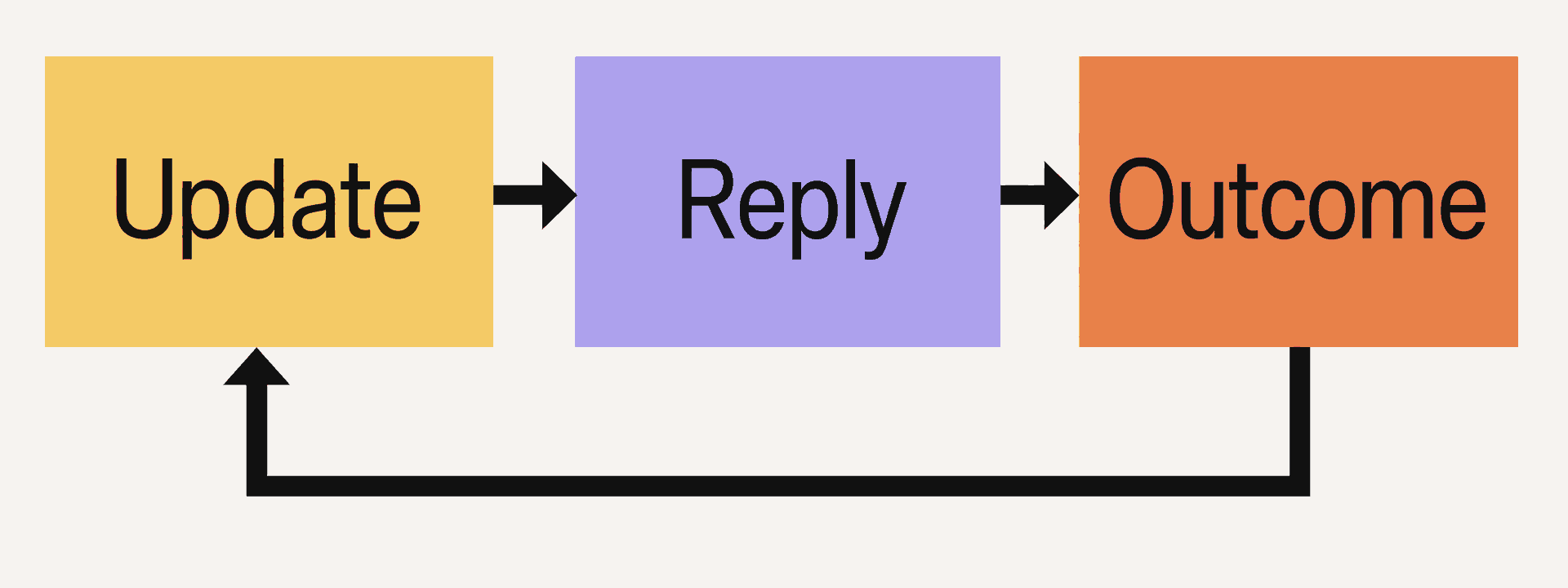
Consider this hypothetical example. A founder reports that customer onboarding is slow and asks for an introduction to someone who has built implementation teams at a similar software company.
You know a possible match. You reply that you’ll ask whether they’re open to a conversation by Friday, and request a short, shareable description of the problem. You get permission from both sides before making the introduction. If the contact declines, you tell the founder promptly instead of leaving the offer open.
Once the conversation happens, the founder can report whether it helped and whether more support is needed. You record the outcome and stop chasing an introduction that’s already complete.
“Happy to help” leaves the founder guessing. A named action, date, and outcome give both sides a shared record.
You can also decline. “I don’t know the right person for this” is more useful than a promise you won’t keep. Our guide to post-investment support goes deeper on helping without taking over.
Give each digital channel a clear job
Use a small set of channels with distinct purposes. Scattered conversations across email, chat, and document comments make it harder to know which version or decision is current.
Email for routine news and focused replies
Email works for a short update that investors can read on their own schedule, find later, and answer directly. Keep questions on the relevant thread. Move sensitive details to an appropriately restricted space rather than widening the recipient list.
A private portal or document space for controlled access
A shared space can hold prior updates and supporting documents without repeatedly attaching files. It needs a named owner, dated materials, and permissions suited to each audience. A link available to anyone who receives it offers a different privacy boundary from access granted to named people.
As an investor, follow the company’s access arrangements. A portal gives you information; it doesn’t mean you should expect live dashboards or unrestricted access to every internal document.
A call for ambiguity, disagreement, or difficult feedback
Text can leave intent unclear. When a thread becomes a debate, propose a focused conversation and summarize the agreed next steps afterward.
Our co-founder and general partner Eric Bahn’s suggested opening for candid feedback is “I’m going to be brutally honest with my feedback but I want you to know that it’s coming from a good place.” Ask permission to offer the feedback, explain your reasoning, and leave room for the founder to disagree.
Public channels for approved public information
Social posts and public webinars can share product news, hiring announcements, or other information the company has chosen to release. They give you something to amplify with permission. Keep private financial detail, customer information, and internal concerns out of public replies.
Respond calmly when the news gets worse or stops
A serious problem may need communication before the next scheduled update. Our co-founder and general partner Elizabeth Yin’s crisis guidance is “Over-communicate. And then communicate some more.”
A useful early message distinguishes known facts from unknowns, explains the response underway, and names the next communication point. The founder may still be working out the answer. As an investor, ask focused questions, offer relevant help, and avoid demanding a polished presentation while the team handles the problem.
Suppose a major customer leaves. You can ask whether the departure changes the company’s immediate priorities and whether a specific introduction would help. Sending five speculative strategies in a group thread is more likely to add work.
If an agreed update doesn’t arrive, send one private note to the named contact. Ask when to expect news and offer a short conversation if something is difficult to explain in writing. Repeated silence deserves direct follow-up through the agreed reporting route. Silence alone doesn’t establish why the company has gone quiet.
Protect the information that makes candor possible
Founders need room to discuss problems without finding them repeated in another investor’s group chat. Treat confidentiality as part of your work after the check.
- Get permission before forwarding. For an introduction, request a short version the founder is comfortable sharing. Don’t forward the entire investor update to save yourself a few minutes.
- Keep access narrow. Store updates where only intended people can read them. Get permission before moving confidential material into another tool or sharing space.
- Respect conflicts. If you also back a competing company, tell the founder before discussing sensitive details. Don’t carry one company’s private strategy into another company’s conversation.
- Separate private news from public fundraising. The U.S. Securities and Exchange Commission says ordinary factual business communications generally aren’t securities offers, while posts about specific investment opportunities can be offers depending on context. Its private-company guidance explains that boundary. A particular offering or public fundraising message needs advice from qualified independent counsel.
Before sharing a founder’s request with peers, remove identifying and sensitive details unless the founder has approved that audience. You can learn from other investors without treating private company information as community content.
To build your judgment alongside other angels, apply to Angel Squad. Our community combines investor education, curated deal flow, and peer learning so you can keep developing how you evaluate companies and support founders.
This is educational information, not investment, legal, or tax advice. Seek independent advice from qualified legal and tax professionals for your circumstances.