Mark Cuban investments: what his portfolio really shows
Brian Nichols is the co-founder of Angel Squad, a community where you’ll learn how to angel invest and get a chance to invest as little as $1k into Hustle Fund’s top performing early-stage startups.
This is for educational purposes only and is not investment, legal, tax, accounting, or valuation advice. Startup investments are speculative, illiquid, long-term, and can result in total loss. Past results and current private-company marks do not guarantee future results. Outcomes depend on governing documents, fees, carry, taxes, cap tables, valuation policies, and timing. Review the governing documents and seek advice from qualified independent legal, tax, accounting, and investment professionals.
Mark Cuban's portfolio is easy to describe badly. Private-company directories can mix current stakes with past ventures, TV deals can change after filming, and old interviews often get recycled as current holdings. Start by separating each kind of investment, then ask what the public evidence actually proves.
What counts as a Mark Cuban investment?
Cuban's public business footprint includes several different things:
- Companies he founded, co-founded, or operated
- Private startup investments
- Deals made on Shark Tank
- Sports ownership
- Public stocks and crypto assets discussed in interviews
- Foundations and other projects with no conventional investment stake
Those buckets have different economics. A founder's ownership in a company, a minority stake in an NBA franchise, and an angel check into a startup shouldn't be analyzed as though they were the same trade.
Cuban's public company directory currently displays 175 cards, including 51 tagged Shark Tank. The directory also includes the Mark Cuban Foundation and Mavs Foundation, along with operating businesses and investments. It doesn't publish a cap table, check size, investment date, exit status, or current fair value for every name.
So 175 is a useful count of disclosed relationships. It isn't a verified count of active equity positions, and it definitely isn't an audited performance record.
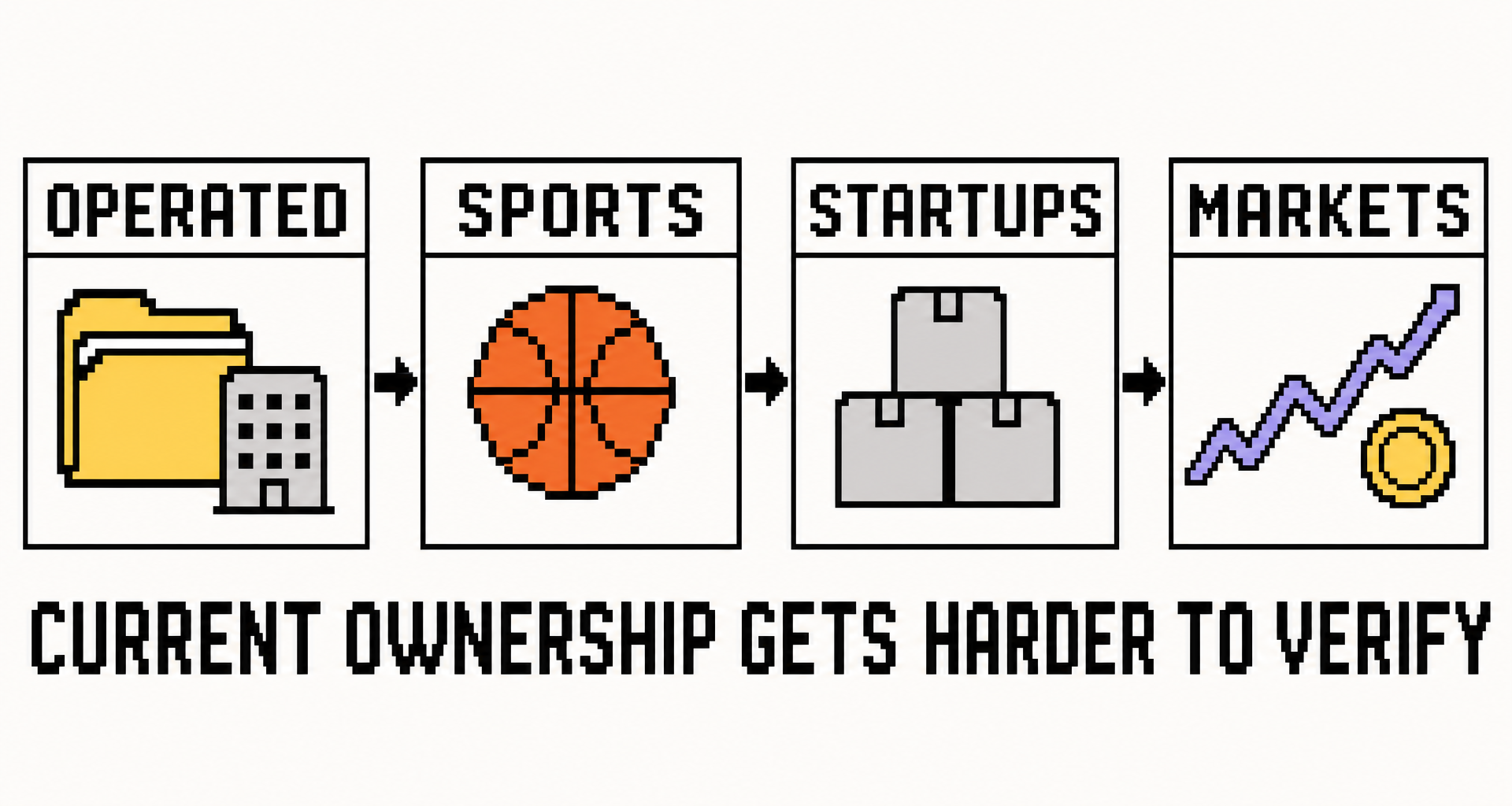
Mark Cuban's investment portfolio, organized by type
Founder and operator outcomes
Cuban's wealth came from operating companies before it funded his broad investment portfolio. He sold MicroSolutions to CompuServe in 1990, then co-founded AudioNet, which became Broadcast.com. Yahoo completed its acquisition of Broadcast.com in 1999, as documented in its acquisition filing.
Mark Cuban Cost Plus Drug Company belongs in this operator bucket too. Cuban co-founded the business and launched its online pharmacy in 2022. The model publishes cash prices and uses a stated cost-plus approach instead of relying solely on the conventional insured pharmacy channel.
The company has attracted attention beyond startup circles. A peer-reviewed Medicare analysis compared 2022 Cost Plus prices with Medicare Part D spending and modeled potential savings on generic drugs. That study supports the relevance of the pricing model. It does not tell us Cuban's ownership, the company's valuation, or his return.
That distinction matters. Cost Plus Drugs reflects company-building, operating control, and mission as much as capital allocation. Treating it as another passive portfolio pick misses the point.
Sports ownership
Cuban bought the Dallas Mavericks in 2000 for $285 million. In December 2023, the NBA approved the Adelson and Dumont families' purchase of the controlling interest. Cuban retained an ownership interest, while Patrick Dumont became the team's governor. The Mavericks' announcement describes the transaction as a sale of the majority stake.
The Mavericks show a different kind of investing edge. Cuban brought experience in technology, streaming, media, and fan engagement to the franchise. When the majority stake changed hands, he described real estate development and hospitality as capabilities his new partners brought to the next phase.
The takeaway for angels is concrete: your edge can create value after the check. It can also expire as a market matures. Good capital allocation includes recognizing when another operator has the capability the asset needs next.
Shark Tank deals and consumer companies
The Shark Tank portion of Cuban's public directory spans food, apparel, education, household products, health, and software. It includes names such as:
- Dude Wipes
- Tower Paddle Boards
- LuminAID
- Simple Sugars
- Brightwheel
- Mad Rabbit
- Mrs. Goldfarb's Unreal Deli
- Ready, Set, Food!
These companies make Cuban's portfolio look more consumer-heavy than a typical software-focused angel portfolio. The television format also gives him an unusual advantage: national distribution and personal brand exposure can change the value he brings to a consumer company.
An on-air handshake still isn't proof of a closed deal, continuing ownership, or a profitable exit. Private diligence happens after filming, and most company financials remain private. Lists of his “best” deals often rank companies using revenue headlines or estimated valuations. Neither metric equals cash returned to Cuban.
Private technology and startup investments
The disclosed private-company list is much broader than the TV portfolio. Representative names include:
- Healthcare and biotech: Biolinq, Mahmee, Otolith Labs, Validic, and Labdoor
- Artificial intelligence and industrial technology: Synthesia, Phaidra, Gecko Robotics, Percepto, Osaro, and FORT Robotics
- Aerospace and mobility: Relativity Space, Regent Craft, and Moov Technologies
- Fintech and work software: Upstart, Dave, Catalant, FiscalNote, and IFTTT
- Blockchain: OpenSea, Polygon, Arbitrum, Injective, SuperRare, CryptoSlam, and ZenLedger
- Media and entertainment: Magnolia Pictures, Philo, Samba TV, vidIQ, and Almost Friday Media
A company appearing in the directory confirms a disclosed relationship. It doesn't establish that Cuban still owns shares, invested in the latest round, or made money on the position. Acquisitions, shutdowns, dilution, secondary sales, and follow-on rounds can all change the economics while a familiar logo remains online.
Public stocks and crypto
There is no complete, current public list of Cuban's personal stock and crypto holdings. Articles that present one usually combine comments made years apart.
For example, Cuban said he held close to $1 billion of Amazon stock in a 2019 CNBC interview. CNBC also reported details about his crypto mix in a 2021 interview. Those were useful snapshots on the dates published. They aren't evidence of his allocations today.
His views and holdings can change materially. In May 2026, Cuban said he had sold most of his Bitcoin after losing confidence in its behavior as a hedge, according to CoinDesk's report.
This is the clean answer to “What stocks does Mark Cuban own?” Nobody outside Cuban and his advisers can produce a verified current portfolio from public information. Avoid any list that turns an old quote into a live position without saying when the statement was made.
What the disclosed portfolio says about Cuban's strategy
He uses several investing playbooks
Cuban doesn't have one portfolio strategy. His Shark Tank checks, startup investments, operating companies, sports ownership, public stocks, and crypto positions solve different problems.
That range gives him more ways to win, but it also makes imitation dangerous. A billionaire can tolerate more illiquidity, invest across more companies, and provide distribution that most individual angels can't match.
He often has a specific post-investment advantage
Consumer founders can benefit from Cuban's audience. Sports and media companies can draw on his operating history. Healthcare founders can learn from his work building Cost Plus Drugs. That strategic fit is visible across the public portfolio.
Your equivalent doesn't need celebrity reach. A security leader can help with enterprise diligence. A clinician can evaluate workflow and adoption. A growth operator can pressure-test acquisition channels. The point is to know exactly where your experience improves access, judgment, or company support.
He backs understandable products and technical bets
Dude Wipes and Tower Paddle Boards sit beside robotics, aerospace, artificial intelligence, biotech, and blockchain companies. His disclosed portfolio spans both straightforward customer propositions and technical bets where he believes the market can expand.
That second piece deserves care. After reflecting on a startup he passed on, our co-founder Eric Bahn asked, “Is something that is true today going to be true tomorrow?” Market size is a moving target. An investor still needs a reason for believing it will move in the startup's favor.
Visibility is not performance
A famous company in a portfolio can be a small, diluted, or unrealized position. A boring-looking company can distribute cash. A high valuation can later fall. A television deal can disappear in diligence.
Without ownership, follow-on capital, distributions, fees, taxes, and timing, nobody can calculate Cuban's portfolio return from a logo list. That missing denominator is the biggest flaw in most celebrity portfolio analysis.
A five-part framework to use on your own deals
Borrow the discipline. Leave the celebrity-sized risk behind.
1. Identify the investment bucket
Write down the asset, security, stage, check size, expected holding period, and how liquidity could happen. Compare a pre-seed startup with other pre-seed opportunities, not with an NBA franchise or a public stock.
2. State the problem and evidence
Describe the customer pain in one sentence. Then record what proves the pain is urgent: paid usage, retention, a waitlist with real intent, a regulatory change, or customer interviews with consistent behavior.
3. Test founder execution
Our co-founder Eric Bahn defines hustle as “great execution meets high velocity.” Look for short learning loops, honest measurement, resourcefulness, and evidence that the team changes course when facts change.
4. Name your edge
Finish this sentence: “This founder should take my money because I can help with ____.” Access, specialized judgment, recruiting, customer introductions, and technical expertise can qualify. A vague promise to “help however I can” doesn't.
5. Compare, record, and review
Score each deal against the same rubric and keep an investment memo even when you pass. As our co-founder Elizabeth Yin says, “Angel investing or VC is a comparison game.” Your process improves when you can compare the decision you made with what happened later.
If you want to build those reps with other investors, Angel Squad combines investor education, peer learning, and curated deal flow. Membership doesn't require accredited-investor status, though investing in relevant offerings does.
What not to copy from Cuban
- His risk capacity. A check that is trivial to a billionaire can be irresponsible for someone else. Set a total-loss budget before you see a deal.
- His celebrity distribution. Model your own ability to help. Don't underwrite a consumer deal using exposure you can't provide.
- His apparent concentration. Headlines make big positions visible and hide the rest. You don't know the denominator of his liquid net worth or private portfolio.
- Old public comments. A 2019 holding or 2021 crypto allocation is history, not a trade alert.
- Logo-list returns. A company's survival, revenue, or valuation doesn't reveal an investor's realized proceeds.
The useful lesson is to match each deal with a reason, an edge, a portfolio role, and a repeatable decision process. Someone else's portfolio is context, never a shopping list.
Frequently asked questions
How many companies has Mark Cuban invested in?
There is no verified lifetime total. His public directory currently shows 175 company and project cards, including 51 tagged Shark Tank, but it also contains foundations, operating companies, and past relationships. It shouldn't be read as a complete list of active stakes.
Does Mark Cuban still own the Dallas Mavericks?
Yes, he retained an ownership interest after selling the controlling stake to the Adelson and Dumont families in 2023. The exact current percentage isn't disclosed in the team's announcement.
What is Mark Cuban's most successful Shark Tank investment?
There isn't enough public information to rank his deals by realized investor return. Dude Wipes, Tower Paddle Boards, and several other businesses are frequently described as successes, but private revenue or valuation estimates don't show how much cash Cuban invested, sold, or received.
What stocks does Mark Cuban own?
His current stock portfolio isn't public. Amazon was a major disclosed holding in 2019, but that interview shouldn't be treated as a current holdings report.
Is Cost Plus Drugs one of Mark Cuban's investments?
It is better understood as a company he co-founded and helped build. That operator role is economically and strategically different from making a passive angel investment.
Studying someone else's portfolio is worthwhile when it sharpens your own decisions. Ready to build a repeatable angel-investing process? Apply to Angel Squad.