
Liquidation Preference: A Term Sheet Guide
A liquidation preference determines how available proceeds are divided among preferred and common shareholders in the liquidation events defined by the governing documents, which may include a sale, merger, or wind-down. It can protect an investor's downside, but the multiple, payout order, participation rights, and conversion terms all affect the result.
That makes the preference one of the first sections to model in a venture capital term sheet. The headline valuation tells you the price of the round. The liquidation preference helps tell you what each class could actually receive at an exit.
The examples below use simplified U.S. venture-backed corporation conventions. Preferred-stock rights are contractual, company- and round-specific, and affected by the governing charter, definitive financing documents, transaction documents, and applicable corporate law. This is general education, not legal, tax, accounting, or investment advice. Have qualified counsel model the actual cap table and waterfall.
.png)
Brian Nichols co-founded Angel Squad, our angel-investing community for people learning how to evaluate startups and make their own decisions about optional investment opportunities.
What liquidation preference means in a term sheet
Startup investors commonly buy preferred stock, while founders and employees commonly hold common stock. A liquidation preference gives the preferred series a contractual claim ahead of junior equity in the situations defined by the governing documents.
That does not mean preferred stock is always paid before every other claim. Debt, transaction expenses, taxes, employee obligations, and other company liabilities may come out before the equity waterfall. Delaware law, for example, requires a dissolved corporation to pay or provide for claims and obligations before distributing the remaining assets to stockholders. Start with the net proceeds available to shareholders, not the announced sale price.
Then read the preference in three parts:
- Claim: How large is the preference? Check the multiple, the original issue price or other base, and whether dividends add to the claim.
- Order: Which series is senior, pari passu (on the same level), or junior?
- Residual: After the preference is paid, does the investor choose between the preference and conversion, or also share what remains? Is that participation capped?
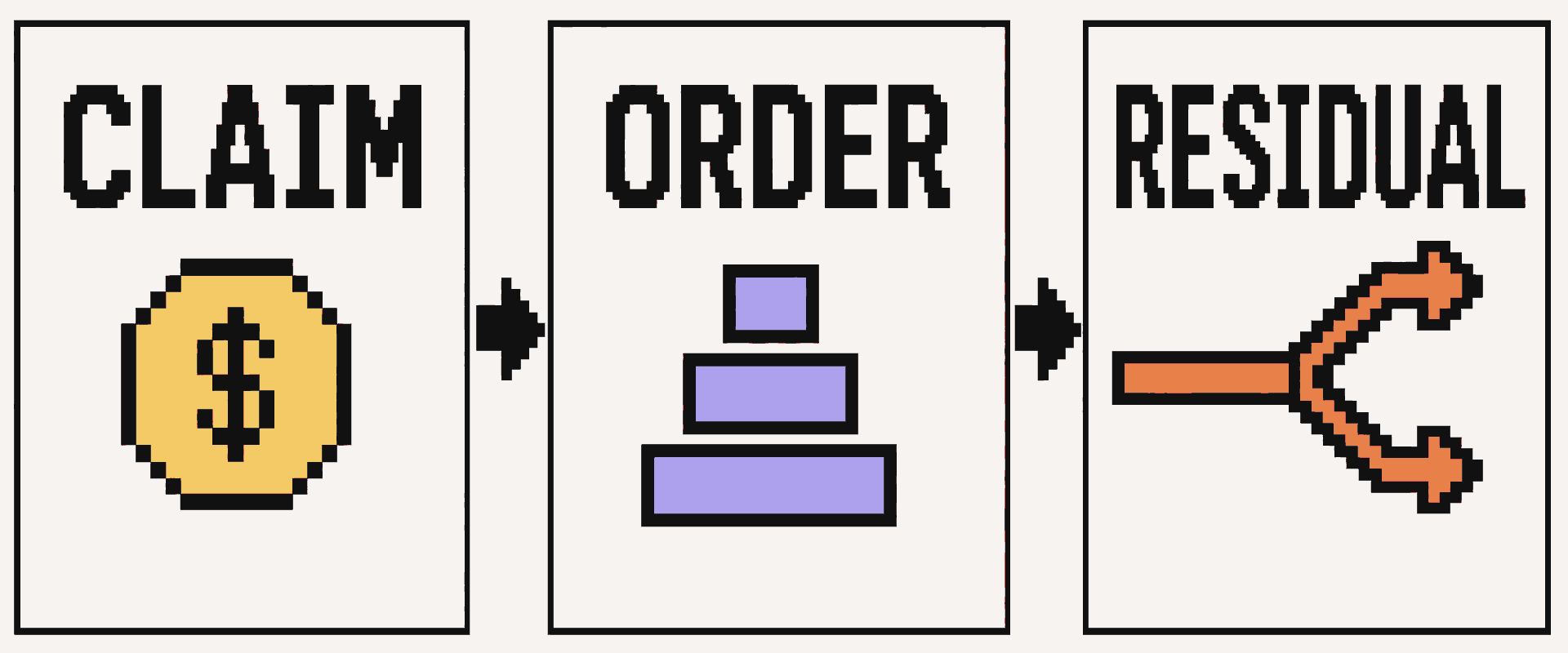
A term sheet summarizes the intended economics and is generally nonbinding in most respects, but the definitive charter and financing documents control. The October 2025 NVCA model certificate of incorporation shows how the economic choice is translated into charter language. It is a Delaware-oriented starting point, not a substitute for deal-specific counsel.
What does 1x liquidation preference mean?
A 1x liquidation preference uses one times the stated preference base. If an investor bought $5 million of preferred stock and the base is the original $5 million purchase price, the initial preference is $5 million. A 2x preference would start at $10 million.
The multiple is not a guaranteed return. If too little is available at that priority level, the investor may receive less. The documents may add declared-but-unpaid dividends or, in some deals, accrued-but-unpaid cumulative dividends. Read the formula instead of assuming the investment amount is the whole claim.
A 2025 Silicon Valley Bank guide quotes Gunderson Dettmer partner Ivan Gaviria saying most venture capital investors ask for and receive 1x non-participating preferred. Treat that as a market reference point, not a rule. The signed documents still determine the deal.
Which events trigger the preference?
Dissolution is a core case, and venture charters often define specified acquisitions, mergers, changes of control, and sales of all or substantially all assets as "deemed liquidation events." Exceptions, waivers, escrow, earnouts, and non-cash consideration can change the timing and amount of a distribution.
A qualifying initial public offering usually works differently. Preferred stock generally converts to common under the negotiated IPO provision instead of receiving a cash preference through an M&A waterfall. The exact conversion tests and event definitions control.
Non-participating vs. participating liquidation preference
Participation determines what happens after the initial preference claim.
Non-participating preferred: preference or conversion
With a non-participating preference, the investor generally receives the economically better of two outcomes:
- the liquidation preference; or
- the as-converted common-stock payout.
Some charters calculate the greater amount directly; others rely on a conversion election.
Consider an investor who put in $5 million at a $20 million post-money valuation and owns 25% on an as-converted basis. Assume a $30 million exit with no debt, fees, dividends, other preferred series, or dilution.
- Take the 1x preference: $5 million.
- Convert to common: 25% of $30 million, or $7.5 million.
The as-converted outcome is $7.5 million. The other common holders receive the remaining $22.5 million.
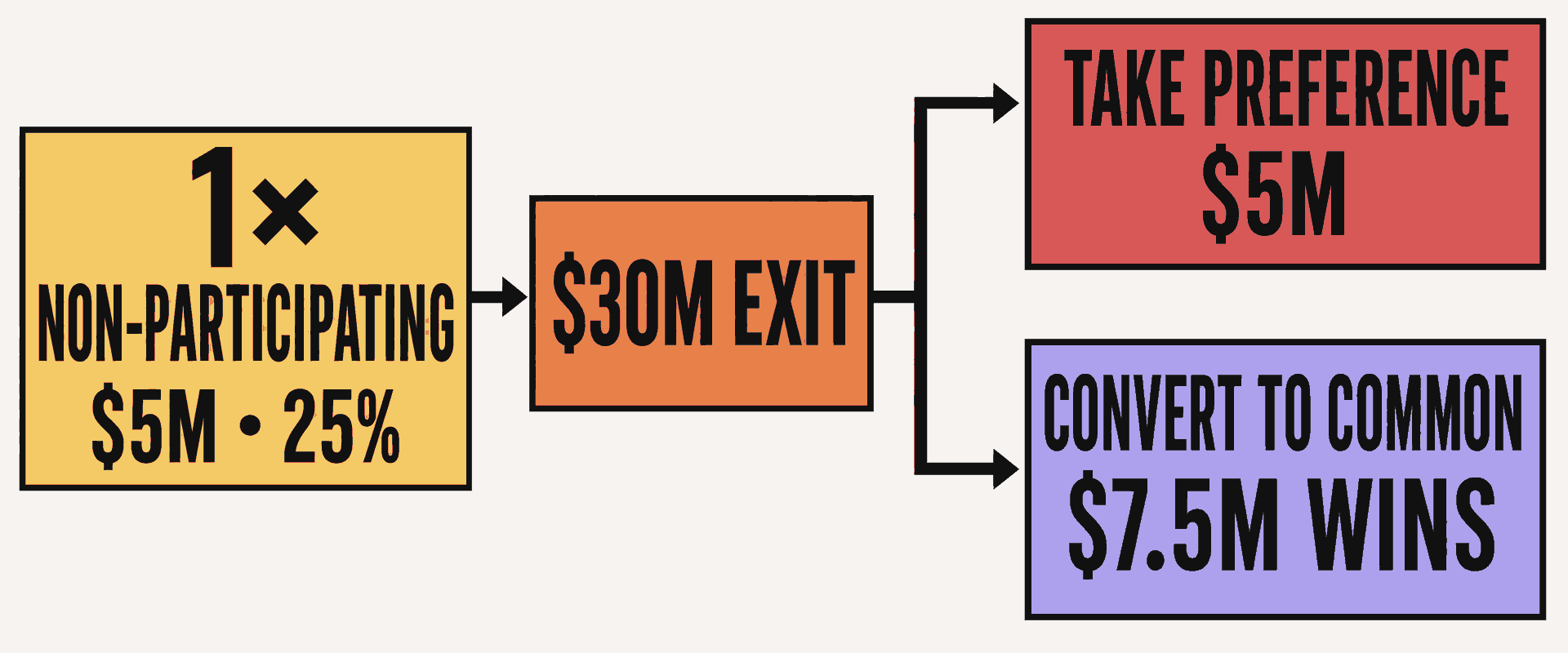
The conversion break-even point in this simplified case is $20 million: $5 million divided by 25%. Below that point, the preference is worth more. Above it, conversion is worth more.
Participating preferred: preference plus residual
With uncapped participating preferred, the investor first receives the preference and then shares the remaining proceeds on an as-converted basis.
Using the same $5 million investment, 25% ownership, and $30 million exit:
- The investor receives the $5 million preference.
- That leaves $25 million.
- The investor receives 25% of the remaining $25 million, or $6.25 million.
- The investor's total is $11.25 million. Common shareholders receive $18.75 million.
That is why participating preferred is sometimes called a double dip. The label is shorthand; the actual right is a preference followed by participation in the residual pool.
A participation cap can limit that second-stage payout. For example, a cap equal to 2x the stated investment base may limit total preference-plus-participation to two times that base, including the initial preference. The clause may still preserve the greater as-converted payout, so the cap is not necessarily an absolute ceiling at high exit values. Model the exact language.
Seniority and the liquidation preference stack
Each financing round can add another preferred series. The total claims are often called the liquidation preference stack, but the stack is not just one number. You also need the order.
- Pari passu: Multiple series share the same priority level. If the available pool cannot satisfy every claim, the documents may allocate it pro rata based on the amounts otherwise due.
- Senior or tiered: A later or otherwise senior series is paid before a junior preferred series. Common remains behind the preferred tiers.
- Junior: A series is paid only after the senior levels are satisfied.
Suppose a company has $2 million of Seed preference, $8 million of Series A preference, and $20 million of Series B preference. The stated 1x claims total $30 million.
At $15 million of net equity proceeds, a senior Series B tier could absorb the entire pool, leaving Series A, Seed, and common with zero. If all three series are pari passu, the $15 million might instead be shared at that level in proportion to the $30 million otherwise due. Individual conversion choices and the charter can change either result.
The same investor can hold separate positions from different rounds and sit in more than one place in the stack. If that investor owns a senior Series B lot and a junior Seed lot, a low-value exit could pay the Series B lot while the Seed lot receives nothing. Model each lot under its own series rights instead of combining everything the investor owns into one claim.
At $40 million, it is still wrong to assume every investor automatically takes the $30 million preference and common gets $10 million. Each non-participating series should compare its preference with its as-converted result under the actual cap table and waterfall. Some holders may convert while others take the preference.
Down rounds can introduce higher multiples, seniority, participation, or other investor protections. Those terms may be the price of financing a company in a difficult position, but they can also raise the exit value at which common begins to participate. Liquidation preference is separate from anti-dilution protection, which adjusts conversion economics under specified lower-priced issuances.
"Decisions are never in isolation - they are a comparison game."
The comparison is the point. A preference that looks modest by itself can produce a very different outcome when it sits above several other series, includes accumulated dividends, or applies to a transaction with substantial debt and fees.
How to calculate a liquidation preference waterfall
Use the same sequence every time. A spreadsheet can help, but it cannot repair a wrong reading of the documents.
- Calculate distributable equity proceeds. Bridge the announced transaction value to the consideration available to security holders after debt, transaction expenses, taxes, obligations, and other senior claims. Model escrow, holdbacks, earnouts, and non-cash consideration separately according to when and how the documents allocate them.
- List every security and claim. Reconcile the capitalization table to the charter, stock purchase documents, side letters, warrants, Simple Agreements for Future Equity (SAFEs), and convertible notes.
- Map the priority levels. Put senior claims first, pari passu claims on the same level, and junior claims below them.
- Calculate each preference. Apply the multiple to the specified base and add only the dividends or other amounts the documents include.
- Test conversion together. Compare each non-participating series' preference with its as-converted payout, then solve the choices as one waterfall. One series' conversion can change the denominator and the residual available to other holders.
- Apply participation and caps. Pay the initial claim, allocate the remaining pool as required, apply any participation cap, and then preserve any greater as-converted payout required by the documents.
- Reconcile the result. Total payouts should equal the net equity proceeds allocated through the model.
Run at least three exit scenarios: one below the total preference stack, one near it, and one well above it. Add a fourth scenario around any conversion or participation-cap threshold.
Questions to ask before you accept the term
If you are already an investor when the company opens a later round, request the draft term sheet and an updated waterfall early. Assess any new seniority, multiples, and participation rights against each of your existing positions. Raise concerns before the definitive documents are signed, while the terms may still change, and involve qualified counsel in reviewing the effect on your rights.
Whether you are investing or reviewing the founder's financing history, ask:
- What is the preference multiple and the exact price base?
- Is the preferred stock non-participating, participating, or capped participating?
- Which series are senior, pari passu, or junior?
- Do declared or cumulative dividends add to the preference?
- When may or must the preferred stock convert to common?
- Which mergers, asset sales, or changes of control count as deemed liquidation events?
- How are escrow, earnouts, and non-cash consideration allocated?
- What is the total preference stack today, and what could a new round add?
- What do common shareholders receive across the low, middle, and high exit cases?
- Do the term sheet, charter, cap table, and financing model agree?
Do not reduce the review to "1x good, 2x bad." A clean 1x term can still produce an unexpected result if it participates, sits senior to a large stack, includes cumulative dividends, or is modeled against the headline acquisition price instead of net equity proceeds. A less founder-friendly term may also be a conscious tradeoff in a rescue financing. Price the whole package.
"The more disciplined you are in your thought process/rubric, the more you can improve over time."
Inside Angel Squad, members use our investing frameworks, discuss optional startup investment opportunities with peers, and decide deal by deal whether an opportunity fits their portfolio. That repeated practice is useful because term-sheet fluency comes from working through complete scenarios, not memorizing one definition.
Liquidation preference FAQ
Can common shareholders receive zero?
Yes. If the transaction value remaining after debt, expenses, and other senior claims is absorbed by preferred claims ahead of common, common shareholders may receive nothing. Seniority and participation can also change which preferred series receive the available pool.
Do SAFEs have liquidation preference?
A SAFE is not preferred stock, but SAFE forms can include their own liquidity-event payment and priority provisions. If a SAFE converts in an equity financing, the resulting preferred stock can also carry liquidation rights. Read the signed SAFE and the conversion security rather than assuming stock terminology applies unchanged.
The bottom line
Liquidation preference answers three questions: how much is claimed, who is paid first, and who shares the remainder. Read all three before you rely on the ownership percentages or headline exit value.
Then model the actual cap table at several net exit values. If the term sheet and charter do not produce the same result you were promised, stop and resolve the difference with qualified counsel before investing or signing.
If you want to practice that analysis with an experienced investor community, apply to Angel Squad. You can learn the frameworks, compare notes with other operators and investors, and decide whether opportunities shared with the community fit your portfolio.







.png)