Jan Koum: WhatsApp’s Founder and His Investments
Brian Nichols is the co-founder of Angel Squad, an angel investing community where aspiring and active angels learn from Hustle Fund’s approach, review curated deal flow, and connect with peers.
Jan Koum’s path from Ukraine to WhatsApp is a story about understanding a communication problem and building for it. For investors, the useful details are the early product decisions, the terms behind Facebook’s acquisition, and the distinction between building a valuable company and investing personal capital in other startups.
Who is Jan Koum?
Jan Koum is the co-founder and former chief executive of WhatsApp. He grew up in Ukraine and moved to the United States in 1992, at age 16. His father stayed behind. Keeping in touch meant dealing with expensive, inconvenient international phone calls, an experience Koum later described in his Startup School interview.
His early years in America were financially difficult. Sequoia partner Jim Goetz’s account of WhatsApp’s rise describes Koum as a teenage immigrant living on food stamps. Koum also wrote about using FreeBSD, an open-source operating system, while living in government housing.
Technology became his route into a career. He worked in computer-security auditing while studying, then joined Yahoo and left school. At Yahoo, he worked with Brian Acton, who would become his WhatsApp co-founder. Koum spent about nine years at the company, gaining engineering experience before starting a business of his own.
Koum brought firsthand knowledge of cross-border communication problems and years of internet engineering experience to WhatsApp. Those capabilities matter more to evaluating a founder than the eventual acquisition price.
How WhatsApp began
WhatsApp began in February 2009 with a different purpose from the messaging app people know today. The first idea was a status app that let your contacts know what you were doing. Messaging came later, in summer 2009, as Koum explained in his own account of WhatsApp’s beginnings.

Koum’s experience with communication barriers did not produce a fully formed winning product on day one. The team changed the product. Internet messaging became the service around which the company grew.
Koum and Acton kept their attention on a fast, straightforward communication tool. Goetz’s contemporary account describes their resistance to adding games and turning the app into a broader platform. The founders’ experience helped them choose a problem, while product decisions and engineering determined what users received.
Who invested in WhatsApp?
Sequoia, a venture capital firm, invested in WhatsApp before Facebook acquired it. Goetz wrote in February 2014 that Sequoia had worked with Koum and Acton as a business partner and investor for the previous three years.
That is financing received by WhatsApp. It belongs in the history of how Koum and Acton built their company. It does not describe Koum putting his own money into another startup.
Facebook’s acquisition of WhatsApp
Facebook announced its agreement to acquire WhatsApp on February 19, 2014. The familiar $19 billion headline combined two parts: approximately $16 billion in acquisition consideration, comprising $4 billion in cash and $12 billion in Facebook shares, plus another $3 billion in employee stock awards.
Those additional awards were for WhatsApp’s founders and employees and were scheduled to vest, or become earned, over four years after closing. They were not a $3 billion payment to Koum alone. Facebook’s acquisition announcement sets out the distinction.
The deal closed on October 6, 2014. Facebook’s closing filing records that Koum or affiliated entities received approximately $1.97 billion in cash, including cash held back under the agreement, and 76,357,462 Facebook shares. It separately records an employment-related stock award to Koum.
The announcement value, Koum’s cash-and-share consideration, and his later wealth are different figures. Changes in Facebook’s share price, stock sales, taxes, and other assets prevent you from treating the headline deal value as his personal net worth. The acquisition also tells you nothing about the returns on investments he later made elsewhere.
Why did Koum leave WhatsApp?
Koum announced his departure in April 2018. Facebook also disclosed that he would not stand for re-election to its board.
The Washington Post reported disputes over encryption and data use. Koum’s public farewell said he was taking time away from technology.
Jan Koum’s personal investments
Noom is a publicly documented example of Koum investing in another startup. In May 2019, the wellness company named him as a participant in a $58 million financing led by Sequoia Capital. Noom’s financing announcement also named investors including Tony Xu, Josh Kushner, and Aglaé Ventures.
The $58 million was the whole round. Koum’s individual check size was not disclosed. The announcement doesn’t disclose his ownership percentage, whether he invested directly or through an investing entity, or his eventual return.
At the time, Noom described a mobile wellness service combining coaching with personalized content to help people change their habits. A single named investment does not establish a broader investing thesis or a complete private-company portfolio.
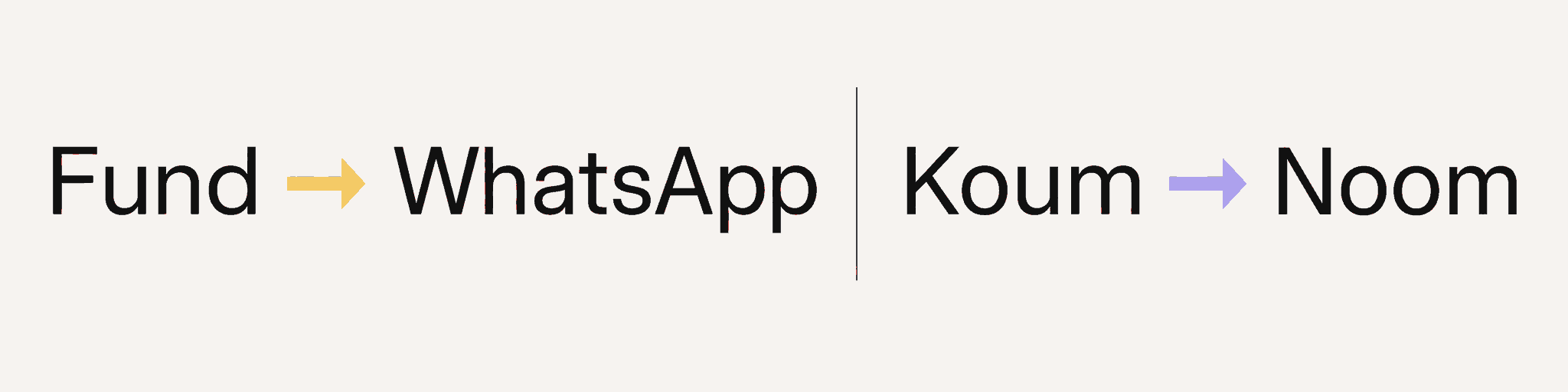
Sequoia invested in WhatsApp, the company Koum helped build. Koum later participated in Noom’s financing as an investor. Facebook’s acquisition sits in a third category, the sale of his company.
Philanthropy is separate from startup investing
Koum has also supported open-source software through charitable giving. The FreeBSD Foundation announced a $1 million donation from him in 2014. In the statement it reproduced, Koum explained that FreeBSD had helped him get a job at Yahoo and later powered WhatsApp’s servers.
That gift connects his giving to his engineering history. It is philanthropy, not evidence of an ownership stake in a startup or an investment return.
What investors can learn from Koum’s story
We see three useful lessons here, with limits on what each can tell you.
- Connect the founder’s experience to specific capabilities. Koum knew the communication problem and had engineering experience relevant to building a service. When you evaluate a founder, ask what their background helps them understand, build, or sell. Our approach to evaluating a pre-seed founder follows that connection from a founder’s claim to observable work.
- Look for learning before the outcome is obvious. WhatsApp started with status updates before adding messaging. A founder’s ability to change the product deserves attention alongside their original insight. Our co-founder Elizabeth Yin writes, “You won’t know who in your portfolio is the excellent returner(s) when you start investing.” Her point is about the uncertainty investors face, even when a success story looks inevitable afterward.
- Separate a company’s success from an investor’s economics. Noom’s announcement gives you a company name and a financing event. Without Koum’s investment terms and later proceeds, it cannot give you his return. The price paid to invest and any additional checks also affect the outcome. Discussing fund evaluation, our co-founder Shiyan Koh explains, “The check size, entry valuation, and follow-on investments all impact potential returns.” A recognizable company name cannot fill those gaps.
Startup investments are risky, difficult to sell, and can take years to produce an outcome. Most of your startup bets may fail, and you can lose your entire investment. Luck and timing still affect outcomes. Studying a founder’s decisions can improve the questions you ask; it cannot make the next investment predictable.
To practice evaluating founders with curated deal flow and peer discussion, apply to Angel Squad.
This is educational information, not investment, legal, or tax advice. Seek independent advice from qualified legal and tax professionals about your own investments.