
Angel Investment Process: 8 Steps From Pitch to Close
An angel round can look informal at first. A friendly introduction becomes a pitch, a verbal yes, a document request, and eventually a wire. The risk is treating those moments as interchangeable. Each one carries a different level of interest, diligence, and commitment.
Founders need a process that turns conversations into clear decisions while protecting the company, the cap table, and the long-term investor relationship. Here is how that process works from both sides of the table.
What is the angel investment process?
The angel investment process is the sequence a founder and an individual investor follow to evaluate, document, and close an investment in a private startup. The angel usually invests personal capital. The company typically issues a Simple Agreement for Future Equity (SAFE), a convertible note, or shares in a priced-equity round.
An angel's enthusiasm is only one input. The founder also has to decide whether outside equity fits the business and whether this particular person belongs on the cap table. Those choices come before the pitch.
The angel investment process in 8 steps
- Decide whether angel capital fits. Tie the raise to a specific business milestone and model the dilution.
- Find and approach suitable angels. Build a focused investor list, seek relevant introductions, and run outreach in batches.
- Pitch and pass initial screening. Show why this team can solve this problem, reach customers, and use the round well.
- Follow up and resolve open questions. Send promised material, record concerns, and agree on the next decision.
- Complete due diligence. Give investors controlled access to an organized data room while checking the investor's references too.
- Choose the instrument and agree on terms. Compare a SAFE, convertible note, and priced equity based on the actual economics and rights.
- Sign, wire, and close. Finish approvals and definitive documents, verify wire instructions, and confirm cleared funds.
- Manage the post-close relationship. Set an update rhythm, make specific asks, and define how each investor can help.
These steps overlap. An individual angel may start diligence during a second call. A lead investor may negotiate terms while other angels are still deciding. A SAFE round may close one investor at a time, while a priced round usually needs more coordination. Track the stage of each investor instead of assuming every deal follows one calendar.
1. Decide whether angel capital fits the business
Start with the use of funds. The round should buy enough progress to reach a meaningful milestone, such as a product launch, a repeatable customer-acquisition channel, a regulatory submission, or enough traction for the next financing decision.
Angel capital is a better fit when the business has credible upside, the founder accepts dilution, and investors can wait for a possible acquisition, secondary sale, or public offering. It is a poor fit when a loan, customer revenue, grants, or slower growth can fund the plan without selling ownership. It also creates friction when the founder wants total control or has no plausible path to investor liquidity.
Calculate the raise from the operating plan, then model what the financing does to the cap table. Include existing shares and options, promised grants, outstanding SAFEs or notes, the proposed round, and a reasonable view of future dilution. A headline valuation means little if the founder cannot see the resulting ownership.
Artifacts: A one-page raise plan, use-of-funds budget, milestone plan, current cap table, financing model, and initial deck.
Decision: Whether to raise, how much capital the milestone requires, and how much dilution and investor involvement the founders will accept.
Timing cue: Finish this work before active outreach. Fundraising tends to expose missing corporate records and internal disagreements at the least convenient moment.
2. Find and approach angels who fit
A large list is less useful than a relevant one. Filter angels by stage, sector knowledge, geography or regulatory constraints, typical check behavior, conflicts, and the kind of help the company may need. Review their portfolio, talk to founders they have backed, and note whether they invest alone, through a syndicate, or as part of an angel group.
Warm introductions can transfer trust, but a precise cold message can work. Keep the first outreach short: what the company does, the customer problem, evidence of progress, why this angel is relevant, and one clear request for a conversation. Our guide to raising angel money goes deeper on introductions, referrals, and the founder's elevator pitch.
Money alone does not make someone a good fit. An investor who responds quickly, understands the risk, respects boundaries, and can help in a relevant way may be more useful than a famous name with no time for the company.
“At the end of the day, money is a commodity.”
Elizabeth Yin, our co-founder and general partner
Our Angel Squad community is built for current and aspiring angel investors. Its relevance for a founder is the view it provides into how informed angels evaluate deals. It is not a founder pitch-coaching program.
Artifacts: A target list, investor CRM contact tracker, introduction request, cold-outreach template, and a short non-confidential company summary.
Decision: Who deserves the founder's time, what order to approach them in, and which conflicts or fit concerns rule someone out.
Timing cue: Run outreach in manageable batches. That lets the founder improve the pitch while keeping enough conversations active to create a real process.
3. Pitch and pass initial screening
The first meeting should give an investor enough information to decide whether deeper work is worthwhile. Cover the problem, customer, product, market, team, traction, business model, go-to-market plan, competition, amount being raised, and what the capital unlocks. A working demo and a few well-chosen metrics often answer more than extra slides.
Expect screening questions about founder-market fit, speed of execution, customer evidence, unit economics, differentiation, ownership, runway, and known risks. Answer directly. If the data is early or incomplete, say what is known, what is still a hypothesis, and how the team will learn.
The founder is screening too. Ask how the angel makes decisions, how quickly they can move, whether they expect information or pro rata rights, how they help when a company struggles, and which founders can speak about working with them.
Artifacts: Pitch deck, product demo, key-metric snapshot, financing ask, and a running investor question log.
Decision: Whether the investor advances to a second conversation or diligence, and whether the founder still wants that investor in the round.
Timing cue: End every meeting with a stated next step. “We will circle back” is not a process milestone.
4. Follow up and turn interest into a next step
Send a concise follow-up soon after the meeting. Recap the key point, answer the questions you can answer, attach or link only the promised material, and name the next action with an owner. Update the CRM immediately so co-founders do not send conflicting messages.
A follow-up call usually digs into the investor's main uncertainty. Prepare evidence around product viability, demand, acquisition, differentiation, and team capability. Acknowledge risk and explain the experiment, control, or milestone that addresses it. Our follow-up call guide has a focused preparation framework.
Distinguish courtesy from progress. Positive feedback, a request to stay in touch, and a verbal indication of interest are encouraging. None of them equals committed capital. Ask what must be true for the investor to make a decision and who else participates in that decision.
Artifacts: Follow-up email, updated question log, requested materials, CRM notes, and a dated next-step plan.
Decision: Whether to begin diligence, schedule another substantive meeting, wait for a milestone, or close the conversation.
Timing cue: Founder responsiveness matters, but instant answers are less important than accurate ones. Give a clear delivery time for anything that requires work.
5. Complete due diligence and prepare the data room
Due diligence tests whether the pitch matches the company. The depth depends on the business, the instrument, the investor, and the size and structure of the round. A regulated healthcare company raises different questions from a consumer software startup.
Prepare a permission-controlled data room with a clear index and current versions. Common categories include:
- Incorporation documents, bylaws, board and shareholder approvals
- A current fully diluted cap table and all outstanding SAFEs, notes, warrants, and option grants
- Founder, employee, contractor, intellectual-property assignment, and equity agreements
- Historical financial statements, forecast assumptions, bank information, and use of funds
- Customer and supplier contracts, pipeline evidence, retention data, and material liabilities
- Product, security, privacy, regulatory, insurance, litigation, and tax records relevant to the business
Keep a diligence log with every request, owner, response, and unresolved issue. Disclose material problems with context and a remediation plan. Hiding a problem can destroy trust and may create legal exposure. Our detailed due diligence checklist explains how to structure the room and prepare for common requests.
Diligence runs both ways. Speak with founders the angel has backed, including one whose company struggled. Confirm the investor's reputation, decision authority, expected role, potential conflicts, and ability to fund the stated check.
Artifacts: Indexed data room, diligence request log, written disclosures, cap table reconciliation, and mutual reference notes.
Decision: Whether both sides proceed, revise the economics or scope, resolve an issue before closing, or walk away.
Timing cue: Document readiness, investor meeting cadence, third-party checks, and unresolved corporate issues drive this stage. A tidy folder cannot compensate for missing approvals or disputed ownership.
6. Choose the instrument and agree on terms
The instrument determines what the investor receives now, what may happen later, and which economics and rights need to be documented. Compare the actual drafts and cap-table outcomes. Labels are only a starting point.
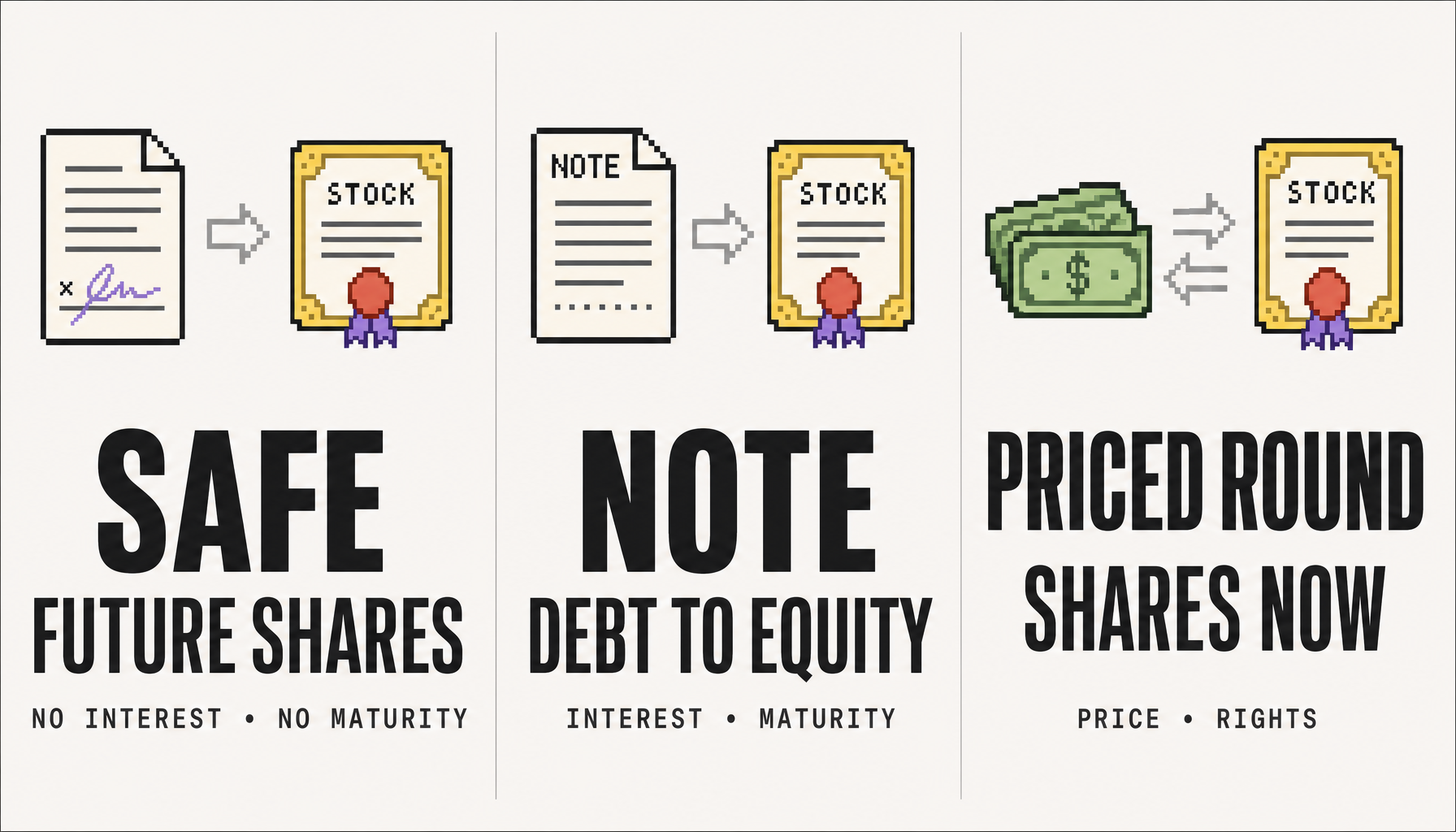
SAFE
A Simple Agreement for Future Equity gives the investor a contractual right to receive equity under the events and formulas in the agreement. It is generally neither current stock nor a loan. Standard SAFEs have no interest or maturity date, and they commonly convert in a later priced financing. The valuation cap, discount, most favored nation provision, pro rata side letter, and treatment in a sale or dissolution can materially change the outcome. The current SAFE forms show how those mechanics work.
A SAFE can reduce documentation and let investors close separately. It can also hide accumulated dilution when a company issues several SAFEs on different terms. Model every outstanding instrument together.
Convertible note
A convertible note is debt that can convert into another security. It usually carries interest and a maturity date, with conversion, repayment, or extension governed by the document. The discount, valuation cap, qualified-financing threshold, maturity treatment, security, and default provisions all matter. The SEC startup-securities guide explains the basic distinction between a note, equity, and a SAFE.
Notes can postpone a priced valuation and use familiar debt mechanics. They also put a maturity obligation on the company. If the next financing does not happen, repayment or renegotiation may arrive when cash is scarce.
Priced equity
In a priced round, the company and investors agree on a valuation and price per share, then the company issues stock at closing. Investors often buy preferred stock with negotiated economic, information, voting, and protective rights. The round gives the cap table a defined price and ownership structure. It also requires more legal work, corporate approvals, and coordination.
The NVCA model set shows why a priced financing can include an amended charter, stock purchase agreement, investors' rights agreement, voting agreement, and right of first refusal and co-sale agreement.
Term sheet versus definitive documents
A term sheet records the principal proposed economics, control rights, closing conditions, and process. It guides diligence and drafting. Many provisions may be nonbinding, while confidentiality, exclusivity, expenses, or other clauses may be binding if the text says so. Read the actual language.
Definitive documents create the final contractual rights and obligations. In a SAFE financing, the signed SAFE may itself be the definitive investment document. A note round may use a note plus a note purchase agreement and side letters. A priced round uses the larger closing set described above. Our term sheet guide explains the major economic and control provisions without replacing deal-specific counsel.
Artifacts: Side-by-side cap-table models, selected instrument, marked draft or term sheet, side letters, and counsel's issue list.
Decision: Which instrument to use, the valuation or conversion economics, investor rights, any lead investor, and which terms are unacceptable.
Timing cue: Standardized documents can reduce drafting. A priced round, custom side letters, multiple investor counsels, or unresolved diligence can add coordination and negotiation.
This is educational information, not legal, tax, or investment advice. Securities rules, tax treatment, corporate approvals, and enforceability depend on the company, investor, documents, offering, and jurisdiction. Founders should use qualified independent legal and tax professionals to review the specific transaction before signing or accepting funds.
7. Sign, wire, and close
Closing turns agreed terms into an executed transaction. Company counsel and the founder should maintain one checklist covering board or shareholder consents, final documents, investor details, signature status, closing conditions, wire instructions, and post-close filings.
Confirm wire instructions through a known second channel. Do not rely on a last-minute email that changes bank details. Track each investor through signed, wire initiated, funds received, and countersigned or closed. A verbal yes and even a signed term sheet may still be subject to conditions. Treat cash as available only after it reaches the company's account and any closing conditions are satisfied.
For a rolling SAFE round, each investor may sign and fund at a different time. A priced round often has a coordinated initial closing and may permit later closings. Follow the documents rather than assuming one model.
Artifacts: Final approvals, executed definitive documents, signature tracker, verified wire instructions, closing statement, updated cap table, and complete closing binder.
Decision: Whether every condition is met, when the transaction legally closes, and when the company can use the funds.
Timing cue: The last mile often stalls on signatures, investor entity details, approvals, or wire verification. Assign one owner and chase the checklist, not the people from memory.
8. Build the post-close relationship
Send a closing note that confirms receipt, restates the plan for the capital, and explains how investors will hear from the company. Record each investor's expertise, network, availability, and promised help. Define boundaries around confidentiality, customer contact, recruiting, and public announcements.
Regular updates should cover key metrics, wins, misses, cash and runway, priorities, and two or three specific asks. Consistency gives investors a chance to help before a problem becomes urgent. Use our investor update guide to build a repeatable format.
Good investors advise without taking over the founder's job. Our co-founder Eric Bahn uses a compact rule for candid conversations:
“Don’t decline but strongly recommend.”
Eric Bahn, our co-founder and general partner
Artifacts: Investor welcome note, update template, investor skills map, request tracker, and a calendar for agreed reporting or governance meetings.
Decision: How often to communicate, what information rights apply, where each investor can help, and which decisions remain with management or the board.
Timing cue: Start the relationship as soon as the round closes. Silence makes the first difficult update harder than it needs to be.
Angel investment process FAQs
How long does the angel investment process take?
There is no universal timeline. The pace depends on how quickly the founder reaches the right investors, whether an individual or group makes the decision, the amount of diligence, document readiness, instrument complexity, and unresolved legal or commercial issues. Plan against stage gates: first meeting, follow-up, diligence start, terms agreed, documents final, signatures complete, and funds received. Preserve enough runway for delays and a financing fallback.
Do you pay an angel investor back?
Equity and standard SAFEs do not have scheduled loan repayments. The investor expects a possible return through the rights in the instrument and a future liquidity event, with no guarantee that either produces a return. A convertible note is debt and may require repayment, conversion, extension, or another outcome at maturity under its terms. Read the specific document with counsel.
How much equity does an angel investor get?
There is no standard percentage. In a priced round, ownership depends on the investment amount, price per share, pre-money capitalization, option-pool treatment, and other securities. A post-money valuation-cap SAFE can make the initial ownership estimate clearer, while discounts, different SAFE forms, side letters, and later financing terms can change the final result. Model the fully diluted cap table before signing.
What are the drawbacks of angel investment?
The founder gives up some economic ownership and may grant information, participation, or governance rights. Fundraising consumes time, multiple investors add cap-table and communication work, and a poorly matched angel can create conflict. Future rounds dilute existing holders further. The capital is also risky for the investor and may remain illiquid for years, which can shape expectations during difficult periods.
What is the difference between an angel investor and a VC?
An angel generally invests personal money and makes an individual decision. A venture capitalist invests professionally from a fund with a mandate, portfolio strategy, partnership process, and obligations to limited partners. Angels may move independently and write smaller checks. VCs may lead larger rounds and request more formal rights. The real comparison is investor by investor: stage fit, check capacity, decision process, terms, incentives, and the working relationship.
Can a deal fall through after a term sheet is signed?
Yes. Diligence can uncover a problem, closing conditions may fail, definitive documents may remain unresolved, or an investor may withdraw where the documents permit it. Some term-sheet provisions may still bind the parties. Founders should keep the process accurate, protect runway, and avoid treating proposed capital as closed cash.
The mechanics get easier when you understand how investors make decisions. If you also want to learn angel investing by evaluating deals with an investor community, apply to join Angel Squad.







.png)