
Impact investing: a practical guide for angel investors
.png)
Brian Nichols is the co-founder of Angel Squad, Hustle Fund's angel-investing community.
Impact investing means putting capital to work with the intention of generating a positive, measurable social or environmental outcome alongside a financial return. For an angel investor, that can mean backing a private startup whose product improves healthcare access, financial inclusion, education, climate resilience, or another outcome you can define and track.
This guide explains what qualifies as impact investing, how it differs from related strategies, and how to evaluate an impact startup without relaxing normal investment discipline.
The Global Impact Investing Network (GIIN) estimated that 3,907 organizations managed $1.571 trillion in impact-investing assets in 2024. Market size is context, not proof that any particular startup is a good investment.
What makes an investment an impact investment?
The GIIN defines impact investments by three linked goals: intention, measurable impact, and financial return. Its broader practice guidance adds a fourth requirement: the investor should manage and learn from impact performance rather than collect a number once and move on.
For an angel, that creates four practical tests:
- Intentional outcome: The company is trying to create a specific benefit for people or the planet. The benefit is part of the strategy, not a side effect added to the pitch deck.
- Credible evidence: There is a reasonable, evidence-backed link between the product and the claimed outcome.
- Measurable result: The company can track what changes, for whom, and by how much without relying only on activity counts.
- Financial-return expectation: You are making an investment, not a donation. The company still needs a plausible way to build enterprise value and return capital.
A startup does not qualify just because it operates in climate, healthcare, education, or financial services. A mission statement is not an impact thesis. The outcome has to be designed into the product, business model, and operating decisions.
Impact investing vs. ESG, values-based investing, and philanthropy
These approaches can overlap, but they ask different questions.
- Environmental, social, and governance (ESG) integration asks how environmental, social, or governance factors affect an investment's risk and opportunity. A company can score well on an ESG screen without selling a product intended to create a positive outcome.
- Values-based or socially responsible investing uses positive or negative screens. An investor might avoid tobacco or favor companies with certain labor practices. The emphasis is alignment with the investor's principles.
- Philanthropy gives capital without expecting a financial return. That can fund work that an investable business model cannot support.
- Impact investing intentionally pursues a measurable outcome and a financial return. Return targets can vary by strategy, but both objectives are explicit.
That distinction matters in startup diligence. "Our founders care about the climate" is a value statement. "Our software cuts the energy used per production run, and customers pay because the savings exceed the subscription cost" is the start of an investable impact thesis.
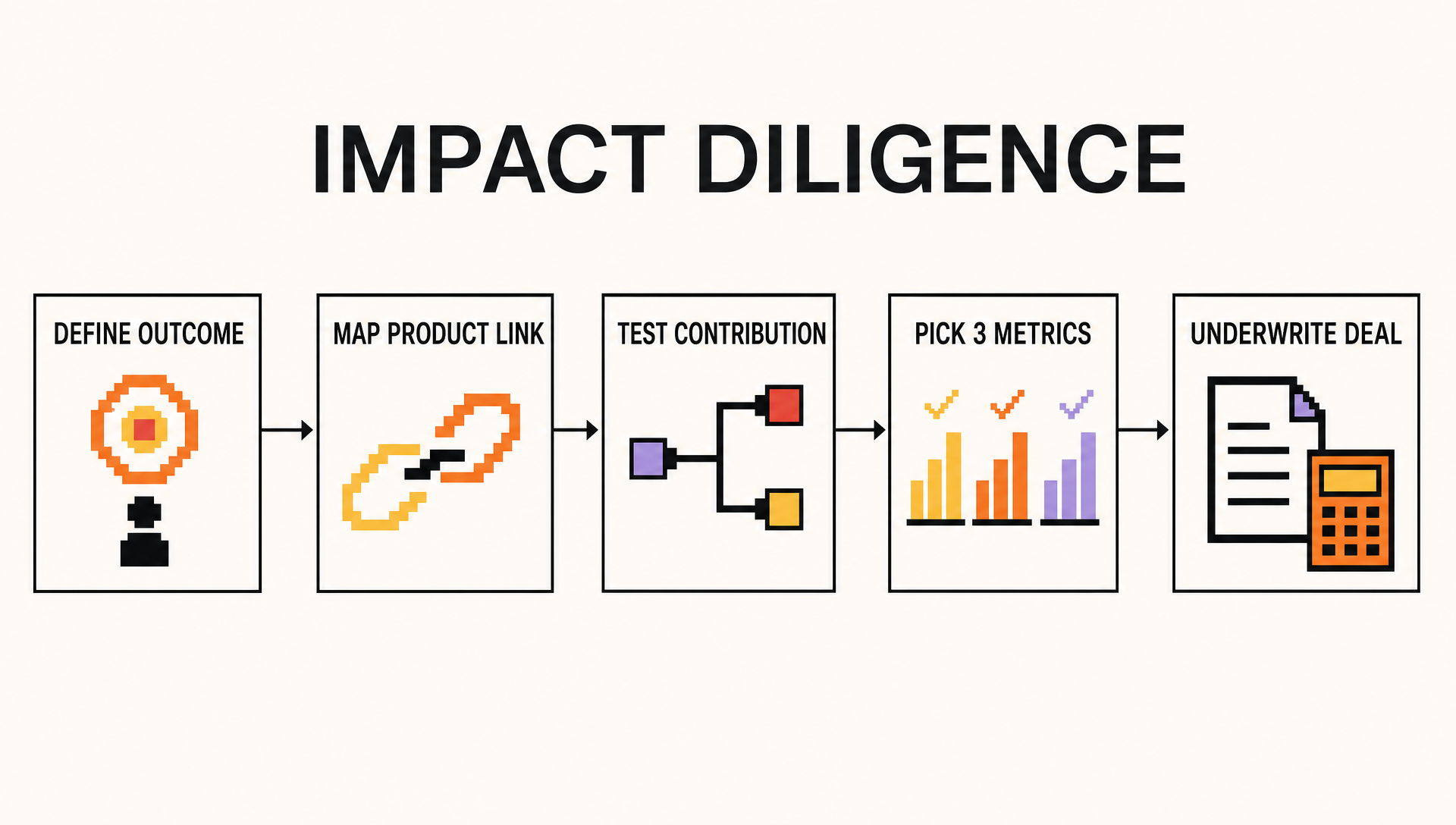
A five-part impact diligence process for angel investors
Impact diligence should sit beside product, market, team, financial, legal, and deal-term diligence. It does not replace them.
1. Define what changes and who experiences it
Name the outcome in concrete language. "Improve health" is too broad. "Reduce the time between an abnormal screening and a confirmed diagnosis for patients at rural clinics" gives you something to investigate.
Then identify who experiences the change. Ask whether those people are actually underserved, what baseline they face today, and whether different groups may experience different results.
Hustle Fund co-founder and general partner Elizabeth Yin puts it this way:
"Investors use their life perspective to assess. For this reason, we need more funders with more varied life perspectives." - Elizabeth Yin
Varied perspectives help investors notice who is missing from the pitch, which assumptions come from lived experience, and which ones need to be tested with customers.
2. Map the product-to-outcome logic
Write the causal chain in one line:
Customer uses the product -> customer behavior or operating condition changes -> a social or environmental outcome changes.
Interrogate each arrow. What evidence supports it? Which part has the startup already observed? Which part is still a hypothesis? What negative effects could occur along the way?
The impact should usually strengthen as the company grows. If the business can hit its revenue target while the claimed outcome stalls or reverses, impact may be a campaign rather than part of the model.
3. Test contribution
Contribution asks what is better because the company exists compared with what probably would have happened anyway.
Look at available substitutes, regulation, market trends, and customer behavior. If customers were already switching to a cleaner or fairer option at the same speed, the startup may be capturing a trend rather than causing additional change.
Ask about your contribution too. Is your check funding a validation study, a lower-cost distribution channel, or a launch into an underserved market? Capital alone is not automatically additional. Advice, customer introductions, hiring help, and patient time horizons may matter more in some deals.
4. Choose a small, useful metric set
The IRIS+ framework asks what changes, who experiences it, how much change occurs across scale, depth, and duration, what the company's contribution is, and what could keep the impact from happening.
At seed stage, turn that into three measures:
- One business-linked output: a leading indicator such as active clinics, loans issued to the target customer, or megawatt-hours of clean capacity installed.
- One outcome: the change that matters, such as earlier treatment, higher income stability, lower emissions, or lower water use.
- One guardrail: a possible harm or failure mode, such as false-negative rates, customer over-indebtedness, rebound emissions, worker injury, or unequal access.
Set a baseline, target, owner, and review cadence for each measure. A short metric set that changes decisions is more useful than a long dashboard nobody uses. GIIN's 2025 measurement research also warns that standardization, long-term outcomes, and the cost of collecting data remain real problems. Measurement has to fit the company's stage and operating capacity.
5. Underwrite the company and the deal
Now do the normal work. Test the team, market, product, customer urgency, distribution, gross margin, burn, financing needs, valuation, cap table, security, governance, and regulatory risk.
Hustle Fund's 5T framework is a useful starting point for the company analysis. Record the impact case and the financial case in the same investment memo so neither one gets a free pass.
A hypothetical impact-startup example
Imagine a startup selling portable diagnostic devices to rural clinics. The pitch says the company will improve access to healthcare. That is a promising theme, but it is not yet an impact case.
Start with the business model. Who pays for the device? How often is it used? What do installation, training, maintenance, and consumables cost? Do clinics renew, and can gross margin support expansion?
Then test the outcome:
- Output: Number of active clinics using the device for the intended patient group.
- Outcome: Percentage of high-risk patients who receive a confirmed diagnosis within 48 hours, compared with the clinic's baseline.
- Guardrail: False-negative rate and time-to-treatment, segmented by patient group.
The startup should explain why its device, rather than staffing changes, a government program, or an existing alternative, caused the improvement. It should also track whether faster diagnosis leads to treatment. More tests are not automatically better care.
Your investment memo still needs the commercial case. A strong outcome with weak unit economics may be better suited to a grant or another form of capital. Strong economics with no credible outcome evidence may be an attractive healthcare investment, but it is not yet an impact investment.
Can impact investing generate market-rate returns?
Yes, some impact strategies target and achieve risk-adjusted market-rate returns. But impact investing has no single return profile, and an impact label does not improve a deal's economics.
The GIIN's financial-performance review found that results vary by asset class, strategy, and manager selection. It also notes gaps and bias in the available benchmarks. Treat that research as evidence that market-rate performance is possible, not as a forecast for your portfolio.
Direct startup investing adds another layer of risk. Investor.gov warns that private placements can result in a total loss, are highly illiquid, and usually provide less disclosure than registered public offerings. Impact startups are not exempt from product risk, financing risk, dilution, weak governance, or a long wait for liquidity.
Portfolio construction matters too:
"Don't try to pick a co. Select a portfolio." - Elizabeth Yin, Hustle Fund co-founder and general partner
One mission-aligned check should not become an excuse to ignore concentration, time horizon, or your ability to lose the capital. Define your investment risk tolerance before the story of a single company pulls you past it.
Red flags in an impact startup pitch
Pause when you see any of these:
- Mission without mechanism: The pitch names a cause but cannot show how product usage changes an outcome.
- Outputs presented as outcomes: Downloads, devices shipped, loans issued, or people reached may be useful operating measures, but they do not prove that lives or environmental conditions improved.
- No baseline or target: The company reports a large number without saying what happened before, what success looks like, or by when.
- No contribution test: The team assumes every positive change was caused by the company.
- No segmentation: Averages hide whether the intended customer benefits or absorbs more risk.
- No negative-impact tracking: The company reports benefits but has no way to spot harm, exclusion, or tradeoffs.
- Impact outside incentives: Leadership compensation, product priorities, board reporting, and budgets do not reflect the stated outcome.
- A financial model that needs a mission premium: Customers are expected to pay more because the product is good for the world, but the company has no evidence that they will.
None of these automatically kills a deal. At seed stage, gaps are normal. The question is whether the founders understand the gaps, will test them, and will share bad news as readily as good news.
How to start impact investing as an angel
- Choose one outcome area. Start where your operating experience or network helps you ask better questions.
- Write a narrow thesis. Define the target population or environmental outcome, geography, stage, check range, and non-negotiable guardrails.
- Set portfolio limits first. Decide how much illiquid capital you can lose, how you will diversify, and whether you will reserve capital for follow-ons.
- Compare several deals. A mission can create urgency, but decisions are clearer when you compare companies, terms, and evidence side by side.
- Write one integrated memo. Put the impact logic, metrics, commercial case, terms, risks, and open questions in the same document.
- Monitor and learn. Ask for a realistic update cadence, review outcomes and guardrails, and revise your thesis when the evidence changes.
Repeated practice helps. Angel Squad's angel-investing community combines education, peer discussion, and optional access to curated startup opportunities, so members can compare how other investors frame a thesis and pressure-test a deal. Joining does not require accredited-investor status; investing in relevant private offerings does.
Impact investing works only when both halves survive diligence. The company needs a credible path to an outcome and a credible path to financial value. If you want to build that judgment with other operators and investors, apply to Angel Squad.













.png)